

13 ex-Trump officials back Kelly’s stand against Trump
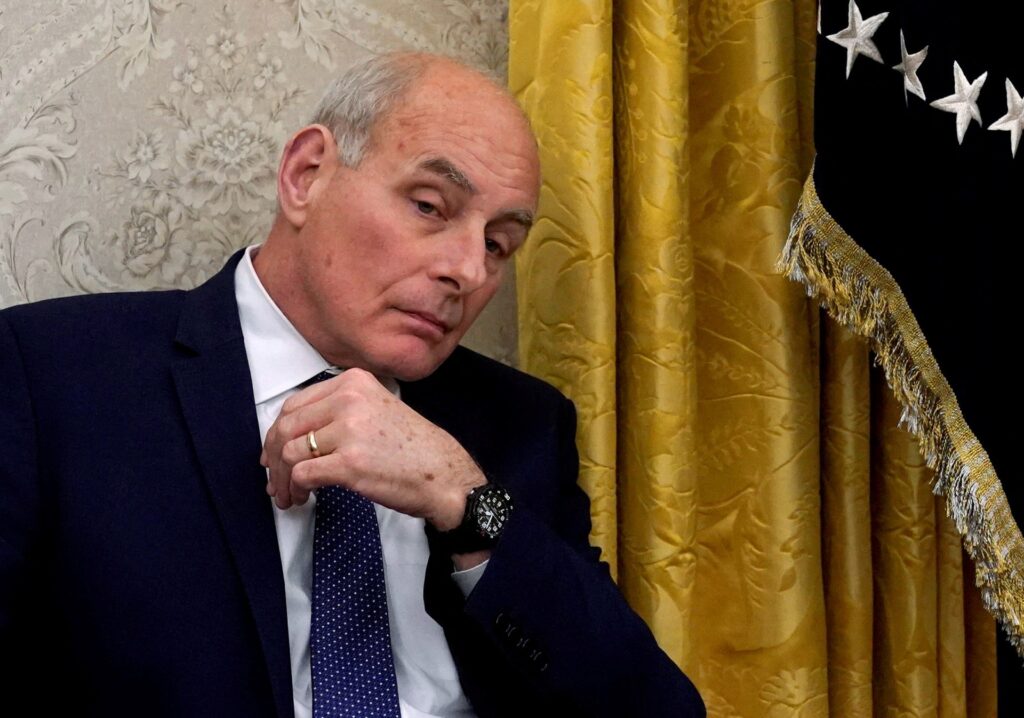
The former Trump aides are ‘not surprised’ by Kelly’s claims Trump complimented Hitler and scorned the US constitution. A group of Donald Trump-era officials have rallied behind former Chief of Staff John Kelly after he warned that the former president behaves like a “fascist” and craves dictatorship. In a letter first reported by Politico on Friday, 13 officials who worked under former US president Trump said they “applaud” Kelly for speaking out against the former president. “There are moments in history where it becomes necessary to put country over party,” wrote the officials, all lifelong Republicans. “This is one of those moments.” They added, “Everyone should heed General Kelly’s warning.” The officials include former Assistant Secretary of Homeland Security Elizabeth Neumann, former White House communications director Anthony Scaramucci, former White House press secretary Stephanie Grisham and former deputy press secretary Sarah Matthews. ‘The dictator approach’ Kelly, a retired general who was Trump’s longest-serving chief of staff, made waves when he detailed his concerns about a possible second Trump term. Kelly told the New York Times that, as president, Trump “preferred the dictator approach”, scorned the US Constitution and threatened to weaponise the US military against his domestic foes. The former chief of staff also said Trump repeatedly complimented Hitler. “He’s certainly the only president that has all but rejected what America is all about, and what makes America, America,” said Kelly, adding that he thought Trump lacked empathy. Trump’s campaign has denied Kelly’s account, calling the four-star general a “total degenerate” and a “lowlife”. But the 13 officials backing Kelly say they are not surprised by his allegations about Trump. “The revelations General Kelly brought forward are disturbing and shocking,” they wrote. “But because we know Trump and have worked for and alongside him, we were sadly not surprised by what General Kelly had to say.” Threat to democracy? Since leaving office, Donald Trump has faced an unprecedented backlash from senior officials within his party, many of whom warn that he poses a unique threat to democracy. Republican former Vice President Dick Cheney, who has endorsed Trump’s Democratic opponent Kamala Harris for president, stated that there has never been a “greater threat to our republic than Donald Trump.” Harris has capitalised on the Republican critiques, saying their warnings provide “a window into who Donald Trump really is.” “Donald Trump is increasingly unhinged and unstable”, Harris told reporters outside the White House on Wednesday. If he wins a second term, officials like Kelly will not be there to “rein him in”, she added. More than 80 American Nobel Prize winners in physics, chemistry, medicine and economics have also signed an open letter endorsing Harris for president, which was published on Thursday by the New York Times. The Nobel laureates warned that Trump would ” jeopardise any advancements in our standards of living” because of his previous proposals for science funding. Trump and Harris are currently neck and neck in the polls ahead of the November 5 election, which analysts describe as a toss-up. With 11 days to go, the latest poll by CNN found 47 percent of likely voters support Harris and an equal 47 percent support Trump. Only 2 percent of all likely voters say they haven’t yet chosen a candidate, and another 9 percent say that they could change their minds before casting a ballot, CNN reported. Adblock test (Why?)
Russia-Ukraine war: List of key events, day 973
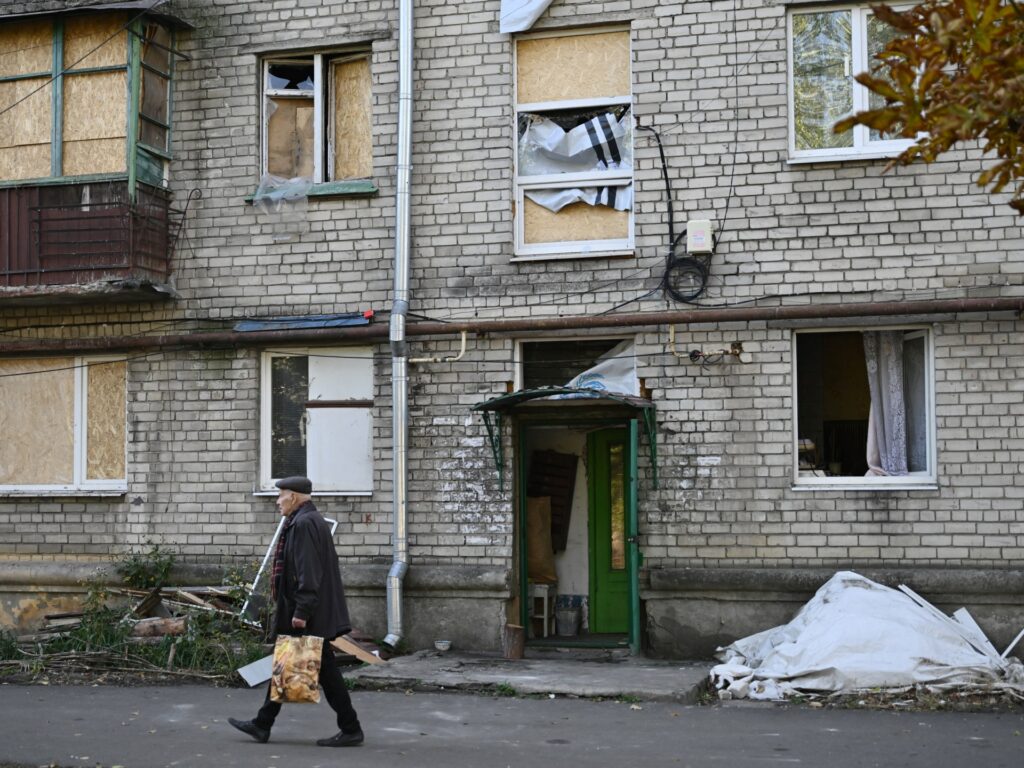
As the war enters its 973rd day, these are the main developments. Here is the situation on Friday, October 25, 2024: Fighting Russian forces launched drone attacks overnight at the Ukrainian capital, the 15th air attack on Kyiv this month, city officials said. There were no immediate reports of injuries. One person was killed and nine wounded in a Russian attack in the town of Kupiansk in the northeastern Ukrainian region of Kharkiv, regional governor Oleh Syniehubov said. Russian shelling killed three people around the strategic hub of Pokrovsk in the eastern Donetsk region, governor Vadym Filashkin said on the Telegram messaging app. A Russian strike on a branch of the Nova Poshta delivery service killed two people in Oleksiievo-Druzhkivka, near the front-line towns of Chasiv Yar and Kostiantynivka, Filashkin said. Russian media and war bloggers reported that Russian forces had advanced into the coal mining town of Selydove, about 20km (12 miles) southeast of Pokrovsk. The General Staff of the Ukrainian Armed Forces said the most intense Russian assaults along the front line were currently taking place on the Pokrovsk front, including near Selydove. But it did not say whether Russian soldiers had entered the town. Ukraine said Russian forces executed four captured Ukrainian servicemen in Donetsk. Ukraine’s military intelligence service said the first North Korean units trained in Russia had been deployed in Kursk, a Russian border region where Ukrainian forces staged a surprise incursion in August. Politics and diplomacy South Korea’s Ministry of Foreign Affairs voiced “grave concern” after Russia moved to ratify its defence treaty with North Korea, calling on Moscow to stop its “illegal cooperation” with Pyongyang. Japan’s Chief Cabinet Secretary Yoshimasa Hayashi said Tokyo was following with “serious concern” reports that North Korean troops are in Russia ahead of their possible deployment in Ukraine. United Nations Secretary-General Antonio Guterres told Russian President Vladimir Putin that his invasion of neighbouring Ukraine violated the UN charter and international law, according to a readout of their meeting on the sidelines of the BRICS summit in Kazan. Putin said any proposals for peace with Ukraine must take into account the territory held by Russian forces, stressing that negotiations must be “based on the realities on the ground”. He also said he welcomed “sincere” comments made by Republican presidential candidate Donald Trump about bringing an end to Russia’s conflict with Ukraine. Yulia Navalnaya, the wife of late Russian dissident Alexey Navalny, slammed Guterres for meeting Putin, calling the Russian president a “murderer”. German Chancellor Olaf Scholz has rejected Ukraine’s request to immediately join NATO, made by President Volodymyr Zelenskyy when he presented his “victory plan” to Western allies, saying a country at war “absolutely cannot become a member” of the bloc. Adblock test (Why?)
Three journalists killed in Israeli attack in southern Lebanon
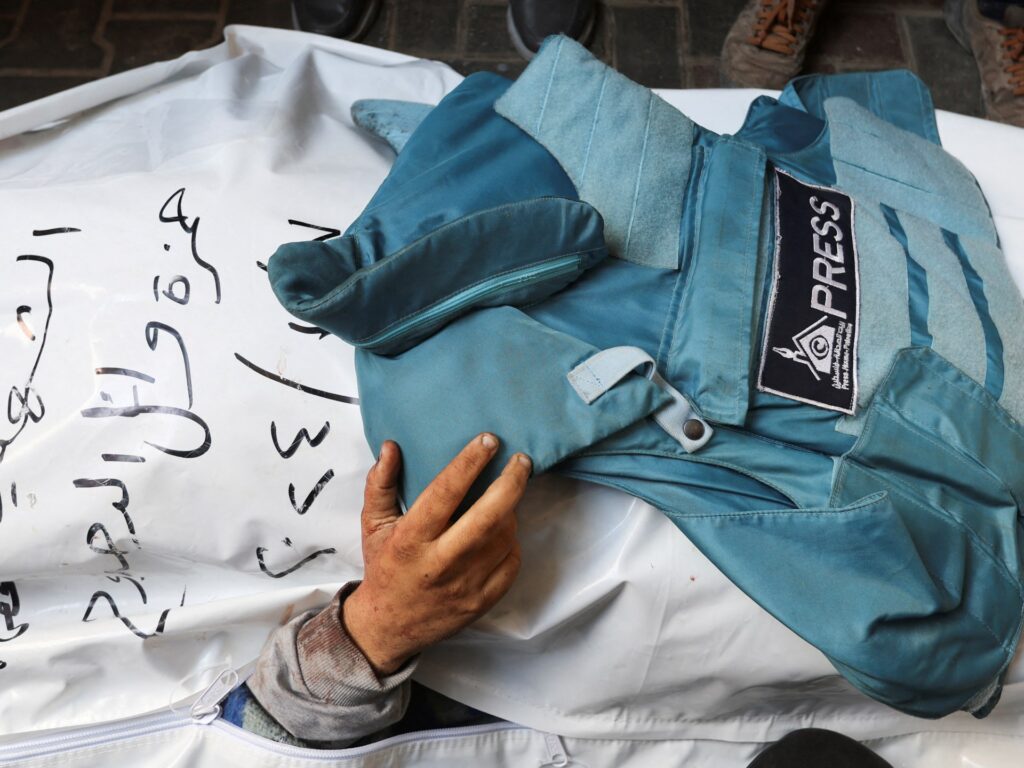
The Israeli military did not issue a warning prior to the attack, which is believed to have targeted the journalists. An Israeli air strike has killed at least three journalists as they slept in their accommodation in southern Lebanon, in what news outlets say was a direct hit on an area removed from the continuing conflict between the Israeli military and Hezbollah. The air raid hit a compound in Hasbaiyya housing several journalists at about 4am (01:00 GMT) on Friday, killing two cameramen and a technician. “This is a very serious incident. Israel didn’t give any warning,” Al Jazeera’s Imran Khan said, reporting from the southern Lebanese city. “Hasbaiyya is under no evacuation orders and, in fact, it has been relatively calm.” The victims were identified as cameraman Ghassan Najjar and engineer Mohamed Reda who worked for Al Mayadeen, the pan-Arab TV channel said. Al-Manar TV, which is affiliated with Hezbollah, said its camera operator Wissam Qassim was also killed. Reporters at the scene said the bungalow where the men were sleeping was directly targeted. Local news station Al Jadeed aired footage showing collapsed buildings and cars marked “press” covered in dust and rubble. Lebanon’s Information Minister Ziad Makary called the attack “a war crime”. “This is an assassination, after monitoring and tracking, with premeditation and planning, as there were 18 journalists present at the location representing seven media institutions,” he wrote on social media platform X. Ghassan bin Jiddo, the director of Al Mayadeen, said on X that Israel’s “targeting of the journalists’ residence was deliberate, and there are injured journalists from other Arab channels”. “We hold the occupation fully responsible for this war crime, in which journalist crews, including the Al Mayadeen team, were targeted.” There was no immediate comment from Israel. ‘Message to journalists’ The attack comes a day after an Israeli strike hit an office used by Al Mayadeen in Beirut’s southern suburbs that killed one person and wounded five others. Al Jazeera’s Khan said “it doesn’t matter whether you like that news organisation or you dislike that news organisation. If you are a democracy, freedom of speech is a core value.” He added that the attack was “a deliberate message to all journalists”, who would now be leaving the area. “Clearly, they are trying to blind the world to what’s going on in southern Lebanon by targeting journalists,” Khan said of the Israeli military. In November, two journalists for Al Mayadeen TV were killed in a drone strike, which the network said was deliberate. A month earlier, Israeli shelling in southern Lebanon killed Reuters videographer Issam Abdallah and wounded other journalists from the AFP news agency and Al Jazeera. Journalists have faced unprecedented danger while covering Israel’s wars in Gaza and Lebanon. Frank Smyth, the founder of the organisation Global Journalist Security, told Al Jazeera that more journalists have been killed in the Palestinian enclave in the past year than in any other conflict worldwide, with the majority being local reporters covering their own communities. Smyth emphasised that there is evidence that Israeli forces are directly targeting journalists, while indiscriminate bombings have also killed many media professionals. Israeli authorities have repeatedly killed and threatened Al Jazeera journalists in Gaza, whom they accused of being Hamas affiliates. The network has denied and condemned the claims. Adblock test (Why?)
US election: 11 days left – What polls say, what Harris and Trump are up to
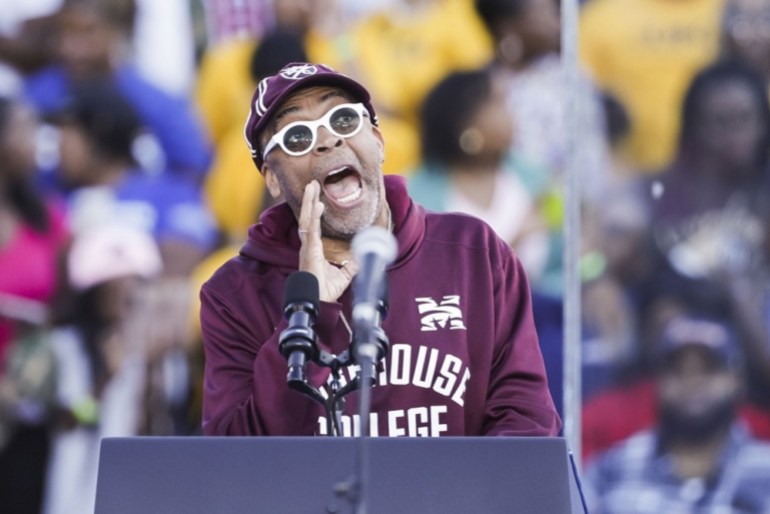
Eleven days before voters head to the polls, Vice President Kamala Harris has appealed to middle-class America at a rally in Georgia, drawing a crowd of about 20,000. Harris was not the only one the crowd had come for: Iconic musician Bruce Springsteen, former President Barack Obama, movie director Spike Lee and actor and filmmaker Tyler Perry were there to back her up. Meanwhile, Donald Trump held rallies in Arizona and Nevada. In Arizona, he said he had watched Kamala Harris’s town hall this week on CNN and described her performance as “pathetic” – only the latest in a series of personal barbs that the candidates have traded in recent days. As of Thursday evening, more than 30 million voters had already cast their ballots, according to tracking data from the Election Lab at the University of Florida. While this has broken early vote records in some states, the numbers, so far, are far below those from 2020, when – amid the COVID-19 pandemic – more than 100 million voters cast their ballots before Election Day. What are the latest updates from the polls? A new poll released by the Financial Times (FT) on Thursday showed that Trump has slightly surpassed Harris as the candidate Americans trust most with the economy. The poll, conducted by the FT and the University of Michigan’s Ross School of Business, found that 44 percent of respondents trust Trump to handle the economy, compared with 43 percent for Harris. The results suggest that Harris’s economic message has stalled in the final stages of her increasingly close race against Trump. Meanwhile, in a separate analysis from FiveThirtyEight’s daily election poll tracker, as of Wednesday, Harris is slightly ahead in the national polls, leading Trump by 1.7 percentage points. However, the long-term trend shows that the race is getting closer, with the gap narrowing from 1.8 points earlier in the week. While national surveys provide valuable insights into voter sentiment, the ultimate winner will be decided by the Electoral College, which reflects the outcomes in individual states. The seven key swing states that could determine the election are Pennsylvania, North Carolina, Georgia, Michigan, Arizona, Wisconsin, and Nevada. Together, these states account for 93 Electoral College votes. According to FiveThirtyEight’s daily poll tracker, Harris’s support in Michigan has grown marginally, from less than half a percentage point to 0.7 percent. The vice president is marginally ahead in Wisconsin. Meanwhile, Trump has a slight edge over Harris in Pennsylvania and holds a slightly larger lead in North Carolina, Arizona and Georgia. In Nevada, Trump and Harris are in a dead heat. However, the results from each state fall within the margin of error of the polls, indicating that the race remains extremely close, and that these swing states could still shift in favour of either candidate. What was Kamala Harris up to on Thursday? Harris campaigned alongside Obama at an event that also saw performances from Springsteen and filmmaker Perry. The vice president was the final speaker and she opened her speech praising Obama. “Thank you, Mr. President,” she said. Harris expressed confidence in winning, adding, “As a certain former president would say, ‘Yes we can.’” Harris highlighted her proposals regarding healthcare and the economy, emphasising the necessity of reducing costs and outlining her plans for small businesses while labelling abortion bans “immoral”. Bruce Springsteen, after a performance of his ballad, The Promised Land, said, “I’m here today to support Kamala Harris and Tim Walz. “Trump is running to be an American tyrant,” he added before performing Land of Hope and Dreams and Dancing in the Dark. Thank you, @Springsteen. Our democracy is only as strong as our willingness to fight for it, and I am grateful you are with us in this fight. pic.twitter.com/tqB3nH0mBy — Kamala Harris (@KamalaHarris) October 24, 2024 Perry walked in to the tune of Aretha Franklin’s Respect and spoke about how he had lived in Georgia for 30 years. “This is where I found the American Dream for myself,” he said. “I know what it is like to be homeless here in Georgia,” he continued. “And I also know – hear me – how expensive it is to be poor.” He called for people to vote for Harris before introducing Obama. “Today, I voted for Kamala Harris,” Tyler Perry said. “And Georgia, it was about 11,400 votes that separated Trump and Biden [in 2020]. So every vote counts. “I’m begging you, imploring you, let’s get out and make Kamala Harris the 47th president,” he added, before introducing Obama. Director Spike Lee speaks during a campaign rally [EPA] As Obama started his speech, he mocked Trump saying he resembled an older family member in need of intervention. “Hey, have you noticed grandpa, he’s acting kind of funny out there?” Obama said. He also said he understood why people were trying to find somebody to “shake things up”. “What I can’t understand is why anyone would think that Donald Trump will shake things up in a way that is good for you, because there is absolutely no evidence that this man thinks about anybody but himself,” he added. Obama campaigns with Democratic presidential candidate Harris [EPA] What was Donald Trump up to on Thursday? On Thursday, Trump rallied in Las Vegas, Nevada, and Tempe, Arizona. In his Arizona rally, he promised to launch the largest deportation operation in history. Condemning violent gangs, he said: “We’ve got to get these animals out of here fast.” In Las Vegas, he arrived at a large rally hosted by the conservative organisation Turning Point Action. During his speech he mocked Harris and tried to reach out to minority communities. “Under the Trump administration, we’re going to build an economy that lifts up all Americans, including African Americans, Hispanic Americans and also members of our great Asian American and Pacific Islander community, many of whom are here today.” Trump attends a campaign event sponsored by conservative group Turning Point Action, in Las Vegas, Nevada [Ronda Churchill/Reuters] Al Jazeera’s John Holman, reporting from
Israel’s claim vs Victim’s relative’s account on Gaza hospital tent attack

Compare & Contrast Israel’s claim vs Victim’s relative’s account on Gaza hospital tent attack. Read more We compare and contrast Israel’s claim that the Gaza hospital tent attack was “fabricated” vs an account from a relative of a victim. Published On 24 Oct 202424 Oct 2024 Adblock test (Why?)
Mozambique ruling party declared winner of election amid fraud claims

The ruling Frelimo party’s presidential candidate Daniel Chapo secures more than 70 percent of votes, election commission says. Mozambique’s ruling party candidate, Daniel Chapo, has been declared the winner of the country’s presidential election amid claims of rigging by the opposition. Chapo, from the Frelimo party which has been in power for almost half a century, secured more than 70 percent of the votes, the National Election Commission (CNE) said on Thursday. His main opponent, the independent candidate Venancio Mondlane, came second with more than 20 percent, while the candidate of the opposition party Renamo, Ossufo Momade, came third with more than five percent, according to the CNE. The results of the October 9 election mean the governing Front for the Liberation of Mozambique party, or Frelimo, has extended its 49 years in power since the southern African country gained independence from Portugal in 1975. It then fought a bloody 15-year civil war against the rebel group Renamo, which later developed into the main opposition party. The 47-year-old Chapo will officially take charge of the southern African country in January, becoming Mozambique’s first president born after independence. Mondlane, 50, backed by the Podemos party, has claimed he won the vote, alleging electoral fraud and manipulation in favour of Frelimo. Since voting day Mondlane has issued calls on social media for protests. In a message on Facebook late Wednesday, he encouraged a “great national demonstration” against Frelimo’s half-a-century in power. “The time has come for the people to take power and say that we now want to change the history of this country,” he said. Frelimo has often been accused of rigging elections, which it has consistently denied. Current President Filipe Nyusi of Frelimo is stepping down after serving two terms, the maximum allowed. The EU’s observer mission said this week that some of its election observers had been prevented from monitoring counting in some areas, and there was an “unjustified alteration” of results at some polling stations. Opposition parties have alleged fraud since the day of the election. The country of around 33 million people has been on edge since Elvino Dias, a lawyer and advisor to Mondlane, was killed when gunmen riddled his car with bullets in the port capital of Maputo, the opposition Podemos party said. Podemos spokesperson Paulo Guambe was also in the car at the time and was killed. Mondlane has accused the security forces of carrying out the killing. Police said they have launched an investigation into the killings, which Frelimo “vehemently” condemned as a “macabre act”. Police also quelled demonstrations by opposition supporters this week, by firing teargas. Adblock test (Why?)
World ‘paying terrible price’ for climate inaction, UN’s Guterres warns

Current policies will result in global warming of more than 3 degrees Celsius (5.4 degrees Fahrenheit) by the end of the century, new report finds ahead of COP29 summit. People around the world are “paying a terrible price” for inaction on global warming, with time running out to correct the course and avoid climate disaster, UN Secretary-General Antonio Guterres has warned. A new United Nations report released on Thursday says current climate policies will result in global warming of more than 3 degrees Celsius (5.4 degrees Fahrenheit) by the end of the century, more than twice the rise agreed to nearly a decade ago. The annual Emissions Gap Report, which takes stock of countries’ promises to tackle climate change compared with what is needed, finds the world faces as much as 3.1C (5.6F) of warming above pre-industrial levels by 2100 if governments do not take greater action on slashing planet-warming emissions. Governments in 2015 signed up to the Paris Agreement and a cap of 1.5 C (2.7 F) warming to prevent a cascade of dangerous impacts. “We’re teetering on a planetary tightrope,” Guterres said in a speech. “Either leaders bridge the emissions gap, or we plunge headlong into climate disaster”. “Around the world, people are paying a terrible price.” The call to action follows a streak of destructive and deadly extreme weather in a year expected to be the hottest in recorded history. The world’s poorest have been particularly hard hit, with typhoons, floods and heatwaves in Asia and the Caribbean, floods in Africa, and droughts and wildfires in Latin America. Global greenhouse gas emissions rose by 1.3 percent between 2022 and 2023, to a new high of 57.1 gigatonnes of carbon dioxide equivalent, the report said. Under current pledges to take future action, temperatures would still rise between 2.6C (4.7F) and 2.8C (5F) by 2100, the report found. That is in line with findings from the past three years. “If we look at the progress towards 2030 targets, especially of the G20 member states … they have not made a lot of progress towards their current climate targets for 2030,” said Anne Olhoff, chief scientific editor of the report. The world has currently warmed by about 1.3C (2.3F). Nations will gather next month at the annual United Nations Climate Change Conference (COP29) in Baku, Azerbaijan, where they will work to build on an agreement made last year to transition away from fossil fuels. Negotiations in Baku will help to inform each country’s updated emissions-cutting strategy, known as a Nationally Determined Contribution (NDC), due in February 2025. The report suggests that nations must collectively commit to and implement a cut of 42 percent on yearly greenhouse gas emissions by 2030, and reach 57 percent by 2035 for any hope of preventing warming beyond 1.5C (2.7F) – a target now seen as likely out of reach. Inger Andersen, executive director of the United Nations Environment Programme, urged countries to use the Baku talks to increase action in their NDCs. “Every fraction of a degree avoided counts,” she said. Guterres said wealthy G20 economies in particular would need to show far more ambition in the next round of NDCs. The world’s 20 largest economies were responsible for nearly 80 percent of global emissions in 2023. The bottom 47 countries accounted for three percent. “These reports are an historical litany of negligence from the world’s leaders to tackle the climate crisis with the urgency it demands, but it’s not too late to take corrective action,” said Tracy Carty from Greenpeace International. Adblock test (Why?)
Want to know who will win the US election? Take a look at the stock market

Want to know who will win the United States presidential election? Take a look at the stock market. Of course, there is no crystal ball to tell us who will prevail on November 5. The polls, as much as they can be trusted, show Vice President Kamala Harris and former President Donald Trump running neck and neck in what many observers believe could be the closest election in decades. Even so, the performance of US stocks has an uncanny track record of predicting the outcome of presidential elections. Since 1928, the S&P 500 – which tracks the performance of 500 of the largest firms listed in the US – has pointed to the winner in 20 out of 24 elections, according to an analysis by financial services company LPL Financial. When US stocks were up during the three months before election day, the incumbent party kept the White House on 12 out of 15 occasions. And the party in power lost eight out of the last nine times that the market was in negative territory leading up to the vote. It is not a bad track record as forecasting models go. With less than two weeks until the election, the S&P 500 is up a healthy 11.8 percent since early August. Assuming US stocks do not take a dramatic tumble in the final days of the campaign, the historical trend clearly favours Harris. However, caveats abound. Unfortunately for Harris, voters do not appear to associate the stock market’s strong performance with the economy doing well. While an estimated 61 percent of Americans own shares, a large segment of voters has no exposure to the market. In an Associated Press-NORC Center for Public Affairs Research poll released this week, 62 percent of registered voters, including overwhelming majorities of Republicans and independents, rated the state of the economy as “bad”. On the plus side for Harris, voters expressed growing confidence in the Democrat’s ability to handle economic issues, suggesting that Trump’s once-clear advantage on the economy has all but disappeared. The prevailing gloom is despite the fact that, by most metrics, including gross domestic product (GDP) growth and the unemployment rate, the US economy is performing at a level that would be the envy of most developed countries. One of the most plausible and frequently offered reasons for the negative sentiment is that consumers are weary of higher prices – even though inflation, which last month fell to 2.4. percent, is now close to the Federal Reserve’s target after surging during the COVID-19 pandemic. While wages have been growing faster than inflation for well over a year, they have still not grown enough to fully offset the rise in the cost of living since the pandemic. Whereas prices rose about 20 percent between January 2021 and June of this year, wages only increased 17.4 percent, according to an analysis by Bankrate using Department of Labor statistics. Although wage growth has continued to beat inflation since then – coming in at 4.2 percent versus 2.6 percent during July-September – Bankrate predicts that the post-pandemic gap will not fully close until the second quarter of 2025. No matter how many positive economic statistics are rolled out to tout the current administration’s record, consumers are reminded that prices for everyday items cost considerably more than they used to every time they are at the supermarket checkout. Another good reason to be cautious about reading too much into the stock market’s predictive powers is that we appear to be living in an era of politics that does not follow any rulebook. Much as his 2016 victory smashed numerous precedents, Trump’s very place on the Republican ticket, in spite of four criminal indictments, numerous scandals and years of negative media coverage, is a challenge to conventional wisdom. Indeed, the last time the S&P 500 failed to predict the next occupant of the White House was the most recent election. After presiding over a 2.3 percent market gain, Trump lost to President Joe Biden. Adblock test (Why?)
Boeing workers vote to reject wage deal, extend strike
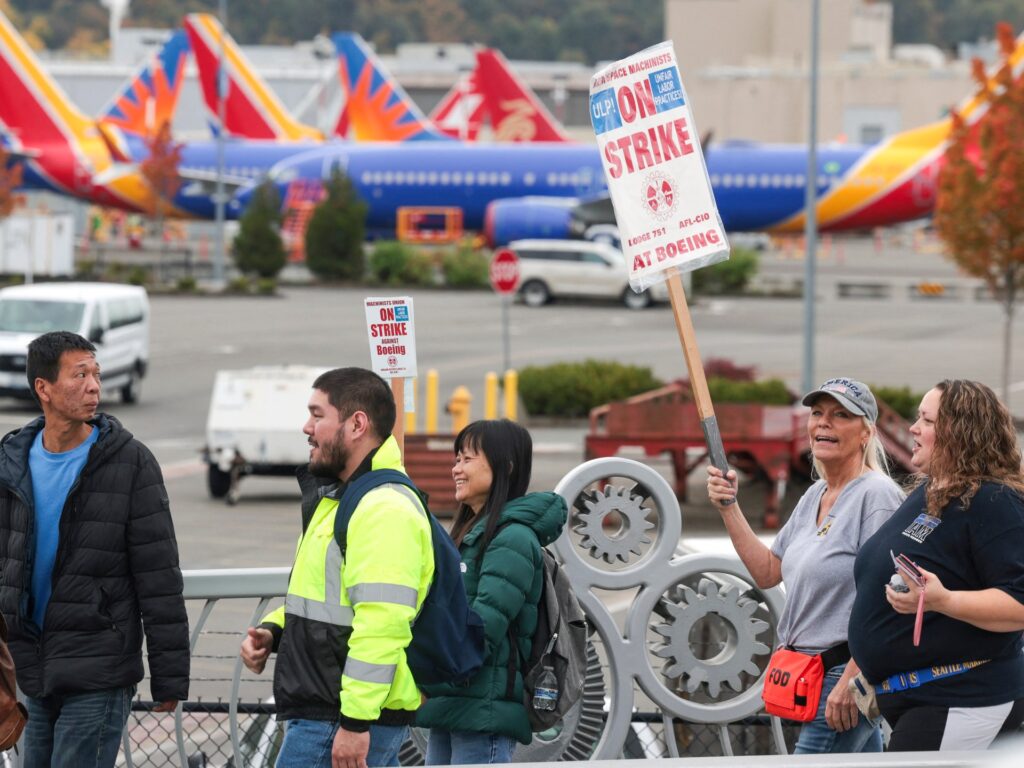
Nearly two-thirds of workers reject offer that includes a 35 percent pay rise. Boeing workers on the West Coast of the United States have voted to reject the aircraft giant’s latest contract offer and extend their nearly six-week strike. Nearly two-thirds of workers rejected the offer, which included a 35 percent wage rise over four years but did not restore a defined pension plan sought by many employees, the Seattle branch of the International Association of Machinists and Aerospace Workers union said on X. IAM District 751 President Jon Holden said the union had made “tremendous gains” in negotiations but had not gone far enough to meet members’ demands. “Senior members with decades of experience, new members with a few months, and members from different backgrounds all stood together to support each other. I’m proud of you and your strength,” Holden said in a statement. “This membership will continue to stand on the line, picketing for the contract they deserve. There is much more to do, and we will work to get back to the bargaining table. Our members’ voices will be heard.” About 33,000 workers have been on strike since mid-September when union members overwhelmingly rejected Boeing’s proposal for a new four-year contract. The industrial action has brought operations to a halt at two Boeing factories in the Seattle area that produce the 737 Max and 777, depriving the company of much-needed cash from its aviation business. The union vote is another blow to Boeing after a difficult year that has thrust longstanding concerns about safety and quality standards at the aircraft maker into view. The company has been under investigation by multiple agencies since an incident in January in which a 737 Max plane operated by Alaska Airlines lost a door panel while in mid-flight. On Wednesday, the company reported a third-quarter loss of more than $6bn. Boeing stock dropped 1.76 percent after the latest results, adding to a slump that has seen its share price fall nearly 38 percent so far this year. Adblock test (Why?)
2024 MLS Cup: Playoffs, schedule, brackets, Messi, teams, players, final

EXPLAINER What’s the difference between the Supporters’ Shield and the MLS Cup? Which teams have qualified? Al Jazeera explains. The 2024 Major League Soccer (MLS) season in North America is heading towards its conclusion, with the region’s top club football teams vying for a chance to lift the coveted MLS Cup. The 2024 tournament is expected to attract a wider global audience with the inclusion of football icon Lionel Messi’s team, Inter Miami, who have qualified for the playoffs for the first time. Here’s everything you need to know about the MLS Cup: How does the MLS season work? The 29 MLS teams are divided into two conferences – eastern and western – and play a series of home and away matches in a league format, known as the regular season. The team at the top of the league at the end of the regular season is awarded the Supporters’ Shield – won by Messi’s Inter Miami in 2024 – and the league then moves towards the MLS Cup. What’s the MLS Cup and what’s its format? Known as the pinnacle of the North American football season, the MLS Cup crowns the MLS champion after a series of knockout games – known in North American sports as playoffs. The top seven teams from each conference automatically make it to the playoffs. The eighth club in each conference is determined through a wildcard playoff between the next two sides in each conference, respectively. How do the MLS Cup Playoffs work? The playoffs are played by conference and the eastern and western winners then meet for the MLS Cup final at the end of the season. In the quarterfinals of each conference, teams must win a best-of-three series of matches to advance. There are no aggregate scores and no ties at that stage. The team that finishes higher in the league hosts the first match. In the case of a draw, the game goes directly to penalty kicks – no extra time. The conference semifinals, finals and MLS Cup final return to the single-game format with possible extra time before penalties. These games will be hosted by the higher-seeded club. What’s the schedule of MLS Cup Playoffs? First round (best of three series): Saturday, October 26 to Sunday, November 10 Conference semifinals: Saturday, November 23 and Sunday, November 24 Conference finals: Saturday, November 30 and Sunday, December 1 Final: Saturday, December 7 Which teams are in the MLS Cup Playoffs? Eastern Conference: Inter Miami Atlanta United Orlando City Charlotte FC FC Cincinnati New York Red Bulls NYCFC Columbus Crew Western Conference: LA Galaxy LAFC Seattle Sounders Houston Dynamos Colorado Rapids Real Salt Lake Minnesota United Vancouver Whitecaps FC Who are the five top players to watch in the MLS Cup 2024? Lionel Messi (Inter Miami): 20 goals, 16 assists Luis Suarez (Inter Miami): 20 goals, 9 assists Luciano Acosta (FC Cincinnati): 14 goals, 19 assists Denis Bouanga (LA FC): 20 goals, 11 assists Cucho Hernandez (Columbus Crew): 19 goals, 14 assists How have the teams been drawn in the MLS Cup Playoffs bracket? The draw for the eight best-of-three quarterfinal games looks like this: Eastern bracket: Inter Miami vs Atlanta United Orlando City vs Charlotte FC FC Cincinnati vs NYCFC Columbus Crew vs New York Red Bulls Western bracket: LAFC vs Vancouver Whitecaps FC Seattle Sounders vs Houston Dynamos Real Salt Lake vs Minnesota United LA Galaxy vs Colorado Rapids Need a goal or assist? Messi led the way. 🐐 pic.twitter.com/EfIgIO94hM — Major League Soccer (@MLS) October 22, 2024 ‘Transformational’ moment: Lionel Messi set for Inter Miami debut What’s the venue of the 2024 MLS Cup final? By winning the Supporters’ Shield, Inter Miami have won the right to host the final as long as they remain in contention for the title-deciding match. Should Miami get knocked out before the final, the team with the next best in-season [league] record that remains in the MLS Cup will host the final. Will Lionel Messi play for Inter Miami in the MLS Cup Playoffs? The Argentinian superstar has been in scintillating goal-scoring form for Inter Miami since his return from injury and is expected to lead them in the best-of-three knockout games against Atlanta United. What’s ‘Messi Cam’ and how I can watch it? While on the field playing during Miami’s MLS Cup games, the forward will wear a special camera on his shirt, which will relay his every move on a TikTok livestream on the MLS and Inter Miami channels. Adblock test (Why?)