

US Justice Department sues Virginia for purging voters before election
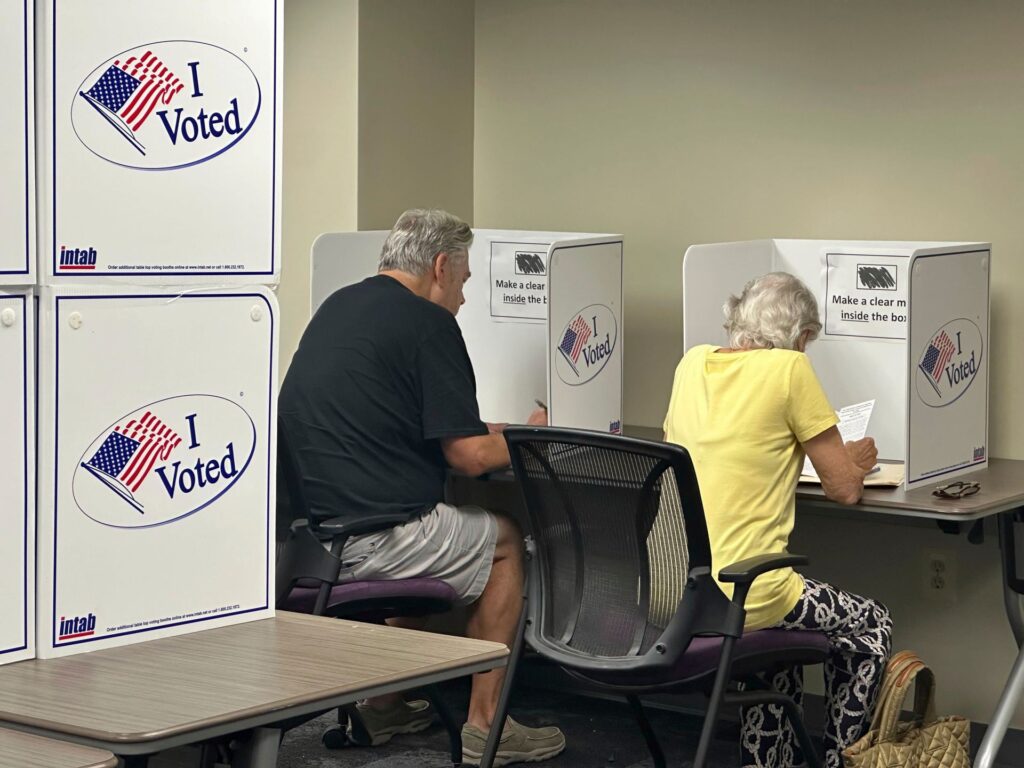
The move comes as Republicans increasingly emphasise the chance of noncitizen voting, despite little evidence of any significant risk posed. The United States Justice Department has sued Virginia for removing voters from registration rolls too close to the presidential election on November 5. The lawsuit, filed on Friday, comes in response to an executive order issued in August by Virginia’s Republican Governor Glenn Youngkin. It initiated the removal of individuals from voter registration rolls if officials are “unable to verify that they are citizens” through the state’s Department of Motor Vehicles. But the Justice Department says the executive order was issued with too little time before election day, violating a 90-day “quiet period” outlined in The National Voter Registration Act. That period requires official systematic removals at least three months ahead of a federal vote. “Congress adopted the National Voter Registration Act’s quiet period restriction to prevent error-prone, eleventh-hour efforts that all too often disenfranchise qualified voters,” Assistant US Attorney General Kristen Clarke said in a statement. “The right to vote is the cornerstone of our democracy and the Justice Department will continue to ensure that the rights of qualified voters are protected.” Youngkin had issued his order on August 7, which marked 90 days until the election. In a statement on Friday, the governor argued the executive order fell within the law. “Virginians – and Americans – will see this for exactly what it is: a desperate attempt to attack the legitimacy of the elections in the Commonwealth, the very crucible of American Democracy,” Youngkin said. He pledged state authorities “will defend these common-sense steps, that we are legally required to take, with every resource available to us”. “Virginia’s election will be secure and fair, and I will not stand idly by as this politically motivated action tries to interfere in our elections, period,” Youngkin said. Republicans and allies of former President Donald Trump – the current Republican candidate for the presidency – have increasingly pushed unfounded claims of possible election malfeasance ahead of this year’s vote. Those claims echo falsehoods spread about the 2020 election, which Trump has continued to falsely say was “stolen” through fraud. Some Republican officials have also advanced baseless claims that noncitizens are voting in large enough numbers to affect the outcome. In the US, only citizens can vote. Most voter administration is determined by state officials and legislatures, with only broad parameters from the federal government. Nearly all US states require some form of voter registration to cast a ballot, although many allow the registration to be done on election day. Ahead of the 2024 elections, several states – including Texas, Tennessee, Ohio and Alabama – have passed measures requiring higher burdens of proof to show a voter’s citizenship. Democracy monitors said those efforts may disenfranchise US citizens who are otherwise eligible to vote. The Brennan Center for Justice – a non-partisan policy organisation – found that noncitizen voting in the US is exceedingly rare. There is no evidence it had any bearing on recent elections. In 2017, the centre released a study looking at 23.5 million votes cast in the 2016 general election. Only 30 votes were flagged for suspected noncitizen voting. Data was not available on how many of those votes proved to have been cast by noncitizens. Adblock test (Why?)
Donald Trump, Kamala Harris locked in close election race: WSJ poll
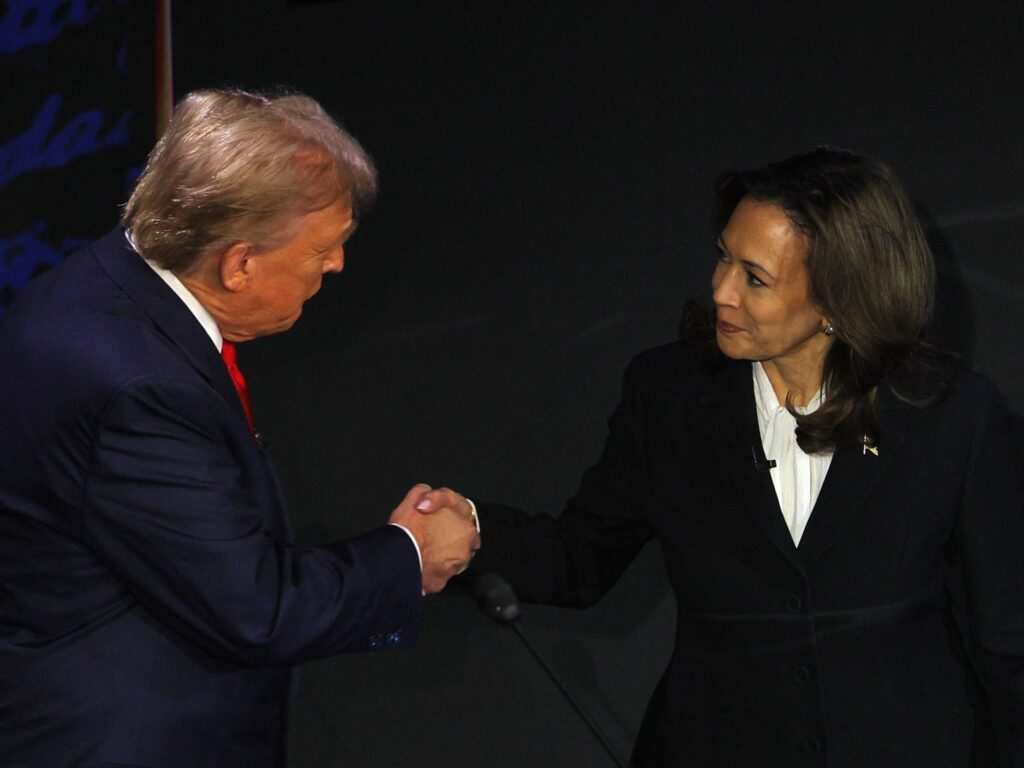
Democratic candidate Kamala Harris and her Republican rival Donald Trump are locked in a dead heat race for the presidency in the United States less than a month before the vote, a new Wall Street Journal poll suggests. According to the data, published on Friday, the vice president and former president are within two percentage points of one another in six of the seven battleground states that will ultimately decide the next president. In the poll, while Harris led in the states of Arizona, Georgia and Michigan, Trump was ahead in Pennsylvania, Wisconsin, North Carolina and Nevada. All the results are within the margin of error with the exception of Nevada, where Trump is led by 5 percent in the WSJ poll. The newspaper said it surveyed 600 registered voters per state between September 28 and October 8. US elections are not won by popular vote nationwide. Rather, candidates compete in individual states to win electoral college votes. It’s akin to a point system, where each state is worth a number of points proportionate to the size of its population. In all but two states – Maine and Nebraska – the winner takes all the electoral college votes. Most states are almost certain to go to one party. For example, a Democratic win in California and Vermont is often projected as soon as the polls close, while states like Oklahoma and Alabama are Republican strongholds. The battleground states That leaves a handful of states where there are close, competitive elections. These are known as swing states. In this round, all eyes are on the seven states polled by WSJ. In 2016, Trump won the presidency despite losing the popular vote because he defeated the Democratic candidate Hillary Clinton in most battleground states. According to a Pew Research Center survey released on Friday, Harris is leading the race nationally by one point – 48 percent to Trump’s 47 percent. US election poll results have fluctuated in recent months. While Trump enjoyed a solid lead over Joe Biden earlier this year in almost all polls, the Democrats received a boost after the US president stepped aside and was replaced by Harris as the party’s nominee. A Morning Consult poll in September had Harris beating Trump 51 percent to 46 percent. But the former president appeared to claw back some support amid concerns about the economy and the turmoil in the Middle East. US election polls have also been wide off the mark in the past. For example, many surveys had indicated that Clinton was set for a comfortable win when she lost to Trump in 2016. Still, this year various polls appear to agree that the US is heading to a close presidential election next month. Senate race Control of the Senate and House of Representatives will also be up for grabs on November 5. A New York Times poll on Friday predicted bad news for Democrats’ hopes of protecting their narrow majority in the Senate. The Democrats currently control the 100-member chamber with 51 seats, including four independents who caucus with the party. But the Times survey found that Democrats are likely to lose a potentially decisive seat in a Republican-leaning state. Republicans were already expected to flip a Senate seat in West Virginia – where conservative Democratic incumbent Joe Manchin is not running for re-election. But the Times poll indicated Democratic Senator Jon Tester is trailing his Republican opponent by eight percentage points in rural Montana, where Trump won with ease in 2016 and 2020. Democrats will also have a fight on their hands to keep Senate seats in Michigan, Pennsylvania, Ohio, Arizona and Nevada, but they will be hoping to challenge Republican incumbents in Texas and Florida. A Republican-controlled Senate can prove to be a major hurdle for Harris should she win in November. Beyond its legislative powers, the Senate is tasked with confirming judicial appointments and cabinet members, which would allow Republicans to pressure Harris, should she be elected, on who she chooses for her governing team. Adblock test (Why?)
Russia’s Putin meets Iran’s Pezeshkian amid spiralling Middle East violence
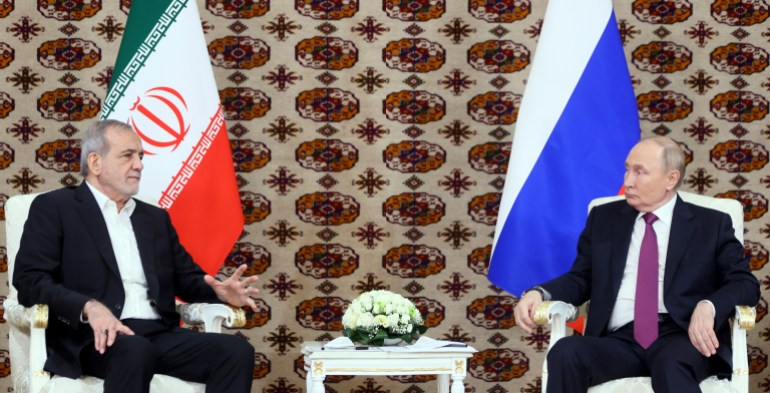
Presidents’ meeting comes before expected signing of strategic partnership agreement by the two countries. Russian President Vladimir Putin has met Iran’s new president as concerns grow over escalating attacks between Israel and Iran along with its network of aligned armed groups. Putin and Iranian President Masoud Pezeshkian discussed the situation in the Middle East on the sidelines of a regional meeting in Turkmenistan on Friday, Russian state media reported. They met before their two countries are expected to sign a strategic partnership agreement. Pezeshkian said on Friday that he hoped the agreement could be finalised at the BRICS (Brazil, Russia, India, China and South Africa) summit, which Putin invited him to, in Russia on October 22-24. During their meeting, Putin told Pezeshkian that Moscow’s and Tehran’s positions on international affairs were often “very close”, Russian state news agency TASS reported. “Relations with Iran are a priority for us. They are developing very successfully,” Putin said. Iranian news agency IRNA also quoted Pezeshkian as sharing a similar sentiment: “Economically and culturally, our communications are being strengthened day by day and becoming more robust.” Pezeshkian also spoke about Israel’s “savage attacks” in Lebanon, adding that Israel should “stop killing innocent people” in the region and accused the United States and Europe of backing its actions. The Israeli military has sent ground troops into southern Lebanon and continues to bombard the country as it battles the Lebanese armed group Hezbollah, which is aligned with Tehran. Russia has also previously condemned Israel for targeting civilian areas during its wars in Lebanon and Gaza. Putin said at the forum on October 11, 2024, that he wants a ‘new world order’ to counter the West as he and Pezeshkian extolled Russia and Iran’s strengthening relationship [Alexander Shcherbak/Sputnik/Kremlin Pool Photo via AP] Relations between Russia and Iran have strengthened significantly since Moscow invaded Ukraine in 2022. The US has accused Iran of supplying Russia with weapons to be used in Ukraine. Tehran has denied that claim. As the conference opened on Friday, Putin said he wanted to create a “new world order” for Moscow’s allies to counter the West. He said Moscow supported “the broadest possible international discussion” on the emerging multipolar world and was open to discussing it in various forums, including the Commonwealth of Independent States, the Eurasian Economic Union, the Shanghai Cooperation Organisation and BRICS. Other regional leaders, including Pakistani President Asif Ali Zardari and the heads of Central Asian nations – Kazakhstan, Kyrgyzstan, Tajikistan and Uzbekistan – attended Friday’s conference. Adblock test (Why?)
Democrats attack third-party candidate Jill Stein in razor-thin race
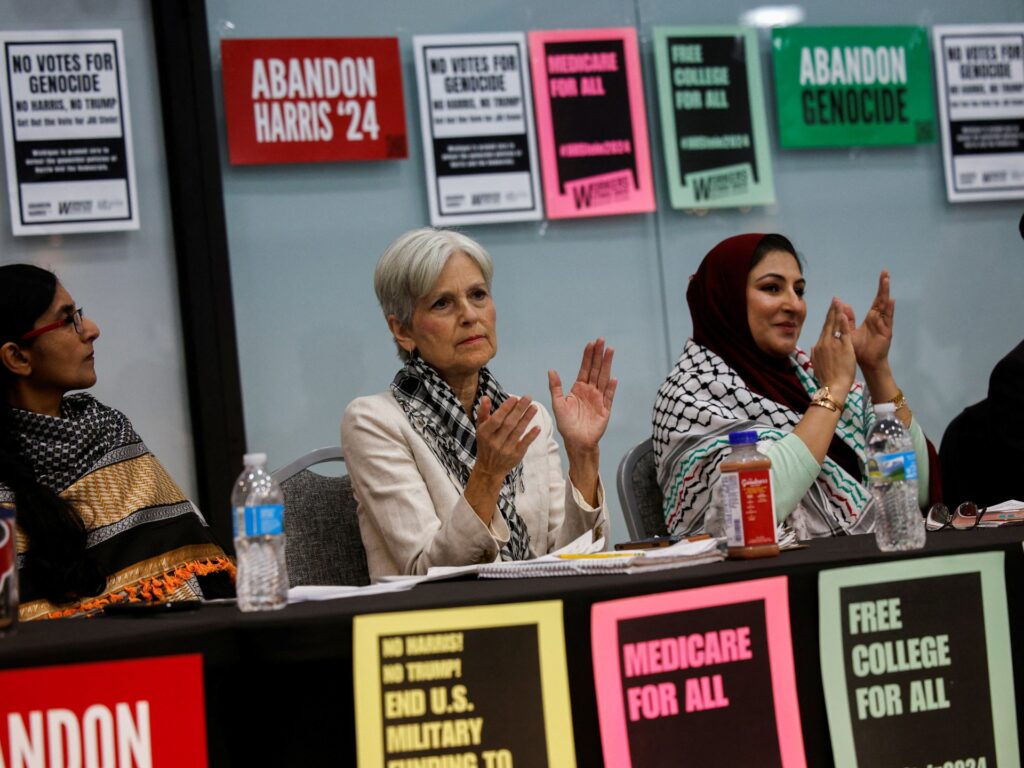
Democrats issue their first ad slamming Green Party candidate, even as she polls at about 1 percent. With less than a month to go to election day in the United States, Democrats are locked in a tight battle for every available vote in the presidential campaign and have taken on the third-party candidates they see as potential “spoilers”. The Democratic National Committee (DNC), the party’s executive branch, issued a television advertisement on Friday attacking Jill Stein, the longtime Green Party candidate to whom some progressives disillusioned with the Democratic candidate, Vice President Kamala Harris, have flocked. The advertisement, which is running in the swing states of Wisconsin, Michigan and Pennsylvania, blames Stein for Republican challenger Donald Trump’s 2016 win and warns that “a vote for Stein is really a vote for Trump” – a refrain Democrats have regularly levelled against her in tight races between their candidates and Trump. The video also includes a comment by former President Trump, saying, “Jill Stein? I like her very much.” The advertisement, the first against the third-party candidate, signals Democrats’ growing worry that every lost vote may cost them such a razor-thin election. Stein has been polling at about 1 percent, similar to progressive academic and independent candidate Cornel West and Libertarian Party candidate Chase Oliver. In some battleground states, those votes may make all the difference. Third-party history Third-party candidates have long been blamed for their impact on tight election outcomes — most notably in 2000 when Green Party nominee Ralph Nader earned 97,421 votes in Florida, a state that eventually went to George W Bush, along with the presidency, by only 537 votes. But third-party candidates and supporters have rejected the blame, arguing that they are working to challenge a fundamentally broken two-party system and giving voters a greater choice. “You don’t have a democracy unless it’s a competitive democracy at election time,” Nader recently told Al Jazeera. “Historically, the function of third parties in an Electoral College system has never really been to win elections but to have new agendas,” he said. With only two choices, Democrat or Republican, Nader added, “on major issues, they are very similar.” A Gallup poll this month found 58 percent of US voters agree that a third major party is needed because the Republican and Democratic parties “do such a poor job” of representing the American people. Stein on Israel While she has virtually no chance of winning the presidency, Stein’s message has been particularly resonant for some voters during Israel’s war in Gaza and Democrats’ and Republicans’ unwavering support for it. She has been a consistent critic of US support for Israel – a position that has won her new supporters this election cycle. “The Kamala Harris campaign is looking for a scapegoat,” she told The Washington Post this week, referring to the Harris campaign’s concern about her candidacy. “They could change their policy right now. The problem is they would rather lose the election than end the genocide”. This week, the Abandon Harris campaign, a Michigan-based Muslim group that says it aims to hold Democratic President Joe Biden’s administration “accountable for the Gaza genocide”, endorsed Stein for president. “Our movement remains dedicated to ensuring that the American people, especially the Muslim-American community, recognize the responsibility we share in standing up against oppression and using all our power to stop genocide — wherever it may arise,” the group said in a statement. “On the precipice of the election, we endorse Jill Stein.” Adblock test (Why?)
North Korea accuses South Korea of sending propaganda drones to Pyongyang

North Korea says flights are an ‘irresponsible and dangerous provocation’ as Seoul denies sending drones. North Korea claims South Korea sent unmanned drones carrying propaganda leaflets to Pyongyang three times and threatened to respond with force if the flights happened again. In a statement on Friday, North Korea’s Ministry of Foreign Affairs said the drones were detected in the night skies of Pyongyang on October 3 and Wednesday and Thursday this week. The ministry accused South Korea of violating its “sacred” sovereignty and threatening its security, describing the flights as an “irresponsible and dangerous provocation that may cause an armed conflict and lead to a war between the two sides,” the ministry was quoted as saying by the state news agency KCNA. The statement added that North Korean forces will prepare “all means of attack” capable of destroying the southern side of the border and the South Korean military. “The safety lock on our trigger has now been released,” the Foreign Ministry said. A balloon believed to have been sent by North Korea, carrying various objects including what appeared to be rubbish, is pictured in Incheon, South Korea, June 2, 2024 [Yonhap via Reuters] South Korea’s Defence Minister Kim Yong-hyun said they had not sent any drones into the North. When asked about North Korea’s claim during a parliamentary audit late Friday, he told lawmakers, “We have not done that.” South Korea’s Joint Chiefs of Staff said it could not confirm the North’s accusations, but also referred in its statement to Pyongyang’s practice of sending balloons into South Korean airspace, with bags of rubbish attached. In its statement, South Korea’s Joint Chiefs of Staff said it “cannot confirm the truth of North Korea’s claims”, adding: “All responsibility for the recent series of events” lies with Pyongyang. It cited “despicable, low-grade and internationally embarrassing acts of filth and garbage balloons and other provocations.” More balloons were being sent on Friday, it said. Since May, North Korea has sent thousands of balloons carrying paper waste, plastic and other rubbish in what it said was in retaliation against South Korean activists who flew balloons with anti-North Korean propaganda leaflets across the border. South Korea’s military has responded to the North’s rubbish balloons by using loudspeakers at the border to broadcast propaganda and K-pop. The new balloons come as North Korea’s army said it would “permanently shut off and block the southern border” with South Korea on Wednesday. The army added that the defence structures would be built to deal with the South’s and US forces’ “confrontational hysteria.” Adblock test (Why?)
Israel attacks UN peacekeepers in Lebanon: Why it’s such a big deal
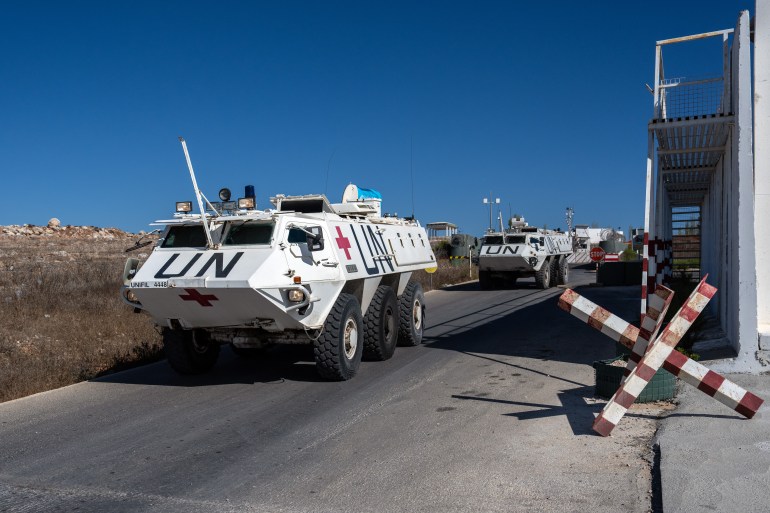
The Israeli military has fired on the United Nations peacekeeping force in Lebanon twice in less than 48 hours, the UN says. Israeli forces repeatedly fired at a guard tower at the headquarters of the UN Interim Force in Lebanon (UNIFIL) on Thursday, injuring two members of the force, and again fired at a watchtower, injuring two more peacekeepers, on Friday. It is almost unheard of for a UN member state to take aim at a UN peacekeeping force, so how significant are these incidents in the unfolding war in Lebanon? UNIFIL armoured personnel carriers depart from a base to patrol the Lebanon-Israel border on October 5, 2024 in Marjayoun, Lebanon [Carl Court/Getty Images] What happened? On Thursday morning, Israeli forces used a Merkava tank to fire at an observation tower belonging to UNIFIL in Naqoura, a small border-area town in southern Lebanon where UNIFIL has been headquartered since 1978. Two Indonesian peacekeepers were directly hit, causing them to fall. “The injuries are fortunately, this time, not serious, but they remain in hospital,” a UN statement issued on Thursday read. The statement added that on Wednesday, Israeli soldiers had “deliberately fired at and disabled” the monitoring cameras at UNIFIL’s headquarters. On Friday, UNIFIL released a second statement saying two more peacekeepers had been injured when two explosions occurred close to an observation tower. One was taken for treatment at a hospital in the Lebanese city of Tyre while the other was being treated in Naqoura. Israel’s attacks were condemned by members of the international community, including Indonesia, Italy, France, Spain, Ireland, Turkey, the European Union and Canada. What is UNIFIL? UNIFIL is a peacekeeping force in Lebanon originally set up by the UN Security Council in March 1978 after Israel first invaded Lebanon in what became known as the South Lebanon Conflict. In 1978, Israel deployed its troops along the border with Lebanon after Palestine Liberation Organization members entered Israel from Lebanon by sea. UNIFIL was established to oversee the Israeli withdrawal from Lebanon and to restore peace and security in the area. After a 34-day war in Lebanon between Hezbollah and Israel in 2006, in which 1,100 Lebanese people were killed, UNIFIL’s mandate was expanded to monitor the cessation of hostilities and support Lebanese armed forces deployed throughout southern Lebanon. As of September 2, 10,058 UNIFIL soldiers are deployed in Lebanon. They come from 50 countries. The largest number of UNIFIL peacekeepers – 1,231 – come from Indonesia. Italy, India, Nepal and China also contribute a large number of soldiers to the peacekeeping force. How common is it for UN peacekeepers to be harmed? From 1948 to the end of August 2024, 4,398 UN peacekeepers on missions all over the world have been killed. Of these fatalities, 1,629 were due to illness, 1,406 were caused by accidents, 1,130 by malicious acts and 233 were due to “other reasons”, according to data from the UN. UNIFIL is the most dangerous of the peacekeeping missions, having suffered the most casualties. In its 46 years, 337 peacekeepers have been killed. It is followed by the UN Multidimensional Integrated Stabilization Mission in Mali, which has suffered 311 fatalities. The highest number of peacekeeper fatalities in one year took place in 1993 when 252 peacekeepers died during missions in Somalia, Bosnia and Herzegovina, Cambodia and other locations. In 2010, the second highest number of fatalities took place when 173 peacekeepers were killed. They included three peacekeepers with the African Union-UN Mission in Darfur during confrontations with unknown attackers. In the same year, 43 members of the UN Stabilization Mission in Haiti (MINUSTAH) died on January 12 in an earthquake in Haiti. Ten other MINUSTAH personnel died in 2010 in “acts of violence”, the UN website reported. In 2017, the UN said an attack on peacekeepers in the Democratic Republic of the Congo was suspected to have been carried out by the Allied Democratic Forces armed group. That attack killed 14 Tanzanian peacekeepers and injured 44. What is the legal position on targeting UN peacekeepers? The deliberate targeting of UN missions amounts to a war crime, observers said. “Under the laws of war, UN personnel involved in peacekeeping operations, including armed members, are civilians, and deliberate attacks against them and peacekeeping facilities are unlawful and amount to war crimes,” a report from Human Rights Watch (HRW) explained. HRW cited Article 8(2)(b)(iii) of the Rome Statute, which established the International Criminal Court in The Hague. It lists the intentional targeting of humanitarian and peacekeeping missions as war crimes. The UN statement that reported Thursday’s attack said not only was the deliberate attack a violation of international law but also a violation of UN Security Council Resolution 1701. After Israel’s attack on Friday on the UNIFIL headquarters, the UN said: “This is a serious development, and UNIFIL reiterates that the safety and security of UN personnel and property must be guaranteed and that the inviolability of UN premises must be respected at all times. “Any deliberate attack on peacekeepers is a grave violation of international humanitarian law and Security Council resolution 1701 (2006).” UN peacekeepers from a Spanish brigade of the United Nations Interim Force in Lebanon (UNIFIL) clean their weapons at their base on August 16, 2024 in Kafarkila, Lebanon [Chris McGrath/Getty Images] Has Israel attacked UN peacekeepers before? Military analyst Elijah Magnier told Al Jazeera that the recent incident was not the first time UNIFIL had come under fire from Israel. In 1987, an Israeli tank squad opened fire on a village where a UNIFIL command post was located, killing an Irish peacekeeper. In 1996, Israel shelled UNIFIL’s Fijian battalion in southern Lebanon’s Qana. More than 120 Lebanese civilians were killed and about 500 injured. Four UN soldiers were also injured. In late November 2023, Israeli forces fired at a UNIFIL patrol close to Aitaroun in southern Lebanon, but no peacekeepers were injured. Magnier said the recent attacks were happening “because Israel needs to go through the UNIFIL position in Naqoura and start the invasion
Aftermath of Israeli air strikes in central Beirut
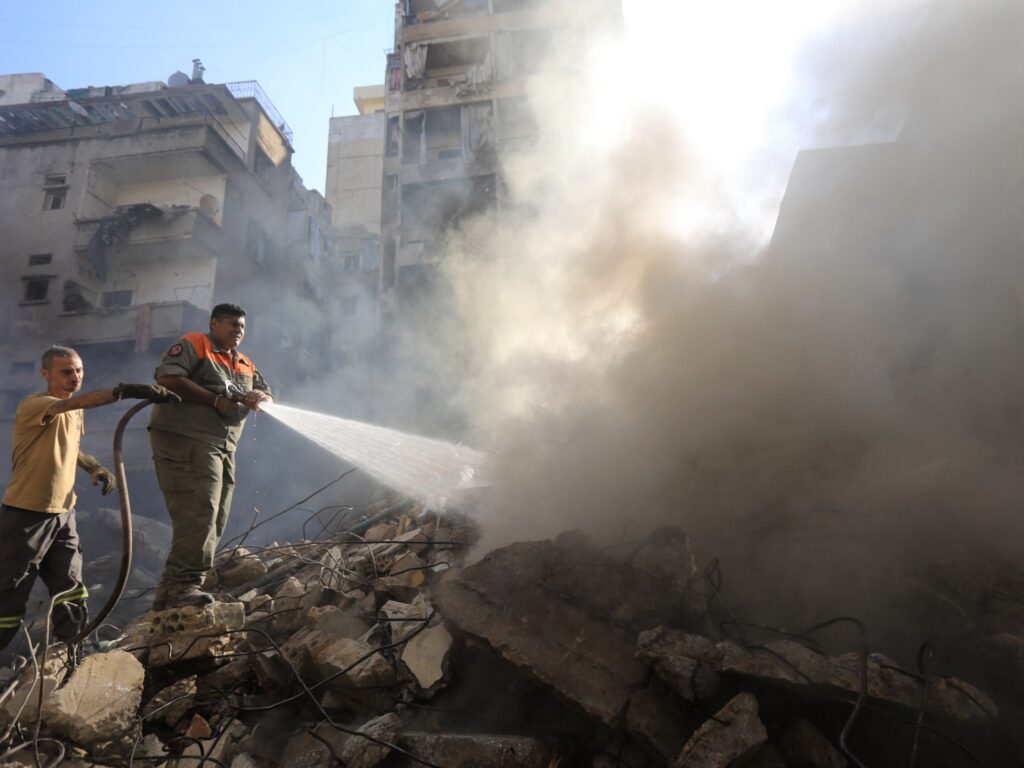
At least 22 people were killed and 117 others wounded in Israeli air strikes in central Beirut on Thursday, Lebanon’s Ministry of Public Health said, in the third such attack on the centre of the Lebanese capital since Israel escalated its bombing campaign last month. Reporting from Beirut, Al Jazeera’s Laura Khan said many people who had been displaced from southern Lebanon in recent weeks had sought shelter in the capital. “Many people who had fled southern Lebanon had found shelter here, and it’s just becoming re-traumatising, unpredictable and dangerous,” Khan said. The injured were brought to local hospitals, which sent out a warning asking people not to donate blood because they were already overwhelmed by the number of casualties and the inflow of family members. Al Jazeera correspondents on the ground said a family of five people that had fled southern Lebanon was killed alongside three relatives who were hosting them. The attacks, which came without warning, mark the third time since Israel expanded its campaign on Lebanon in late September that its bombs have hit outside Dahiyeh, a southern suburb that has seen near-daily air raids in recent weeks. A Lebanese security source, without giving further details, said a “Hezbollah figure” was targeted after a series of killings of top officials in the Iran-aligned movement. Adblock test (Why?)
Kyiv says Ukrainian reporter Victoria Roshchyna died in Russian detention
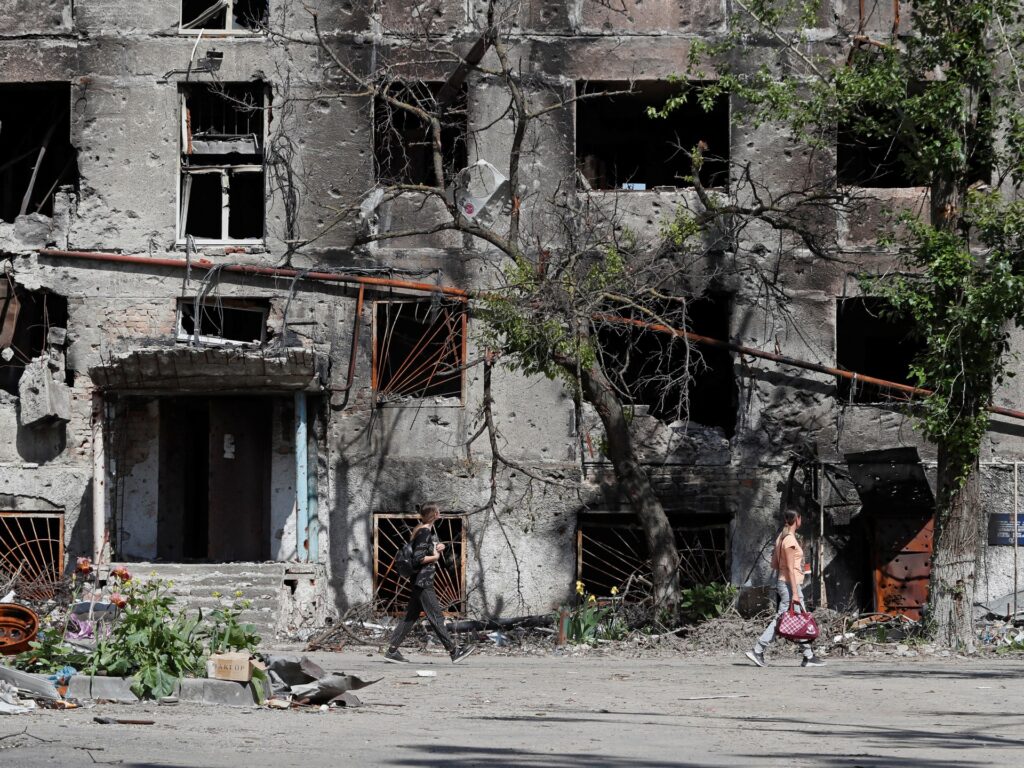
The award-winning freelance journalist was known for her reporting on life in Russian-occupied Ukraine. An award-winning Ukrainian journalist who wrote firsthand accounts of life in Russian-occupied Ukraine has died in detention in Russia. Victoria Roshchyna, who was 27, worked freelance for Ukrainian media outlets Ukrainska Pravda and Hromadske Radio, as well as for US-funded Radio Liberty. She went missing in August last year after she travelled to Russian-occupied parts of Ukraine on a reporting trip. Russia’s Ministry of Defence acknowledged in a letter to her father in May that she was in Russian custody. “Unfortunately, information about Victoria’s death has been confirmed,” Petro Yatsenko, a spokesperson for Ukraine’s prisoners of war coordination headquarters, told Ukrainian television. He said investigations were continuing into how she died. Media rights group Reporters Without Borders (RSF) said in a statement that Russia informed Roshchyna’s family on Thursday that she had died on September 19. “The Russian authorities have never provided any information about her detention, despite repeated requests from her family, the Ukrainian authorities, and RSF,” Jeanne Cavalier, head of RSF’s Eastern Europe and Central Asia desk, said in a statement. “They must shed light on all the circumstances surrounding her detention and death.” A terrible tragic news: Ukrainian journalist Viktoria Roshchyna, who was kidnapped in the occupied territories of Ukraine, has died in a Russian prison. It has happened on September 19th, but her father received the news only today. She was on hunger strike for many days, many… pic.twitter.com/FHXc5rii2m — Anastasia Magazova 🌻 (@a_magazova) October 10, 2024 Roshchyna wrote vivid accounts of life in Crimea, which Russia annexed from Ukraine in 2014, as well as in areas of eastern Ukraine seized by Russian-funded separatists. She also documented the nearly three-month defence of the port of Mariupol after Moscow launched its full-scale invasion in February 2022. She was initially detained by the Russians for 10 days, shortly after the country embarked on its war. A spokesperson for Ukraine’s HUR Intelligence Directorate, Andriy Yusov, told public broadcaster Suspilne that Roshchyna had been on a proposed prisoner exchange and was due to be transferred to Moscow from detention in Taganrog near the Ukrainian border. Ukraine said in May more than two dozen Ukrainian media workers were being held in Russian captivity and that negotiations for their return were under way. RSF said Roshchyna was the 13th journalist to die as a result of their work since the Russian invasion. Adblock test (Why?)
Armed attackers kill 20 coal miners in southwest Pakistan
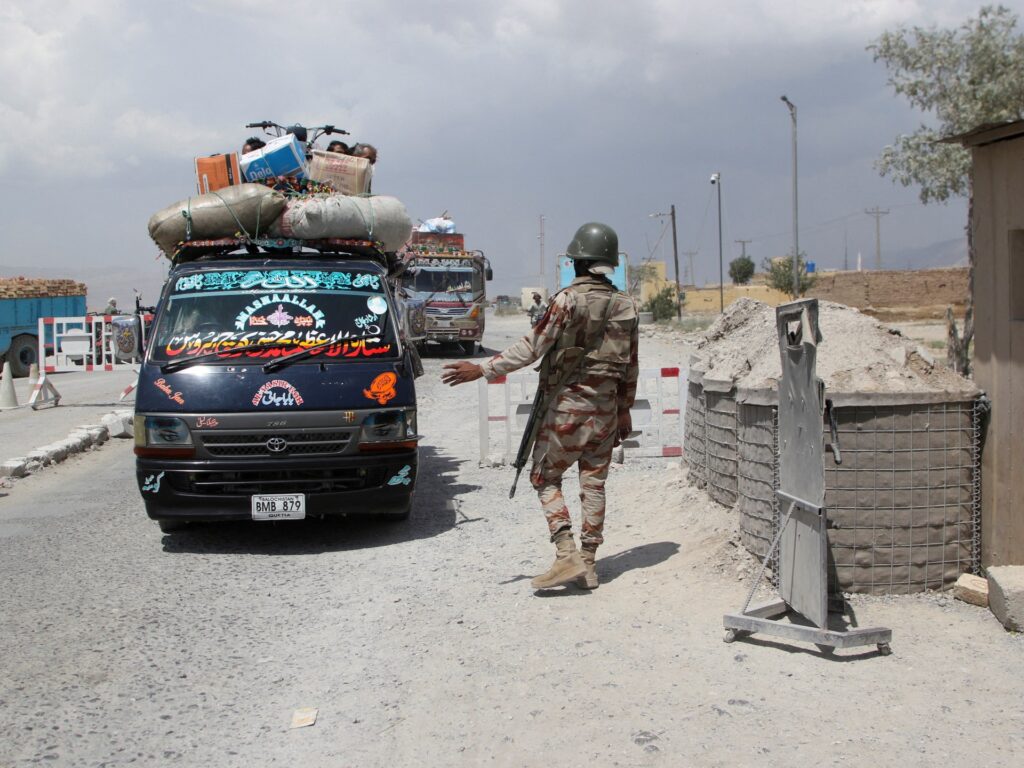
The attack is the latest in Balochistan province and security concerns are growing in advance of a key international summit in Islamabad. Armed assailants have killed 20 miners and injured another seven at a small private coal mine in southwest Pakistan, police said, raising security concerns just days before a major international summit is set to be held in the country. The attackers broke into the miners’ quarters in Dukki district in Pakistan’s restive Balochistan province on Thursday night, gathered the workers together and opened fire, local police official Hamayun Khan Nasir said on Friday. “A group of armed men attacked the Junaid Coal company mines in the [Dukki] area in the [early] hours using heavy weapons,” he said, adding the attackers fired rockets and grenades at the mines as well. Most of the victims were from Pashtun-speaking regions within Balochistan, according to Nasir. Three of the deceased and four of the injured were Afghan nationals. No group has immediately taken responsibility for the assault. Balochistan is a hotbed of armed movements, with the Balochistan Liberation Army (BLA) most prominent among them. They accuse the central government in Islamabad of exploiting the province’s rich oil and mineral resources to the detriment of the local population in the country’s largest and least-populated province, which borders Iran and Afghanistan. On Monday, the BLA – designated a terrorist group by Pakistan, the United Kingdom and the United States – claimed responsibility for an attack targeting Chinese nationals near Pakistan’s largest airport. The Chinese embassy in Pakistan said at least two of its citizens were killed and a third injured after their convoy was targeted with an improvised explosive device believed to have been detonated by a suicide bomber. Local media reports suggest at least 10 people were injured in total, with four cars destroyed in the explosion and 10 more vehicles damaged in the resulting fire. Thousands of Chinese nationals work in Pakistan, many of them involved in Beijing’s multibillion-dollar infrastructure project the Belt and Road Initiative. Despite China’s repeated requests for Pakistan to bolster security, there has been a surge in attacks and unrest surrounding key Belt and Road infrastructure projects in the country. The attack has raised concern about the ability of Pakistani security forces to safeguard high-profile events and foreign nationals in advance of next week’s Shanghai Cooperation Organisation Heads of Government summit, which is set to meet in Islamabad on October 15 and 16. Adblock test (Why?)
Taiwan says four employees of Apple supplier Foxconn arrested in China

Workers reportedly arrested in Zhengzhou for equivalent of breach of trust. Taipei, Taiwan – Four Taiwanese employees of Apple supplier Foxconn have been detained in China since January, Taiwan’s national news agency has reported. The workers were detained in Zhengzhou, the home of Foxconn’s largest iPhone factory, by the local public security bureau for the equivalent of “breach of trust”, Central News Agency (CNA) reported Thursday, citing the Taiwanese government. Taiwan’s Mainland Affairs Council (MAC) cited Foxconn as stating that its employees had done nothing to harm the company’s interests and that it could not rule out corruption and abuse of power by a small number of police officers, CNA said. The MAC told the Reuters and AFP news agencies that the case was “quite strange” and had “severely damaged business confidence”. Foxconn and the MAC did not immediately respond to a request for comment. The case is the latest incident to draw attention to the risks facing Taiwanese living and working in China. Last month, a court in Wenzhou sentenced Taiwanese independence activist Yang Chih-yuan to nine years in prison for secession in the first such prosecution of its kind. Also last month, an executive of Taiwan’s Formosa Plastics was detained as he tried to leave China, CNA reported. In June, the MAC raised the travel alert for China, Hong Kong, and Macau from “yellow” to “orange” and advised citizens against “unnecessary travel”, citing China’s strict national security and anti-espionage laws. Taiwan’s National Security Bureau in July told the island’s legislature that, during the previous 12 months, 15 citizens had been detained or put on trial on Chinese soil, while 51 had been interrogated at the border. Beijing’s Communist Party claims self-ruled Taiwan, whose formal name is the Republic of China, as one of its provinces, while Taipei insists it is a sovereign democracy. Beijing also does not recognise dual citizenship and considers Taiwanese to be Chinese citizens. Hundreds of thousands of Taiwanese lived and worked in China during the 1990s and 2000s, but their numbers have fallen sharply since the Beijing-sceptical Democratic Progressive Party took power in 2016, marking a deterioration in Chinese-Taiwanese relations. Adblock test (Why?)