

Who is Pakistan’s new spy chief Asim Malik?
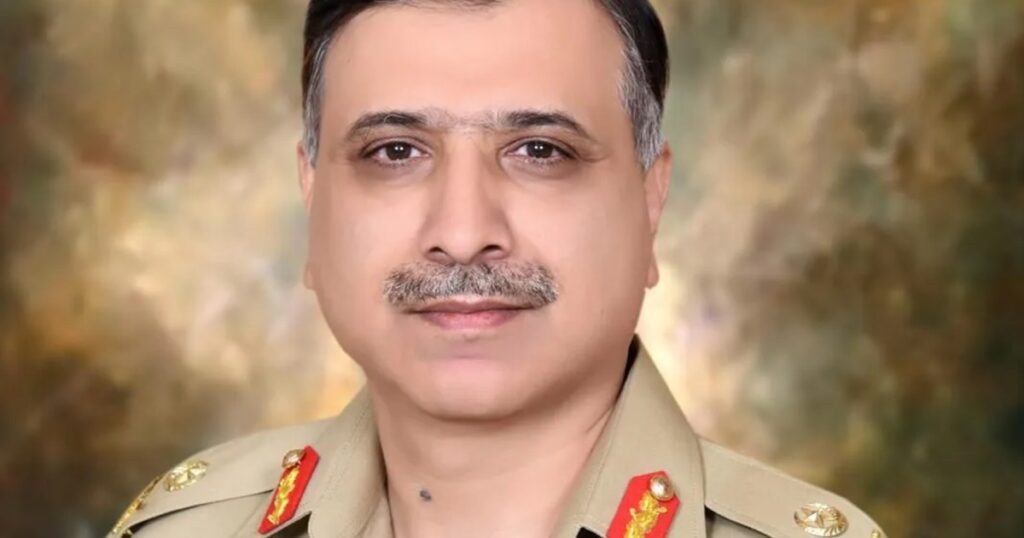
Islamabad, Pakistan – Pakistan’s military has announced the appointment of Lieutenant General Asim Malik as the new head of the country’s premier intelligence agency, the Directorate of Inter-Services Intelligence (ISI). Malik will assume his role on September 30. Before this appointment, he served as the adjutant general (AG) at the army’s general headquarters, overseeing military administrative affairs, including legal and disciplinary matters, for the past three years. The ISI chief is often seen as the second-most powerful person in the military after the Chief of Army Staff — in a country where the military is the most powerful institution. The outgoing ISI chief, General Nadeem Anjum, took office in November 2021 under then-Prime Minister Imran Khan. His tenure, extended by a year in September 2022, coincided with significant political upheaval, including Khan’s ouster through a parliamentary vote of no confidence in April 2022 – a move Khan attributed to military interference, a charge that the military has consistently rejected. Malik, a highly decorated officer who enjoys goodwill within Pakistan’s close-knit military community, has not been immune from that tumult either. Who is Asim Malik, the new ISI chief? Malik, 59, has no direct experience in intelligence-related postings but has commanded infantry divisions in Balochistan and an infantry brigade in South Waziristan, areas that have been hotbeds of violence for nearly two decades. He has also served as an instructor at Pakistan’s National Defence University and the Command and Staff College in Quetta. A top-performing cadet during his training, Malik is the son of Ghulam Muhammad Malik, who was a three-star general in the 1990s and held prominent positions during his career. Asim Malik is a graduate of the Royal College of Defence Studies in London and Fort Leavenworth in the United States, where he wrote a thesis on mountain warfare. Retired Lieutenant General Naeem Khalid Lodhi, who served with Malik’s father, describes the incoming spy chief as a quiet yet highly respected officer. “Even as the AG, he did substantial work for the welfare of retired soldiers, particularly concerning pensions and other related issues,” Lodhi told Al Jazeera. He said Malik is credited with resolving concerns over delays in pensions and the medical treatment of veterans during his time as AG. However, Malik’s tenure as AG also coincided with a crackdown on former PM Khan and his Pakistan Tehreek-e-Insaf (PTI) party, leading to the arrest of numerous party supporters and leaders. After Khan was detained briefly on May 9 last year, many PTI supporters went on a rampage and damaged public property and military installations. Thousands were arrested, and just about 100 individuals faced military trials under the supervision of the AG. Last year, the army also announced prison sentences for two retired officers – a major and a captain – on charges of “inciting sedition” after court-martial proceedings. In August, former ISI chief General Faiz Hameed, along with three other former military officials, was also arrested for court-martial proceedings. A former colleague of Malik, a retired general, says his appointment reflects the trust placed in him by General Asim Munir, the current army chief. “In normal circumstances, with his career trajectory, Malik would have been given command of a corps. But with less than 20 months until his retirement, that’s unlikely. His appointment to the ISI underscores the strong confidence Munir has in him,” the former general said, requesting anonymity due to his familiarity with Malik. However, he also acknowledged that the roles of AG and ISI chief come with inherent controversies and that, in many ways, Malik must now in his new job be willing to do the dirty tricks his current role would have needed him to drown upon. “AG’s job is to ensure complete discipline in the institution and to take to task those who fail to uphold it. Whereas in the ISI, the job requires one to undertake unsavoury tasks which are controversial by nature,” he added. “Both these positions contradict each other.” The legacy of the outgoing ISI chief Founded in 1948, the ISI is Pakistan’s equivalent of the CIA in the US, the British MI6 or India’s Research and Analysis Wing (RAW). While the agency officially reports to the prime minister, the army chief recommends the appointment of its head. However, the intelligence agency is also highly controversial, with its critics describing it as a “state within a state”. The Pakistani military itself remains the single most powerful institution in the country, which wields considerable influence on the country’s political and foreign policy sphere, with the ISI often playing the role of enforcer. Anjum’s appointment as ISI chief in November 2021 was contentious, causing a rift between then-army chief General Qamar Javed Bajwa and then-Prime Minister Khan. At the time, General Hameed, now facing a court martial, was the ISI chief, and Khan insisted he should continue in the role. Khan’s critics say Hameed was seen as Khan’s enforcer against his political rivals — a charge the former PM has repeatedly denied. However, critics allege that under Anjum, the ISI continued to act in a manner that could be viewed by some as politically partisan, through its role in the crackdown against Khan’s political party, PTI. “I personally feel that Hameed was the wrong choice to lead ISI, but was brought by Bajwa, then army chief, to do his bidding,” said the former general who was also Malik’s colleague. “However, Anjum’s era saw a doubling down on those policies of repression and surpassed those.” The military and the ISI have consistently denied acting against Khan and his party because of political reasons, arguing that the crackdown against the PTI has been driven by legal considerations alone. What lies ahead for the ISI under Malik? Lodhi said he doubts whether Malik’s appointment could portend major changes in the ISI’s functioning. “The way institutions work, these appointments don’t change direction or policies in a drastic manner,” he said. The former three-star general, also a former war college instructor, echoed this sentiment. “Every new leader brings
Why is Israel attacking Lebanon?
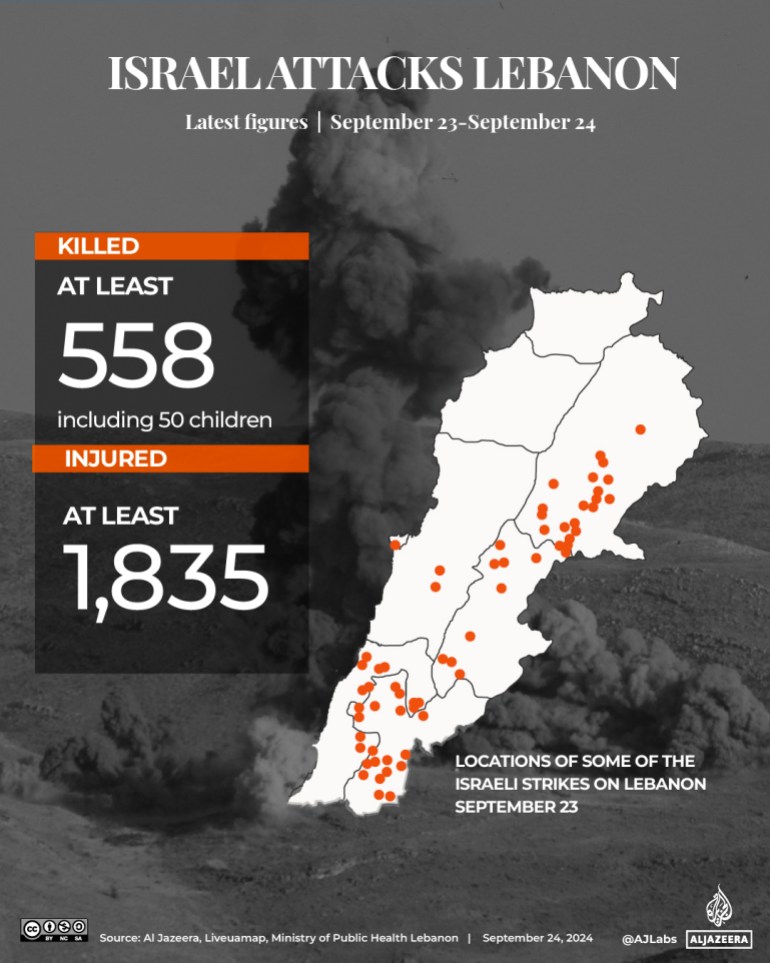
Over the last 24 hours, Israel has unleashed a series of air strikes across Lebanon. Hundreds of Lebanese people are dead, many are wounded and thousands are displaced as they scramble to try to figure out safe areas to get their families to. Calling this part of its “new phase” of the war on Gaza, the Israeli army said it struck more than 1,000 targets in Lebanon – claiming they were Hezbollah strongholds or military facilities placed in people’s homes. What happened and when? Israel has just killed at least 558 Lebanese people. Among the dead are 50 children and 94 women, while about 2,000 people were wounded, the Lebanese Ministry of Public Health said. More than 10,000 people have been forced from their homes in the most ferocious onslaught Lebanon has experienced since its civil war of 1975-1990. The first Israeli strikes on Lebanon were reported on Monday at 6:30am, hitting an uninhabited area near Byblos, north of Beirut. More than 1,300 strikes on what Israel claimed were Hezbollah military targets followed. The attacks are ongoing. Where in Lebanon is Israel attacking? Satellite mapping of the strikes by Al Jazeera shows attacks across Lebanon, with the highest concentration in the south and the Bekaa Valley, where Hezbollah’s influence is considered strongest. Before the attacks, some 80,000 phone calls from the Israeli army to Lebanese people – predominantly in the south – were reported, urging them to evacuate their homes and find “safety”. The result was panic, chaos and bottlenecks, with the main coastal road to the capital, Beirut, gridlocked for several kilometres as residents tried to flee an impending attack. Why is Israel attacking Lebanon? Israel says it is attacking Hezbollah so it can return its displaced citizens to the north. On Wednesday, Israeli Defence Minister Yoav Gallant announced the redeployment of “forces, resources and energy” towards the north and Hezbollah as the war entered a “new phase”, seeming to imply the war on Gaza was winding down. According to Gallant, this was part of a bid to return the 65,000 Israelis he had ordered evacuated in the early days of the conflict in anticipation of Hezbollah attacks on their homes near Lebanon’s border. That big Hezbollah attack never happened but Israel and Hezbollah have been maintaining a steady exchange of fire over Lebanon’s southern border since October 2023. Hezbollah has promised to keep up its attacks until Israel reaches a ceasefire agreement with the group’s ally Hamas in Gaza. In a news conference on Monday night, Israel’s military spokesperson did not rule out a land invasion of Lebanon, saying: “We will do whatever is necessary to bring back home all our citizens to the northern border safely.” It appears so. On September 17, a day before Gallant’s “new phase” announcement, hundreds of pagers belonging to Hezbollah members were detonated in an attack widely believed to have been undertaken by Israel. Israel did not comment. Volunteers carry an elderly displaced man on a chair displaced Lebanese people are received at an art institute transformed into a shelter in Beirut, on September 23, 2024 [Fadel Itani/AFP] The following day, another attack hit Hezbollah’s walkie-talkie radios. The two attacks killed 37 people, including two children, and wounded and maimed thousands more. The attacks compromised the group’s communications and, according to analysts, undermined its morale. Exchanges between Israel and Hezbollah have escalated since, with a devastating Israeli strike in southern Beirut on Saturday killing 45 people and wounding many more. How dangerous is this? Very. Israel and Hezbollah’s alliances could pull other countries in. Israel’s ally, the United States, announced it was deploying additional troops to the area, without specifying how many and for what purpose. The US currently has about 40,000 troops in the region. Hezbollah and Iran have worked in tandem since Hezbollah’s founding as a response to Israel’s invasion of Lebanon in 1982. Israel has pitched its battles with groups such as Hamas and Hezbollah as part of a wider battle against Iran. Israel, while it has never admitted to having nuclear weapons, is estimated to have an arsenal of 90 nuclear warheads. Mourners carry the coffin of Hezbollah member Ali Mohamed Chalbi, after hand-held radios and pagers detonated across Lebanon, at his funeral in Kfar Melki, on September 19, 2024 [Aziz Taher/Reuters] Iran, while not yet nuclear-armed, is considered to be close to it after an agreement to limit the country’s nuclear programme was dissolved by former US President Donald Trump in 2018. Regardless, Iran has one of the region’s largest and most powerful militaries as well as a network of alliances with groups including Yemen’s Houthis and Gaza’s Hamas. What would it take for other states to become involved? Both the US and Iran have repeatedly shown themselves to be aware of the risks any escalation might pose. Despite Israeli provocations – such as the April 2024 air strike on Iran’s consulate in Damascus, Syria, and the killing of Hamas political leader Ismail Haniyeh in Tehran in July – Iran’s response to Israel has so far been tepid. Retaliation to the April air strike was telegraphed long in advance and was mostly intercepted. No response to Haniyeh’s killing has been forthcoming. The US, despite its unflagging support for Israel, has also shown itself to be aware of the risks of escalation. President Joe Biden, right, meets with Israeli Prime Minister Benjamin Netanyahu, left, in the Oval Office of the White House in Washington, DC, on July 25, 2024 [Susan Walsh/AP Photo] US diplomats continue to facilitate indirect talks between Hamas and Israel to reach a ceasefire, with Biden even announcing a ceasefire deal in May, which at the time he attributed to Israel. However, it was subsequently rejected. What does Israel want? For many in Israel, after decades of tension, war with Hezbollah is inevitable. As the war on Gaza rumbles on and the death toll there soars past 41,455, many have accused Israeli Prime Minister Benjamin Netanyahu of prolonging and escalating the conflict for his political ends.
Myanmar anti-coup forces target Mandalay in struggle to oust military
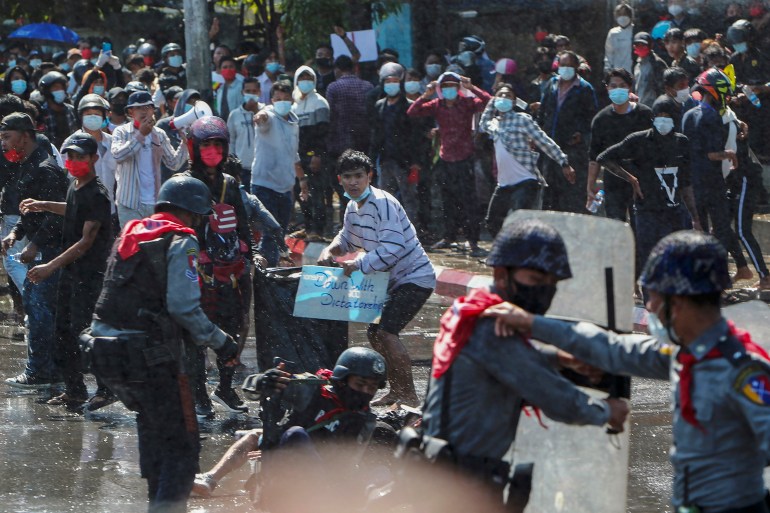
Myanmar’s second-biggest city is beginning to feel like a city under siege. But while armed groups might be at the gates of Mandalay, most residents do not consider them the enemy. “I’ve lived in Singu since I was born and we’ve never seen anything like this before,” said Tun, a 47-year-old resident of a small town in the Mandalay region, roughly 80km (50 miles) north of the city. He asked to be identified by only part of his name for security reasons. “At first, most residents didn’t flee from the town because we had no experience with war. When the fighting got more intense near the town, we understood we couldn’t stay here.” While Myanmar’s borderlands, home to many of the country’s ethnic minorities, have been ravaged by conflict for decades, the mostly Bamar areas in the heart of the country had not seen conflict since World War II. That all changed when the military overthrew Aung San Suu Kyi’s democratically elected government in 2021, plunging the country into a political crisis and civil war. Since then, the Myanmar military has suffered stunning defeats at the hands of longstanding ethnic armed groups and more-recently-established pro-democracy militias. But perhaps no development has been as unexpected as the recent capture of four towns in northern Mandalay, leaving the anti-coup alliance within striking distance of a city with a population of nearly 2 million people. Tun said he was “very happy” that resistance groups seized Singu, even though it has had a devastating effect on the town. Public services have collapsed and nearly every resident has fled as the military launches air and artillery attacks in an attempt to reclaim it. Mandalay saw huge protests after the coup in February 2021 [AP Photo] Tun has been sheltering in a village not too far from the town and, like other Singu residents, would occasionally go back to check on his house. But after air strikes in July, he returned to find only ashes and splinters. “Everything is gone,” he said. “Our house was very precious. It was made of teak wood and it was the only thing I inherited from my parents. When I told my wife, she sobbed.” Mandalay, Myanmar’s old royal capital and cultural centre of the Buddhist heartland, saw some of the largest protests after the coup – and some of the most brutal crackdowns. Many of those young protesters fled to territory controlled by ethnic armed groups to get weapons and training. They are now returning – armed and determined. Pyay, 22, was a university student in Mandalay city before the coup. His parents were public school teachers who joined a mass strike of civil servants while he hit the streets to protest. On March 27, 2022 – a year after the military shot dead at least 40 civilians in Mandalay in a nationwide crackdown on opposition to its coup – he decided to join an armed resistance group called the Madaya People’s Defence Team. On August 5 this year, he and his troops were recuperating at an outpost on the outskirts of Madaya, the last town between the anti-coup fighters and Mandalay. “Suddenly, a military aeroplane came and we dived to crawl on the ground. The military must have got some information that there were revolutionary groups based in the area,” said Pyay, who also asked to use just part of his name for security reasons. But instead of striking their outpost, the bombs fell directly on a village, destroying homes and injuring three civilians. “I felt so angry,” Pyay said. “The residents are innocent and there was no reason to attack them… but they don’t dare fight us on the ground so they use artillery and aeroplanes.” ‘Operational depth’ Groups like Pyay’s are generally loyal to the National Unity Government (NUG), a parallel administration of elected lawmakers removed in the coup. But the most effective units typically operate under the guidance of an ethnic armed group. The most powerful of all may be the Mandalay People’s Defence Force (PDF), which fights under the command of the Ta’ang National Liberation Army (TNLA) and has been central to the operations in northern Mandalay. “Without the Mandalay PDF, we can’t take Madaya,” Pyay conceded. Anthony Davis, an analyst with the Janes defence and security publications, said the Mandalay PDF has become so powerful because it operates as “a virtual extension of the TNLA”. The TNLA fights for the autonomy of the ethnic Ta’ang people, who largely live in the mountains of northern Shan State, some of the least developed parts of Myanmar. There is a long history of Ta’ang armed movements but the modern TNLA was founded in 2009. It enjoys a close relationship with China and has seized an unprecedented swath of territory from the military in an offensive that began in October last year. Morgan Michaels, from the International Institute for Strategic Studies, agrees with Davis. “The Mandalay PDF’s success is directly attributable to the training, weapons, command and control, and operational depth the group has been afforded by the TNLA. The outfit was raised by the TNLA,” he said. “There is no operation under way where it’s purely the Mandalay PDF on its own. They still rely on the command and control of the TNLA.” Both analysts agree the Mandalay PDF would need TNLA support to seize the city. But it is unclear whether the TNLA would provide such support. Its closest ethnic armed group ally, the Myanmar National Democratic Alliance Army, recently announced it had no intention to march on Mandalay, seemingly in response to Chinese pressure to rein in the conflict. Even if the resistance does not push south towards Mandalay city, capturing the northern Mandalay region is still significant to the fight because it connects opposition-controlled territories. Davis said the “logistical and operational connectivity between now-contiguous swaths of resistance-dominated territory… will be critically important, perhaps decisive.” Analysts also warn that an attack on a city like Mandalay would carry immense risk for the people
Gunman who killed 10 in Colorado grocery store found guilty of murder
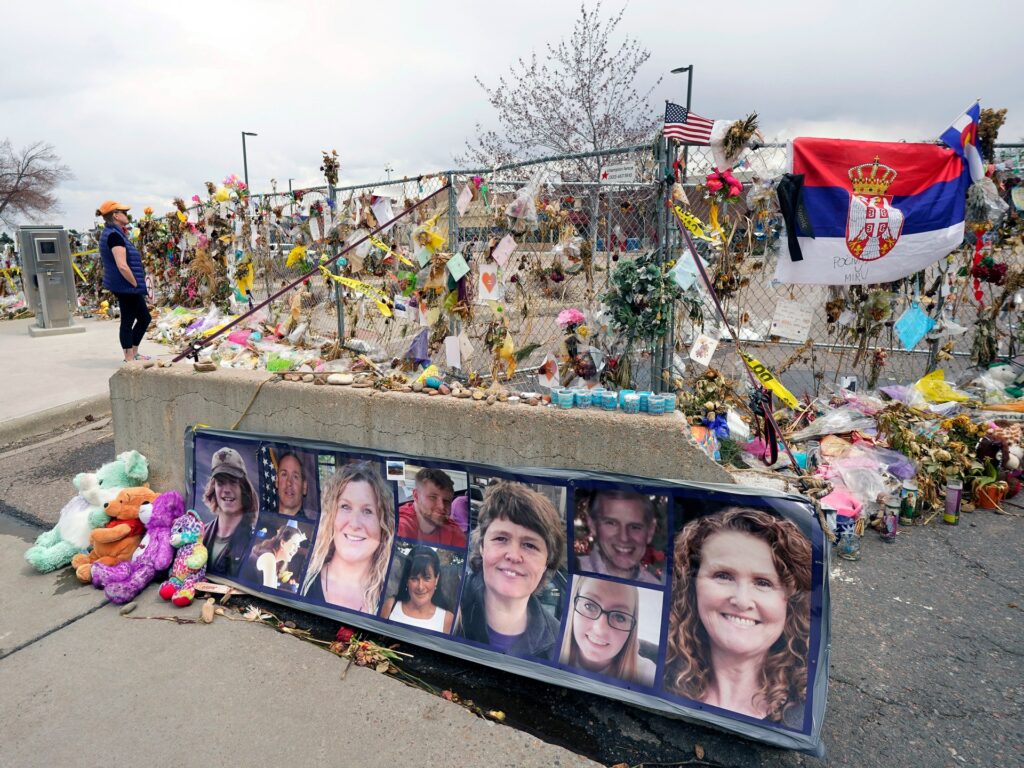
Jury rejects defence plea that Ahmad Alissa was insane and hearing voices prior to 2021 shooting. A gunman who fatally shot 10 people at a grocery store in Colorado in 2021 has been found guilty of murder and could face life in prison. On Monday, a jury rejected the defence’s argument that 25-year-old Ahmad Alissa should be found not guilty by reason of insanity. The defence had argued that Alissa was diagnosed with schizophrenia and could not distinguish the meaning of his actions when he opened fire at the King Soopers grocery store in the city of Boulder. “This tragedy was born out of disease not choice,” defence lawyer Kathryn Herold told the jury during closing arguments. District Attorney Michael Dougherty, meanwhile, argued that the nature of the attack showed Alissa was intentional in his actions. “He is methodical and he is brutal,” Dougherty told jurors. Whether Alissa was responsible for the shooting and the details of the attack were never in question during the trial, which began earlier this month. Alissa had started shooting within moments of arriving in the car park of the store, killing three people before heading inside. He chased several of those he shot and sought out others who were hiding. Prosecutors pointed to those decisions as evidence that Alissa was acting sanely during the attack. They also argued that the illegal magazines and steel-piercing bullets Alissa carried showed the attack was deliberate. State forensic psychologists said that Alissa’s fear of being arrested or killed by the police showed he was sane at the time of the killings. Still, psychologists said they could not provide full confidence in their finding – a point seized on by the defence. Alissa had repeatedly told the psychologists he heard what he described as “killing voices”, but he did not provide further details. Alissa’s family also reported that he had become withdrawn and spoke little, and that he had become increasingly paranoid and heard voices in the years leading up to the attack. They said he had not received any mental health treatment prior to the attack. The state forensic psychologists also concluded that voices likely played a role in the attack and that they did not believe it would have happened if he did not have a mental illness. Still, Colorado law draws a distinction between mental illness and insanity. It defines the latter as having a mental disease so severe that it is impossible for a person to tell right from wrong. The verdict capped a trial filled with harrowing testimonies from survivors of the attack. One survivor, an emergency room doctor, said she crawled onto a shelf and hid among bags of potato chips. A pharmacist at the grocery store testified that she heard Alissa say, “This is fun” at least three times as he fired throughout the store with a semi-automatic pistol resembling an AR-15 rifle. Prosecutors said Alissa, who was born in Syria and emigrated to the US with his family as a small child, had researched locations for possible attacks. However, they did not provide any other motive. Adblock test (Why?)
Biden administration designates UAE ‘major defence partner’ in rare move
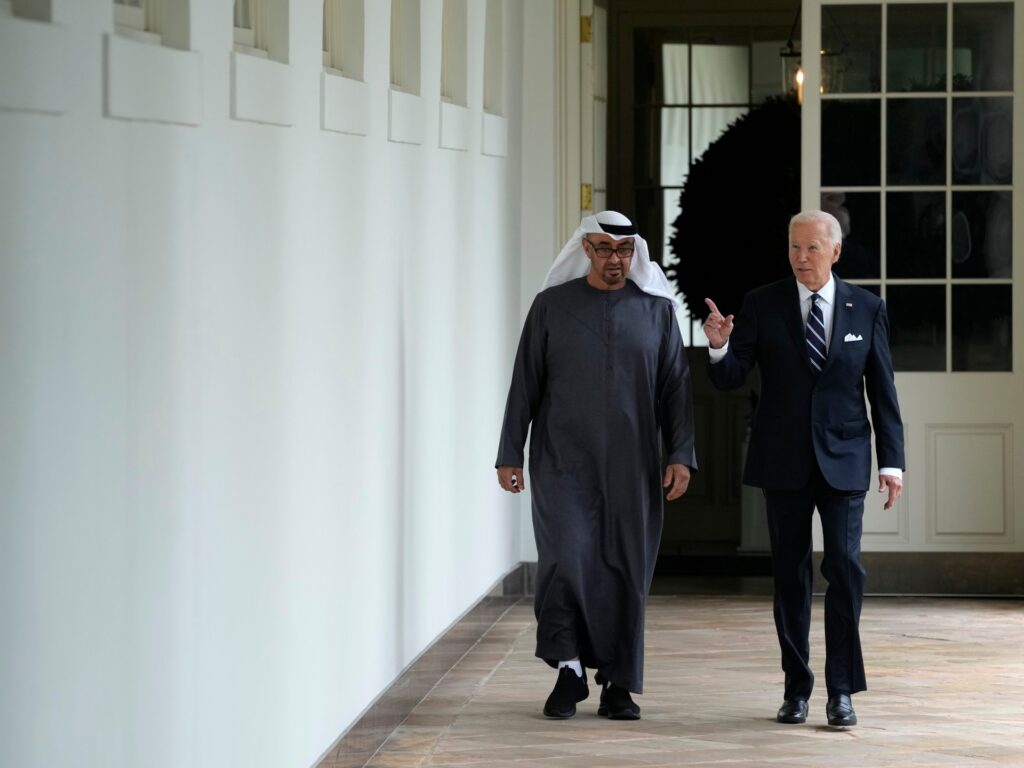
US-UAE boost military cooperation as Middle East tensions over war in Gaza surge and despite friction over Sudan war. United States President Joe Biden has recognised the United Arab Emirates (UAE) as a “major defence partner”, deepening military ties despite friction over the war in Sudan and as deadly tensions ratchet in the Middle East. The announcement on Monday, which came following a White House meeting between Biden and UAE President Sheikh Mohamed bin Zayed Al Nahyan, makes the UAE only the second country to receive the designation. The Biden administration gave India the designation in 2021. In a statement, the White House said the designation would “further enhance defense cooperation and security in the Middle East, East Africa, and the Indian Ocean regions”. It added that it would also “allow for unprecedented cooperation through joint training, exercises, and military-to-military collaboration, between the military forces of the United States, the UAE, and India, as well as other common military partners, in furtherance of regional stability”. The meeting came as Israel stepped up its attacks on Lebanon. At least 492 people, including 35 children, were killed on Monday in Israeli attacks on the territory which it said were targeting Hezbollah military infrastructure. “My team is in constant contact with their counterparts, and we’re working to de-escalate in a way that allows people to return to their home safely,” Biden told reporters during a photo opportunity in the Oval Office. A US State Department official, speaking to reporters on background on Monday, also said that US officials would be discussing “concrete ideas” for an “off-ramp” on the sidelines of the United Nations General Assembly this week. Washington has been regularly criticised for avoiding using its leverage – including the billions in military aid it provides to Israel – to calm tensions in the region. On Gaza, the two leaders “underscored their commitment to continue working together towards ending the conflict” and the need for UN humanitarian aid to be allowed into the enclave, the White House said. To date, at least 41,431 Palestinians have been killed in Gaza amid a nearly yearlong Israeli offensive. The UAE has been a leading voice in the UN Security Council, putting forward resolutions condemning Israel’s war on Gaza, often putting it at odds with the veto-carrying US. Still, Washington has long viewed the Gulf country as integral to any post-war recovery plans in Gaza. The White House said Biden and Al Nahyan discussed “a path to stabilisation and recovery that responds to the humanitarian crisis, establishes law and order, and lays the groundwork for responsible governance” as well as their “commitment to the two-state solution” for Israel and Palestine. Conflict in Sudan The designation on Monday comes despite friction over the UAE’s alleged role in the war in Sudan. The UAE has been accused of channelling weapons to Rapid Support Forces (RSF), which have been locked in a bloody civil war with the Sudanese army since April last year. Both sides have been accused of abuses in the fighting, which has internally displaced more than 10.7 million people and forced a further 2.3 million to flee the country, according to the UN. Ahead of the White House meeting, five US lawmakers sent a letter to Biden calling on him to use Washington’s leverage to seek a change of course. The White House statement said the leaders had discussed the conflict and “stressed that there can be no military solution to the conflict in Sudan”. They also “underscored that all parties to the conflict must comply with their obligations under international humanitarian law”, it added. In a separate meeting with the UAE president, US Vice President and presidential candidate Kamala Harris “raised her deep concerns about the conflict in Sudan”, the White House said. “She expressed alarm at the millions of individuals who have been displaced by the war and the atrocities committed by the belligerents against the civilian population,” the statement said. Adblock test (Why?)
Israeli air raids hit wide swaths of southern Lebanon, kill dozens

Israeli air attacks on southern Lebanon have killed at least 50 people and wounded more than 300, according to the Lebanese Ministry of Public Health. Children, women and medics were among the victims in Monday’s attacks that came after Israel told residents of southern Lebanon to evacuate from homes and other buildings where it claimed Hezbollah had stored weapons, saying the military would conduct “extensive strikes” against the group. A Lebanese man checks a message received on his mobile phone calling people to evacuate the areas where Hezbollah hides its weapons [Joseph Eid/AFP] Lebanese media also reported that residents received text messages telling them to move away from any building where Hezbollah stores arms until further notice. The warnings were the first of their kind in nearly a year of steadily escalating conflict that has forced the displacement of communities on both sides of the border. On Sunday, Hezbollah launched about 150 rockets, missiles and drones into northern Israel in retaliation for strikes that killed a top commander and dozens of fighters. The increasing strikes and counterstrikes have raised fears of an all-out war. With Israel’s war on Gaza approaching the one-year mark, Hezbollah has decided to continue its strikes in solidarity with the Palestinians in the besieged and bombarded territory even as Israel says it is committed to returning calm to its northern border. Adblock test (Why?)
India wins historic double team gold at FIDE Chess Olympiad 2024

India’s two team and four individual gold medals are hailed as the beginning of the country’s reign as the ‘best chess nation in the world’. India’s chess masters have created history by winning team gold medals in both men’s and women’s competitions at the 45th International Chess Federation (FIDE) Chess Olympiad in Budapest. In addition to winning the team championships, India also walked away with four individual gold medals as the tournament wrapped up in the Hungarian capital on Sunday. Wins for Gukesh Dommaraju (more commonly known as Gukesh D), Rameshbabu Praggnanandhaa and Arjun Erigaisi sealed gold in the men’s event, known as the Open event, while Harika Dronavalli, Vaishali Rameshbabu, Divya Deshmukh, Vantika Agrawal, and Tania Sachdev won their respective games to secure gold in the women’s competition. Gukesh, Erigaisi, Deshmukh and Agrawal bagged individual gold medals on their respective boards. 🇮🇳 India triumphs at 45th Chess Olympiad, winning both Open and Women’s competitions 🏆 India has come a long way since Vishy Anand paved the way for the new generation of chess players. Young talents have emerged and grown to become some of the top players in the world. Gukesh… pic.twitter.com/KvOVjAFx3I — International Chess Federation (@FIDE_chess) September 23, 2024 The feat was termed an “unbelievable” achievement by India’s chess great Viswanathan Anand. “It feels like a magical time for India,” the former five-time world champion said on the International FIDE YouTube channel in the lead-up to the final day. Anand, who also won the Chess World Cup twice, said the result was a few years in the making but for India to walk away with team and individual honours exceeded his expectations. The men’s team won 27 of their 44 games, losing just once and drawing six. Their final round of matches was against Slovenia, whom they defeated 3.5-0.5, while the women’s team beat Azerbaijan with the same score. Gukesh, who has also qualified for the final of the World Chess Championship in November, said he was delighted that his team got over the line in a dominant fashion after having some close misses in the past. India was declared a joint winner in the men’s competition along with Russia in the 2020 edition, which was held online during the COVID-19 pandemic. “We are very happy with how we played together as a team,” Gukesh said after the win. Eighteen-year-old Deshmukh was a standout performer in the women’s competition and remained undefeated, winning seven of her 11 games and drawing four. “It started off well but got a bit tough in the middle but I am proud of how we handled it [the situation] and fought back,” she said in the winners’ news conference. “I feel quite overwhelmed with emotions.” Hungarian American chess great Susan Polgar hailed Deshmukh’s run at the tournament. “With an absolutely amazing performance in this Olympiad,” Polgar wrote in a post on X. The four-time world champion predicted more wins for the Indians, saying: “This team will stay on top for years.” Congratulations to India! 2024 #BudapestOlympiad Champions! 🇮🇳 #FIDE100 🥇🏆 They were so focused and determined at the start of the final round! Even though this was all about teamwork, @DGukesh and @ArjunErigaisi had insane performances! This team will stay on top for years… pic.twitter.com/Sv5ZbOxYKV — Susan Polgar (@SusanPolgar) September 22, 2024 Final standings of top 10 teams at FIDE Chess Olympiad 2024 Men India (21) USA (17) Uzbekistan (17) China (17) Serbia (17) Armenia (17) Germany (16) Azerbaijan (16) Slovenia (16) Spain (16) Women India (19) Kazakhstan (18) USA (17) Spain (17) Armenia (17) Georgia (17) China (16) Ukraine (16) Poland (16) Bulgaria (16) Adblock test (Why?)
Rhino numbers tick higher, but poachers lurk amid high demand for horns
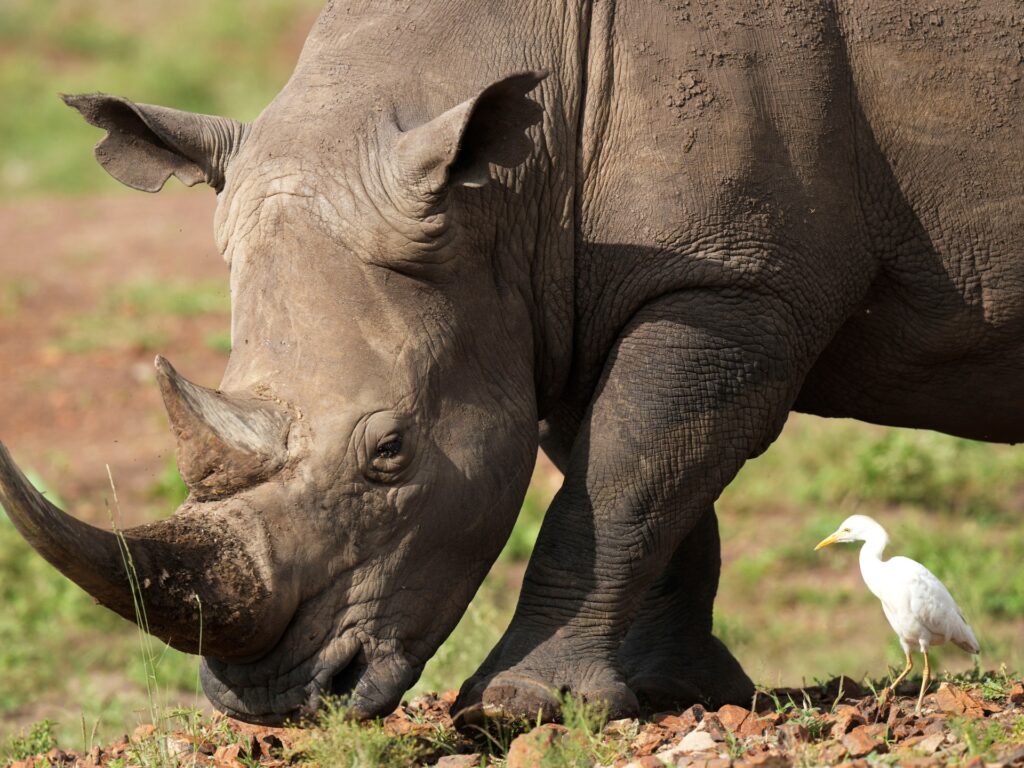
Africa reports 586 rhinos killed in 2023, up from 551 in 2022, with poaching the main threat. Rhinoceros numbers across the world increased slightly in 2023, but so too did the number of animals killed by poachers, according to a new report. Thanks to preservation efforts, the white rhino population increased by 1,522 to 17,464 in 2023, an annual report by the International Rhino Foundation said as it marked World Rhino Day on Sunday. However, the number of black and greater one-horned rhinos stayed the same, it added. That left the global rhino population of the five subspecies at about 28,000, which stood at 500,000 at the beginning of the 20th century. In Africa, one rhino was killed every 15 hours last year as demand for the animal’s horn remains high, the State of the Rhino report says. A total of 586 rhinos were killed across the continent, most of them in South Africa, which has the highest population of rhinos at an estimated 16,056. The number of killed rhinos increased marginally from 551 in 2022, according to the International Union for Conservation of Nature. Still, the white rhino population in South Africa is on the rise despite the poaching thanks to preservation efforts, the report said. While thriving in several regions, the total black rhino population declined slightly over the last year due to heavy poaching in Namibia and South Africa. Since July 2023, Indonesian authorities have been investigating and prosecuting Javan rhino poaching groups, who confessed to killing 26 animals in Ujung Kulon National Park from 2019 to 2023. In India, the one-horned Asian rhino population has risen from 1,500 four decades ago to more than 4,000 thanks to conservation and antipoaching efforts, according to government data included in the report. Rhinos face various environmental threats like habitat loss due to development and climate change but poaching, based on the belief that their horns have medicinal uses, remains the top threat. Philip Muruthi, the vice president for species conservation at the Africa Wildlife Foundation, said protection has played a big role in increasing the rhino population. In Kenya, their numbers rose from 380 in 1986 to 1,000 last year, he said. “Why has that happened? Because the rhinos were brought into sanctuaries and were protected.” Muruthi advocates for a campaign that will end the demand for rhino horns as well as the adoption of new technology in tracking and monitoring rhinos for their protection while also educating communities where they live on the benefits of rhinos to the ecosystem and the economy. Known as megaherbivores that mow the parks and create inroads for other herbivores, rhinos are also good for establishing forests by ingesting seeds and spreading them across the parks in their dung. Adblock test (Why?)
Scholz’s SPD narrowly ahead of far right in east German state: Projections

Scholz’s centre-left Social Democrats likely to win 31 percent of the vote in Brandenburg, a slight lead over AfD at 29 percent, projections show. German Chancellor Olaf Scholz’s Social Democratic Party (SPD) has narrowly beaten the far-right Alternative for Germany (AfD) in a local election in the east German state of Brandenburg, initial projections show. Scholz’s centre-left SPD won around 31 percent against the anti-immigration and anti-Islam AfD, which scored about 29 percent, according to the projections by public broadcasters on Sunday. The result in the formerly communist east offers a rare moment of respite for Scholz’s embattled coalition government, which has sunk in opinion polls a year ahead of national elections. It is unlikely, however, to give him or his party a major boost given that popular, incumbent SPD premier Hubert Dietmar Woidke has distanced himself from Scholz during the campaign and criticised the federal government’s policies. The election in Brandenburg was closely watched because Scholz’s SPD has ruled there ever since Germany’s 1990 reunification. The chancellor’s own electoral district is in the state capital Potsdam, outside Berlin. The AfD, which rails against asylum seekers, multiculturalism, Islam and Scholz’s government, had hoped to replicate its recent electoral success in the east. Three weeks ago, the far-right party stunned the political establishment by winning its first-ever parliamentary vote – in the eastern state of Thuringia – and coming a close second in neighbouring Saxony. Despite its ballot box success, the AfD is unlikely to take power in any state since all other mainstream parties have so far ruled out entering into a governing alliance with the party. SPD’s Woidke, in office for more than a decade, had also thrown down a challenge to voters by telling them he would quit if the AfD won. The AfD, which had vowed “to send Woidke into retirement”, nonetheless hailed its strong showing. Party co-leader Tino Chrupalla said it had “taken gold once and silver twice” in three elections in the east this month. The AfD’s populist rhetoric has heaped political pressure on Scholz and his governing allies, the Greens and the liberal Free Democrats. Both parties scored in the low single digits in Sunday’s state election. Adblock test (Why?)
UN aims ‘to bring multilateralism back’ as it adopts Pact for the Future
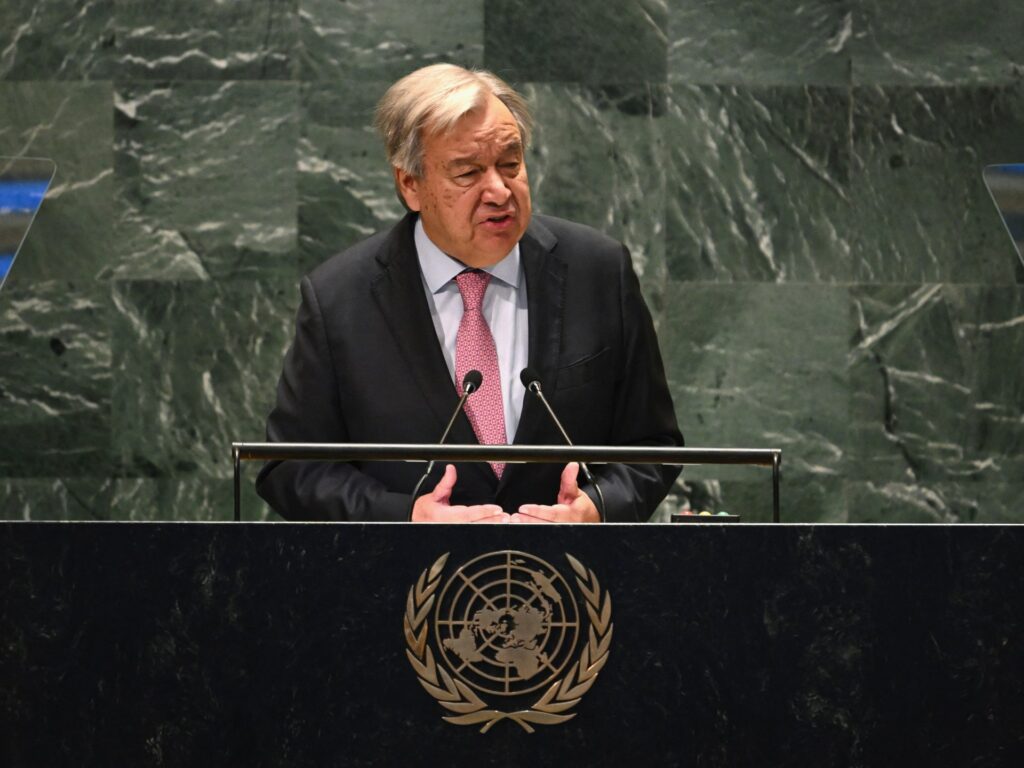
UN member countries adopt blueprint for the future to tackle wars, environmental threats and technological challenges facing humanity. The United Nations General Assembly has adopted a “Pact for the Future”, which UN Secretary-General Antonio Guterres described as a landmark agreement that is a “step-change towards more effective, inclusive, networked multilateralism”. The pact, which also includes an annex on working towards a responsible and sustainable digital future, was adopted without a vote on Sunday at the start of a two-day Summit of the Future. The agreement came after some nine months of negotiations. “We are here to bring multilateralism back from the brink,” Guterres told the summit. As an opener for the annual high-level week of the UN General Assembly, which begins on Tuesday, dozens of heads of state and government had gathered for the adoption of the pact. Leaders pledged to bolster the multilateral system to “keep pace with a changing world” and to “protect the needs and interests of current and future generations” facing “persistent crisis”. “We believe there is a path to a brighter future for all of humanity,” the document of the pact said. The UN chief has long pushed for the pact, which covers themes including peace and security, global governance, sustainable development, climate change, digital cooperation, human rights, gender, youth and future generations. It lays out some 56 broad actions that countries pledged to achieve. The adoption of the pact, however, faced a brief delay when Russia’s deputy minister of foreign affairs, Sergey Vershinin, introduced an amendment, emphasising the “principle of non-interference in the internal affairs of states”. Russia’s objections were backed by allies Belarus, North Korea, Iran, Nicaragua and Syria, but its amendment was overwhelmingly dismissed in a motion to take no action. “It was somewhat irritating that, in the end, Russia once again tried to stop the whole process,” said German Chancellor Olaf Scholz, co-sponsor of the text. Despite criticism of the pact, it is still “an opportunity to affirm our collective commitment to multilateralism, even in the difficult current geopolitical context”, one diplomat told AFP news agency, emphasising the need to rebuild trust between the Global South and North. “This pact gives us hope and inspiration for a better future,” said Sierra Leone’s President Julius Maada Bio, who has been a keen advocate for the Global South at the UN through his country’s membership in the Security Council. Developing countries have been particularly vocal in demanding concrete commitments on the reform of international financial institutions, aiming to secure easier access to preferential financing, especially considering the impacts of climate change. “This [existing] approach to governance reinforces the notion that it is acceptable to have first-class and second-class citizens,” said Barbados Prime Minister Mia Mottley. The pact and its annexes – a Global Digital Compact and a Declaration on Future Generations – are nonbinding. This has raised concerns about implementation – especially as some principles, such as the protection of civilians in conflict, are violated daily. Adblock test (Why?)