

Does the Israeli military have a clear battle plan?
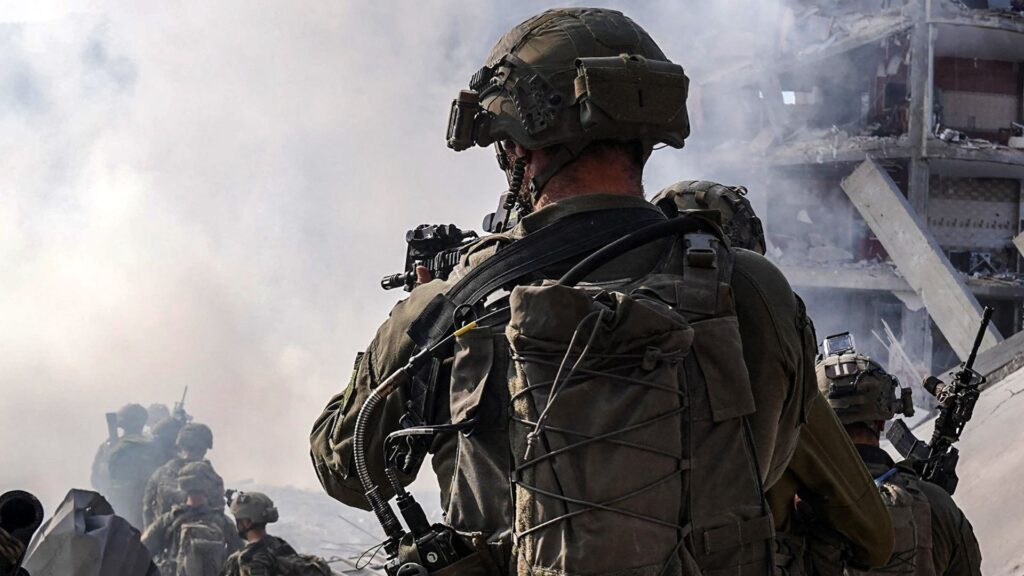
Almost a year into its war on Gaza, Israel is fighting on multiple fronts in the region. Israel targets Al Jazeera Media Network yet again, this time in the occupied West Bank. During a predawn raid on Sunday, the military issued an order to close the channel’s bureau in Ramallah for 45 days. The Israeli government has already banned Al Jazeera from reporting within Israel. And with no let-up in its bombardment of Gaza, the military is also expanding operations in the occupied West Bank and across the border into Lebanon. There are also reports Israel is planning to issue mass evacuation orders in northern Gaza, similar to what it did in the first week of the war back in October. What’s the real objective behind this plan? Does Israel intend to reoccupy Gaza? Presenter: James Bays Guests: Daniel Levy – President of the US/Middle East Project and a former Israeli negotiator Meron Rapoport – Award-winning Israeli investigative journalist Ilan Pappe – Israeli historian and author of The Ethnic Cleansing of Palestine Adblock test (Why?)
Israel closes Al Jazeera bureau in Ramallah: All you need to know
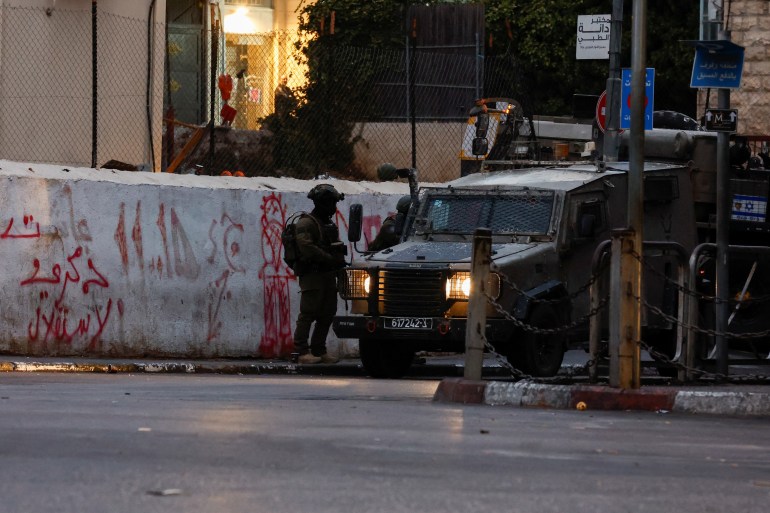
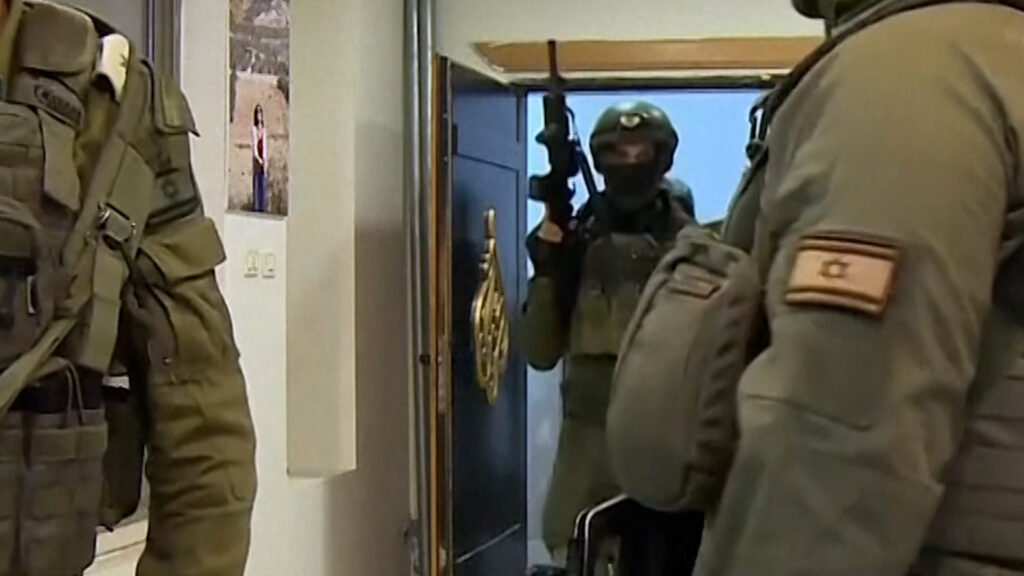
On live television, heavily armed Israeli soldiers raided Al Jazeera’s occupied West Bank bureau in Ramallah and handed the bureau head, Walid al-Omari, a notice to shut it down. The soldiers ordered everyone working the overnight shift at the bureau to leave, telling them they could take only their personal belongings. What happened and why? Here’s everything we know: Who closed the bureau? The order came from the Israeli military authority despite the bureau being in Area A, an area delineated as being under Palestinian control in the Oslo Accords. Wait, so if Ramallah is under Palestinian control, how can Israel do this? This is not the first time Israel has undertaken actions in the Oslo Accords-defined Area A, where Ramallah is and where the Palestinian Authority (PA) has its seat. One year ago, UN Special Coordinator for the Middle East Peace Process Tor Wennesland reported that, just between June and September last year, there had been many Palestinian casualties caused by Israeli operations in Area A. The other two areas in the occupied West Bank are Area B, which the PA also administers on paper, sharing security control with Israel. Area C is under complete Israeli control. Regardless of legal jurisdiction, Israel has acted with impunity across the occupied West Bank. Why did Israel raid the bureau? Israel has often targeted Al Jazeera and its journalists, at times going as far as killing them – as it did Shireen Abu Akleh, Samer Abudaqa, Ismail al-Ghoul and Rami al-Rifi. “This is very much in line with the policy of the state of Israel since 1948 … to prevent real news about Palestinians or about what the state of Israel is doing to Palestinians … colonising them and arresting them and torturing them,” Rami Khouri, distinguished fellow at the American University in Beirut, told Al Jazeera. But why did Israel do this? The closure order accuses Al Jazeera of incitement and supporting “terrorism”. Khouri said Al Jazeera is “the primary instrument for informing the world about” Israel’s violations in Palestinian territory. What did Israel do to the bureau? The entire team working in the bureau overnight was told to leave. Initially, they were told on camera that they should leave with their personal belongings and cameras. However, they had to leave the cameras in the office in the end. An Israeli soldier stands next to a military vehicle near the building where the Al Jazeera office is, in Ramallah, Israeli-occupied West Bank, September 22, 2024 [Mohammed Torokman/Reuters] Al Jazeera’s Jivara Budeiri, who had been working when the raid happened, told Al Jazeera Arabic that the Israeli group that raided the office had included engineers, which made her fear that the raiders had also come to destroy the bureau’s archives. The soldiers were in the offices for a few hours, during which time the only thing that could be observed was some of them tearing down a large banner of slain Al Jazeera Arabic journalist Shireen Abu Akleh. Are the Al Jazeera team OK? Nobody on the team has been injured. They spent hours standing on the street at a distance from the office building, unable to approach it to retrieve their cars. They were also, according to Al Jazeera Arabic’s Budeiri, unable to move to cover the raid, as any member of the group who moved was threatened with an Israeli weapon’s laser. As the Israeli soldiers were in the Al Jazeera bureau destroying things like the banner of Shireen Abu Akleh, more soldiers in armoured cars patrolled the area around the building, and the bureau team could hear gunfire and firing of tear gas canisters all around. When can the bureau reopen? The order is for 45 days. However, bureau head al-Omari said he assumes it will be renewed automatically, as has been the case with an early May civilian order Israel issued to close the Al Jazeera bureau in Israel. Military vehicles roamed around the bureau building in Ramallah until daybreak. Gunfire and firing of tear gas canisters were heard, September 22, 2024 [Mohammed Torokman/Reuters] What’s the difference between a civilian order and a military one? Probably nothing in practice, however, there are some differences in form. Al Jazeera’s bureau in Israel was closed in May after the Israeli parliament passed what became known as the “Al Jazeera Law”, which allowed the government to shut down, for 45 days at a time, any foreign media that posed a threat to the state. With this justification, a large number of inspectors from the Ministry of Communications arrived at the Al Jazeera offices and confiscated equipment on May 5. The “temporary shutdown” has been renewed since then and still holds. The Ramallah closure comes from an authority that does not, in theory, have any power over Ramallah. What can the bureau do about this? Bureau head al-Omari was told by one of the soldiers that any inquiries would have to go to the military command that issued the order. Al-Omari told Al Jazeera Arabic over the phone that this likely meant that any appeal would have to go through the military courts system. The Israeli military courts run on an opaque system of “secret evidence” and indefinite administrative detentions. What’s the situation now? The Al Jazeera bureau is inaccessible to the team, sealed off with two large metal plates welded over the entrance. Adblock test (Why?)
German police chase and detain boy at pro-Palestine rally

NewsFeed Video shows German police chasing a 10-year-old boy carrying a Palestinian flag who ran, visibly afraid, when officers approached him during a protest in Berlin, before he was caught and taken into custody. Published On 22 Sep 202422 Sep 2024 Adblock test (Why?)
Israel’s attempted silencing of Al Jazeera’s coverage of the occupation
NewsFeed ‘All we’ve been doing is reporting on what the Israeli military does to Palestinians’. Al Jazeera’s Zein Basravi recorded this message in case Israel shut down Al Jazeera’s bureau in Ramallah, from where our journalists have reported on the realities for people living under Israeli occupation for decades. Published On 22 Sep 202422 Sep 2024 Adblock test (Why?)
France’s Macron appoints new government weeks after divisive election

The announcement signals end to more than two months of political uncertainty in the EU member state. French President Emmanuel Macron has named a new government, hoping to put an end 11 weeks of political uncertainty after an inconclusive parliamentary election delivered a hung parliament. Conservative Prime Minister Michel Barnier on Saturday put together the government whose first major task will be to submit a 2025 budget plan addressing France’s financial situation, which the prime minister this week called “very serious”. The 38-member Cabinet includes ministers from Macron’s centrist alliance and the conservative Republicans (LR) party. The difficult job of submitting a budget plan to parliament next month falls to 33-year-old Antoine Armand, the new finance minister. He has previously served as head of parliament’s Economic Affairs Committee. Jean-Noel Barrot is the new foreign minister. He brings extensive experience in navigating complex international issues, notably within the European Union. Sebastien Lecornu, a close Macron ally, retains his post as defence minister. The interior minister job goes to Bruno Retailleau, a staunch conservative who will now handle critical domestic issues like national security, immigration, and law enforcement. Barnier’s ability to govern effectively is already under scrutiny, with his political opponents on the left promising to challenge him at every turn. The party of far-left Jean-Luc Melenchon, France Unbowed, held protests on Saturday against his government. Marine Le Pen’s far-right National Rally said it would monitor the government closely and has enough votes in parliament to bring it down, but expressed willingness to cooperate on key budgetary issues. In the July election, a left-wing bloc called the New Popular Front (NFP) won the most parliamentary seats, but not enough to get an overall majority. Macron argued that the left would be unable to muster enough support to form a government that would not immediately be brought down in parliament. He turned instead to Barnier, 73, to lead a government drawing mostly on parliamentary support from the conservative Republicans and the centrist groups, while counting on a neutral stance from the far right. Even before Saturday’s announcement, thousands of people with left-leaning sympathies took to the streets in the capital, Paris, and the southern port city of Marseille to protest the formation of a government that they say does not reflect the outcome of the parliamentary election. Adblock test (Why?)
Kenya’s Ruto lands in Haiti to assess police mission as insecurity deepens
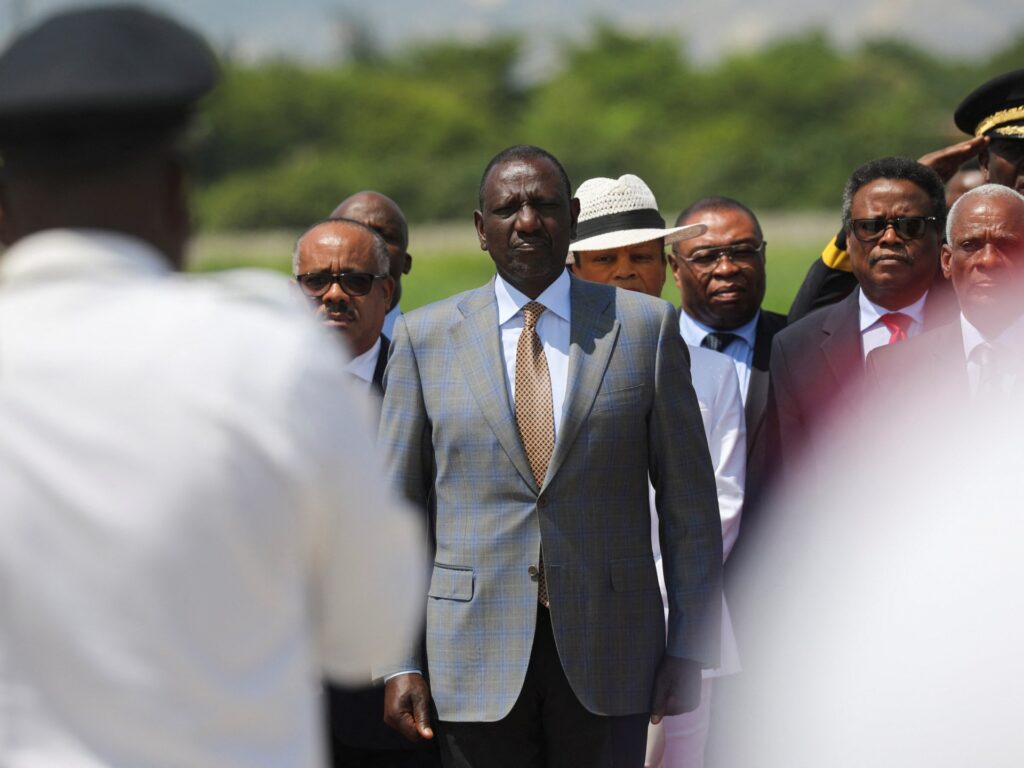
Kenyan President William Ruto has landed in the Haitian capital to assess a Kenya-led security mission in the Caribbean nation, a day after a United Nations expert warned that Haiti faced deepening violence and insecurity. In a statement on Saturday, a spokesperson for Ruto said the Kenyan leader would “visit and commend the Kenyan contingent working alongside their Haitian counterparts”. Ruto also planned to meet with Haiti’s transitional presidential council and other officials, Hussein Mohamed said in a social media post. The visit to Port-au-Prince comes about three months after the first Kenyan officers arrived in Haiti as part of a UN-backed, multinational mission aimed at tackling a surge in gang violence. Haiti has reeled from years of violence as armed groups – often with ties to the country’s political and business leaders – have vied for influence and control of territory. An uptick in attacks across Port-au-Prince at the end of February prompted the resignation of Haiti’s unelected prime minister, the creation of the transitional presidential council and the deployment of the Kenyan police deployment. President @WilliamsRuto arrives in Port-au-Prince, Haiti, 100 days after flagging off the Kenyan police contingent of the Multinational Security Support Mission (MSS) to Haiti. The President is in Haiti to assess the progress of the MSS mission, visit and commend the Kenyan… — Hussein Mohamed, MBS. (@HusseinMohamedg) September 21, 2024 Yet despite the presence of Kenyan and other foreign police officers in the country, insecurity remains rampant, with armed groups believed to still control about 80 percent of Port-au-Prince. As of August, more than 578,000 Haitians had been internally displaced, largely due to the violence, according to data (PDF) from the International Organization for Migration (IOM). Displaced families have been forced to live in squalid conditions as they wait to safely return to their homes. On Friday, William O’Neill, a UN human rights expert on Haiti, said the country faced a dire humanitarian crisis as the armed groups continued to exert influence and carry out attacks. He said the UN-backed mission – formally known as the Multinational Security Support Mission (MSS) – had so far deployed less than a quarter of its planned force. The mission’s mandate expires early next month. “The equipment it has received is inadequate, and its resources are insufficient,” O’Neill said at the end of a visit to the country. For its part, the Haitian National Police continues to lack “logistical and technical capacity to counter the gangs”, he said. “This enduring agony must stop. It is a race against time,” O’Neill said of the situation. It remains unclear what will happen when the UN-backed mission’s mandate expires in early October. The United States, the deployment’s key backer, has been pushing to get more funding and personnel to bolster the force. “The United States has been actively working to secure this additional support,” US Secretary of State Antony Blinken, who visited Port-au-Prince in early September, recently said. Blinken added that he plans to convene a meeting at the UN General Assembly this month “to encourage greater contributions to help meet Haiti’s security needs, its economic needs, its humanitarian needs, as well as to renew the mission’s mandate”. Citing unnamed sources, The Miami Herald reported on September 4 that Washington was exploring the possibility of transitioning the mission into a UN peacekeeping operation. “In coordination with partners, the United States is exploring options to bolster the Multinational Security Support mission and ensure the support that the MSS is providing Haitians is sustained long-term and ultimately paves the way to security conditions permitting free and fair elections,” a national security official told the US newspaper. Many Haitians remain wary of UN interventions, however, saying past deployments have brought more harm than good. A deadly 2010 cholera outbreak was linked to a UN peacekeeping base, for example, while past UN forces have been accused of sexual abuse. The UN-backed security mission also ran into numerous delays and met initial criticism. But Haitian civil society groups have said help is needed to stem the violence. They have added that a security deployment alone cannot solve systemic problems in the country, and urged safeguards to be put in place to prevent possible abuses by the international police force. Adblock test (Why?)
Israeli explosion rocks Beirut, crossing another red line for Hezbollah
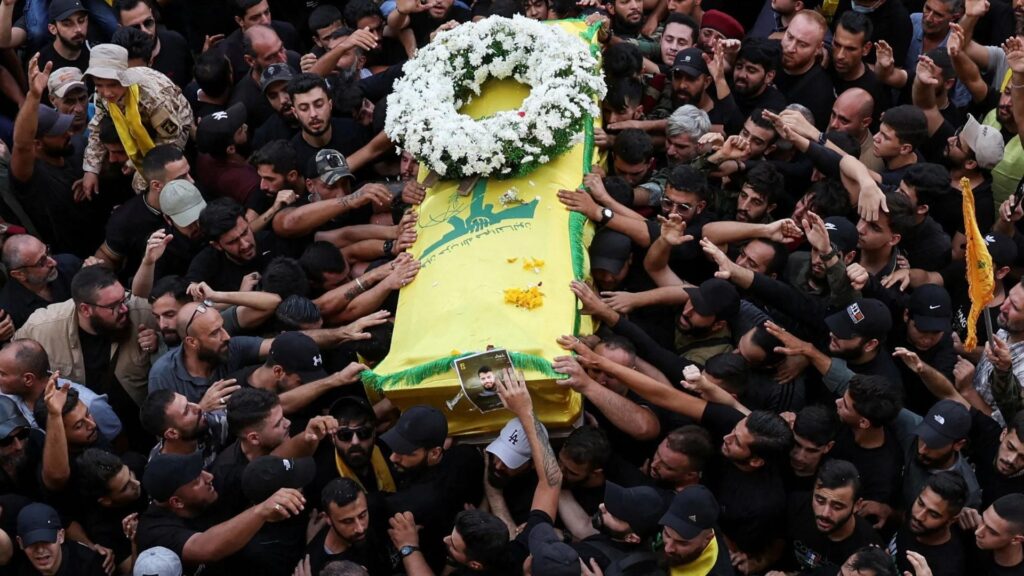
An Israeli explosion has rocked southern Beirut, crossing another so-called red line for Hezbollah. The killing of senior commanders and civilians is another major breach of security for the group, with Lebanon already on edge for years. Its foreign minister told an emergency meeting of the UN Security Council that nobody is safe. With Israel diverting its focus and forces to the north, is it preparing a ground invasion for what it calls the “second phase of the war” on Gaza? How much of a blow is all this for Hezbollah? And is the region already at war? Presenter: James Bays Guests: Nicholas Noe – editor-in-chief of the Beirut-based Mideastwire.com Sami Nader – director of the Levant Institute for Strategic Affairs Samuel Ramani – associate fellow at the Royal United Services Institute’s Middle East programme Adblock test (Why?)
Earth to get a mini-moon for two months, but what is it?

From late September until late November this year, a “mini-moon”, called 2024 PT5 by the astrologers who spotted it approaching will be orbiting the planet. Although this mini-moon cannot be seen by the naked eye – it is just 10 metres (33ft) in diameter – it can be viewed through a high-powered telescope. Mini-moons are asteroids which have been pulled by the Earth’s gravity into orbit around the planet and remain there until they become dislodged and move away again. The length of time these mini-moons remain in orbit depends on the speed and trajectory with which they approach the Earth. Most mini-moons that enter Earth’s orbit are hard to see because they are too small and not bright enough to be seen against the backdrop of the darkness of space. What, exactly, is a mini-moon? Mini-moons are extremely rare. Asteroids are usually pulled into Earth’s orbit by the gravity of the planet as rarely as once in 10 to 20 years, but a few more have appeared in recent years. They can remain in the exosphere, which is roughly 10,000km (6,200 miles) above the surface of the Earth. On average, mini-moons remain in Earth’s orbit for anything from a few months to two years with the asteroid eventually breaking away from Earth’s gravitational pull, then moving back into space to resume a trajectory away from the planet. Similar to other rocky bodies in space, mini-moons can be composed of a mixture of metallic substances, carbon, clay and silicate material. According to a 2018 mini-moons study published in the Swiss journal, Frontiers in Astronomy and Space Sciences, most mini-moons come towards Earth from the asteroid belt between Mars and Jupiter. Unlike Earth’s permanent moon, mini-moons do not have stable orbits. Instead, they embark on a “horseshoe” orbit path as a result of the asteroids being constantly pulled forwards and backwards by the gravity of Earth. [embedded content] This orbital instability allows the asteroids to gradually move farther away from Earth’s gravitational pull. Once the mini-moon has escaped Earth’s gravitational pull, it is released back into space. Although mini-moons are usually rare, several have been identified within Earth’s orbit since 2006. In that year, 2006 RH120, the Earth’s first confirmed mini-moon with a diameter of about 2 to 4 metres was captured in Earth’s orbit for roughly a year. This was the only mini-moon to have been photographed. The Southern African Large Telescope (SALT) was used to capture the image of it. It was spotted by the Catalina Sky Survey (CSS) which was established by NASA using telescopes near Tucson, Arizona in 1998 to search for “near-Earth objects”. Visitors view the 91 hexagonal mirror segments that make up the array of the Southern African Large Telescope (SALT) near Sutherland in South Africa’s arid Karoo region on November 10, 2005, just months before it captured the first image of a mini-moon in 2006 [Mike Hutchings/Reuters] The 2022 NX1 mini-moon, with a diameter of somewhere between 5 and 15 metres was first seen in 1981, then again in 2022. It is expected to return to Earth’s orbit to take up a horseshoe orbital path again in 2051. What do we know about the latest mini-moon? The asteroid currently approaching the planet is known as 2024 PT5. It was first spotted on August 7 using the NASA-funded Asteroid Terrestrial-impact Last Alert System (ATLAS) located at the Haleakala Observatory on the island of Maui, Hawaii. The system continuously scans the sky while identifying and tracking near-Earth objects that might either pose a threat to the Earth or provide an opportunity to gather significant scientific knowledge. “Every time an object with an orbit so Earthlike is discovered, there is a chance that we are just recovering space debris,” said Raul de la Fuente Marcos, an astronomer at the Complutense University of Madrid and a co-author of the study. However, astronomers from the study have now confirmed that 2024 PT5 is an asteroid. Astronomers have determined that the mini-moon will complete a trajectory around the Earth from September 29 to November 25, before ultimately breaking free from Earth’s gravitational pull before heading into space. Are there other types of moon? Apart from our permanent moon, which can appear in different forms depending on conditions, there are some other types of “moon”. Ghost moons Also known as Kordylewski clouds, ghost moons are concentrations of dust that are typically found in the Lagrangian points in the Earth-moon system. These Lagrangian points, sometimes known as gravitational “sweet spots”, are where the gravitational forces of the Earth and the moon meet, allowing the ghost moon to maintain a stable position. These clouds can measure as much as 100,000km across and were first discovered by Polish astronomer Kazimierz Kordylewski in the 1960s using a technique called polarimetry, measuring the direction of how light waves vibrate. These dust clouds were later confirmed in 2018 by the Royal Astronomical Society. (Al Jazeera) Quasi-moons These moons share an orbit with Earth around the Sun but do not orbit the Earth themselves. Instead, a quasi-moon follows a path around the Sun that closely matches Earth’s orbit, but is not an exact match. In 2016, HO3, a quasi-moon, was discovered by astronomers using the Pan-STARRS 1 telescope in Hawaii. Pan-STARRS (Panoramic Survey Telescope and Rapid Response System) is a project designed to detect near-Earth objects such as asteroids or comets, which come from further afield than the asteroid belt between Mars and Jupiter. 2016 HO3 is between 100 and 300 metres in diameter and, according to scientists, will continue to orbit the Sun for hundreds of years. It is not known how long it has already been orbiting the Sun. Other celestial bodies, such as planets, moons and asteroids, can also be orbited by quasi-moons. Venus, Jupiter, Saturn, Neptune and Pluto all have quasi-moons which will eventually change their paths and leave orbit. Even the asteroid Ceres, currently located in the constellation of Sagittarius and classified as a dwarf planet with a diameter of approximately 940km (about
Japan orders thousands to evacuate quake-hit region as rains trigger floods

A dozen rivers burst their banks in Ishikawa where the meteorological agency issued its highest alert level. Japanese authorities have told tens of thousands of people to evacuate the earthquake-hit region of Ishikawa as “unprecedented” rains triggered floods and mudslides. The Japan Meteorological Agency (JMA) on Saturday issued its highest alert level for Ishikawa and public broadcaster NHK reported that two people were reported missing in the prefecture’s Wajima city due to the flooding. The fire department reported receiving several rescue calls in the cities of Wajima and Suzu, in central Japan’s Noto peninsula, which were among the areas hardest hit by a New Year’s Day earthquake that killed at least 236 people. About 44,700 people have already been ordered to evacuate in Wajima and Suzu, as well as Noto town, officials said. JMA forecaster Satoshi Sugimoto told reporters that the areas under the warning were seeing “heavy rain of unprecedented levels”, adding “it is a situation in which you have to secure your safety immediately.” Another 16,000 residents in Niigata and Yamagata prefectures north of Ishikawa were also told to evacuate, the agency said. Hourly rainfall came to a record 121mm (4.8 inches) on Saturday morning in Wajima, while neighbouring Suzu saw 84.5mm in an hour, also an all-time high. Video footage aired by NHK TV showed brown floodwaters turning streets into rivers in Wajima, with cars half submerged. At least 12 rivers in Ishikawa breached their banks on Saturday, according to the Land and Infrastructure Ministry. Power company officials said nearly 6,000 households in Ishikawa were left without electricity, NHK reported. Weather agency officials warned people in the affected areas to exercise “maximum caution” amid flooding and said possible mudslides could be “life-threatening”. Scientists say human-driven climate change is intensifying the risk of heavy rains in the country and elsewhere because a warmer atmosphere holds more water. The region is still reeling from the magnitude-7.5 quake that toppled buildings, ripped up roads and led to a major fire. Adblock test (Why?)
US lawmaker Rashida Tlaib slams racist image of her with exploding pager

Cartoon published in National Review would ‘incite more hate and violence against our Arab and Muslim communities’. Palestinian-American Congresswoman Rashida Tlaib has condemned as racist a cartoon that depicts her with a detonating pager, days after thousands of communication devices exploded across Lebanon in attacks blamed on Israel. “Our community is already in so much pain right now. This racism will incite more hate + violence against our Arab & Muslim communities, and it makes everyone less safe,” Tlaib said of the cartoon published in conservative magazine National Review. “It’s disgraceful that the media continues to normalize this racism,” the only Palestinian-American lawmaker in the United States Congress wrote on X on Friday. Created by Henry Payne, the cartoon shows a woman sitting at a desk with a name card reading “Rep. Tlaib” where a device explodes. The woman remarks: “ODD. MY PAGER JUST EXPLODED.” Thank you, Mayor @AHammoudMI, for speaking up. Our community is already in so much pain right now. This racism will incite more hate + violence against our Arab & Muslim communities, and it makes everyone less safe. It’s disgraceful that the media continues to normalize this… https://t.co/JTn2mur4Yj — Rashida Tlaib (@RashidaTlaib) September 20, 2024 The illustration alludes to attacks in Lebanon on Tuesday and Wednesday when thousands of pagers and walkie-talkies exploded killing at least 37 people and wounding nearly 3,000, including civilians. After the attacks, Tlaib shared a post by fellow Democratic Congresswoman Alexandria Ocasio-Cortez referring to it as a clear violation of “international humanitarian law”. Tlaib, a Democrat from Michigan in the US House of Representatives who is a vocal critic of Israel’s war on Gaza, has often weathered harsh vitriol from Republican and some Democratic opponents, including baseless accusations of sympathies with Hamas. In November, Tlaib was formally censured by the House, a step just below expulsion, for allegedly “promoting false narratives” about the Gaza war and “seeking Israel’s destruction”, charges she rejects. Tlaib said at the time she “will not be silenced and I will not let you distort my words”. Tlaib voiced her support on Thursday for Palestinians in the Gaza Strip, criticising her colleagues in the US Congress for their silence as US-funded weapons continue to fuel bloodshed in the besieged enclave. “We are living through one of, again, the most documented horrific crimes against humanity in our history. These are children who did not live to see their first birthday. We cannot normalize this,” said Tlaib. “My colleagues continue to be silent. I wonder if it’s because these babies are Palestinian? They’re children, that’s it,” she added. Adblock test (Why?)