

Tornado kills five, causes widespread destruction in China’s Guangzhou
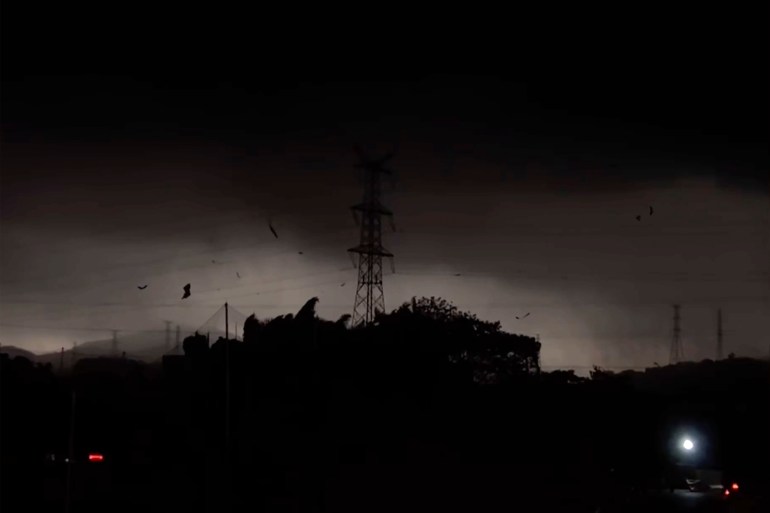
The tornado struck China’s southern city at the weekend, devastating several communities. People are cleaning up in China’s southern city of Guangzhou after a tornado struck at the weekend killing at least five people and injuring dozens more. Aerial photos published by state media showed the scale of the devastation after the tornado tore through several communities in Guangzhou’s Baiyun district on Saturday afternoon during a thunderstorm. The images showed block upon block of devastation in the hardest-hit areas with a few clusters of buildings standing amid the destruction, a truck overturned on its side and cars crushed by rubble. The sheet metal roofs on some buildings had been torn off. The tornado emerged during a major storm that brought strong winds and hail [Douyin@Antique via AP Photo] The extreme weather was the latest to hit China’s industrial heartland after torrential rain last week caused serious flooding and killed four people in Guangdong, China’s most populous province. The area is home to 127 million people and thousands of factories that power the country’s export sector. At least 33 people were injured and some 141 factories damaged in Saturday’s tornado, Xinhua reported. Such weather systems are not unusual in China. In September, 10 people were killed after a tornado struck Suqian, Jiangsu Province, in the country’s east. In 2021, two tornadoes struck the country in one day, killing 12, including eight in the central city of Wuhan. Adblock test (Why?)
At least four dead in US after dozens of tornadoes rip through Oklahoma

Hospitals across the state reported about 100 injuries, including people apparently struck by debris. At least four people were killed and dozens more injured after multiple tornadoes wreaked havoc in the central state of Oklahoma in the United States. The tornadoes caused extensive damage in the town of Sulphur, home to about 5,000 people, flattened buildings, threw vehicles into the air and ripped the roofs from houses. “You just can’t believe the destruction,” Oklahoma Governor Kevin Stitt said during a visit to the hard-hit town on Sunday afternoon. “It seems like every business downtown has been destroyed.” A four-month-old baby was among the dead, Hughes County Emergency Management Director Mike Dockrey told Oklahoma television station KOCO. A car lies on its side after a tornado tossed it into the air [Ken Miller/AP] Stitt said about 30 people were injured, including some who were in a bar when the tornado struck. Hospitals across the state reported about 100 injuries, including people apparently cut or struck by debris, and more than 20,000 residents were still without electricity on Sunday evening. Stitt issued an executive order declaring a state of emergency in 12 counties due to the severe weather, while in a call with the Oklahoma governor, President Joe Biden offered the federal government’s full support with recovery efforts, the White House said in a statement. The National Weather Service (NWS) reported that 38 possible tornadoes hit the area and that the worst of the storms rolled through Central Oklahoma on Saturday into early Sunday morning, spreading into northwest Texas, western Missouri and Kansas. Adblock test (Why?)
Japan’s yen plunges to lowest level against the dollar since 1990
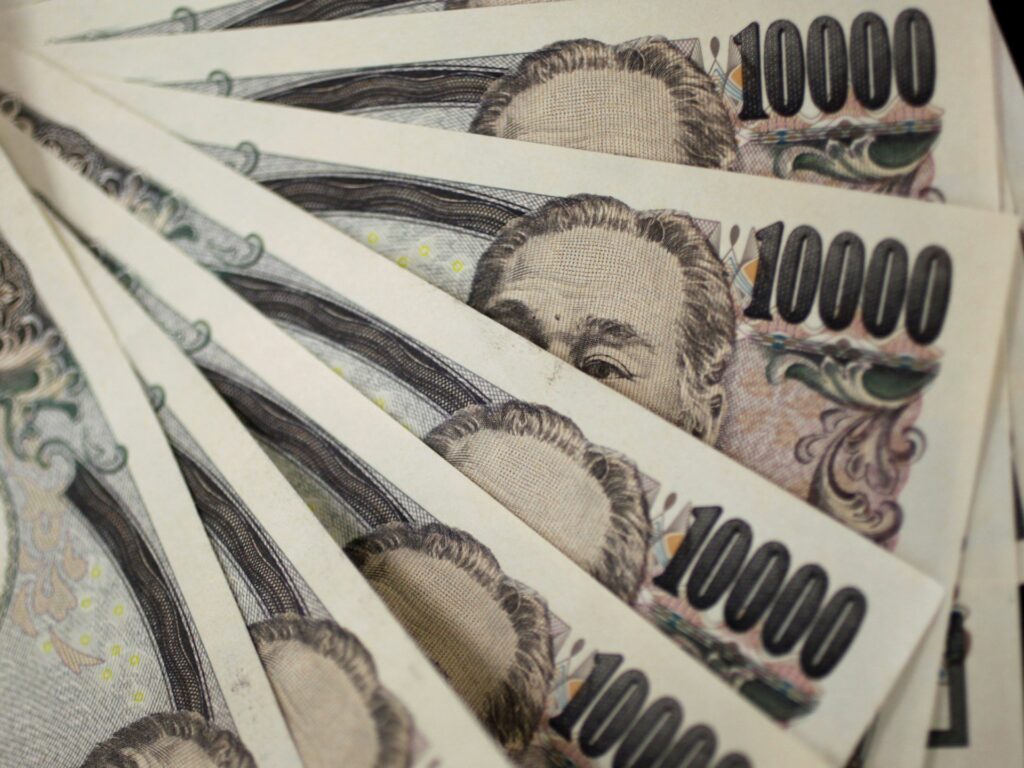
Japanese currency sinks to 160.17 per dollar, the lowest since April 1990. The Japanese yen has slumped to a 34-year low against the United States dollar. The yen on Monday sank to 160.17 per dollar, the lowest since April 1990, prompting speculation that Japanese authorities would intervene to prop up the currency for the first time since late 2022. The yen has been on a continual slide since early 2021 as the Bank of Japan (BOJ) has maintained ultra-low interest rates, while the US Federal Reserve and other central banks have hiked borrowing costs. The downward spiral has continued in recent weeks despite the BOJ raising interest rates last month for the first time in 17 years, as expectations of interest rate cuts in the US fade amid above-target inflation. While the weak yen has helped Japanese exporters boost profits and put more cash in the pockets of tourists visiting Japan, it has put pressure on household budgets by raising the prices of imported goods. Japanese officials have repeatedly stated that they are prepared to step in to prevent sharp movements in the exchange rate, though authorities have refrained from intervening during the currency’s year-long slide. On Friday, the Japanese central bank kept its benchmark rate unchanged at 0-0.1 percent. BOJ Governor Kazuo Ueda said in a news conference that exchange-rate volatility would only affect monetary policy if there was a significant impact on the economy. “If yen moves have an effect on the economy and prices that is hard to ignore, it could be a reason to adjust policy,” Ueda said. Adblock test (Why?)
Palestinian President Abbas says only US can halt Israel’s attack on Rafah
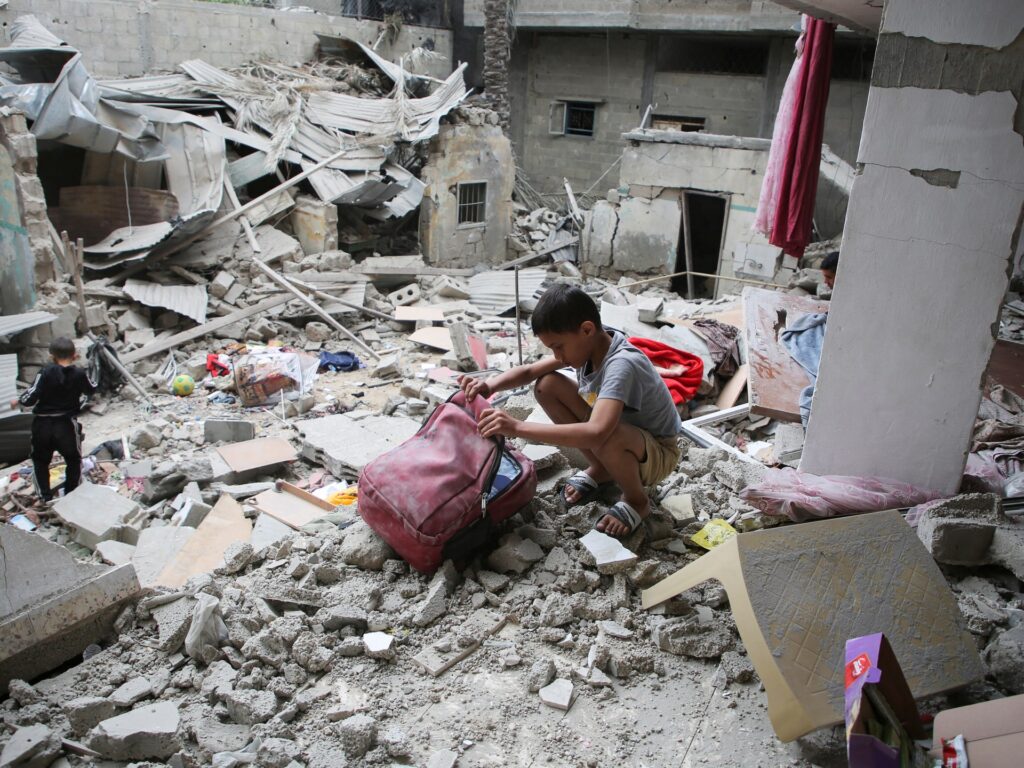
More than a million Palestinians are sheltering in the southern Gaza city after being displaced by Israeli attacks. Palestinian Authority President Mahmoud Abbas says only the United States could stop Israel from attacking the border city of Rafah in Gaza, adding that the assault, which he expects within days, could force much of the Palestinian population to flee the enclave. “We call on the United States of America to ask Israel to not carry on the Rafah attack. America is the only country able to prevent Israel from committing this crime,” Abbas told a special meeting of the World Economic Forum in the Saudi capital Riyadh on Sunday. Israel, which has threatened for weeks to launch an all-out assault on the city, saying its goal is to destroy Hamas’s remaining battalions there, stepped up air attacks on Rafah last week. Western countries, including Israel’s closest ally the US, have pleaded with it to hold back from attacking the southern city, which abuts the Egyptian border and is sheltering more than a million Palestinians who fled Israel’s seven-month-long assault on much of the rest of Gaza. Abbas said that even a “small strike” on Rafah would force the Palestinian population to flee Gaza. “The biggest catastrophe in the Palestinian people’s history would then happen,” he said. Abbas reiterated that he rejects the displacement of Palestinians into Jordan and Egypt and said he is concerned that once Israel completes its operations in Gaza, it will then attempt to force the Palestinian population out of the occupied West Bank and into Jordan. Al Jazeera’s Zein Basravi, reporting from Ramallah, said that Abbas’s remarks were significant as it was the first time a senior leader in the PA made such a statement, but added that the Palestinians expect more from the leader of the PA. “Abbas is simply echoing the things that the Palestinians we have been speaking to said for the last six months,” he said. “The reaction to Abbas’s remarks on the Palestinian streets is likely to mirror a broader political response. The people we have been speaking to say that what they see is a speech from their leader, far too late and far too weak.” Israel launched its offensive in Gaza after Hamas led an attack on southern Israel on October 7 in which Israel said 1,139 people were killed and 253 taken captive. More than 34,400 Palestinians have since been killed, according to the Gaza health ministry, and most of the population is displaced. Hundreds of thousands of people sheltering in Rafah have nowhere to flee in the face of Israel’s offensive that has levelled large swaths of the urban landscape in the rest of the territory. United Nations officials and human rights groups warn that an attack on Rafah will be catastrophic. Adblock test (Why?)
Hinglaj Yatra Hindu festival brings mountainous region in Pakistan to life
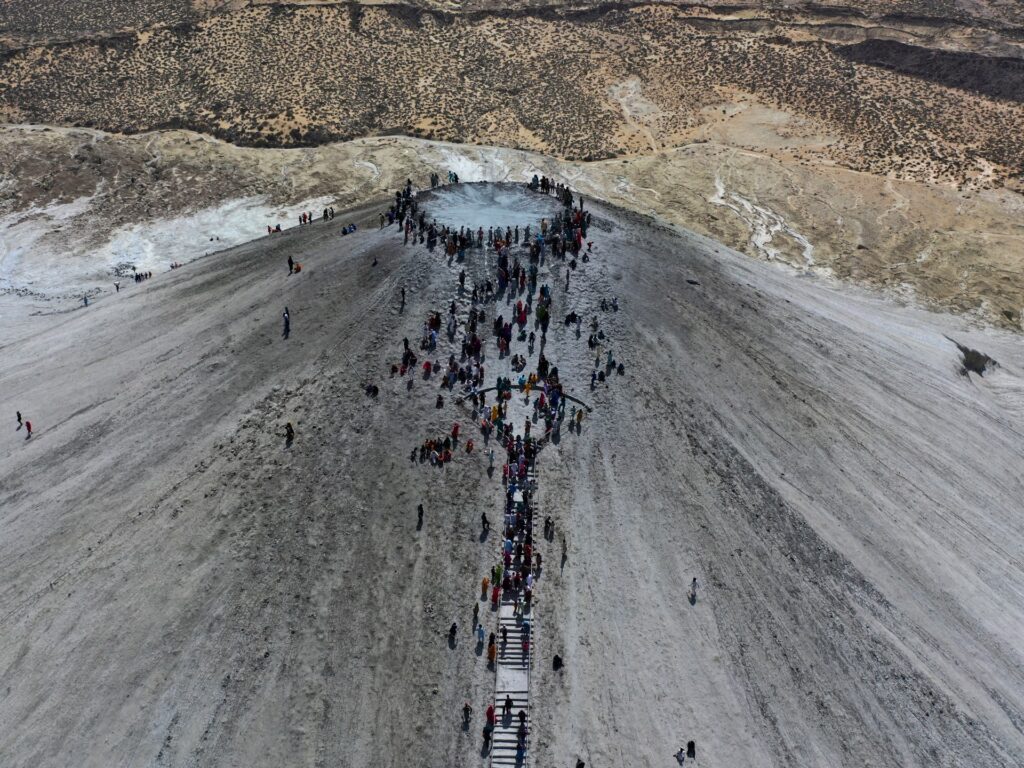
The dramatic surroundings of Hingol National Park in Balochistan province are the setting for Pakistan’s largest Hindu celebration, Hinglaj Yatra, which started on Friday and ends on Sunday. Muslim-majority Pakistan is home to 4.4 million Hindus, just 2.14 percent of the population, and the ancient cave temple of Hinglaj Mata is one of the few Hindu sites in the country that continues to draw large numbers of pilgrims every year. The journeys begin hundreds of kilometres away, mostly from neighbouring Sindh province. Hundreds of packed buses set off from cities like Hyderabad and Karachi, travelling along the Makran Coastal Highway that hugs Pakistan’s south and southwest. But there is scant parking and vehicular access to the holy sites, so many pilgrims disembark and complete their travel by walking over parched and rocky terrain, sometimes barefoot and carrying children or luggage. It’s a few kilometres from the main road to the mud volcano and then, from there, almost 45km (28 miles) to Hinglaj Mata. Kanwal Kumar, 28, was visiting the temple for the first time with her husband. “We have yet to conceive a child after six years of marriage, so we are hopeful for help from the goddess,” she said. “We believe that no one returns empty-handed. All wishes are granted by Hinglaj Mata.” While there is no ban on Hindu worship in Pakistan, openly practising the faith is not routine, as ties between Pakistan and Hindu-majority India are riddled with animosity and suspicion. Versimal Divani, the general-secretary of Hinglaj Mata, lamented that only Hindus in Pakistan can attend the festival. “We can visit this temple in our beloved country whenever our heart desires,” said Divani. “But this is not the case for the rest of the world’s Hindus. I would like the Pakistani government to issue them visas so they can come here and take blessings with them. It’s good for people-to-people contact and it’s good for the economy, too.” Adblock test (Why?)
Two Russian journalists arrested over alleged work for Navalny group
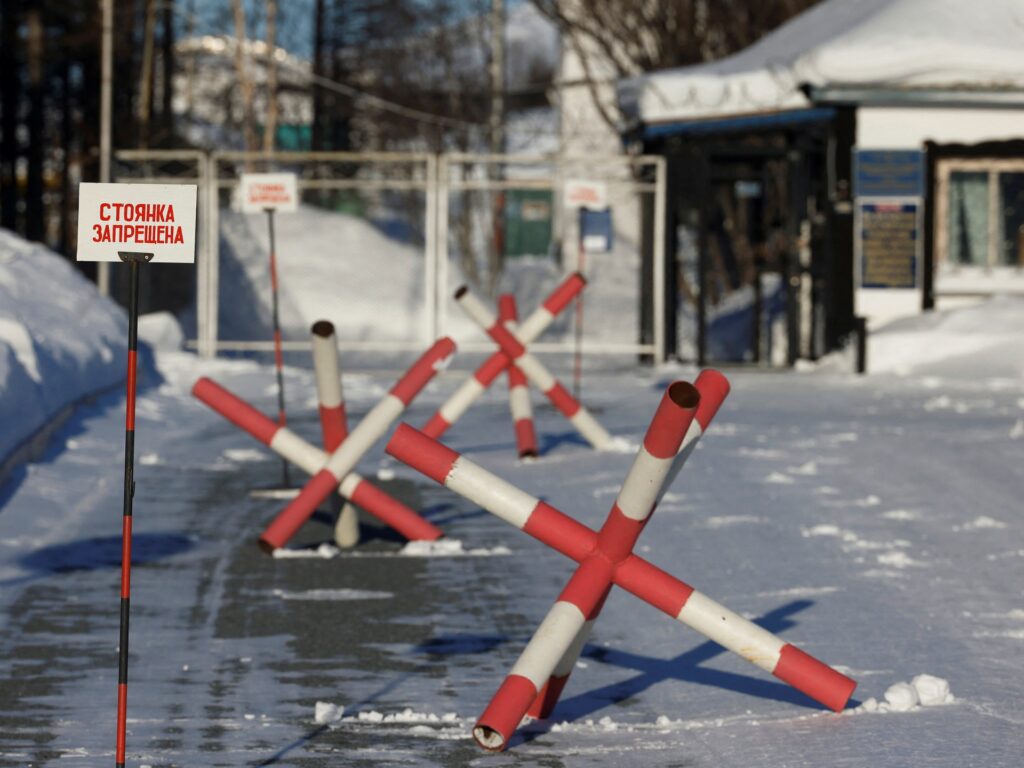
Konstantin Gabov and Sergey Karelin deny ‘extremism’ charges related to group founded by late anti-Putin dissident. Two Russian journalists have been arrested by their government on “extremism” charges and ordered by courts to remain in custody pending investigation and trial on accusations of working for a group founded by the late Russian opposition politician Alexey Navalny. Konstantin Gabov and Sergey Karelin both denied the charges for which they will be detained for a minimum of two months before any trials begin. Each faces a minimum of two years in prison and a maximum of six years for alleged “participation in an extremist organisation”, according to Russian courts. They are just the latest journalists arrested amid a Russian crackdown on dissent and independent media that intensified after its full-scale invasion of Ukraine more than two years ago. The Russian government passed laws criminalising what it deems false information about the military, or statements seen as discrediting the military, effectively outlawing any criticism of the war in Ukraine or speech that deviates from the official narrative. A journalist for the Russian edition of Forbes magazine, Sergei Mingazov, was detained on charges of spreading false information about the Russian military, his lawyer said on Friday. Gabov and Karelin are accused of preparing materials for a YouTube channel run by Navalny’s Anti-Corruption Foundation, which has been outlawed by Russian authorities. Navalny, President Vladimir Putin’s most prominent critic, died under murky circumstances in an Arctic penal colony in February. Gabov, who was detained in Moscow on Saturday, is a freelance producer who has worked for multiple organisations, including the Reuters news agency, the court press service said. Karelin, who has dual citizenship with Israel, was detained on Friday night in Russia’s northern Murmansk region. Karelin, 41, has worked for a number of outlets, including for The Associated Press. He was a cameraman for German media outlet Deutsche Welle until the Kremlin banned the outlet from operating in Russia in February 2022. “The Associated Press is very concerned by the detention of Russian video journalist Sergey Karelin,” the AP said in a statement. “We are seeking additional information.” Russia’s crackdown on dissent is aimed at opposition figures, journalists, activists, members of the LGBTQ community, and Russians critical of the Kremlin. A number of journalists have been jailed in relation to their coverage of Navalny, including Antonina Favorskaya, who remains in pre-trial detention at least until May 28 following a hearing last month. Favorskaya was detained and accused by Russian authorities of taking part in an “extremist organisation” by posting on the social media platforms of Navalny’s foundation. She covered Navalny’s court hearings for years and filmed the last video of Navalny before he died in the penal colony. Kira Yarmysh, Navalny’s spokeswoman, said that Favorskaya did not publish anything on the foundation’s platforms and suggested that Russian authorities have targeted her because she was doing her job as a journalist. Evan Gershkovich, a 32-year-old American reporter for The Wall Street Journal, is awaiting trial on espionage charges at Moscow’s notorious Lefortovo Prison. Both Gershkovich and his employer have vehemently denied the charges. Gershkovich was detained in March 2023 while on a reporting trip and has spent over a year in jail; authorities have not detailed what, if any, evidence they have to support the espionage charges. The United States government has declared Gershkovich wrongfully detained, with officials accusing Moscow of using the journalist as a pawn for political ends. The Russian government has also cracked down on opposition figures. One prominent activist, Vladimir Kara-Murza, was sentenced to 25 years in prison. Adblock test (Why?)
Hamas releases video of two Israeli captives held in Gaza
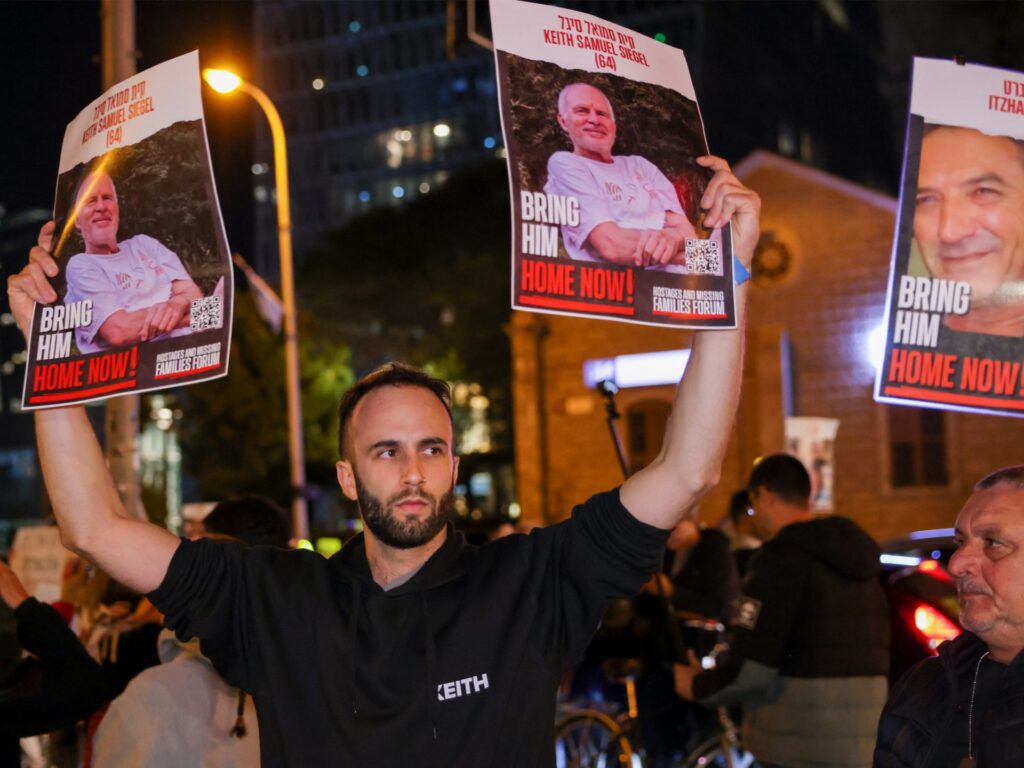
The two men, identified as Keith Siegel and Omri Miran, send love to their families and ask to be released in the video. Hamas’s military wing has published a video of two Israeli captives held in Gaza, showing footage of them calling on Prime Minister Benjamin Netanyahu’s government to make a deal to secure their release. The video released on Saturday is similarly filmed to previous captive videos made public by the group, which Israel has condemned as “psychological terrorism”. The two men, identified as Keith Siegel, 64, and Omri Miran, 47, speak individually in front of an empty background. They send their love to their families and ask to be released. Miran was taken captive from his home in the community of Nahal Oz in front of his wife and two young daughters during the October 7 Hamas attack. “I have been here in Hamas captivity for 202 days. The situation here is unpleasant, difficult and there are many bombs,” Miran is heard saying in the footage, indicating it was taken earlier this week. “It’s time to reach a deal that will get us out of here safe and healthy … Keep protesting, so that there will be a deal now.” Saturday’s video comes as Hamas says it is studying Israel’s latest counterproposal for a Gaza ceasefire after reports that mediator Egypt had sent a delegation to Israel to jump-start stalled negotiations. The video was published during the Passover holiday, when Jews traditionally celebrate the biblical story of gaining freedom from slavery in Egypt. At one point, Siegel breaks down crying as he recounts celebrating the holiday with his family last year and expresses hope that they will be reunited. “We are in danger here, there are bombs, it is stressful and scary,” he said, burying his face in his arms as he cried. “I want to tell my family that I love you very much. It’s important to me that you know that I am fine.” The latest video comes just three days after Hamas released another video showing captive Hersh Goldberg-Polin alive. About 250 Israelis and foreigners were taken captive during the Hamas assault, which killed 1,139 people, according to Israeli tallies. In response, Israel launched an assault on Gaza, pledging to destroy Hamas and bring the captives home. The war has so far killed at least 34,388 Palestinians. The Israeli military has said 129 of the captives are still being held in Gaza, including the bodies of 34 people who died in captivity. Reporting from Tel Aviv, Al Jazeera’s Bernard Smith said the families and friends of the captives were relieved to see evidence that they were alive. “They’ve said ‘time is running out. We need our Prime Minister [Benjamin Natanyahu] to accept any deal fast’,” he said. Smith was speaking from a protest against Netanyahu. “These protests are calling for the resignation of Prime Minister Netanyahu. They’re calling for an end to the war and they’re calling for the release of hostages,” he said. “Many of the protesters here are saying Netanyahu is deliberately prolonging this war in Gaza because it saves him from the ultimate reckoning of the ballot box.” Adblock test (Why?)
Iraq criminalises same-sex relationships with maximum 15 years in prison
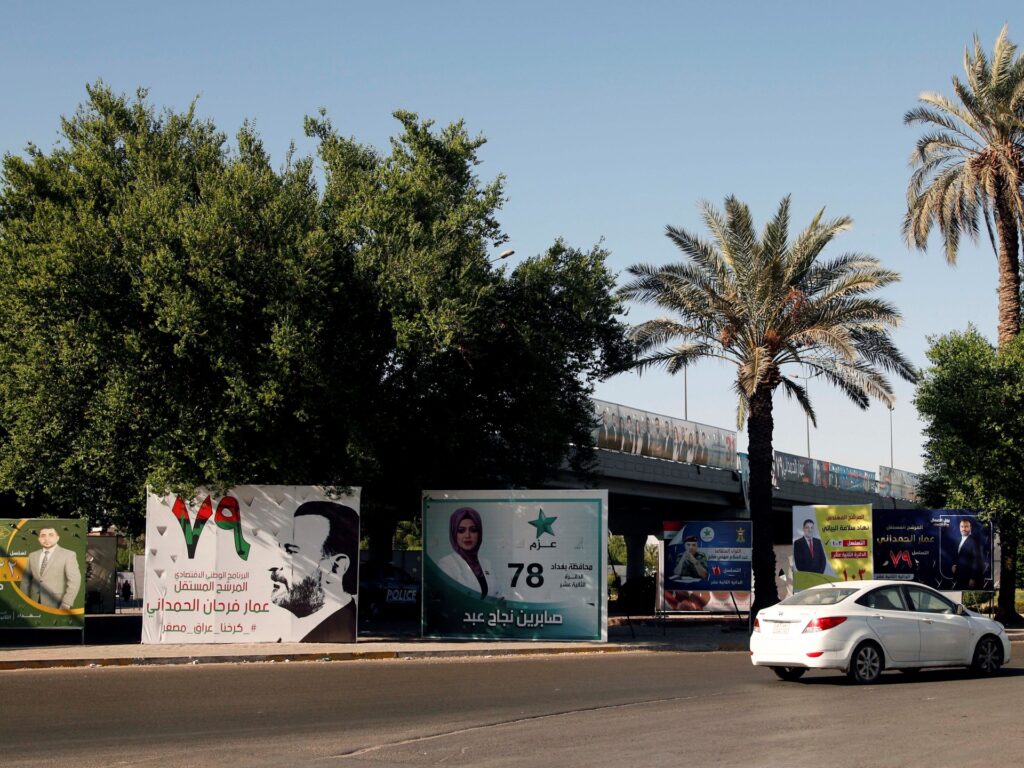
The law is backed mainly by Shia Muslim parties who form the largest coalition in Iraq’s parliament. Iraq’s parliament has passed a law criminalising same-sex relationships with a maximum 15-year prison sentence, in a move it said aimed to uphold religious values, but was condemned by rights advocates as the latest attack on the LGBTQ community in Iraq. The law adopted on Saturday aims to “protect Iraqi society from moral depravity and the calls for homosexuality that have overtaken the world,” according to a copy of the law seen by the Reuters news agency. It was backed mainly by conservative Shia Muslim parties who form the largest coalition in Iraq’s parliament. The Law on Combating Prostitution and Homosexuality bans same-sex relations with at least 10 years and a maximum of 15 years in prison, and mandates at least seven years in prison for anybody who promotes homosexuality or prostitution. The amended law makes “biological sex change based on personal desire and inclination” a crime and punishes transgender people and doctors who perform gender-affirming surgery with up to three years in prison. The bill had initially included the death penalty for same-sex acts but was amended before being passed after strong opposition from the United States and European nations. ‘A serious blow to human rights’ Until Saturday, Iraq did not explicitly criminalise gay sex, though loosely defined morality clauses in its penal code had been used to target LGBTQ people, and members of the community have also been killed by armed groups and individuals. “The Iraqi parliament’s passage of the anti-LGBT law rubber-stamps Iraq’s appalling record of rights violations against LGBTQ people and is a serious blow to fundamental human rights,” Rasha Younes, deputy director of the LGBTQ rights programme at Human Rights Watch, told Reuters. “Iraq has effectively codified in law the discrimination and violence members of the LGBTI community have been subjected to with absolute impunity for years,” the AFP news agency quoted Amnesty International’s Iraq Researcher Razaw Salihy as saying. “The amendments concerning LGBTI rights are a violation of fundamental human rights and put at risk Iraqis whose lives are already hounded daily,” Salihy added. Lawmaker Raed al-Maliki, who advanced the amendments, told AFP that the law “serves as a preventive measure to protect society from such acts”. Major Iraqi parties have in the past year stepped up criticism of LGBTQ rights, with rainbow flags frequently being burned in protests by both governing and opposition conservative Shia Muslim factions last year. More than 60 countries criminalise gay sex, while same-sex sexual acts are legal in more than 130 countries, according to Our World in Data. Adblock test (Why?)
Has South Africa’s ANC failed to live up to its promises?
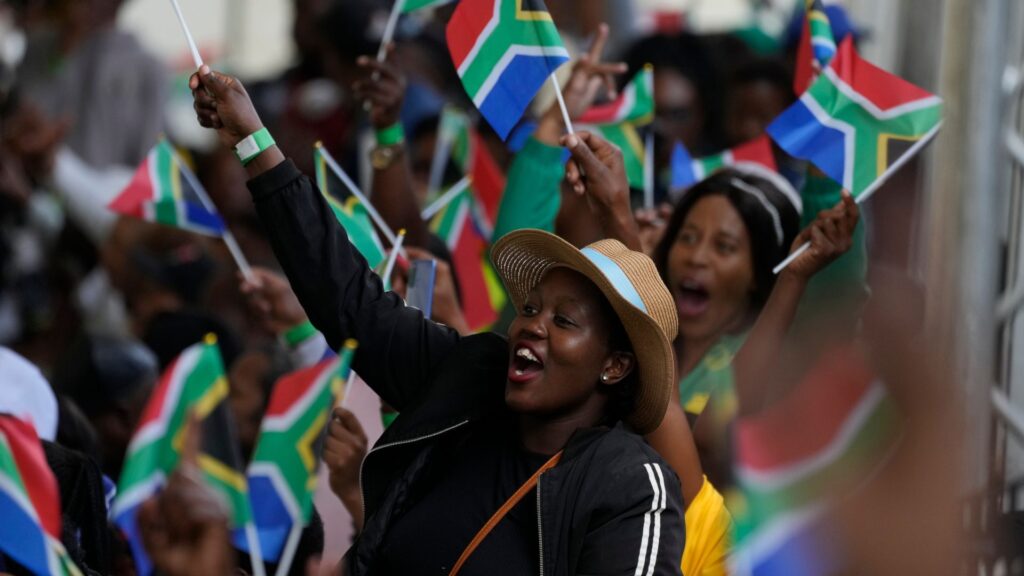
South Africa is commemorating the 30th anniversary of its first democratic election. South Africa is marking Freedom Day – the historic day that changed the course of the country. Hopes were high in 1994, as years of segregation and white-minority rule came to an end, and millions of Black South Africans cast their vote for the first time. But 30 years on, many say there’s little to celebrate. Hope has been replaced by disappointment and scepticism. The African National Congress, which has been in power since the end of apartheid, is accused of not keeping its promises. It has been embroiled in corruption scandals. Unemployment is at an all-time high, crime is widespread and race-based inequality is still a problem. This year’s anniversary comes a month ahead of general elections – which could see the governing party lose its majority for the first time. So, has the ANC failed to live up to its promises? Presenter: Neave Barker Guests: Melanie Verwoerd – Political analyst William Gumede – Founder of Democracy Works Foundation Zackie Achmat – Activist and independent candidate for South Africa’s parliament Adblock test (Why?)
Ramaphosa hails ANC record as South Africa marks 30 years of democracy
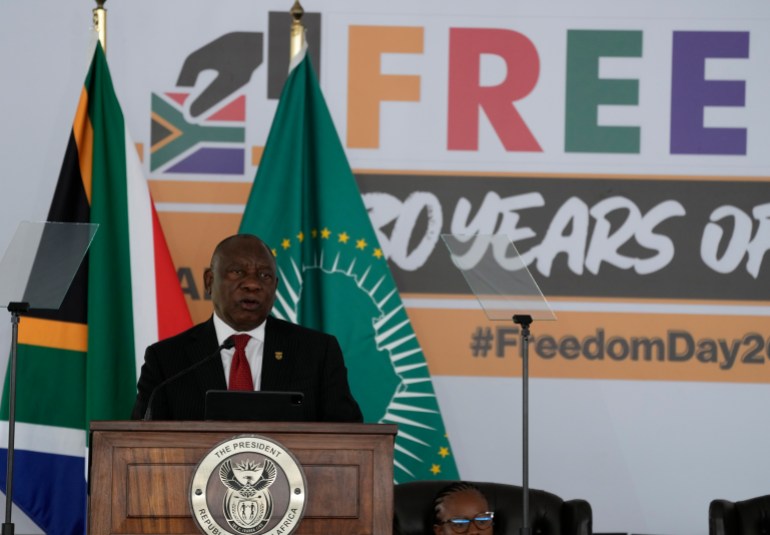
President Cyril Ramaphosa has hailed South Africa’s achievements under his party’s leadership as the country celebrated 30 years of democracy since the end of apartheid. April 27 is the day “when we cast off our shackles. Freedom’s bells rang across our great country,” Ramaphosa, 71, said on Saturday, reminding South Africans about the first democratic election in 1994 that ended white-minority rule. “South Africa’s democracy is young. What we’ve achieved in these short 30 years is something of which all of us should be proud. This is an infinitely better place than it was 30 years ago,” he said in a speech marking “Freedom Day” at the Union Buildings, the seat of government, in Pretoria. South African President Cyril Ramphosa delivers a speech as he attends Freedom Day celebrations in Pretoria, South Africa [Themba Hadebe/AP] The first inclusive election saw the previously banned African National Congress (ANC) party win overwhelmingly and made its leader, Nelson Mandela, the country’s first Black president, four years after being released from prison. With the ANC winning a landslide victory, a new constitution was drawn up, and it became South Africa’s highest law, guaranteeing equality for everyone, regardless of race, religion, or sexuality. The ANC has been in government since 1994 and is still recognised for its role in freeing South Africans, but for some, it is no longer celebrated in the same way as poverty and economic inequality remain rife. ANC struggling in the polls Ramaphosa used the occasion to list improvements shepherded by the ANC, which is struggling in the polls due on May 29 and risks losing its outright parliamentary majority for the first time. “We have pursued land reform, distributing millions of hectares of land to those who had been forcibly dispossessed,” he said. “We have built houses, clinics, hospitals, roads and constructed bridges, dams, and many other facilities. We have brought electricity, water and sanitation to millions of South African homes.” Al Jazeera’s Jonah Hull, reporting from the capital Pretoria, said that while there is freedom of speech, many South Africans will say there is no economic freedom. “The country has a 32 percent unemployment rate. The World Bank describes this society as the most unequal on earth,” Hull said. “Corruption is rife. Infrastructure is in a dire state, and in an election due just next month, polls predict that for the first time, the ANC could fall beneath 50 percent of the vote. That, if it happens, would in itself be a pretty significant milestone in this country.” People listen to South African President Cyril President, right, through a screen, during Freedom Day celebrations in Pretoria, South Africa [Themba Hadebe/AP] An Ipsos poll released on Friday showed support for the governing party, which won more than 57 percent of the vote at the last national elections in 2019, has fallen to just more than 40 percent. Were it to win less than 50 percent, the ANC would be forced to find coalition partners to remain in power. The party’s image has been badly hurt by accusations of graft and its inability to effectively tackle poverty, crime, inequality, and unemployment, which remain staggeringly high. The governing party is being largely blamed for the lack of progress in improving the lives of so many South Africans. Thandeka Mvakali, 28, from the Alexandra Township in Johannesburg, said life is no different from the time of her parents during apartheid. “It’s almost the same. You can see, we are living in a one bedroom, maybe we are 10 inside the house, for my family, we are 10 and then maybe two is employed, like my mother [and] my brother,” Mvakali told Al Jazeera. “All of us we are not employed, we did go to school but there’s no job in South Africa.” Mvakali added that she will vote for the first time in the May 29 elections because she is “hoping” her vote will count this time. Ramaphosa acknowledged the problems, but denounced critics as people who wilfully “shut their eyes”. “We have made much progress and we are determined to do much more,” he said. Adblock test (Why?)