

Thousands protest against over-tourism in Spain’s Canary Islands
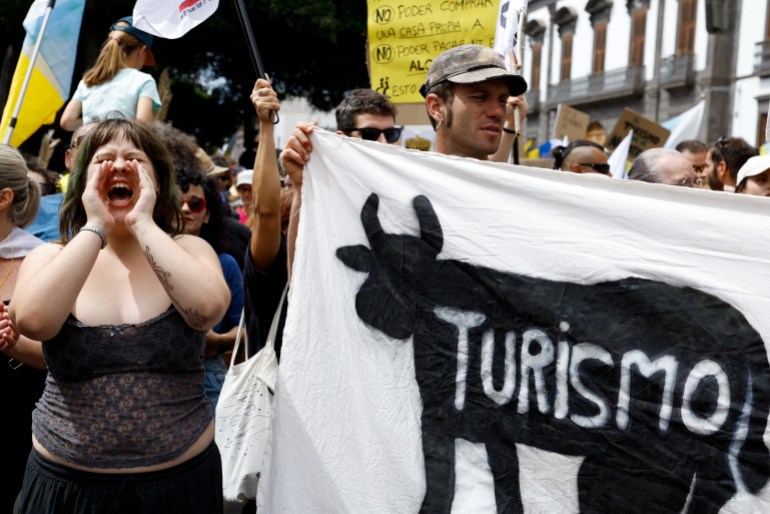
Demonstrators say mass tourism is overwhelming the Atlantic archipelago. Tens of thousands of demonstrators have hit the streets of Spain’s Canary Islands to demand changes to the model of mass tourism they say is overwhelming the Atlantic archipelago. An estimated 57,000 people joined the protests, which began at midday (11:00 GMT) on Saturday, Spanish media reports said, citing the central government’s representative in the islands. Flag-waving crowds packed the streets of the main towns across all of the archipelago’s seven islands, chanting and whistling, and holding placards with slogans like: “The Canary Islands are not up for sale!”; “A moratorium on tourism”; and “Respect my home”. “It’s not a message against the tourist, but against a tourism model that doesn’t benefit this land and needs to be changed,” one of the protesters told the Reuters news agency during the march in Tenerife’s capital, Santa Cruz de Tenerife. Smaller marches were held elsewhere in the island group and other Spanish cities, all of them organised by about two dozen environmental organisations ahead of the peak summer holiday season. The protests were called by some 20 social and environmental groups who say tourist overcrowding perpetuates an economic model that harms local residents and damages the environment. They want the authorities to limit the number of visitors and have proposed introducing an eco-tax to protect the environment, a moratorium on tourism and a clampdown on the sale of properties to non-residents. “The authorities must immediately stop this corrupt and destructive model that depletes the resources and makes the economy more precarious. The Canary Islands have limits and people’s patience [does], too,” Antonio Bullon, one of the protest leaders, told Reuters. A woman shouts next to a banner with the word “tourism” during a demonstration in the Canary Islands [Borja Suarez/Reuters] ‘We can’t keep looking away’ The archipelago of 2.2 million people was visited by nearly 14 million foreign tourists in 2023, up 13 percent from the previous year, according to official data. Authorities in the islands are concerned about the impact on locals. A draft law expected to pass this year – one that toughens the rules on short lets – follows complaints from residents priced out of the housing market. Canary Islands President Fernando Clavijo said on Friday that he felt “proud” that the region was a leading Spanish tourist destination, but acknowledged that more controls were needed as the sector continues to grow. “We can’t keep looking away. Otherwise, hotels will continue to open without any control,” he told a press conference. Anti-tourism protests have multiplied in recent months across Spain, the world’s second-most visited country, prompting authorities to try to reconcile the interests of locals and a lucrative sector that accounts for 12.8 percent of Spain’s economy. The Canary Islands, which lie off the northwestern coast of Africa, are known for their volcanic landscapes and year-round sunshine attracting millions of visitors every year, with four in 10 residents working in tourism – a sector that accounts for 36 percent of the islands’ gross domestic product (GDP). Before the coronavirus pandemic brought the global travel industry to its knees in 2020, over-tourism protest movements were already active in Spain, notably in Barcelona. After travel restrictions were lifted, tourism surged, with Spain welcoming a record 85.1 million visitors last year. Adblock test (Why?)
‘When will our good days come?’ The Mumbai cook voting in India’s election

What’s your money worth? A series from the front lines of the cost-of-living crisis, where people who have been hit hard share their monthly expenses. Name: Manisha Santosh Kadam Age: 42 Born: Manchar, in the Indian state of Maharashtra Occupation: Cook Lives with: Her husband, Santosh, 48, their daughter, Rithuja, 21, and son, Sujal, 17. Lives in: A 37sq-metre (400sq-foot) house in Diva, located in Maharashtra’s Thane district, which is about an hour’s drive from Mumbai, India’s financial capital. The house, which is located on a busy street, has two small rooms – a medium-sized hall where all of them sleep together, and a kitchen. They do not have a garden or any open space. Monthly income: Working as a cook for eight hours a day at a household in the Byculla area of South Mumbai, Manisha earns a wage of 17,000 rupees ($203.64) per month. India’s daily minimum wage is currently 176 rupees ($2.11). Manisha’s husband works as an electrician and earns an erratic income ranging from 3,000 to 4,000 rupees a month ($35.94 to $47.92). Total expenses for the month: 16,673 rupees ($199.72) on family living expenses. At the end of March, Manisha only had 327 rupees ($3.92) left in her bank account. She also paid 90,000 rupees ($1,078) to repay a loan she had taken from the government to cover running costs at their family farm near the town of Manchar, where Manisha is from. She paid back the loan by borrowing money from friends and relatives. Adblock test (Why?)
What does Israel have in its arsenal that it could use against Iran?
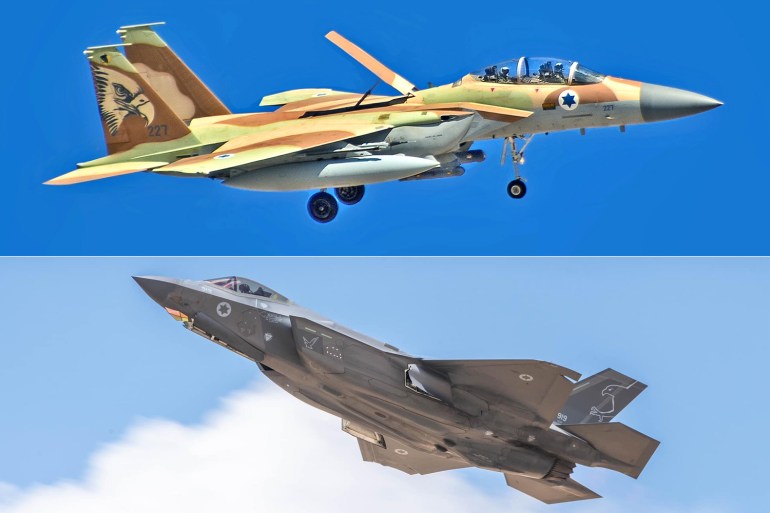
On Friday morning, Iranian air defences shot down three drones above its central province of Isfahan. Iran has yet to announce the results of its investigation into the incident, but the US said early on that Israel launched the attack. Israel has not commented despite speculation that it was behind it. Observers have, however, been anticipating an Israeli attack on Iran as the next link in a chain of escalation that began with an April 1 attack on the Iranian mission in Damascus that Iran blamed on Israel. The second was Iran launching 331 drones and missiles towards Israel on Saturday night in a well-choreographed attack, giving rise to expectations of an Israeli response. But if Israel were to strike Iran, how would it go about it? Israel has been planning strikes on sensitive Iranian sites for decades, but this response would have to be limited, part of the coded diplomatic and military dialogue between Iran and Israel. Israel would have to hit a high-value target but not one so valuable it would warrant a further military response from Iran and push the escalation into a full-on conflict. So what are Israel’s choices? Air strikes The two countries are more than 900km (560 miles) apart at their closest point with most of Iran’s military bases and nuclear sites more than 2,000km (1,243 miles) away from Israel. For strikes deep inside Iran, F-15i Ra’am and F-35i Adir stealth jets would be used. An Israeli F-15i Ra’am, top, and F‑35I Adir [Courtesy: Creative Commons] Both aircraft are optimised for long-range, but they would still need to refuel unless taking the shortest routes to Iranian targets near the border. The route would also be tricky. It is unlikely Saudi Arabia or Jordan would give Israel permission to fly through their airspace to attack Iran because it could draw them into a potential conflict and stands a good chance of inflaming domestic opinion, already vocal against Israel’s war on Gaza. Flying down the Red Sea and around Yemen and Oman to attack targets in southern Iran would mean a 4,700km (2,920-mile) trip before Israeli jets even reach the Iranian coastline. The fastest route to attack targets in the north of Iran would be through Syria and Iraq. The Israeli air force would have to suppress Syria’s air defences either by jamming or by cyberattack, as in 2007 when Israel destroyed what it said was a nuclear reactor being built in Syria. Israel “switched off” a large section of Syria’s air defence radar network beforehand. A technique like this could be used only in strategically important moments like a major air strike or at the start of a conflict. Even if Israel could still do this, it’s highly unlikely it would “show its hand” and reveal a major capability. Extended range External fuel tanks added to fighter jets can significantly extend their range but would make them show up on enemy radar. There have been reports of Israel-designed fuel tanks that can be fitted on their F-35 Adirs that would still allow them to stay moderately stealthy and invisible to radar. The tanks, to be jettisoned later, would allow the aircraft to reach and destroy targets much deeper inside Iran, return to their home airbases without being seen and fly unaided by the usual accompanying jets needed to destroy radar and protect fighter-bombers from other fighters. The plan would still be complex and, like all complex plans, subject to failure at its weakest link. Bad luck or enhanced radar the Iranians have not yet revealed could contribute to Israeli jets getting shot down – not the message of invincibility or revenge Israel wants to send. The naval option Israel has at its disposal five Dolphin-class submarines, German diesel-electric subs that run quietly and are ideal for coastal operations. Two of the latest subs built for Israel have AIP, or air-independent propulsion, meaning they can stay submerged for weeks as they stalk potential targets. One of the more obvious targets is the Behshad, an intelligence-gathering command ship that belongs to Iran’s Islamic Revolutionary Guard Corp (IRGC). It had been at sea for three years and was positioned up until recently at the mouth of the Red Sea near the Bab al-Mandeb Strait. It was ordered back to port, and satellite imagery put it just outside the naval base at Bandar Abbas, just within the Strait of Hormuz. The ship is now in home waters and protected by shore defences but not invulnerable. The Dolphin-class subs are armed with a land attack variant of the Popeye cruise missile, the Turbo Popeye, having a range of 200km to 350km (124-217 miles) and launchable under water through the submarines’ torpedo tubes. The Dolphin subs are part of Israel’s nuclear deterrent, and there are reports a version of the Popeye has a range of 1,500km (932 miles) and the latest version of the improved Dolphin-class has a VLS (vertical launching system) in its sail, allowing for longer missiles to be launched that would hold more fuel and, therefore, have a longer range. It would be far easier to attack Iranian coastal targets from international waters, then submerge and disappear. Again, the target would have to be big enough to make its point but not large enough that it has to invite a response from Iran. These are the two real options. Any other military action, such as using special operations troops – Israeli boots on Iranian soil – stands the chance of escalating the conflict. The real question is, will Israel risk a full-scale war while it is already fighting on two fronts, one war on Gaza and a slow-burning confrontation with Lebanon’s Hezbollah. Adblock test (Why?)
Russia-Ukraine war: List of key events, day 786
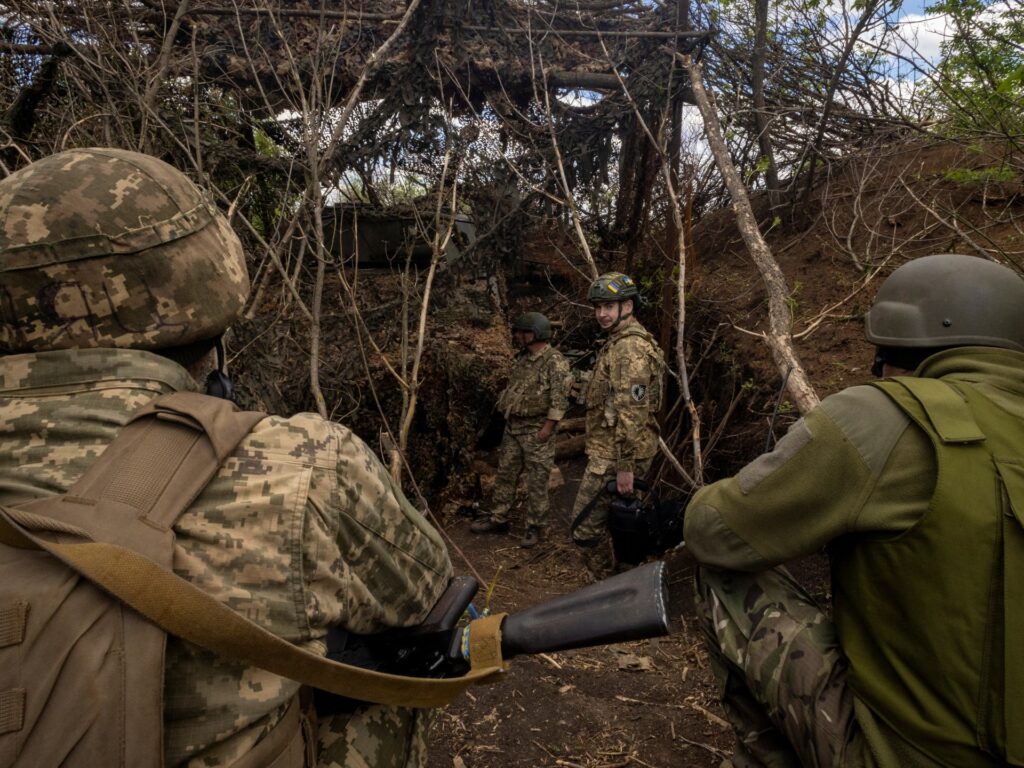
As the war enters its 786th day, these are the main developments. Here is the situation on Saturday, April 20, 2024. Fighting Russia’s Ministry of Defence reported Ukrainian drone strikes overnight and into Saturday. It said 26 drones were detected over the Belgorod region, 10 over Bryansk, and eight over Kursk, among several other regions. The strikes killed two people in Russia’s Belgorod region, Governor Vyacheslav Gladkov said on Saturday. The governors of Kursk, Kaluga and Bryansk, all in western Russia, reported strikes in their regions as well. Ukraine’s air force said it shot down a Russian strategic bomber with antiaircraft missiles for the first time since the war began in 2022. The warplane was downed in Russian airspace, 300km (186 miles) from Ukraine’s border, on Friday after it took part in a long-range air strike in the central region of Dnipropetrovsk. The Russian attack killed at least nine people in the eastern city of Dnipro and surrounding region and injured at least 28 others, regional officials said. Ukraine’s President Volodymyr Zelenskyy visited the site of the strike in Dnipro and called on his country’s allies to rush in more air defences. Zelenskyy said Russian missiles also struck the Black Sea port of Pivdennyi in the southern Odesa region, destroying grain storage facilities and the food inside. Politics and diplomacy German Chancellor Olaf Scholz said he believed the war in Ukraine could drag on for several more years and on Friday defended Germany’s military support for Ukraine. Foreign ministers from the Group of Seven (G7) countries expressed “strong concern” about the transfer of materials and weapons components from Chinese businesses to Russia for its military offensive in Ukraine. At their meeting on the Italian island of Capri on Friday, US Secretary of State Antony Blinken said this was heightening “the biggest threat to European security since the end of the Cold War”. Weapons The United States House of Representatives is scheduled to vote later on Saturday to approve $95bn in foreign aid for Ukraine, Israel and other US allies. The package includes $61bn for Ukraine. Ukraine’s Zelenskyy on Friday told a gathering of NATO defence ministers via videolink that the alliance must decide if it is Ukraine’s ally, urging member states to step up arms deliveries to his struggling forces. “Our sky must become safe again,” he said, telling the minister that Ukraine could not defend itself without Western support. Adblock test (Why?)
Man reportedly on fire outside of New York Trump trial
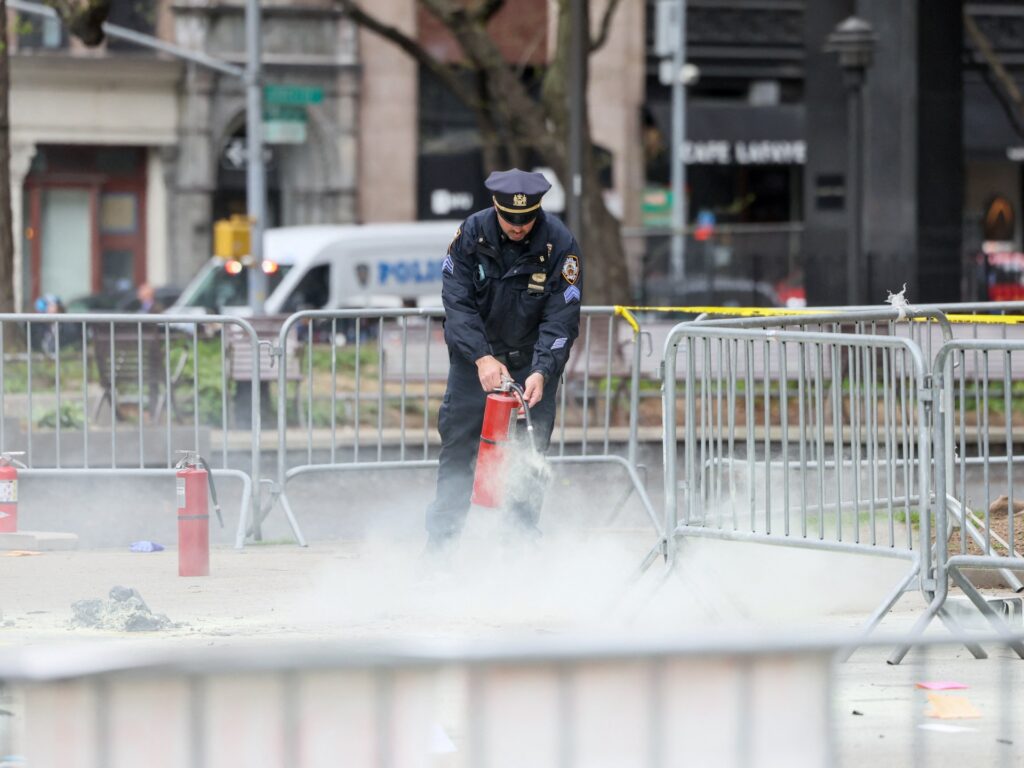
DEVELOPING STORYDEVELOPING STORY, Emergency crews doused the flames and man taken away on stretcher, according to US media reports. A man was reportedly on fire outside of the Manhattan courthouse where former United States President Donald Trump is standing trial on criminal charges for falsifying business records. CNN reported the man was covered in flames outside of the courthouse. Inside, the fourth day of the Trump trial was unfolding, with jury selection concluding. A correspondent for the network was reporting live on air when the incident occurred at a park across the street. “There is chaos that is happening,” she said. “I can smell the burning of agent used.” “We now have officers removing their coats, trying to surround his body to engulf him from further going into flames,” she said. “People are climbing over the barricade to try to separate the public from this man.” A video of the incident showed the man still in flames and twitching on the concrete as a police officer rushed over with a fire extinguisher. Politico reporter Emily Ngo said that police appeared to initially have trouble reaching the man due to barricades around the park. There has been massive security at the trial as Trump faces felony charges related to hush money payments he allegedly made to adult film star Stormy Daniels. Reporters from across the world have been staked out at the courthouse during the trial. “very scary, active scene,” Ngo wrote on X. “He was responsive when he was removed but he is very, very badly burned. Body charred,” she wrote. The man, whose identity was not immediately known, was carried away on a stretcher. This is a developing story. Adblock test (Why?)
US policy is leading to a wider war: Jeffrey Sachs on Middle East tensions
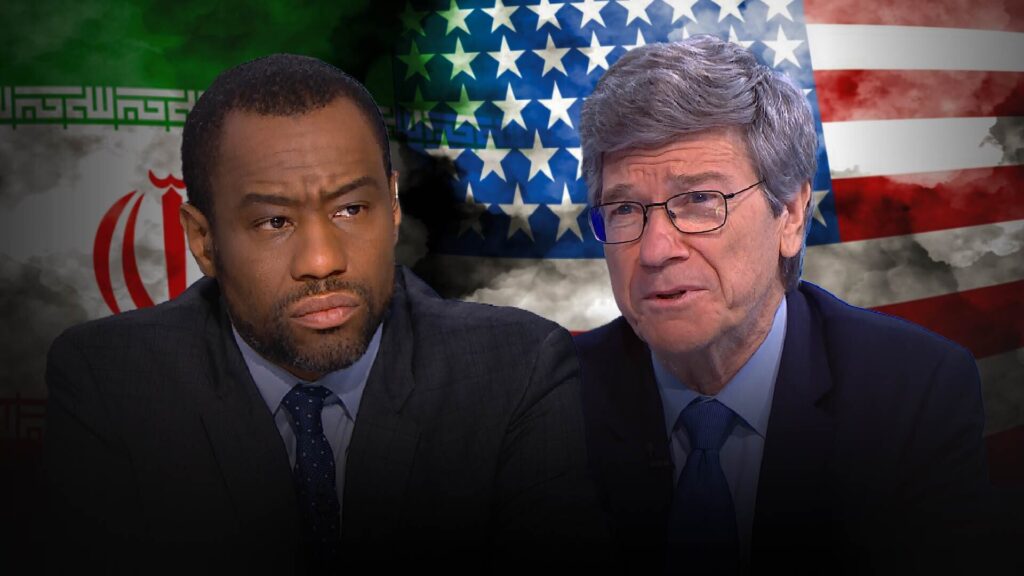
Marc Lamont Hill discusses US policy in the Middle East and the risks of escalation with renowned scholar Jeffrey Sachs. Six months into Israel’s war on Gaza, fears of a wider conflict in the Middle East are mounting. On April 13, Iran launched more than 300 drones and missiles towards Israel in an unprecedented attack. The strike came after Israel’s April 1 bombing of the Iranian consulate in Damascus, Syria that killed two top generals. Israel vowed retaliation and, less than a week later, reportedly launched a drone strike on Isfahan, in central Iran. Secretary of State Antony Blinken said the United States has “not been involved in any offensive operations”. But the US government has announced new sanctions on Iran, including on its drone production, and urged de-escalation. So what lies ahead? And is the US doing enough to avert a wider regional conflict? On UpFront this week, Marc Lamont Hill talks to Columbia University Professor and Special Advisor to the United Nations Jeffrey Sachs about US foreign policy and rising tensions in the Middle East. Adblock test (Why?)
Croatia’s top court bars President Milanovic from becoming prime minister
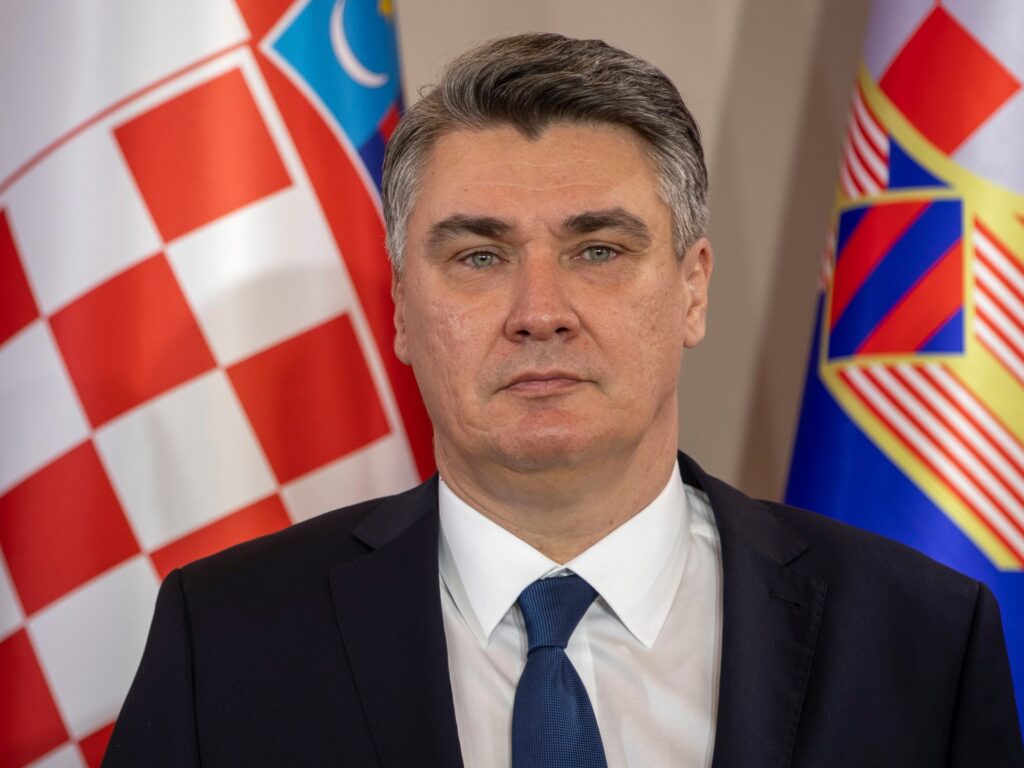
Constitutional Court says Zoran Milanovic cannot take up PM post because he did not first step down as president. Croatia’s top court has ruled that President Zoran Milanovic, who had campaigned to become prime minister before this week’s parliamentary elections, may not head the new government. “The president has been warned in time that he cannot participate in the campaign but that he must [first] resign. Now it is over. He can no longer be a prime minister-designate,” Constitutional Court President Miroslav Separovic said at a news conference on Friday. “Everyone is obliged to adhere to the constitution and the law,” he added. Croatia held parliamentary elections on Wednesday, in which the ruling conservative Croatian Democratic Union (HDZ) won the most seats but not enough to form a government alone. The vote was held after a bitter campaign between longtime political foes – the conservative incumbent, Prime Minister Andrej Plenkovic, and the left-wing populist Milanovic. For months, Plenkovic and his Croatian Democratic Union (HDZ) party seemed poised for an easy victory that would secure his third term as premier. But in mid-March, Milanovic, who tops opinion polls, made the shock announcement that he would challenge Plenkovic and become the candidate for the Social Democrats. Milanovic dissolved parliament on March 18, triggering this week’s snap election in the European Union member state of 3.8 million people. He said he would run for prime minister and resign only after winning the polls. The Constitutional Court then immediately warned him that he could only stand in the elections if he first stepped down as president. But Milanovic ignored the warning and campaigned across the country, accusing Plenkovic of leading the “most corrupt government in Croatia’s history”. Corruption has long been the Achilles heel of the HDZ, which has been in power most of the time since Croatia’s 1991 independence from Yugoslavia. The HDZ won 61 seats in the 151-member assembly, and a centre-left coalition led by the Social Democratic Party (SPD) won 42. The nationalist, right-wing Homeland Movement party came third with 14 seats, making it a likely kingmaker. ‘Preparation for coup d’etat’ Al Jazeera’s Marina Barukcic, reporting from Zagreb, said President Milanovic’s next move was unclear after the court’s verdict. “He believes that the Constitutional Court’s decision is a preparation for a coup d’etat led by Prime Minister Andrej Milanovic,” she said. Barukcic said the president promised to bring back the will of the people to the state. Plenkovic said on Thursday that it would be known “very soon” with whom the party would form a new parliamentary majority. The SDP was also trying to cobble together a majority although its task appears more difficult. Croatia has a parliamentary democracy in which the prime minister and his cabinet set all major policies. The president nominates the prime minister based on election results, may dissolve parliament and acts as the head of the armed forces with some say in foreign policy. Final election results are not expected until next week because a rerun is needed in two polling stations after irregularities were recorded. Adblock test (Why?)
Can Sunil Kanugolu bring India’s Modi down, 10 years after helping him win?
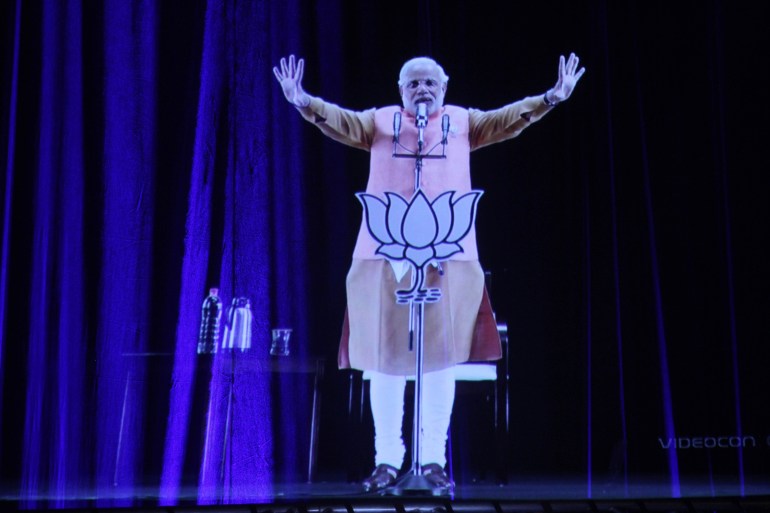
A small crack in one of the pillars supporting the world’s largest lift-irrigation project was the opening that Sunil Kanugolu was looking for as he shepherded the election campaign of the opposition Congress party in the southern Indian state of Telangana late last year. Up against the regional Bharat Rashtra Samithi (BRS) party whose leader K Chandrashekhar Rao had ruled Telangana since the state’s birth a decade earlier, the Congress, riding on disenchantment over alleged corruption and nepotism, was polling well. But Kanugolu, the in-house election mastermind of the Indian National Congress or Congress party, wanted something more — something that would drive home his party’s advantage, based on a mantra that’s central to his approach. “No election is ever won by logic. Emotions win elections,” the 40-year-old says often, according to a close confidant who requested anonymity. In Telangana, a member of Kanugolu’s team found a photograph of the small crack in the Kaleshwaram lift irrigation project that morphed into a poll strategy to topple the BRS from power. Mock ATM machines, branded as “Kaleshwaram ATM”, were set up in different parts of Telangana and photos of Congress workers inserting fake currency notes into the slot — which was the chief minister’s mouth — went viral. In the story that the Congress was telling, the project, constructed at a staggering cost of $9.8bn and being touted as a symbol of Telangana pride, was a crumbling testament to the BRS’ brazen corruption. The campaign was a classic example from Kanugolu’s election strategy playbook. “I’m not a believer in fighting elections with multiple, three-four-five items. There has to be one single narrative that you keep pushing and get the entire party, entire ecosystem, resources at your disposal to rally around. Other issues are sprinklings that you add to speeches and stuff like that,” Kanugolu’s confidant recalls him saying. In Telangana, that “sprinkling” included publicising welfare schemes the Congress would implement for women, farmers, youth, the elderly and poor families if voted to power. “Within about a week there was a three to nine percent swing in the vote share on the basis of the promises,” a researcher with Inclusive Minds, the Bengaluru-headquartered election consultancy firm that Kanugolu runs for the Congress, told Al Jazeera. The Congress won a clear majority and formed the government in Telangana. A decade ago, Kanugolu, a former consultant with McKinsey, was a member of the team that strategised, shaped and implemented Narendra Modi’s prime ministerial campaign. Now, a decade later, he is one of the top political consultants in the country and is working with the Congress to bring down PM Modi in the national elections that began on April 19 with the first phase of voting, and will be conducted in seven phases ending on June 1. But the challenge Kanugolu faces is not just from Modi and his Bharatiya Janata Party (BJP), but his own Congress party as well. The Congress party has been out of power federally for 10 years, and has just 52 members of parliament (MPs) in the 543-member lower house of Indian parliament, the Lok Sabha. In May 2022, when Kanugolu officially joined the Congress, he was inducted into an eight-member “Task Force-2024”. The plan was to let him lead the Congress’s campaigns in nine states that went to polls for their regional governments in 2023 — and then tackle the 2024 general elections. But internal politics within the Congress derailed the state election plan and the task force failed to take off, forcing Kanugolu to narrow his focus and ambition. He is now working on a plan B, focussing on 100-120 constituencies where the Congress either has a winning chance or wants to put up a fight as a matter of prestige. The general hired to win India’s 2024 election war by launching a full-frontal attack on Modi’s BJP is now busy managing a hundred or so snipers and trying to make sure they don’t miss their targets. “Political consultants are not magicians. They play an important but limited role if a party is in good shape,” Sanjay Kumar, co-director of Lokniti, a New Delhi-based research organisation that studies public opinion during and between elections, told Al Jazeera. “Is there a magician who can make the Congress win the 2024 elections? Even 50 magicians can’t make the Congress win.” Narendra Modi, then chief minister of the state of Gujarat, addresses the public via a 3D projection as part of his campaign in the 2014 national election that made him prime minister, in Ahmadabad, India, Friday, April 11, 2014. Kanugolu was a part of the team that crafted Modi’s campaign [Ajit Solanki/AP Photo] Crack team Ahead of the 2014 national election, Modi, then the chief minister of the western state of Gujarat, roped in public health specialist Prashant Kishor to create a tech-savvy, data-driven election consultancy, much like future US President Barack Obama’s in 2008, to catapult him on to the national stage. Kishor in turn brought in Kanugolu, among other bright, ambitious professionals, and together they set up Citizens for Accountable Governance (CAG). They conducted extensive surveys to understand what motivated people’s voting decisions, studied past voting patterns, tested what resonated with people and created a campaign strategy for the BJP by putting Modi at its centre. “There are only two ways to win elections — either you make your line big, or you cut the other person’s line,” Abhimanyu Bharti, a former political consultant with CAG, who now runs the online School of Politics, told Al Jazeera. The CAG used both these strategies effectively. It pulled out all the stops to launch a powerful campaign to exploit the rising anger against the Congress’s inefficient and corrupt government at the centre. Millions of dollars were spent to create Brand Modi and to project him as an able administrator, a decisive leader who had brought development, foreign investment and prosperity to his home state of Gujarat. A blitzkrieg of 3D vans in almost every Lok Sabha constituency beamed Modi’s
US chef’s bid to own ‘chili crunch’ name raises ire in Indonesia, Malaysia
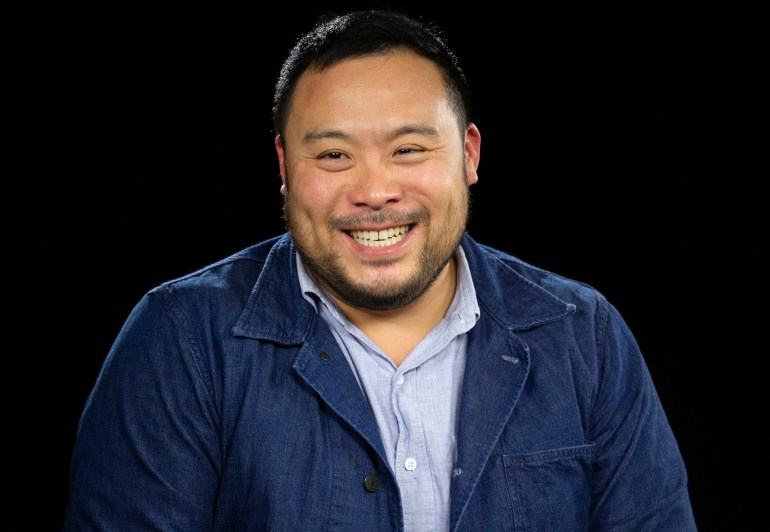
Medan, Indonesia – When Michelle Tew, the owner of Malaysia-based food company Homiah, received a cease and desist letter from American-Korean celebrity chef David Chang last month, she felt “sadness and betrayal”. The letter informed Tew that she had 90 days to stop using the term “chili crunch” on the labels of her sambal – a chilli-based condiment popular across Southeast Asia – as Chang had trademarked the phrase. “David Chang is such a large name in the Asian-American food community and it felt very personal, even though I don’t know him personally,” Tew told Al Jazeera. “The Asian food community is really like a family and, to go after a woman-owned business, to even think of that at all and not to have a friendly conversation first, I really wondered where his compassion was.” Chang, who owns the Momofuku restaurant chain in the US and has since abandoned his trademark claim, began selling jars of “Chili Crunch” in 2020, but he is far from the first person to put such a product on the market. David Chang has come under fire for attempting to enforce a trademark for the term ‘chili crunch’ [Damian Dovarganes/AP Photo] Chilli-based condiments have been used across Asia since time immemorial. In English, they have gone by various names, including chilli crunch, chilli crisp and chilli oil, depending on their consistency and the proportions of ingredients. Tew, who learned to cook from her Malaysian grandmother, chose to call her product “Sambal Chili Crunch”, as sambal, which typically includes ingredients such as chillies, shrimp paste, garlic and palm sugar, is not widely known outside of Southeast Asia and she needed to find a way to explain it to a foreign audience. The practice of trying to trademark generic food terms is not unique to Chang or the US food and beverage industry. Arie Parikesit, a culinary guide who runs the Kelana Rasa food and tour business, said that while Chang had been trying to “monopolise” the term “chili crunch”, there had been similar cases in his native Indonesia. “A similar thing happened in the Indonesian food and beverage world when the term ‘kopitiam’ [coffee shop] was accepted as a brand right submitted by a company that had recently been established and forced classic kopitiam entities that were decades old not to use this brand,” Parikesit told Al Jazeera. “Trade name monopolies like this are clearly unhealthy and, instead of promoting Asian cuisine more widely, as David Chang and Momofuku have done, it creates a bad atmosphere among Asian food and condiment players.” “Small heritage companies will also be affected. At a time where collaboration is key, this kind of old-style rivalry deserves to be left behind,” he added. The need for a collaborative approach is underscored by the difficulty Southeast Asian food and beverage players face trying to get a foot in the door outside of the region. Tew of Homiah said that Southeast Asian food is not widely known in many parts of the world, particularly compared with other cuisines. “If you go to a supermarket in the US, there will be two whole aisles dedicated to olive oil, which is just one product. Then you might find half an aisle or a stand which has food from ‘other’ places in it, like Southeast Asian cuisine mixed together with other cuisines like Mexican.” Jun Yi Loh, a Malaysian food writer and recipe developer, agreed that Malaysian food terms are not necessarily easy to grasp, which is why descriptors such as “chili crunch” need to be used. “I’ve long held the opinion that one of the key reasons Malaysian food hasn’t blown up in the way that Singaporean or Thai food has in recent years is that our food isn’t as easy to describe or package in a sort of elevator pitch way,” Loh told Al Jazeera. Michelle Tew, the owner of Malaysia-based food company Homiah, says she felt ‘betrayed’ after receiving a cease and desist letter [Courtesy of Michelle Tew] After weeks of outcry over Momofuku’s cease and desist letters, which were sent to dozens of small businesses in the US, Chang last week backed down, saying on The Dave Chang Show podcast: “I understand why people are upset, and I’m truly sorry.” In a statement sent to Al Jazeera, Momofuku said: “When we created Chili Crunch, we wanted a name to differentiate our product from the broader chilli crisp category. We believed the name ‘Chili Crunch’ reflected the uniqueness of our product, which blends flavours from multiple culinary traditions, and bought a pre-existing trademark for the name.” Momofuku said it had taken feedback from the community on board and now understood that the term “chili crunch” carried a broader meaning. “We have no interest in ‘owning’ a culture’s terminology and we will not be enforcing the trademark going forward,” the company said. While Chang may have done a u-turn, the episode has nonetheless left a nasty taste in the mouths of some of those promoting Southeast Asian cuisine abroad. Loh said the debacle had brought to light the legal tribulations that can come with running a business in a foreign market. “It will factor into the minds of small business owners for sure,” he told Al Jazeera. “I believe this event will be remembered as a frivolous case, initiated by Momofuku and David Chang with tonnes of hubris and very little thought,” Auria Abraham, the owner of Auria’s Malaysian Kitchen, a food company selling sambal, spice blends and kaya, told Al Jazeera. Abraham, who moved to the US in the 1990s before launching her first product, Hot Chilli Sambal in 2013, said that the Momofuku furore has sparked a wider debate around who “owns” food. “We have to accept and understand that no single country, entity or person can lay claim to things like condiments, ingredients or recipes,” she said. Abraham said that Malaysian food has been shaped for centuries by immigrants who brought recipes that were shared, adopted and then modified to reflect the ingredients available in different regions. “With
Google fires 28 staff after protests against cloud contract with Israel

Tech giant says employees engaged in ‘completely unacceptable behaviour’ during sit-in at company offices. Google has fired 28 employees following a sit-down protest over the tech giant’s contract to provide cloud computing and artificial intelligence services to the Israeli government The terminations come after the group No Tech for Apartheid on Tuesday occupied Google offices in California and New York to protest the $1.2bn contract known as Project Nimbus. Video of the demonstrations shared on social media showed police arresting employees in the office of Google Cloud CEO Thomas Kurian. In a statement on Thursday, Google said that physically impeding employees and preventing them from accessing company facilities was a “clear violation of our policies and completely unacceptable behaviour”. “After refusing multiple requests to leave the premises, law enforcement was engaged to remove them to ensure office safety,” a spokesperson said. “We have so far concluded individual investigations that resulted in the termination of employment for 28 employees, and will continue to investigate and take action as needed.” Google also denied that the contract was related to weapons or intelligence services. In a blog post, Google CEO Sundar Pichai issued a veiled warning to protesting employees. “We have a culture of vibrant, open discussion that enables us to create amazing products and turn great ideas into action. That’s important to preserve. But ultimately we are a workplace and our policies and expectations are clear: This is a business, and not a place to act in a way that disrupts coworkers or makes them feel unsafe, to attempt to use the company as a personal platform, or to fight over disruptive issues or debate politics,” Pichai said. “This is too important a moment as a company for us to be distracted.” No Tech for Apartheid accused Google of retaliation and said those fired included staff who had not directly participated in the protests. “This flagrant act of retaliation is a clear indication that Google values its $1.2 billion contract with the genocidal Israeli government and military more than its own workers. In the three years that we have been organising against Project Nimbus, we have yet to hear from a single executive about our concerns,” it said in a statement posted on Medium. No Tech For Apartheid also described claims that protesters had defaced property and physically impeded other employees’ work as a “lie”. “Even the workers who were participating in a peaceful sit-in and refusing to leave did not damage property or threaten other workers. Instead, they received an overwhelmingly positive response and shows of support,” the group said. Adblock test (Why?)