

Hamas says no progress in Gaza truce talks as sides set to meet again

Israeli and Hamas officials say no significant progress has been made in the latest round of Gaza truce talks in Cairo attended by representatives from mediators Egypt, Qatar and the United States. “There is no change in the position of the occupation and, therefore, there is nothing new in the Cairo talks. … There is no progress yet,” a Hamas official, who asked not to be named, told the Reuters news agency on Monday, shortly after reports quoting Egyptian sources said headway had been made. Israel’s Ynet news outlet cited an unidentified Israeli official as saying there had been “nothing dramatic” in the talks. “We still don’t see a deal on the horizon. The distance is still great, and there has been nothing dramatic in the meantime,” the official said. A separate senior Israeli official was quoted by Ynet as saying: “Patience is needed. There is potential, but we are not there yet.” Much of the international community has expressed outrage over the Palestinian death toll and humanitarian crisis arising from Israel’s military operation that it says is aimed at destroying Hamas in the Gaza Strip. More than 33,000 Palestinians have been killed in Israel’s war on Gaza since October 7, according to Palestinian officials. Israel launched its assault on Gaza in response to Hamas-led attacks on Israel on October 7, which killed 1,139 people, according to an Al Jazeera tally based on Israeli statistics. Hamas seized 253 people at that time and took them back to Gaza. Of those, 133 captives remain, and negotiators have spoken of about 40 going free in the first stage of a prospective deal with Hamas. Israel’s army says more than 600 of its soldiers have been killed in combat. Delegations set to return to Cairo Israel and Hamas sent teams to Egypt on Sunday after the arrival on Saturday of CIA Director William Burns, whose presence underlined rising pressure from the White House for a deal that would reach a truce, free captives held in Gaza and get aid to isolated civilians. Al Jazeera’s Imran Khan, reporting from occupied East Jerusalem, said the fact that talks have not broken down was a positive development. “There is apparently a ceasefire framework that the Israelis are now taking back to the war cabinet and Hamas is discussing within the movement,” he said. Khan said senior Israeli politicians are actually talking about the potential of the talks. “Finance Minister [Bezalel] Smotrich is calling for a meeting to get an update on what this framework is, and Yair Lapid, head of the opposition, says he’s willing to give the government a safety net to be able to come to some sort of deal,” Khan said. Two Egyptian security sources and state-run Al-Qahera News said on Monday that some progress had been made in the Cairo talks. The security sources said both sides had made concessions that could help pave the way for a deal for a truce that – as proposed during previous talks – would be staggered over three stages with the release of the remaining Israeli captives and a long-term ceasefire addressed in the second stage. The concessions relate to the release of Israeli captives and Hamas’s demand for the return of displaced residents to northern Gaza, they said. Mediators suggested the return could be monitored by an Arab force in the presence of Israeli security deployments that would later be pulled back, they added. Delegations left Cairo, and consultations were expected to continue within 48 hours, the sources and Al-Qahera said. ‘Mixed messages’ Luciano Zaccara, a professor of Gulf politics at Qatar University’s Gulf Studies Center, told Al Jazeera that while mixed messages were emerging from Egypt, the Israeli government has made it clear the war will go on. The weekend pullout of Israeli forces from Gaza is aimed at reorganising troops for their future mission in Rafah, “meaning that Israel has not stopped pursuing the main objective, which is to destroy Hamas completely”, Zaccara said. “But the government is aware of the mounting pressure from captives’ families who joined forces with those seeking the prime minister’s resignation,” he added. “It seems like something is moving inside Israel to reach an agreement. They have to show they are working towards a solution, but we have to wait for the next 48 hours to see if a deal is reached,” Zaccara said. Six months into its offensive on Gaza, Israel has devastated the enclave and left most of its 2.3 million people homeless and many at risk of famine. The country is under global pressure to ease Gaza’s humanitarian crisis and drop its plans to storm Rafah, a town on the southern border with Egypt packed with more than a million displaced Palestinians. Israeli Prime Minister Benjamin Netanyahu said on Monday that a date has been set for the Israeli offensive on Rafah. He did not disclose when it would be. Adblock test (Why?)
Trump says abortion should be up to US states, avoids backing national ban

Presumptive Republican presidential nominee Donald Trump has said the issue of abortion access should be left up to states to decide, eschewing calls from within his party to support a nationwide ban on the procedure in the United States. In a video posted on his Truth Social platform on Monday, the former US president said he was “proudly the person responsible” for overturning Roe v Wade, the landmark legal precedent that had guaranteed abortion rights on the national level for decades. The US Supreme Court, bolstered by a 6-3 conservative majority that included several Trump appointees, overturned Roe v Wade in June 2022. That put the question of abortion access largely in the hands of individual states to decide, though some anti-abortion activists have pushed for a nationwide ban to be implemented. “The states will determine by vote or legislation, or perhaps both, and whatever they decide must be the law of the land,” Trump said in Monday’s video. “Many states will be different,” he said, adding that, “At the end of the day, this is all about the will of the people.” Reproductive rights are expected to be a central issue heading into November’s presidential election, which is set to pit Trump against his Democratic Party rival, President Joe Biden. Biden has made defending access to reproductive healthcare a central plank of his re-election campaign, condemning Trump and Republican Party lawmakers for supporting the end of Roe v Wade. Conservatives had spent decades trying to overturn the 1973 legal precedent, and several Republican-led US states enacted strict limits on abortion after the Supreme Court’s decision nearly two years ago, in a case known as Dobbs v Jackson Women’s Health Organization. But abortion has become an Achilles heel for the Republican Party, as polls show abortion bans and restrictions are unpopular and most Americans want to protect access to the procedure. The Pew Research Center reported in April 2023 — nearly a year after Roe was overturned — that 62 percent of Americans said abortion should be legal in all or most cases, compared with 36 percent who said it should be illegal. Looking along partisan lines, the survey found that 84 percent of Democrats or Democratic-leaning independents said abortion should be legal in all or most cases, while 40 percent of Republicans or right-leaning independents said the same. NEW from @JoeBiden on Trump’s abortion comments >> “Trump is scrambling. He’s worried that since he’s the one responsible for overturning Roe the voters will hold him accountable in 2024. Well, I have news for Donald. They will. pic.twitter.com/PHSIvITw1z — Ammar Moussa (@ammarmufasa) April 8, 2024 November’s election is expected to be hard fought, and experts say Trump could risk losing votes in critical swing states if he were to come out strongly in favour of a national abortion ban. Jeanette Hoffman, a Republican political consultant, told the Reuters news agency that “leaving abortion to the states is [Trump’s] way of punting on the issue”. “Now that the primary is over, there’s nothing to be gained from proposing a national abortion ban, as he’ll lose support from voters in many swing states,” Hoffman said. Trump’s comments on Monday drew criticism from anti-abortion groups in the US, however. Marjorie Dannenfelser, president of the anti-abortion group Susan B Anthony Pro-Life America, said the organisation was “deeply disappointed” by Trump’s position. The Supreme Court’s 2022 decision “clearly allows both states and Congress to act”, she said in a statement. “Saying the issue is ‘back to the states’ cedes the national debate to the Democrats.” Senator Lindsey Graham, a top Republican and ally of the former president, also said he disagreed with Trump’s stance. “I will continue to advocate that there should be a national minimum standard limiting abortion at fifteen weeks,” Graham wrote on the social media platform X. Meanwhile, Biden slammed his predecessor for making “it clear once again today that he is — more than anyone in America — the person responsible for ending Roe v Wade”. “Trump is scrambling,” Biden said in a statement. “He’s worried that since he’s the one responsible for overturning Roe the voters will hold him accountable in 2024. Well, I have news for Donald. They will.” Adblock test (Why?)
UN Security Council refers Palestine’s full membership bid to committee

Palestinian UN envoy Riyad Mansour urges Security Council to ‘elevate itself to implementing the global consensus on the two-state solution’. The United Nations Security Council president has referred the Palestinian Authority’s (PA’s) application for Palestine to become a full member of the world body to its membership committee. The 15-member committee is expected to make a decision about Palestine’s status this month, said Vanessa Frazier, Malta’s UN ambassador, who also proposed that the committee meet on Monday to consider the application. Malta is president of the Security Council for April. Palestinian UN envoy Riyad Mansour told reporters in New York that the PA sincerely hoped that after 12 years as an observer state at the UN, the Security Council would “elevate itself to implementing the global consensus on the two-state solution by admitting the state of Palestine for full membership”. Last week, the PA formally asked for renewed consideration by the Security Council of its 2011 application to become a full member of the world body. The Palestinians are a non-member observer state at the UN, the same status as the Holy See. Reporting from UN headquarters in New York, Al Jazeera’s Gabriel Elizondo said the PA’s membership bid was “moving forward” and highlighted that this is a significant and symbolic moment for Palestine. “This is only the second time that Palestine has been able to get this far in their bid for full UN membership. The last time was 2011 when it essentially failed in the Security Council standing committee due to a threat by the US to veto it if it ever came to a vote,” he noted. He added that for any country to become a full member of the UN, the international body’s charter says the country’s membership first has to be approved by the Security Council and then it would need to get the support of two-thirds of the 190 members of the UN General Assembly. “It is believed that Palestine has the support in the General Assembly. That is pretty much widely accepted. The issue is in the Security Council, … where any of the five permanent members could veto it, and this would then stop the process,” Elizondo said. Security Council approval requires at least nine votes in favour and no vetoes by the United States, Russia, China, France or Britain. Earlier on Monday, the Security Council met behind closed doors to discuss the letter from the PA. Mansour told Reuters last week that the aim was for the council to make a decision at an April 18 ministerial meeting on the Middle East. Israel’s UN ambassador, Gilad Erdan, said recognition of a Palestinian state would be a threat to Israel’s national security. “Granting the Palestinian statehood is not only a blatant violation of the UN Charter, it also violates the fundamental principle that everyone can understand of reaching a solution, a lasting solution, at the negotiating table,” Erdan told reporters on Monday. “The UN has been sabotaging peace in the Middle East for years, but today marks the beginning of the point of no return,” he said. Adblock test (Why?)
Political merchandise sales spike days before nearly a billion Indians vote

Ahead of the first voting day of the seven-phase election on April 19, garment makers are temporarily converting factories into production hubs for election flags and banners. Days before India heads into a six-week election with nearly a billion registered voters, political party merchandise and flag makers are expanding operations and working overtime to meet a surge in demand. Ahead of the first voting day of the seven-phase election on April 19, garment makers are temporarily converting factories where they usually make saris into production hubs for election flags and banners. One such factory owner, Mukesh Agarwal, said there are as many as 40 similar factories in Mathura, a temple town in Uttar Pradesh, India’s most populous state and key political battleground. “The cheapest and best items used for political campaigns are banners and flags,” Agarwal said. A worker sorts finished flag fabrics of the Congress party at a factory in Mathura, India [Sharafat Ali/Reuters] Election merchandise is a low-margin, high-volume business, where the price of a party badge can start from 1 rupee ($0.01). Agarwal said some factories can produce a million flags a day if demand continues to increase. During an election, India is plastered with posters of hundreds of political parties and thousands of candidates. “As many people have little education, party workers use flags to promote their symbols and hang them outside houses and make them the medium of their campaigns,” Agarwal said. A textile hub in Surat, in Prime Minister Narendra Modi’s home state of Gujarat, is the centre of election merchandise along with several smaller hotspots like Mathura in the north and Hyderabad in the south. Workers arrange the flag of the regional Bahujan Samaj Party at a factory in Mathura [Sharafat Ali/Reuters] Elections give the economy a boost as political parties spend on goods and services as varied as small merchandise and helicopter rental. Gulshan Khurana, general secretary of a traders association in Old Delhi’s Sadar Bazaar market, said political parties spend 30 billion to 50 billion rupees ($360-600m) on election merchandise, creating as many as 10 million jobs. Khurana, who has been a market trader for nearly 50 years, said there has been a nearly 30 percent increase in business compared with the last election in 2019, when Modi’s Bharatiya Janata Party spent a record sum to retain power. An opinion poll last week predicted an easy win for a Modi-backed coalition. But opposition politician Rahul Gandhi of the Indian National Congress said at the Friday release of his party’s manifesto that the election is “much closer than being propagated”. Adblock test (Why?)
Khan Younis ‘smells like death’ as Palestinians return to devastated homes

“It smells like death,” says Maha Thaer, a mother of four, as she returns to her devastated home in Khan Younis after Israeli troops announced their withdrawal from southern Gaza. “We don’t have a city any more, only rubble. There is absolutely nothing left. I could not stop myself crying as I walked through the streets,” said the 38-year-old on Sunday. “All the streets have been bulldozed. And the smell … I watched people digging and bringing out the bodies,” said Thaer, whose home was partially destroyed. Soon after the Israeli army said its troops were pulling out, people began to emerge into the devastated landscape, the residents of Khan Younis returning to find what remained of their homes. Nearly 400,000 people lived in Khan Younis and its environs before October 7. Much of the area is now in ruins after months of Israeli bombardment and heavy fighting. A straggle of men and boys riding donkey carts, bicycles and the odd pick-up truck headed north out of Rafah in the far south of the Gaza Strip, where more than 1.5 million Palestinians had taken refuge from the relentless Israeli ground invasion and bombardment. They passed the burned-out shell of Dar Essalam Hospital, with almost all of the buildings around it razed to the ground. Thaer, from the upmarket Hamad City district in the west of Khan Younis, said she was “very shocked and sad”. “There were no walls or windows. Most of the towers were completely blown up,” she said. Thaer said she would move back into her badly damaged apartment, “even though it is not suitable for living, but it is better than tents”. Her neighbours suffered a greater misfortune. “They found their homes destroyed and they don’t know where they will go,” she said. Other Palestinians in Gaza carried a mattress on their heads in the hope they would still have four walls to put it in. One of those who left Rafah on Sunday climbed on the top of a heap of rubble in Khan Younis which once had been a home. Not a single structure within sight appeared untouched by the war. Adblock test (Why?)
Total solar eclipse 2024: Where, when, and how to watch
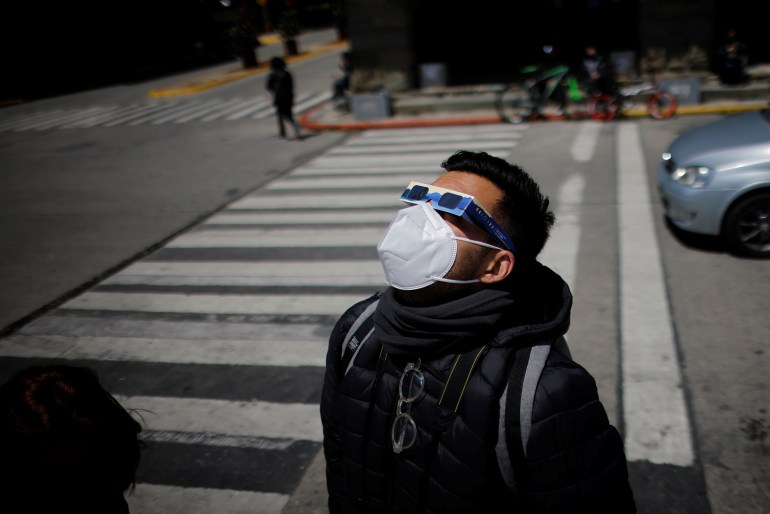
Millions of people across North America will get the chance to experience a very special natural event on Monday when a total solar eclipse will be visible from parts of Mexico, the United States and Canada. The total eclipse – which occurs when the moon completely blocks out the sun – will darken skies for a few minutes “as if it were dawn or dusk”, the US’s NASA space agency explains. It will be visible from a 185km-wide (115 mile-wide) band that stretches from the western coast of Mexico, through the US, and up to Canada’s easternmost province of Newfoundland and Labrador – what’s known as the “path of totality”. “Weather permitting, people along the path of totality will see the sun’s corona, or outer atmosphere, which is usually obscured by the bright face of the sun,” NASA says on its website. The path of totality is really “where it’s at” on Monday, said Anthony Aveni, professor emeritus at Colgate University in New York and author of the book, In the Shadow of the Moon: The Science, Magic, and Mystery of Solar Eclipses. “It’s that precious three minutes or so … of totality when you see a whole range of phenomena that you just don’t see in everyday life,” he told Al Jazeera. “It takes your breath away and you stop what you’re doing and gawk at nature.” So how often do total solar eclipses occur? How long does it typically last? Where and how can you watch safely? Here’s everything you need to know. A man uses protective glasses to observe the solar eclipse over South America, in Bariloche, Argentina, on December 14, 2020 [File: Carlos Barria/Reuters] Where will the total eclipse be visible from, and at what time? Monday’s total eclipse will be visible from parts of Mexico, the US and Canada. It will enter continental North America in Mazatlan, in the northwestern Mexican state of Sinaloa, at 11:07am local time (18:07 GMT). It will exit the continent on the Atlantic coast of Newfoundland, Canada, at 5:16pm local time (19:46 GMT). In the US, the eclipse will enter the state of Texas at 1:27pm local time (18:27 GMT) and exit in Maine at 3:35pm local time (19:35 GMT). It will last only a few minutes, and the exact time it will be visible depends on where you are within the path of totality. For example, in Erie, Pennsylvania, totality starts at 3:16pm local time (19:16 GMT) and ends at 3:20pm (19:20 GMT). It will reach Buffalo, New York, a few minutes later: there, totality starts at 3:18pm local time (19:18 GMT) and ends at 3:22pm (19:22 GMT). A partial eclipse also will be visible for about two hours on Monday, before and after totality. What happens during a total solar eclipse? While the Earth and moon both orbit the sun, the moon also circles the Earth each month. During a total solar eclipse, the moon passes directly between the sun and the Earth, completely blocking the sun’s light on one side, and casting a shadow on a small area of Earth on its other side. The dark inner part – the “umbra” – of this shadow creates a narrow track or “path” as the moon orbits the Earth. Areas on this path, and especially on its centreline, which fall directly under the shadow, are the ones from where the total eclipse will be visible. This track is about 160km (100 miles) wide and 16,000km (10,000 miles) long. “If it was a lunar eclipse, it would last for a few hours and people around the world could see it. But the difference is that total eclipses only happen over a specific path of that new moon,” said Khady Adama Ndao, a NASA eclipse ambassador. This eclipse only occurs during a new moon. And the moon’s position in its orbit, relative to the sun and Earth, as well as the angles of all three at a specific time, are what create a total eclipse. While the moon will be close enough to Earth so as to look as though it entirely covers the sun during an eclipse, in reality the moon is 400 times smaller than the sun. It’s the increased distance between the moon and the sun at the time of a total eclipse that makes the moon look like it is big enough to cover the sun. Meanwhile, people who are close to the path of totality, but not directly in it, may see what’s known as a partial eclipse on Monday. That’s when only a part of the sun is obscured by the moon. Areas from which a partial eclipse will be visible fall under faint parts of the moon’s wider shadow, called the “penumbra”. What does a total eclipse look like? As the moon moves past the sun during an eclipse, it will slowly obscure the sun – creating a dark sky – before reaching the moment of “totality”. That’s when almost the entirety of the sun will be covered, leaving only a faint circle of the sun’s light or the corona. After a few minutes, people in the path of totality will see a partial eclipse again as the moon moves away. The sun will become fully visible again. What else happens during the moment of totality? There is a drop in temperature and animals also start to behave as if it’s nighttime. The chirping patterns of birds may change, while nocturnal animals such as bats and owls may start to wake up and look for prey. Stars and celestial objects hanging in the dark sky may also become more visible. If a person were to stand on the moon or a space station orbiting Earth, they would also be able to see a dark shadow passing over the Earth. The eclipse will go through several stages before and after totality [File: Ted S Warren/AP Photo] How long will the total solar eclipse last on April 8? A total solar eclipse can last between two
Russia says Ukraine attack hits Zaporizhzhia nuclear power plant

Ukraine has struck the dome above a shutdown reactor at the Russian-controlled Zaporizhzhia nuclear station, the plant’s Russian-installed administration said. It was not immediately clear what weapon was used in Sunday’s attack against the nuclear plant, which was taken by Russian forces shortly after their full-scale invasion of Ukraine in 2022, although the Russian state-owned nuclear agency Rosatom said the site had come under a drone attack. Radiation levels were normal and there was no serious damage after the attack, according to the plant’s officials. But Rosatom later said that three people had been wounded, specifically in a drone strike near the site’s canteen. The International Atomic Energy Agency (IAEA), which has experts at the site, said it had been informed by the Russian-run plant that a drone had detonated at the site and the information was “consistent” with IAEA observations. IAEA Director General Rafael Grossi has warned both sides to refrain from actions that “jeopardise nuclear safety”. IAEA experts have been informed by ZNPP that a drone detonated on site today. Such detonation is consistent with IAEA observations. “I urge to refrain from actions that contradict the 5 IAEA principles and jeopardise nuclear safety,” Director General @rafaelmgrossi said. — IAEA – International Atomic Energy Agency ⚛️ (@iaeaorg) April 7, 2024 The nuclear plant, which is the largest in Europe, has six Soviet-designed VVER-1000 V-320 water-cooled and water-moderated reactors containing uranium-235. There is also spent nuclear fuel at the facility. Reactors number one, two, five and six are in cold shutdown, while reactor number three is shut down for repair and number four is in so-called “hot shutdown”, according to the plant’s administration. The plant remains close to the front lines, and both Ukraine and Russia have repeatedly accused the other of attacking the plant and so risking a possible nuclear disaster. Front-line fighting Earlier on Sunday, a woman was killed when shrapnel from a downed Ukrainian drone hit a car travelling in Russia’s Belgorod region, according to the local Governor Vyacheslav Gladkov. In a statement on the Telegram messaging app, Gladkov said that four more people, including two children, had been wounded after air defences downed four Ukrainian drones on the approach to Belgorod city. The Belgorod region, which borders Ukraine, has come under regular attack from Kyiv’s forces since 2022, with 25 people killed in a single missile strike on Belgorod city in December. Russia’s army on Sunday said that it had destroyed 15 Ukrainian drones over its border in Belgorod and in the Bryansk region. The army added that 12 of the 15 drones were destroyed over the Belgorod region. Ukraine has for months launched drone attacks on several border areas as it tries to push back Russia’s advancing forces. “Ukrainian drones destroy the occupiers. They protect the lives of our soldiers on the front lines. And they help Ukraine decrease Russiaʼs war potential,” Ukrainian President Volodymyr Zelenskyy said in a post on the social media platform X on Saturday. “In the sky and at sea, our drones have demonstrated that Ukrainian strength can defeat Russian evil,” he added. Ukrainian drones destroy the occupiers. They protect the lives of our soldiers on the front lines. And they help Ukraine decrease Russiaʼs war potential. In the sky and at sea, our drones have demonstrated that Ukrainian strength can defeat Russian evil. I thank everyone who… pic.twitter.com/AFPAiLlyyW — Volodymyr Zelenskyy / Володимир Зеленський (@ZelenskyyUa) April 6, 2024 However, Zelenskyy also highlighted that Russian attacks continue in front-line regions like Kharkiv and Zaporizhia. On Sunday, Kyiv said that a Russian strike on the town of Huliaipole in the southern Zaporizhia region killed three people. “Two men and a woman died under the rubble of their own private house, which was hit by a Russian shell,” the head of the region, Ivan Fedorov, said on social media. Officials added that a woman was also killed in the city of Kupiansk, in the northeastern Kharkiv region that has seen increased attacks in recent months. Meanwhile in the main city of Kharkiv, Kyiv said Russia launched another attack on Sunday, wounding five civilians, a day after a deadly attack there. On Saturday, two Russian strikes on Kharkiv, Ukraine’s second-largest city, killed eight civilians and injured at least 10 people, according to regional officials. “We must put an end to this terror,” Zelenskyy said. On Sunday, during a video meeting of the Kyiv-organised fundraising platform United24, Zelenskyy said that it was crucial for the US Congress to approve military aid to Ukraine, as the war continues to rage. “It is necessary to specifically tell Congress that if Congress does not help Ukraine, Ukraine will lose the war,” he said. “If Ukraine loses the war, other states will be attacked.” Adblock test (Why?)
Week in pictures: An earthquake in Taiwan to Ramadan prayers in Jerusalem
[unable to retrieve full-text content] A roundup of some of last week’s events.
Fighting in southern Syria following bombing kills 17: War monitor

A blast that killed eight children on Saturday in al-Sanamayn led to clashes between rival groups in Deraa, says the Syrian Observatory for Human Rights (SOHR). A war monitor has said at least 17 people were killed in southern Syria’s Deraa province in violence triggered by an explosion a day earlier that killed a group of children. Deraa was the cradle of the 2011 uprising against President Bashar al-Assad’s, rule but it returned to government control in 2018 under a ceasefire deal backed by Russia. The province has since been plagued by violence, with frequent clashes and precarious living conditions. The Britain-based Syrian Observatory for Human Rights (SOHR) said on Sunday that an armed group led by a figure who previously worked for a Syrian state security agency had been accused by a rival group of planting an explosive device that went off on Saturday in the city of al-Sanamayn, killing eight children. On Sunday, a rival armed group led by a former member of ISIL (ISIS) who now works for military intelligence stormed part of al-Sanamayn and the two groups began clashing, the monitor said. The battle left 17 dead, among them a former ISIL member, 12 fighters, and a civilian killed by a stray bullet, SOHR said. The monitor, which added that clashes were ongoing on Sunday afternoon, had reported 12 dead in a previous toll. Syrian state media did not immediately report the clashes. Blast blamed on ‘terrorists’ Official news agency SANA, quoting a police source, gave a different toll for Saturday’s explosion, saying seven children were killed in the blast, which it blamed on “terrorists”. Attacks, some claimed by ISIL, regularly occur in Deraa province, as well as armed clashes and assassinations of government supporters, former opposition figures and civilians working for the government. Former rebels in the province who accepted the 2018 ceasefire deal sponsored by Russia – a key ally of Damascus – were able to keep their light weapons. In late January, SOHR said a local leader and seven other members of an ISIL affiliate were killed in clashes with local factions in the province. The war in Syria, which erupted in 2011 after the government repressed peaceful pro-democracy protests, has killed more than half a million people, displaced millions, and ravaged the country’s economy and infrastructure. Adblock test (Why?)
Thousands of Israelis protest against government, urging captive deal
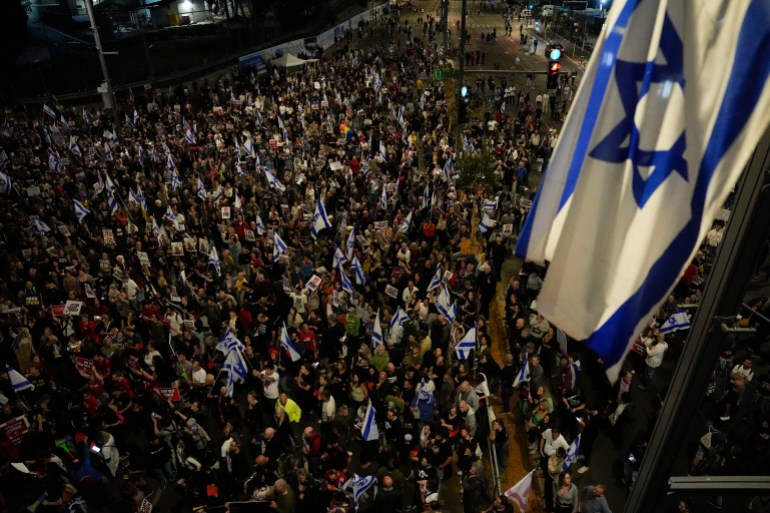
Local media reported demonstrations taking place in 50 locations across the country amid anger at Netanyahu’s government. Thousands of Israeli antigovernment protesters have gathered in Tel Aviv, among other parts of the country, to call on the government to reach a deal to free dozens of captives held by the Hamas group in Gaza and to hold early elections. The demonstrators shouted slogans late on Saturday, expressing anger at Benjamin Netanyahu’s government for its inability to secure the release of the captives after six months of fighting. Israeli media reported scenes of confrontations between security forces and protesters in Tel Aviv, where demonstrators reportedly started several fires, before they were quickly put out by the police. People chanted “Police, police who exactly are you guarding?”, and “Ben-Gvir is a terrorist”, referring to Israel’s minister of national security, the Haaretz newspaper reported. The protest organisers quoted by local media said rallies were taking place at about 50 other locations nationwide in addition to Tel Aviv. Such Saturday protests have become a regular occurrence in Tel Aviv and other parts of the country, since the early months of the war that began on October 7. The latest demonstrations come as ceasefire negotiations – which include discussions about the release of the captives – are set to take place in Cairo. The talks are being mediated by Qatar, Egypt and the United States. Two protests merge Al Jazeera’s Imran Khan, reporting from Tel Aviv, said that two different rallies had merged on Saturday, and the huge turnout of protesters was likely to put a lot of pressure on Netanyahu. “The ‘Bring Them Home Campaign’ now joined the antigovernment protesters,” he said. “The former is the advocacy group for the hostages. For six months, they have been demanding the prime minister to release the Palestinian political prisoners and in turn, get the hostages back. “Now, they are saying enough is enough. It has been six months and nothing has happened in terms of getting the majority of people out,” our correspondent added. “All the speeches we heard tonight had two key messages: Netanyahu failed and the hostages have to come home now.” Organisers of the antigovernment protests in Tel Aviv say that 100,000 people participated in the demonstrations, according to the Israeli media. Saturday protests calling for the release of captives have become a regular occurrence in Tel Aviv and other parts of the country [Ariel Schalit/AP] Israel declared war on Gaza after Hamas carried out a deadly attack on October 7, killing some 1,200 people and taking more than 200 others captive. More than 100 have since been released, but others remain captive in Gaza. Netanyahu launched Israel’s relentless war on Gaza in the aftermath of Hamas’s attack. In the last six months, at least 33,137 Palestinians have been killed and 75,815 wounded in Israeli attacks on the strip – with starvation and famine reported in particular in the north of the enclave due to lack of international aid access. Israel said on Saturday its special forces had recovered the body of a captive killed in Gaza. A new round of indirect truce negotiations is expected to begin in Cairo on Sunday. CIA Director Bill Burns will attend the talks along with his Egyptian counterpart. A representative from Hamas will also attend, the group said on Saturday. The Israeli side has not yet said whether it would send a delegation to the talks. Adblock test (Why?)