

Does Israel’s attack on aid workers mark a turning point for its allies?

The killing of international aid workers with World Central Kitchen (WCK) sparks strongest Western reaction to date. After six months of war and more than 33,000 Palestinians in Gaza killed, it was Israel’s killing of international aid workers this week that triggered the West’s most furious response to date. Israel has faced sharp criticism since Monday’s attack on a World Central Kitchen (WCK) aid convoy in Gaza – with even the United States joining the global chorus of condemnation. So how have events this week affected Israel’s international standing? Presenter: James Bays Guests: Nour Odeh – Palestinian political analyst Gideon Levy – Columnist for Haaretz newspaper in Tel Aviv Chris Doyle – Director at the Council for Arab-British Understanding in London Adblock test (Why?)
Latin American countries condemn Ecuador raid on Mexico embassy

Governments across Latin America have rallied around Mexico after security forces in Ecuador stormed the Mexican embassy in Quito to arrest a controversial politician who had been granted political asylum there. Argentina, Bolivia, Brazil, Chile, Colombia, Cuba, Peru, Uruguay and Venezuela sharply rebuked Ecuador on Saturday, hours after the seizure of Ecuador’s former Vice President Jorge Glas, with Nicaragua joining Mexico in severing diplomatic ties with Quito. During the incident, which took place late on Friday night, special forces equipped with a battering ram surrounded the Mexican embassy in Quito’s financial district, and at least one agent scaled the walls to extract Glas. The 54-year-old politician is wanted on corruption charges and has been holed up inside the Mexican embassy since seeking political asylum in December. Mexican authorities granted that request on Friday. Following his arrest, Glas could be seen on video circulating on social media being taken by a police convoy to the airport in Quito, flanked by heavily armed soldiers. He then boarded a plane en route to a jail in Guayaquil, the Andean nation’s largest city. Mexican President Andres Manuel Lopez Obrador blasted the unusual diplomatic incursion and arrest as an “authoritarian” act as well as a breach of international law and Mexico’s sovereignty, while the government of Ecuador’s President Daniel Noboa argued asylum protections were illegal because of the corruption charges Glas is facing. Still, under international law, embassies are considered the sovereign territory of the country they represent, and the Vienna Convention, which governs international relations, states that a country cannot intrude upon an embassy on its territory. Brazil’s government condemned Ecuador’s move as a “clear violation” of international norms and said the action “must be subject to strong repudiation, whatever the justification for its implementation”. Colombian President Gustavo Petro argued in a post on X that Latin America “must keep alive the precepts of international law in the midst of the barbarism that is advancing in the world”, while his government said in a separate statement that it will seek human rights legal protections for the now-detained Glas. The United States also said it condemns any violation of the convention protecting diplomatic missions and encouraged “the two countries to resolve their differences in accord with international norms”. United Nations Secretary-General Antonio Guterres, meanwhile, said he was “alarmed” by the raid, and urged both sides to show moderation in resolving the dispute, according to a spokesman. The Washington-based Organization of American States also issued a call for dialogue to resolve the escalating dispute, adding in a statement that a session of the body’s permanent council will be convened to discuss the need for “strict compliance with international treaties, including those that guarantee the right to asylum”. On Saturday, the Mexican embassy remained surrounded by police and the Mexican flag had been taken down. Mexico’s Ministry of Foreign Affairs said late in the day that diplomatic personnel and their families would leave Ecuador on a commercial flight on Sunday, adding that personnel from “friendly and allied countries” would accompany them to the airport. In Mexico City, about 50 demonstrators rallied outside Ecuador’s embassy, accusing Quito of being “fascist”. In an interview with national broadcaster Milenio, Mexico’s top diplomat Alicia Barcena expressed shock at Ecuador’s incursion into the country’s embassy, adding that some embassy personnel were injured in the raid. She added that Glas was granted asylum after an exhaustive analysis of the circumstances surrounding the accusations he faces. Glas was vice president under former leftist president, Rafael Correa, between 2013 and 2017. He was released from prison in November after serving time for receiving millions of dollars in kickbacks in a vast scandal involving Brazilian construction giant Odebrecht. He faces another arrest warrant for allegedly diverting funds that were intended for reconstruction efforts after a devastating earthquake in 2016. Glas has claimed he is the victim of political persecution, a charge Ecuador’s government has denied. Former President Correa, who has been exiled in Belgium since 2017 and was sentenced in absentia to eight years in prison for corruption, wrote on X that “not even in the worst dictatorships has a country’s embassy been violated”. He said Glas “was struggling to walk because he was beaten”. Adblock test (Why?)
Reporting under genocide: Six months in Gaza

With international reporters locked out, Palestinian journalists have made huge sacrifices to keep the world informed of the unprecedented killing and destruction in Gaza. More media workers have been killed by Israel since October 7 than in any other conflict in modern history. Like the rest of the population, Gaza’s journalists have also been maimed, arrested or threatened, have seen their homes and offices destroyed and are grieving over the loss of those close to them. The Listening Post spent time with three Al Jazeera journalists between February and March 2024. Contributors:Anas al-Sharif – Reporter, Al Jazeera ArabicHind Khoudary – Reporter, Al Jazeera EnglishMarah Elwadiya – Journalist, Al Jazeera Digital A Listening Post/Ain Media co-production. Videography by Mahmoud Sarraj, Ibrahim Nofal and Sari Hennawi. Tariq Nafi – Senior ProducerShrouq Aila – Gaza-based ProducerAhmed Madi – ProducerKit Harwood – EditorMeenakshi Ravi – Executive Producer Adblock test (Why?)
Palestinians mark last days of Ramadan on the eve of six months of war

Palestinian Muslims are marking a tense and sombre last weekend in Ramadan, as Israel’s war on Gaza approaches the six-month mark. Some 120,000 people descended on the Al-Aqsa Mosque compound, which dominates the Old City in Jerusalem, officials said on Friday. There were minor scuffles between worshippers and Israeli police controlling the entrance to the mosque, which is the third holiest site in Islam. Adli al-Agha, 53, from Jerusalem, told the AFP news agency that many people “had to flee dawn prayers” after Israeli police deployed a mini-drone spraying tear gas to disperse worshippers. Friday marked Laylat al-Qadr (“The Night of Power”), considered the holiest night of Ramadan, which commemorates the moment the Quran was first revealed to the Prophet Muhammad. It is the night when Muslims believe their prayers are most likely to be granted, a festive moment while children stay up late and shops stay open till the small hours. But many Palestinians are not in the mood to celebrate and are praying for an end to the war in Gaza after almost six months of bloodshed. Sameeha al-Qadi, 55, who had come from near Bethlehem, said Jerusalem “is sad and has lost its light – we all feel what is going on in Gaza. We can’t escape it for a minute”. This year there are few Ramadan decorations or lights in the Holy City, with Palestinians instead having a bitter coffee and a date – traditionally to mark mourning – on Tuesdays and Wednesdays, when feasts are usually held. “There is sweet nothing about the feast this year. People are not celebrating,” said Sabah, 54, some of whose relatives have been killed in Gaza. “Everything is bitter in my mouth. It is so painful at this time which is all about family.” In Rafah, in the southern Gaza Strip, Palestinians gathered on Laylat al-Qadr, praying in and outside a tent they had built near the debris of al-Faruq Mosque – now reduced to ruins by Israeli air strikes. People also gathered to pray within the surviving section of the Great Omari Mosque in Gaza City. Also known as the Great Mosque of Gaza, the largest and oldest mosque in the strip was destroyed by Israeli military bombardments. Despite its destruction, the mosque remains a favoured venue for residents of the region to gather for prayers. Palestinians displaced from their homes in Gaza for almost six months by Israeli attacks have observed Ramadan in makeshift tents, under limited means and difficult conditions. Many are spending the last days reading the Quran or decorating their tents for Eid. Adblock test (Why?)
Palestinians and the world must not lose hope

When in early October we, Palestinians, laid out to the world what was going to happen, our testimonies and foresight were seen as an exaggeration. Our warnings of Israel’s terrifying enthusiasm for using excessive violence were not taken seriously. Worse, our warnings that Israel was going to commit killings of Palestinians on a massive scale were dubbed “anti-Semitic”. Today, the official statistics say 33,000 Palestinians have been killed by Israeli air strikes with US-made bombs, shelling and field executions in Gaza and the West Bank. This number does not account for all those “missing” under the rubble, shot dead in the streets or in their homes by the occupation soldiers, or buried under the sand by their bulldozers. And while Gaza is bearing the brunt of Israel’s tormenting violence, Palestinians in the West Bank are being arrested by the thousands, including children, most of whom are denied trial. They are held under torturous and abusive conditions that have resulted in the killing of at least 13 Palestinian captives in the last six months. Meanwhile, Palestinians with Israeli citizenship as well as Palestinians in Jerusalem suffer under Israel’s draconian apartheid laws while being policed, detained, tortured and attacked by Israeli mobs for simply sharing social media posts or consuming what Israel calls “terrorist media”. If I were to describe the past 26 weeks, it would be one hour after another of just barely pulling through. I have asked myself, what is the point of writing another piece about Israel’s remorseless sadism? Between pitching this article and finding the strength to actually write it, more than 3,000 Palestinian children, women and men were killed. Al-Shifa Medical Complex was completely destroyed and the extrajudicial killings in the West Bank have only intensified. The feeling of numbness, of paralysis among Palestinians is one of the aims of the Israeli “attrition” strategy. A war of attrition is meant to create the conditions to drain, exhaust and weaken an opponent. It is meant to diminish the capacity to fight back. Israel’s goal is the emotional, moral and mental depletion of those resisting its occupation and colonisation so they lose motivation and commitment to engage and mobilise in the face of brute repression. It has applied this strategy in “peacetime” as well. Following in the footsteps of European colonialists and their logic of pacification, Israel has sought to wear down the Palestinian population into full submission by making life impossible at all levels. While feeding the world the false narrative of “self-defence”, it has tried to create the moribund Palestinian: not necessarily dead, but always on the edge, constantly facing the choice between death and torment. I do not think I will ever be able to fully explain what it is like to be a Palestinian – in all the shades of bruises we come in. It is not for the lack of words as much it is for the recognition that if I were to speak of the horrors, I am not confident that those who listen would bear to hear all the pain embedded in the Palestinian experience. For the past 182 days, Palestinians have been plunged into waves of deep grief, penetrating pain, and a crippling fear of anticipated loss. Quivers of terror remain stuck in our spine unable to escape, just like us. One of the most testing parts of this aggression is having to manage this grief. So many people we know are either killed, arrested or displaced. Palestinians have suffered not only physical displacement but psychological displacement as well; our mental and emotional anchors have been dislodged. It is an excruciating type of pain to keep witnessing the different ways in which Palestinian bodies can be turned lifeless. There is no capacity to bury the slain bodies, no ability to collectively mourn our losses, not just the material but also the emotional: the destroyed homes, the destroyed memories, and the destroyed hope we mustered to have. With continued exposure to Israel’s unyielding psychopathy, comes a collective feeling of burnout not only among the population still trying to survive Israel’s slaughter, but also among those mobilising to stop a genocide still being committed as I write these words. The burnout is real. Too many of us are too exhausted to say anything, to resist succumbing to the delusion that our voices do not matter and will achieve nothing. As we sit with those uncomfortable and hopeless feelings, the war persists and the scale of the horrors increases. And it is not just us, Palestinians in Palestine. This extends to those in the world who rose up against the genocide. Israel has responded to global resistance with more slaughter – like the killing of international humanitarian workers – and more lobbying for its critics to be punished. As governments refuse to take action to end the slaughter, those mobilising against the genocide are slowly and strategically pushed towards incapacitation, despair, and the conviction that the Israeli onslaught cannot be stopped. In May of 2021, when Palestinians were in the midst of the largest uprisings of the past decades, when they showed true unity across Gaza, the West Bank, the 1948 territories and the diaspora, I wrote a piece for the Guardian titled, Why are Palestinians protesting? Because we want to live. I wrote the piece on my phone in between running from tear gas fired by Israeli soldiers and barely escaping the brutal beatings at the hands of the Palestinian Authority’s security forces. Those were brutal times, terrifying times, and defining times. In that piece, I tried to capture the strategy of colonialism: “This is what colonialism does: it suffocates every part of your life, and then it finishes by burying you.” I was not trying to draw a silhouette of a killer. I was trying to capture the moment of defiance and renewed unity among Palestinians from the river to the sea and in the diaspora. “It is a strategic, deliberate process, and it is only obstructed or delayed because oppressors are
‘Mission impossible’: Families slam Canada’s Gaza visa scheme as a failure
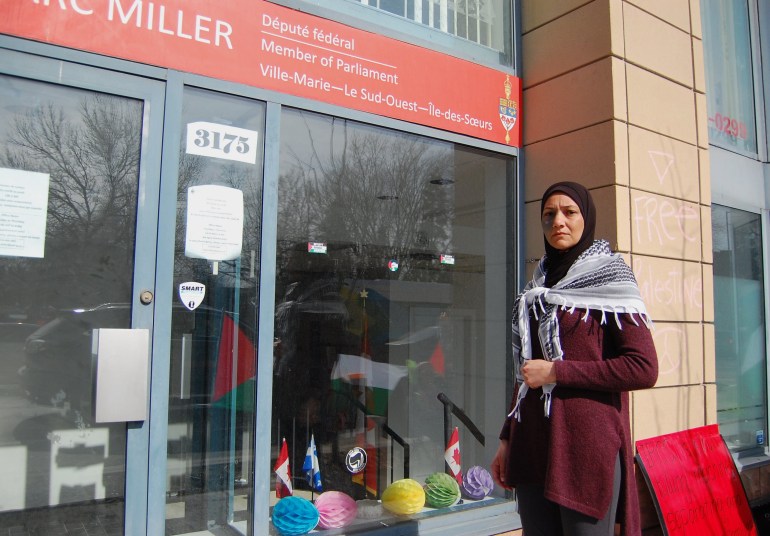
Montreal, Canada – “Unlivable.” That’s how Canada’s immigration minister, Marc Miller, described the situation in the Gaza Strip in late December. The Palestinian territory was under fierce Israeli bombardment at the time. At least 20,000 people had been killed, and hunger was spreading at an alarming rate as Israel blocked deliveries of food, water and other necessities. As conditions continued to deteriorate, Miller announced that the Canadian government was launching a special visa programme to allow citizens and permanent residents to bring extended family members from Gaza to Canada. “To be clear, today is about providing a humanitarian pathway to safety and recognising the importance of keeping families together given the ongoing devastation,” he told reporters on December 21. But more than three months later, not a single Palestinian applicant has left the Gaza Strip as a result of the visa programme. That has fuelled a sense of anger and frustration for families who say Canada has abandoned them and their loved ones — and are demanding action from Prime Minister Justin Trudeau’s government. Samar Alkhdour stands in front of Canadian Immigration Minister Marc Miller’s office in Montreal on March 29 [Jillian Kestler-D’Amours/Al Jazeera] “What are they waiting for?” asked Samar Alkhdour, a Palestinian mother who has lived in Canada since 2019 and received permanent residency in February. Alkhdour began a daily sit-in outside Miller’s office in Montreal, the second-largest city in Canada, late last month to put pressure on the government to get her relatives out of Gaza. She is trying to bring her sister, her sister’s husband and their two children — who are currently living with relatives in Deir el-Balah, in central Gaza — to Montreal to join her and her family. But the family’s applications remain in the early stages of the process, Alkhdour told Al Jazeera. “I’m still fighting, I’m working on it,” she said in late March at the sit-in, a black-and-white keffiyeh draped over her shoulders. “But deep down inside, in my heart, I’m starting to lose hope. “And maybe that’s one reason I’m here — because no one’s doing nothing.” Adblock test (Why?)
Amid diplomatic spat, Mexico grants former Ecuadorian vice president asylum

Amid a developing diplomatic spat, Mexico has granted asylum to a former Ecuadorian vice president accused of bribery while in office. In a statement on Friday, Mexico’s foreign ministry said it had offered political asylum to Jorge Glas, who has been staying in Mexico’s embassy in Quito since late last year. The statement called on Quito to grant “safe passage” to Glas, who had twice been convicted of corruption, to leave the country. “Once asylum is granted, the asylum state can request the departure of the asylum seeker to a foreign territory, and the territorial state [Ecuador] is obliged to immediately grant the corresponding person safe passage,” Mexico’s foreign ministry wrote. The ministry also condemned what it described as an “increase in the presence of Ecuadorian police forces” outside of its embassy in Quito. Ecuadorean authorities have continually sought permission to enter the embassy and arrest Glas, who was sentenced to six years in prison in 2017. The announcement has come at a moment of heightened tension for the two countries. On Thursday, Ecuador declared Mexico’s ambassador a “persona non grata”, in response to comments made by Mexican President Andres Manuel Lopez Obrador. What did Lopez Obrador say? The remarks that set off the diplomatic incident were aired on Wednesday, during Lopez Obrador’s daily news briefing. Speaking to reporters, the left-leaning Mexican president implied that violence had affected the outcome of Ecuador’s recent presidential elections. “In a very strange way, there were elections in Ecuador,” Lopez Obrador explained. He then proceeded to address the assassination of Ecuadorean presidential candidate Fernando Villavicencio in August 2023, weeks before the first round of voting. Lopez Obrador implied that frontrunner Luisa Gonzalez ultimately lost Ecuador’s election because of Villavicencio’s murder and the media speculation it produced. Villavicencio had been a longtime anticorruption campaigner and was a vocal critic of Gonzalez’s left-wing party, the Citizen Revolution Movement. “A male candidate who speaks ill of the female candidate who was on top is suddenly murdered,” Lopez Obrador said, without naming either Villavicencio or Gonzalez. “And the female candidate who was at the top falls.” In the run-off vote in October, Gonzalez narrowly lost the Ecuadorian presidency to centre-right businessman Daniel Noboa, a relative newcomer to national politics and the heir to a banana industry fortune. What was the reaction? The Ecuadorian foreign ministry followed Lopez Obrador’s statements on Thursday by declaring Mexico’s ambassador to Ecuador, Raquel Serur Smeke, persona non grata and telling her to leave the country “soon”. It also acknowledged Villavicencio’s assassination, which took place outside of a political rally in Quito on August 9. “Ecuador is still mourning this unfortunate event that caused shock in Ecuadorian society and threatens democracy, peace and security,” the ministry wrote. It also called Lopez Obrador’s statements on the matter “unfortunate”. Supporters of the Mexican president, however, defended his remarks, saying that he was attempting to compare the situation in Ecuador to the recent violence Mexico has faced in the run-up to its June 2 elections. Several local candidates in Mexico have already been killed, including Bertha Gisela Gaytan, a candidate representing Lopez Obrador’s Morena party in the race to be mayor of Celaya. Critics have also pointed out that Lopez Obrador’s statements appeared to be largely critical of the media. In his Wednesday remarks, Lopez Obrador accused media companies of whipping up a “heated atmosphere” in Ecuador before the vote. On Friday, Lopez Obrador said Mexico would not expel Ecuador’s ambassador in retaliation. Speaking shortly before his foreign ministry made the announcement on Glas, he shrugged off the suggestion that there was any dispute between the two countries. “For there to be a fight, there need to be two parties involved,” he said. He also called Mexico’s ambassador to Ecuador, Serur Smeke, an “exceptional person”. Known for his outspokenness, Lopez Obrador has spurred tensions in recent years with his comments about regional politics. Last year, for instance, he provoked ire in Peru after offering asylum to impeached former President Pedro Castillo, who is currently in jail. He also questioned the legitimacy of Castillo’s successor, current President Dina Boluarte. “So long as there isn’t democratic normalcy in Peru, we don’t want economic or trade relations with them,” he said. Peru’s Congress responded by declaring Lopez Obrador a “persona non grata”. Adblock test (Why?)
‘Fishing’: Judge denies Trump team bid to seize NBC Stormy Daniels material

Judge Juan Merchan criticised the defence team’s attempt to compel NBC to turn over documents related to Stormy Daniels. A New York Judge has blocked an attempt by Donald Trump‘s lawyers to force the NBC news network to turn over materials related to a recent documentary about adult film actor Stormy Daniels. The ruling on Thursday by Manhattan Judge Juan Merchan comes shortly before a trial related to both Trump and Daniels is set to start on April 15. In New York, Trump – the former United States president – faces 34 felony counts of falsifying business records for alleged hush money payments he made to Daniels and others. Marchan called the Trump team’s efforts to subpoena NBC “the very definition of a fishing expedition”. The request, he said, did not meet the heavy legal burden needed to require a news organisation to provide unrestricted access to its reporting. The ruling is the latest setback for Trump, who is set to be officially named the Republican Party’s candidate for the 2024 presidential race. He faces four separate criminal cases, with the New York trial the first to begin. The case centres on allegations that Trump falsified his company’s internal records to hide the true nature of the hush money payments, made during the 2016 presidential campaign. The payments were made through his former lawyer Michael Cohen, who allegedly helped bury negative stories about Trump, a presidential hopeful at the time. Among other payments, Cohen offered Daniels $130,000 to suppress her claims of an extramarital sexual encounter with Trump years earlier. Daniels is set to be a key prosecution witness in the trial. On Wednesday, Merchan also rejected a request from the defence team to delay the trial until the US Supreme Court rules on claims of presidential immunity claims Trump has made in a separate case. Merchan said the request was untimely. Trump’s lawyers had previously failed to block Cohen and Daniels from testifying in the trial. The New York indictment was the first of the four criminal cases against Trump to be announced. After the history-making indictment in March of last year, Trump pleaded not guilty to the 34 felony counts. His lawyers had argued the payments were legitimate legal expenses. The former president has also denied having a sexual encounter with Daniels, whose real name is Stephanie Clifford. Trump’s lawyers had subpoenaed NBC Universal on March 11. They sought all documents related to the production, editing, marketing and release of the documentary, as well as any compensation Daniels received and any agreements between her and the network. The lawyers argued the subpoena would yield evidence that NBC Universal and Daniels colluded to release the documentary close to the start of the trial to bias the public and increase profits. NBC had denied those claims. In the four-page decision, Judge Merchan wrote that the defence subpoena was “far too broad” and that its collusion claims were “purely speculative and unsupported” by evidence. Merchan added the subpoena sought to “rifle through the privileged documents of a news organization”. In addition to the New York state hush money case, Trump also faces two federal criminal cases. One, in Florida, is for allegedly hoarding classified documents after leaving office. The other, in Washington, DC, accuses him of conspiring to overturn the 2020 presidential elections. He faces a fourth criminal case in Georgia for efforts to overturn election results in that state too. Adblock test (Why?)
Is India behind targeted killings in Pakistan? What we know

Islamabad, Pakistan — Since June 2021, Pakistan has tracked and accused Indian intelligence agencies of multiple attempts — some successful — at assassinating individuals New Delhi views as terrorists sheltered by Islamabad. On Thursday, British newspaper The Guardian backed those claims, three months after Pakistan’s government formally levelled similar allegations against India. But in the murky world of spies and contract killers, where little can be confirmed independently, New Delhi has long denied its role in extraterritorial assassinations — even as allegations against it have mounted, including from the United States and Canada, friends of India. Here’s what’s known about the alleged killings in Pakistan, what remains limited to accusations, and the implications of the allegations. Who is India accused of having killed in Pakistan? Pakistani security officials speaking to Al Jazeera on condition of anonymity acknowledged at least six killings in 2023, and two in the year before, as those that they believe were carried out by a “hostile intelligence agency” — code for India’s external spy agency, the Research and Analysis Wing — and were investigating. In January this year, Pakistan’s top diplomat in a news conference also claimed that there is “credible evidence” of Indian involvement in killings in the country. “These are killings-for-hire cases involving a sophisticated international set-up spread over multiple jurisdictions,” Foreign Secretary Muhammad Syrus Sajjad Qazi told reporters on January 25 in Islamabad. Qazi specifically mentioned the murders of Muhammad Riaz, killed in Pakistan-administered Kashmir in September 2023, and Shahid Latif, killed a month later in the city of Sialkot in the eastern province of Punjab. The diplomat alleged that both the murders were orchestrated by Indian agents. After the killing of two men, Indian news outlets claimed that Riaz was a top commander of the Lashkar-e-Taiba (LeT), a Pakistan-based armed group that New Delhi has long accused of some of the deadliest attacks on its soil — including in Mumbai in 2008, when gunmen killed 166 people over three days. Latif, Indian channels claimed, was associated with another Pakistan-based armed group, the Jaish-e-Muhammad (JeM), and was allegedly a key figure involved in the attack on an Indian airbase in Pathankot in January 2016, in which one civilian and seven Indian security personnel were killed. Pakistan did not confirm these alleged links. While Pakistan has not formally acknowledged any other killings besides the two, Qazi in his news conference said there were more incidents that the government is probing into. “There are a few other cases of similar gravity at various stages of investigation,” he said. Among the suspected assassinations was the killing of Sikh community leader Paramjit Singh Panjwar in Lahore — Panjwar was shot dead in May last year. The Indian government had declared Singh an “individual terrorist”, issuing a notification [PDF] in 2020, which accused him of arranging arms training and supplying weapons to carry out attacks in India. Saleem Rehmani, also wanted by India as a “terrorist”, was shot dead in January 2022 in Pakistan. The residence of Hafiz Saeed, co-founder of the banned organisation Lashkar-e-Taiba (LeT), was targeted in June 2021 in Lahore [EPA] What about other Indian operations in Pakistan? Abdul Sayed, a Sweden-based researcher on armed groups says the recent killings — if indeed orchestrated by India — were foreshadowed by a significant event three years ago in June 2021 when a car bomb explosion in Lahore took place near the residence of Hafiz Saeed, the co-founder of the LeT. “Pakistani authorities attributed this incident to Indian intelligence,” Sayed told Al Jazeera. “Subsequently, there was an escalation in attacks from early 2022 onwards, targeting key commanders of various former Kashmiri armed groups.” National Security Advisor Moeed Yusuf had first blamed India for the attack outside Saeed’s house in July 2021 — a charge that Pakistan levelled again in December 2022. Saeed, who is currently in custody in Pakistan, is accused by India and the United States of masterminding the 2008 Mumbai attacks. India has been demanding that Pakistan hand over Saeed — who has denied the charges — to face trial in the case. The last such demand was made by the Indian government in December last year. The primary bone of contention between the two nuclear-armed neighbours is the picturesque Kashmir valley, which is currently divided in two, with both India and Pakistan controlling parts of it. They have fought two of their three full-fledged wars over the territory. India accuses Pakistan of supporting armed groups such as the LeT and JeM in a bid to foment trouble in Indian-administered Kashmir. Pakistan has steadfastly denied the charges, saying it merely supports the right of Kashmiri citizens to self-determination against Indian rule. India calls armed rebels in Kashmir “terrorists”. What has India said about Pakistan’s allegations? India, which denied the allegations in the latest news report, has also rejected the accusations made by Pakistan previously that New Delhi’s spies were involved in killings on foreign soil. In January, after the Pakistani foreign secretary’s media briefing, the Indian Ministry of External Affairs described the allegations as Pakistan’s attempt at “peddling false” propaganda, saying Pakistan will “reap what it sows”. “As the world knows, Pakistan has long been the epicentre of terrorism, organised crime, and illegal transnational activities. India and many other countries have publicly warned Pakistan cautioning that it would be consumed by its own culture of terror and violence,” the Indian statement said. But Pakistan is no longer the only country levelling such allegations against India. Is India accused of other killings on foreign soil? The allegations and reports of India’s involvement in the killings of Pakistani nationals come at a time when New Delhi has also been accused by the US and Canada of a potential role in plots to assassinate dissidents living in those countries. In November, US prosecutors said an Indian intelligence official had masterminded a plan for the killing of Sikh separatist Gurpatwant Singh Pannun, a dual citizen of the US and Canada, in New York. Nikhil Gupta, a middleman tasked with finding
Few changes after Kuwait holds first parliamentary election under new emir

Opposition candidates won 29 seats in the 50-member assembly, closely matching the outcome of last year’s polls, official results show. Opposition politicians maintained a majority in Kuwait’s parliament, results have shown after the country’s third parliamentary vote in as many years. The polls on Thursday were the first to be held under new Emir Sheikh Mishal al-Ahmad al-Sabah who came to power late last year after the death of his half-brother and predecessor, Sheikh Nawaf al-Ahmad al-Jaber al-Sabah. The official KUNA news agency said on Friday that opposition candidates had won 29 seats in the 50-member assembly, matching the outcome of last year’s election. Results also showed a single female candidate was elected, the same as in the previous parliament, while Shia Muslim legislators secured eight seats in the predominantly Sunni Muslim country, one more than last year. Seats for the Islamic Constitutional Movement, which represents the Kuwaiti branch of the Muslim Brotherhood, fell to one from the previous three. Overall, the makeup of the new parliament is very similar to the outgoing one, with all but 11 politicians retaining their seats. “No radical change was expected in the results,” said Bader al-Saif, assistant professor of history at Kuwait University. “This is one of the lowest change ratios,” he told AFP news agency. Turnout was about 62 percent after polling stations closed at midnight, the information ministry said. Parliamentary elections have become an annual occurrence for Kuwait, which has seven percent of the world’s oil reserves and the monarchical Gulf’s most powerful elected assembly. However, disputes between the national assembly and the royal-appointed cabinet have caused constant deadlocks, delaying much-needed reforms. The vote was the third since 2022 and the fourth in five years. Political showdown With little change to the parliamentary lineup, the political impasse is expected to continue, according to al-Saif. “A new showdown is in the making,” he said, adding that “some of the new faces are quite outspoken.” Sheikh Mishal has been eager to push through economic reforms in what observers say is an apparent attempt at helping the OPEC producer to catch up with Gulf neighbours which have been implementing ambitious plans to wean their economies off oil. The 83-year-old took aim at the last National Assembly and the government in his first speech before parliament after taking office in December, saying they were “harming the interests of the country and its people”. The government of Sheikh Ahmed Al-Nawaf resigned hours after the speech. Sheikh Muhammad Sabah Al-Salem Al-Sabah formed a new government that included new ministers of oil, finance, foreign affairs, interior and defence. Sheikh Mishal then dissolved parliament on February 15, less than two months into his tenure. His decree cited the assembly’s “violation of the constitutional principles” as a reason for the dissolution. The new parliament will be tasked with approving the emir’s choice of crown prince, Kuwait’s future emir. If the assembly takes the unprecedented step of rejecting his heir, Sheikh Mishal will submit three candidates for parliamentarians to choose from. Adblock test (Why?)