

Outrage grows over Israel’s deadly attack on Gaza aid convoy
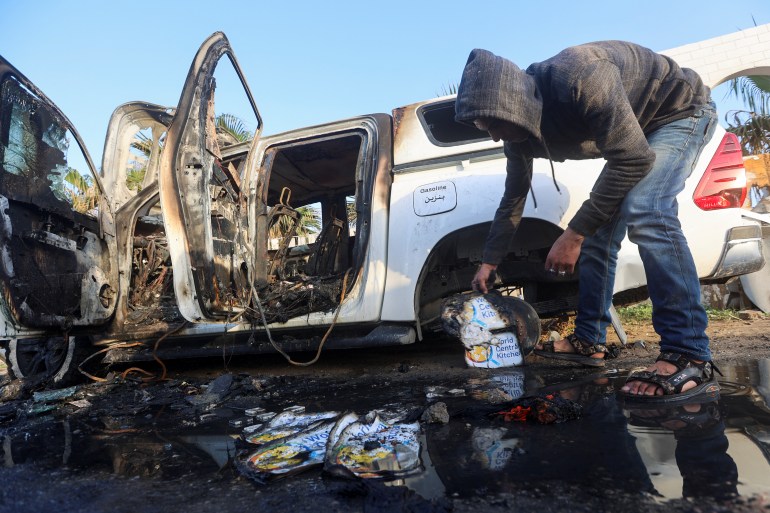
There is growing outrage around the world after Israeli air strikes killed seven aid workers from the World Central Kitchen (WCK) charity, as the country faces increased scrutiny over its conduct in the war on Gaza. WCK, one of two NGOs spearheading efforts to distribute aid brought by boat, said a “targeted Israeli strike” on Monday killed Australian, British, Palestinian, Polish and US-Canadian staff. Israeli Prime Minister Benjamin Netanyahu has said Israeli forces “unintentionally” killed the aid workers and promised an inquiry. The military said on Wednesday it had committed a “grave mistake”. “It shouldn’t have happened,” military chief Herzi Halevi said in a video message as he blamed the strike on a “misidentification – at night during a war in very complex conditions”. Several of Israel’s key allies have expressed outrage at the deaths and called for an independent investigation into the attack. Australian Prime Minister Anthony Albanese said he had spoken to Netanyahu and conveyed that his country was “outraged” by the “completely unacceptable” death of the Australian worker, Zomi Frankcom. Albanese said he raised the importance of full accountability and transparency, and that Netanyahu had committed to a comprehensive inquiry. Poland’s Prime Minister Donald Tusk said the attack and Netanyahu’s subsequent reaction have caused “understandable anger”. “Mr. Prime Minister Netanyahu, Mr. Ambassador Livne the vast majority of Poles showed full solidarity with Israel after the Hamas attack,” Tusk said in a post on social media platform X. “Today you are putting this solidarity to a really hard test. The tragic attack on volunteers and your reaction arouse understandable anger.” United Nations Secretary-General Antonio Guterres called the strike “unconscionable”, adding it was “an inevitable result of the way the war is being conducted”. “It demonstrates yet again the urgent need for an immediate humanitarian ceasefire, the unconditional release of all hostages, and the expansion of humanitarian aid into Gaza,” he said in a speech to the UN General Assembly. The UN says the war has killed almost 200 aid workers, including more than 175 members of the UN staff. Earlier, US President Joe Biden said he was “outraged” and demanded that Israel’s investigation into the strikes “must be swift, it must bring accountability, and its findings must be made public”. He said Israel had not “done enough to protect civilians”. The US, which gives $3.8bn in annual military assistance to its longtime ally Israel, has so far resisted calls to condition any arms transfers amid the war in Gaza. Asked on Tuesday whether incidents like the killing of WCK staff gave the US pause in light of its recent approval of a new weapons package worth $2.5bn, Secretary of State Blinken said Washington had “a longstanding commitment to Israel’s security and to help it ensure its ability to defend itself”. Canada and the United Kingdom have also condemned the attack and called for a thorough investigation. A Palestinian inspects a vehicle in which World Central Kitchen employees were killed in an Israeli attack [Ahmed Zakot/Reuters] The attack on the aid workers comes amid a growing hunger crisis in the coastal enclave, with a recent UN-backed report saying famine in northern Gaza was imminent. Last week, the International Court of Justice (ICJ) ordered Israel to increase the flow of humanitarian aid into Gaza without delay. Nevertheless, Israel continues to hinder the work of the NGOs attempting to distribute food aid, including the UN agency for Palestinian refugees, UNRWA, from accessing northern Gaza, where hunger is at its extreme. Israel has accused UNRWA employees of participating in Hamas’s October 7 attacks, leading to a host of countries suspending funding to the agency. However, Israel has yet to provide evidence to support its claim, and several donors, including the European Union, Canada and Australia, have resumed funding. An investigation by Al Jazeera’s Sanad Verification Agency found that the Israeli army attacks on the convoy were intentional, based on research using open-source information, witness testimonies, and images from the site. At least 32,916 people have been killed, mostly women and children, in the Israeli assault on Gaza since October 7, according to Palestinian authorities. Adblock test (Why?)
One in 10 Afghan children under five malnourished, 45 percent stunted: UN

Roya carefully spoon-feeds her daughter fortified milk in a ward for malnourished children, praying the tiny infant will avoid a condition that stalks one in 10 children in Afghanistan after decades of conflict. The nine-month-old had been hospitalised three times already in remote Badakhshan province because her mother had trouble breastfeeding. “She has gained a bit of weight. She has a bit of a glow,” 35-year-old Roya said, cradling Bibi Aseya at the Baharak district hospital. “She drinks milk as well, but she still doesn’t smile,” she added. “I would stay awake day and night. Now I can sleep.” Poor nutrition is rife in a country plagued by economic, humanitarian and climate crises two and a half years since the Taliban returned to power. Ten percent of children under five in Afghanistan are malnourished and 45 percent are stunted, meaning they are small for their age in part due to poor nutrition, according to the United Nations. Afghanistan has one of the world’s highest rates of stunting in children under five, said Daniel Timme, communications chief for UNICEF. “If not detected and treated within the first two years of a child’s life, the condition [stunting] becomes irreversible, and the affected child will never be able to develop mentally and physically to its full potential,” he said. “This is not only tragic for the individual child but must have a severe negative impact on the development of the whole country when more than two out of five children are affected.” A plunge in international aid and medical professionals leaving the country have weakened an already vulnerable health system, and women and children are particularly impacted, NGOs said. Hasina, 22, and her husband, Nureddin, are volunteers at one of the hundreds of community-based health posts supported by UNICEF in Badakhshan, a mountainous region that borders Pakistan, Tajikistan and China. The couple is an initial lifeline for the more than 1,000 residents of Gandanchusma village. “We gather women and children and weigh the babies. If they are malnourished, we support them and refer them to the clinic,” a 30-minute walk away, Hasina said. In warmer weather, she added, she sees more cases of malnutrition due to water-borne illnesses. Nearly 80 percent of people in Afghanistan lack sufficient access to clean water, according to the UN Development Programme. Aisha, who asked that her real name not be used, had a clean water pump installed at her home in the Badakhshan town of Khairabad through a UNICEF project. But she said the women around her still lack access to information. “The women who had some education could boil water, provide medicine or make homemade medicines, but the women who did not have any education were less capable,” she said. In a recent report warning of the frailty of the Afghan health sector, Human Rights Watch underscored the outsized impact on women because of restrictions on their movement, education and employment. Aisha and her peers share information but worry that doing so is not enough to combat their web of challenges, both social and economic, that contribute to poor nutrition and stunting. “At the village level, it is difficult for us because we have many illiterate mothers,” another Khairabad resident, Amina, said. “We need more health and community workers to raise awareness among the people, distribute medicines for malnourished children and provide family planning and healthcare advice.” Adblock test (Why?)
‘No means no’: How Portugal resisted the far right, but only just

When the March elections in Portugal saw the hard-right political party, Chega, quadruple its parliamentary representation from 12 seats to 50, one conclusion appeared overwhelmingly obvious. Overnight, it looked as if Europe’s most westerly country had become the continent’s latest front line between populist, ultra-conservative parties enjoying surging support and more traditional, centrist formations facing crumbling voter backing. The Chega electoral earthquake – and the narrowest of victories for the centre-right Democratic Alliance (AD) coalition over the incumbent Socialists by just 80 seats to 78 – showed how voter support for the two main parties had slumped to its lowest level since 1985. But when it comes to running the country, albeit with much shakier support than they would like, for now Portugal’s long-standing political establishment remains at the helm. On April 2, Luis Montenegro, whose conservative Social Democratic Party (PSD) constitutes AD’s principle component, is set to be sworn in as leader of a new minority government, and he will do so without counting on default parliamentary support from the hard-right “new kid on the political block”. “Governing under the current circumstances is anticipated to be challenging,” warns Sofia Serra-Silva, a political scientist at the University of Lisbon’s Social Science Institute. “The new government will navigate a fragmented parliament, with the Socialist Party strongly established as the opposition and Chega applying pressure from the right. For the AD, securing a simple majority will be a complex task.” So, while the PSD celebrates its return to power for the first time since 2015, the question of how a minority centre-right government will successfully legislate its policies – while avoiding a power-sharing agreement with Chega – will be central to the country’s political future. That dilemma, in turn, overlaps with a second, more deep-rooted issue: How will a political establishment with an apparently chronic case of withering electoral support handle Chega’s seemingly relentless rise in the polls? Supporters of the far-right Chega party react to the first exit polls during the general election in Lisbon, Portugal, on March 10, 2024 [Pedro Rocha/Reuters] ‘Cordon sanitaire’ unlikely Both predicaments have parallels across Europe, but Serra-Silva argues that the idea of a “true cordon sanitaire, meaning complete non-cooperation” – as is the case in Germany, for example, between the traditional parties and the hard-right Alternative for Germany (AfD) – “in Portugal seems unlikely”. “Despite the centre-right party leader’s campaign assertion of no coalition with Chega, internal opinions and past collaborations, like Chega’s support for PSD in Azores, suggest a more nuanced stance.” “The ‘no means no’ statement [by Montenegro] referred only to cabinet formation, not precluding other forms of cooperation.” Meanwhile, grassroots voter-level concern is rising in some quarters about how Chega’s ideas are becoming increasingly mainstream, paralleling their sharp rise in political influence. “I am concerned because of the election result but also because I think the attitude of Portuguese people towards these kinds of politics is changing a bit,” says Alexandre Pinto, a language teacher in Lisbon. “The taboo towards displaying racist or xenophobic attitudes is disappearing and the end result is Chega. Of course, these things don’t change abruptly. But perhaps what was hidden has now become more open.” While Serra-Silva says a clear-cut cordon sanitaire in parliamentary politics is very unlikely, Pinto argues that on a practical level, some kind of agreement is needed between the traditional parties to handle the rise of a party as notoriously volatile as Chega. “I wouldn’t call it a cordon sanitaire – the Socialists have already had that discussion. But when it comes to solid policies for defending democratic values, I believe understanding between the two traditional parties must be reached, because, basically, we don’t know what Chega will do.” The events in Portugal’s parliament last week, where Chega backtracked on an agreement with the PSD over their votes for parliamentary president and vice-president – positions of largely symbolic importance – highlight the complexities the government faces in navigating agreements, Serra-Silva says, and “showcase how the far-right has disrupted Portugal’s traditionally stable two-party system”. On the other hand, Serra-Silva argues that historically, finding common ground on numerous policy issues for the two main parties, the PSD and Socialists, has proved possible. She points to a Socialist offer of support on March 19 for a rectification of the 2025 State Budget in order to prioritise the welfare of key public-sector workers as one such area where potential new deals could be struck. According to Serra-Silva, Luis Montenegro’s future strategy hints at bypassing parliament when necessary and governing by decree, “reflecting a practical response to legislative hurdles”. “However, this approach has its limitations, as evidenced by the recent difficulties encountered during the election of the Parliament’s president,” Serra-Silva says. “Given these constraints, the question arises: Will Montenegro seek support from Chega or the Socialists?” Portugal’s Social Democratic Party (PSD) and Democratic Alliance (AD) leader Luis Montenegro reacts following the result of the general election in Lisbon, Portugal, on March 11, 2024 [Pedro Nunes/Reuters] Can minds meet? Meanwhile, the idea of using persuasion and discussion to enable society to absorb the shock waves caused by the far right also has its grassroots supporters. Among them is Dr Francisco Miranda Rodrigues, president of one of Portugal’s top associations of mental health professionals, the Ordem dos Psicologos Portugueses. “If we want more progressive ideas to have a place in the future, we have to deal with a context in which there are a lot of people who don’t think in a progressive way,” he argues. “If we just fight this, rather than talking to other people who think in a different way, we are doing just the opposite of what we want to happen. We are just adding more fuel to the fire, and we are going to render both sides more extreme.” His idea that it is by no means impossible for mainstream society to engage in dialogue with Chega voters – and perhaps return them to mainstream politics in the process – was already in circulation
Portugal’s minority government takes office, faces fragmented parliament
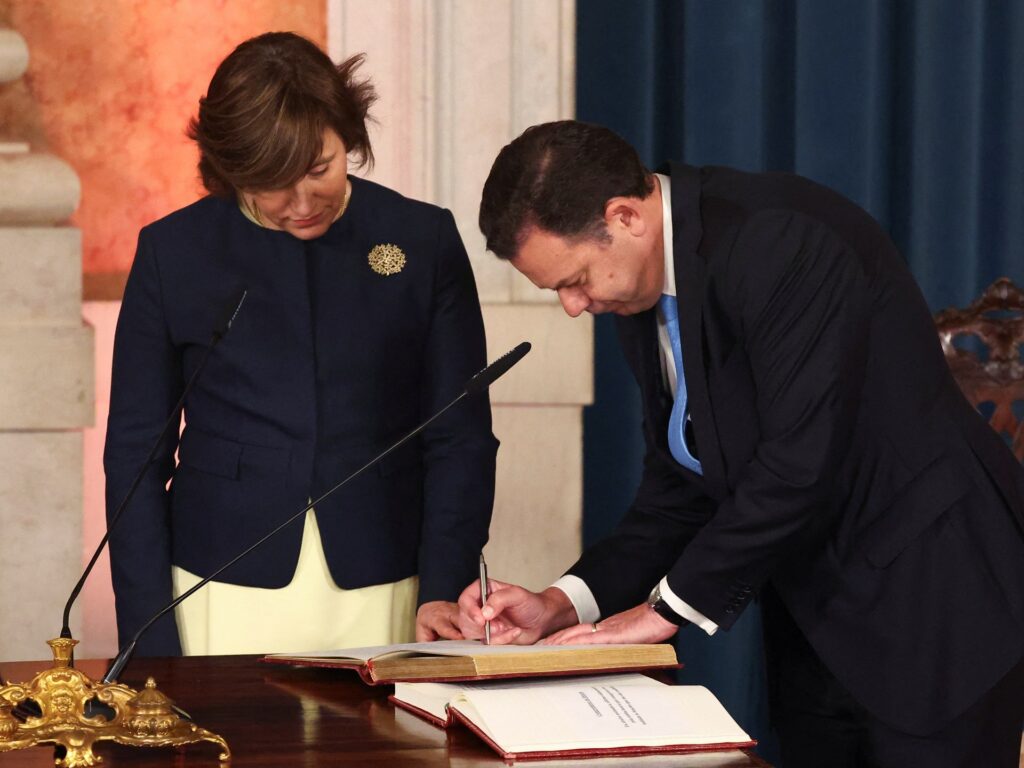
With just 80 seats in 230-seat parliament, the government will need the support of the opposition to pass legislation. Portugal’s new centre-right minority government led by Prime Minister Luis Montenegro has been sworn in amid uncertainty about its long-term viability as it faces a highly fragmented parliament. The Democratic Alliance (AD) coalition won the March 10 election by a slim margin over the outgoing Socialist Party (PS). Montenegro said on Tuesday that the government was determined to govern until the end of its four-and-a-half-year mandate and promised to act with “humility, patriotic spirit and capacity for dialogue”, while demanding the same from the opposition. “The [expected] investiture in parliament [next week] can only mean the opposition will respect the principle of letting us work and execute the government’s programme,” he said. With just 80 seats in the 230-seat legislature, the AD will need the support of either the far-right Chega party, which quadrupled its parliamentary representation to 50 members of parliament, or the centre-left PS, which secured 78 seats, to pass legislation. Chega, an anti-immigration party whose fast rise reflects a political tilt towards right-wing populism across Europe, has demanded a government role or a long-term agreement to support the AD, but Montenegro has repeatedly refused to negotiate. Speaker elected with PS support Montenegro’s precarious position was exposed last week when Chega rejected his candidate for parliamentary speaker, who was ultimately elected with PS help. The PS warned, however, that such support was a one-off to unblock parliamentary activities. Portugal, a country of 10.3 million people, is receiving more than 22 billion euros ($23.6bn) through 2026 from the EU to fuel growth and enable economic reforms. The government has promised tax reductions for families and companies, and higher pensions. It has also promised to quickly address shortcomings in public healthcare, especially long waiting lists for treatment, and a housing crisis, as well as resolve simmering disputes with police and teachers over pay and work conditions. The government can push some of its agenda through parliament with opposition support but the key piece of legislation – and its first big test – will be the 2025 budget. Failure to approve a budget has in the past habitually resulted in early elections in Portugal, and it is likely that the AD will be forced to negotiate the spending plan, and possibly other measures, with the PS. “The PS … must be clear about its attitude: be a democratic opposition or a blockade,” Montenegro said. Adblock test (Why?)
Biden denounces Florida abortion ruling as ‘outrageous’ as state vote looms
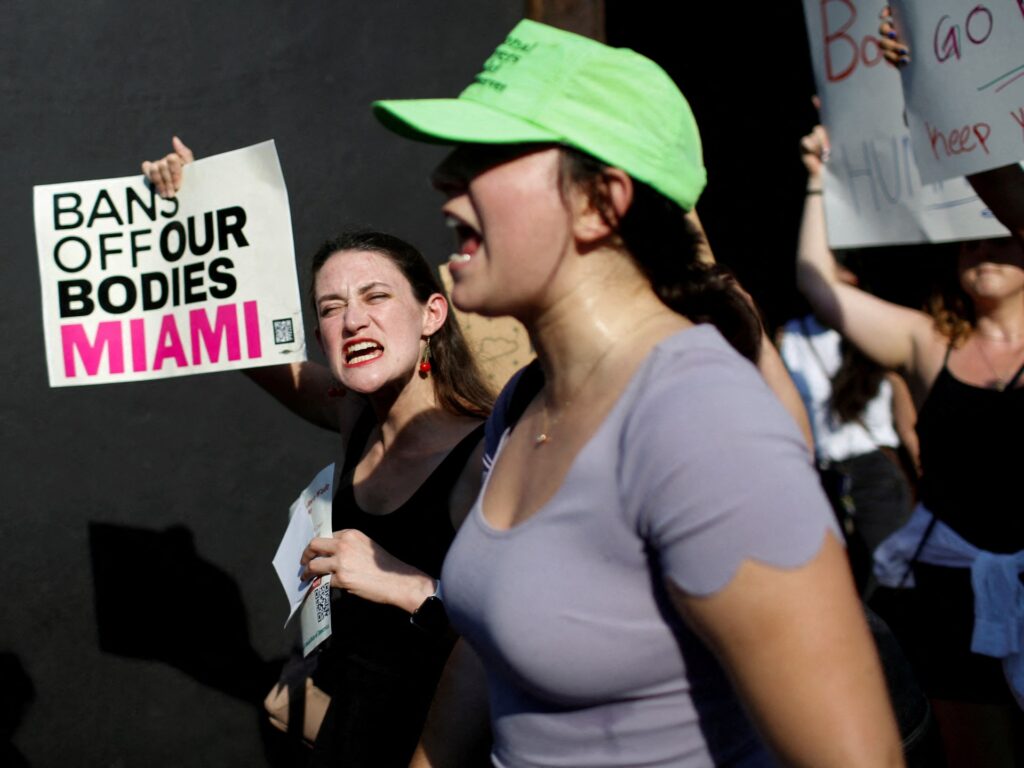
United States President Joe Biden has denounced a Florida Supreme Court decision that allows a six-week ban on abortion to take effect, calling it “outrageous” and “extreme”. In a statement released on Tuesday, Biden lashed out at Republicans for limiting reproductive rights in Florida and other US states, a key election issue in 2024. “Florida’s bans — like those put forward by Republican elected officials across the country — are putting the health and lives of millions of women at risk,” he wrote. The statement comes in response to a series of rulings from Florida’s highest court on Monday, one of which upheld a ban on abortions after 15 weeks of pregnancy. But that same decision is expected to pave the way for the six-week ban to go into effect, too. In April of last year, the conservative-dominated Florida state legislature passed the six-week ban to replace the 15-week one, and Governor Ron DeSantis signed it into law. However, the 15-week ban had been the subject of long-standing legal challenges. The six-week ban’s implementation hinged on whether the 15-week one could withstand the lawsuits it faced. Prior to the 15-week ban, Florida had allowed abortion through the second trimester of pregnancy, which made it a destination for those seeking the procedure from nearby states with tighter restrictions. Abortion headed to the ballot box Monday’s string of decisions from the Florida Supreme Court also tees up another battle over abortion access in the state, set to unfold in the midst of November’s heated general elections. The justices allowed a measure to be placed on the ballot that would amend the state constitution and protect abortion access “before viability” — up to around 24 weeks of pregnancy. The ballot measure passed by a vote of four to three and is known as Amendment 4 or the “Amendment to Limit Government Interference with Abortion”. It calls for the following language be inserted into the Florida constitution, “No law shall prohibit, penalize, delay or restrict abortion before viability or when necessary to protect the patient’s health.” Biden referenced the ballot measure in his Tuesday statement, reaffirming his commitment to protecting “reproductive freedom in Florida and across the nation”. “Vice President [Kamala] Harris and I stand with the vast majority of Americans who support a woman’s right to choose, including in Florida, where voters will have the opportunity to make their voices heard in support of a reproductive freedom ballot initiative this November,” he wrote. Biden faces a tight campaign for re-election this November, as he is expected to run against former Republican President Donald Trump in a rematch of their 2020 race. Florida was once considered a swing state, with Republicans and Democrats competing neck and neck in key races. But in recent years, Florida has swung rightwards, with Trump winning the state over Biden in 2020. The last time Florida had a Democratic governor, for instance, was in 1999, nearly a quarter century ago. Still, experts see the question of abortion access as weighing in Democrats’ favour. The Pew Research Center found that 56 percent of adults in Florida believed abortion should be “legal in all/most cases”. Another poll (PDF), published last November by the University of North Florida Public Opinion Research Lab, found that 62 percent of survey participants planned to vote for the constitutional amendment protecting abortion access, if it were to appear on the ballot. A ‘blueprint’ for the US Florida is the third most populous state in the US, and as such, it carries significant weight in the Electoral College, the system the country uses to determine who wins its presidential elections. The state is entitled to 30 Electoral College votes, out of a total of 538. It is also considered a bellwether for trends in legislation nationwide, with Governor DeSantis calling Florida a “blueprint for America’s revival” in a recent book. DeSantis, a prominent conservative and former 2024 presidential contender, signed the 15-week abortion ban into law in 2022. But abortion providers and groups like the American Civil Liberties Union (ACLU) and the Center for Reproductive Rights quickly filed complaints to prevent it from being implemented. However, in June 2022, within months of the bill’s passage, the US Supreme Court overturned Roe v Wade, the 1973 decision that upheld the federal right to an abortion for nearly a half a century. That placed the question of abortion rights in the hands of the states, creating a shifting patchwork of restrictions across the country. Plaintiffs in the case before the Florida Supreme Court this week argued that the 15-week abortion ban violated the state constitution’s privacy protections, but the justices rebuffed that argument in a six-to-one vote. Privacy protections had also been the basis for the now-defunct Roe precedent at the federal level. The decision to overturn Roe featured heavily in the Florida court’s decision on Monday. “The US Supreme Court abandoned Roe’s position that the right to abortion was grounded in any sort of privacy right,” the justices wrote. “This demonstrates the tenuous connection between ‘privacy’ and ‘abortion’ — an issue that, unlike other privacy matters, directly implicates the interests of both developing human life and the pregnant woman.” The ACLU of Florida responded to the decision by calling on voters to turn out for the November election. “These strict bans have and will continue to lead to multiple tragedies as patients are unable to receive needed care after the arbitrary deadline,” it wrote in a statement. “In the face of a six-week abortion ban, Floridians now have the chance to assert their will at the ballot box, shaping a Florida that is free from government interference in abortion.” Adblock test (Why?)
Israel’s planned Al Jazeera ban condemned
NewsFeed A new Israeli law that permits the banning of foreign news networks, including Al Jazeera, is being received with sharp criticism from governments and press freedom groups. Published On 2 Apr 20242 Apr 2024 Adblock test (Why?)
Violence flares again in Haiti as PM questions promised political solution
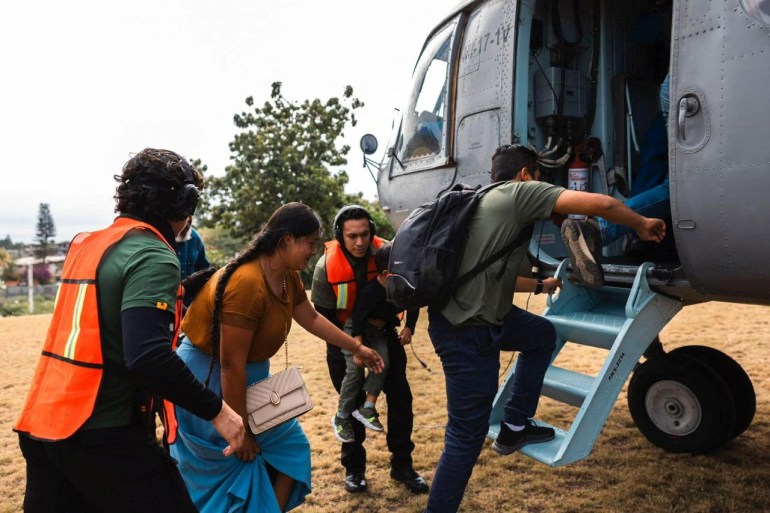
Panic descends in Haiti’s capital as police and gangs exchange fire overnight, while political leaders continue to debate the formation of a transition council. Violence has flared again in Haiti, with gangs engaging in running gun battles with police, as the effort to push forward with a political solution to the crisis drags on. Gangs launched an armed attack overnight on Monday, clashing with police in the capital, Port-au-Prince. The violence came as Prime Minister Ariel Henry appeared to question the promised establishment of a transitional council, planned to oversee the instalment of a new government. Witnesses said gunfire broke out in the area of Champ de Mars, a big public park near the national palace, which is the presidential residence. The renewed violence, following weeks of chaos, ignited panic among residents. At least five people were reported to have been killed around the city overnight, while scores were trapped for hours in the city centre. At least four police officers were reported to have been wounded. Local media reports said police were forced to flee an armoured vehicle, which was then set on fire by the gangs. The violence flared as outgoing Prime Minister Ariel Henry cast doubt upon the promised formation of a broad transitional council. Racked for decades by poverty, natural disasters, political instability and gang violence, Haiti has had no president since the assassination of Jovenel Moise in 2021 and it has no sitting parliament. Its last election was held in 2016. It descended into chaos in late February, when the country’s powerful armed gangs launched a campaign of violence, attacking police stations, prisons, and the airport. More than 1,500 people were killed in the first three months of this year and about 60 were lynched by vigilante groups operating where police presence was lacking, according to a United Nations report. The gangs demanded that Henry, who took power without being elected following Moise’s death, step down. Henry, who remains stranded outside Haiti, announced on March 11 that he would do so once a transitional council, which would name a new prime minister, had been established. However, its formation has been mired in disagreement among political parties and other stakeholders since. Further raising the stakes, in a statement on Monday, Henry’s office suggested that the council has not yet been formed because Haiti’s constitution does not allow for such a body. Henry is seeking advice from CARICOM, the Caribbean regional body overseeing this urgent transition process, the statement said. Mexican citizens board a helicopter while being evacuated from Haiti by the Mexican Navy, in Port-au-Prince on Monday [Mexican Foreign Ministry/Handout via Reuters] In the meantime, as the gang violence continues, Haitians are ensnared in a severe humanitarian crisis with shortages of food, medicine and other basics. The new US ambassador to Haiti, Dennis Hankins, arrived in the country on Monday, as the United States and other nations continue evacuating their citizens. Mexico evacuated 34 of its nationals the same day, including seven minors and four diplomatic officials, on board a military ship. Adblock test (Why?)
Tourist numbers up in post-war Afghanistan
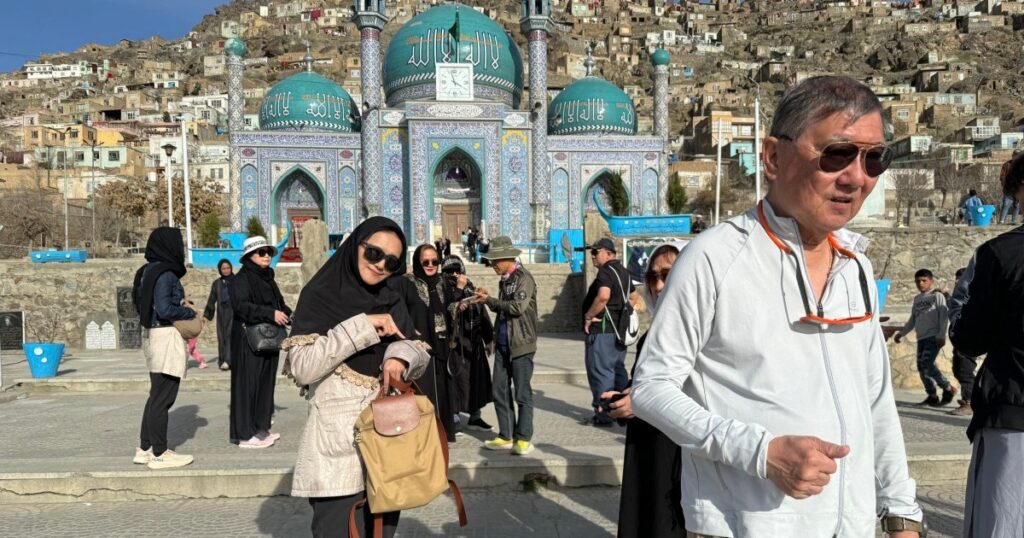
His soldier son toured Afghanistan with fighters in his crosshairs, but US traveller Oscar Wells has a different objective – sightseeing promoted by the Taliban’s fledgling tourism sector. Marvelling at the 15th century Blue Mosque in northern Mazar-i-Sharif, 65-year-old Wells is among a small but rising number of travellers visiting Afghanistan since the war’s end. Decades of conflict made tourism in Afghanistan extremely rare, and while most violence has now abated, visitors are still confronted with extreme poverty, dilapidated cultural sites and scant hospitality infrastructure. They holiday under the austere control of the Taliban authorities, and without consular support, with most embassies evacuated following the fall of the Western-backed government in 2021. They must register with officials on arrival in each province, comply with a strict dress code and submit to searches at checkpoints. ISIL (ISIS) attacks also pose a potential threat in the country. The number of foreign tourists visiting Afghanistan rose 120 percent year on year in 2023, reaching nearly 5,200, according to official figures. The Taliban government has yet to be officially recognised by any country, in part because of its heavy restrictions on women, but it has welcomed foreign tourism. “Afghanistan’s enemies don’t present the country in a good light,” said Information and Culture Minister Khairullah Khairkhwa. “But if these people come and see what it’s really like,” he added, “they will definitely share a good image of it.” Wells, on a trip with travel company Untamed Borders, which also offers tours of Syria and Somalia, describes his visit as a way to connect with Afghanistan’s people. He describes a “sense of guilt for the departure” of United States troops. “I really felt we had a horrible exit, it created such a vacuum and disaster,” he said. “It’s good to help these people and keep relations.” For solo traveller Stefanie Meier, a 53-year-old US citizen who spent a month travelling from Kabul to Kandahar via Bamiyan and Herat in the west, it was a “bittersweet experience”. “I have been able to meet people I never thought I would meet, who told me about their life,” she said, adding that she did not face any issues as a woman on her own. She did experience “disbelief that people have to live like this”, she added. “The poverty, there are no jobs, women not being able to go to school, no future for them.” Adblock test (Why?)
Anti-Assad Syrians lead protests against prison torture by rebel group
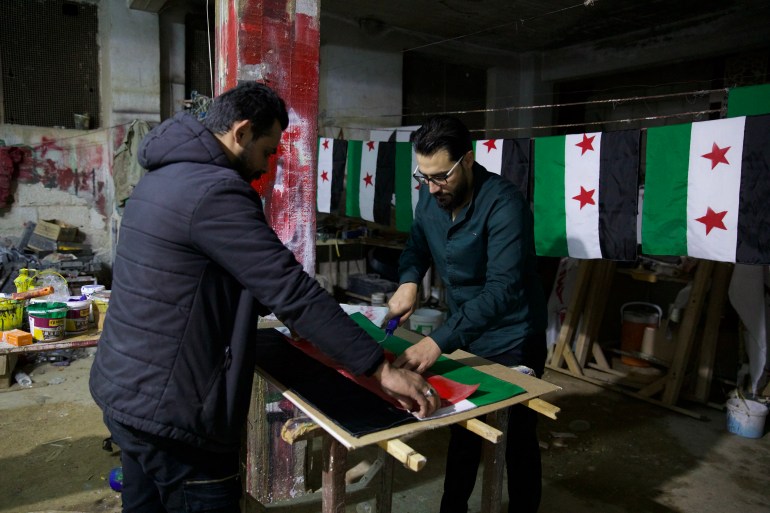
Binnish, Syria – Despite the dangers of dissent, people in northwestern Syria have been taking to the streets in recent weeks to protest an armed group formed out of an al-Qaeda breakaway faction. The protests against Hay’et Tahrir al-Sham (HTS), which controls a large portion of Idlib province, began on February 25 in Sarmada, near the Syria-Turkey border. Prompted by the treatment of prisoners by the group’s security arm, the General Security Service (GSS), protesters carry banners calling HTS prisons “slaughterhouses”. Protests with hundreds of participants have now taken place across Idlib. In Binnish, 29-year-old Mohammed Ali Basha spent the night before an anti-HTS protest last week preparing flags and banners with his friends. The activist painted three red stars on the green, white and black backdrop of the Syrian opposition’s flag. A large banner being prepared displays the message Basha and his fellow protesters want to put across: that the Syrian revolution – which began in 2011 – is not just against the country’s President Bashar al-Assad, but against all “tyrants”. “All of them means all of them,” it says, a slogan long adopted by members of the Syrian opposition to indicate their opposition to autocrats of all persuasions. And for Basha, that includes HTS and its leader, Abu Mohamad al-Jolani. “Our protests against HTS resemble our early demonstrations against Bashar al-Assad and his regime because in both cases we have taken to the streets to denounce injustice and preserve our dignity and freedom,” Basha told Al Jazeera. “Over the past few years, I have noticed the injustice practised against the people of the liberated areas [not controlled by al-Assad], and how the security branches affiliated with HTS have begun to commit the same criminal acts committed by al-Assad’s security forces, such as killing under torture and arbitrary detention.” Mohammed Ali Basha, right, and a friend prepare flags for their anti-HTS protest [Ali Haj Suleiman/Al Jazeera] Tortured to death Ahmad Alhakim said he knows all too well what can happen in an HTS prison. His brother, Abdulqadir, was tortured to death in one, he told Al Jazeera. Abdulqadir, 27, a father of three and a fighter in the Jaish al-Ahrar opposition group, was arrested by HTS last year on charges of dealing with foreign powers. “They abducted my brother for 10 months without us being able to know his whereabouts, any information about him, or even appoint a lawyer to pursue his case,” Alhakim said. In mid-February, Alhakim was told by a released detainee that Abdulqadir had died after being tortured in prison. His death was confirmed to Jaish al-Ahrar by HTS on February 22. “We demanded that the General Security Service hand over my brother’s body, but they told us that they buried him and gave us the address of the burial place,” Alhakim said, describing it as a large trench where many bodies were buried – a mass grave. “There were many graves without names, only numbered.” Protesters have braved potential reprisals from HTS to denounce it and its leader, Abu Mohamad al-Jolani [Ali Haj Suleiman/Al Jazeera] Calls to overthrow al-Jolani It was Abdulqadir’s death that sparked the protest movement, which quickly spread to Idlib’s main towns. In Binnish the next day, Basha and his fellow activists took their banners and flags and headed to the town centre to join the few dozen people who had gathered. Much of the anger was directed towards the HTS leader al-Jolani, with protesters calling for his removal in areas controlled by HTS and its affiliated Salvation Government, and its replacement by an elected body. “The era of slavery and tyranny ended with the start of the Syrian revolution in 2011, and the Syrian people, after paying dearly to gain their freedom and dignity, will not allow it to be taken away from them,” Basha said. It is a brave stance to take. Idlib province largely remains under the control of Syrian opposition fighters, dominated by HTS after it gradually forced out other opposition factions and monopolised governance of the region. HTS – designated a “terrorist” group by the European Union, Turkey and the United States – formed in 2017 as an alliance of several factions opposed to al-Assad in the country’s ongoing war. The principal force in the alliance was Jabhat Fateh al-Sham, formerly an affiliate of al-Qaeda known as the Nusra Front. HTS has attempted to rebrand itself over the years, severing ties with al-Qaeda and portraying itself as a more moderate group with local aims, with al-Jolani even going as far as to give an interview to US media outlet PBS. It became the most powerful rebel group in northwestern Syria but opposition to its rule is increasing, with activists deeming it vital to break the silence over the group’s violence and grip on security. At an event in Idlib city, 30-year-old activist Abdulrahman, who did not wish to give his full name, reiterated the movement’s demands. “We want the release of all prisoners of conscience, the disclosure of the fate of those missing in the prisons, and dissolving and restructuring the General Security Service,” he said. Promises to meet demands As an initial response to the protests, HTS held meetings – chaired by al-Jolani – between ministers in the Salvation Government and community elites and village elders who presented the protesters’ demands and received promises to fulfil them. “The protests … in the streets against Hay’et Tahrir al-Sham and the Salvation Government are natural and we do not view them in any other context,” said the HTS media office. “We’re confident that those who work make mistakes and all protests aim to correct these mistakes that have recently transpired.” HTS told Al Jazeera the protesters’ demands were complex and resolving them would require some time. For example, it said, wider participation in the group’s leadership Shura Council would take time to recruit community representatives from different areas. Anti-HTS protests have continued in Idlib despite these attempted assurances. However, as of yet, there have been no confirmed
DR Congo president names Judith Suminwa Tuluka as first woman PM

Judith Suminwa says she will work for peace and the development of the country, after being appointed by President Tshisekedi. Democratic Republic of Congo’s President Felix Tshisekedi has appointed the country’s first-ever female prime minister, naming planning minister Judith Suminwa to the role. An economist, she takes over as prime minister from Jean-Michel Sama Lukonde, following Tshisekedi’s sweeping re-election as president on December 20. Tshisekedi’s inauguration for a second term in January kick-started a lengthy search for a majority coalition in the National Assembly – a key step before a prime minister could be named and a government formed. “I am aware of the great responsibility … We will work for peace and the development of the country,” Suminwa said on national television on Monday. Tshisekedi officially triumphed with 73.47 percent of the vote in December, and the election passed largely peacefully in a country long torn by violence and instability. The opposition branded the ballot a sham. Voting was officially extended by a day due to logistical snarls, and polls were open for days afterwards in remote areas. PM’s challenges Parties supporting Tshisekedi garnered more than 90 percent of the seats in parliament, allowing him to legislate with ease. The new prime minister will be tasked with pushing the president’s declared priorities of employment, youth, women and national cohesion for the nation of about 100 million people. Tshisekedi first became president in 2019 promising to improve living conditions in the DR Congo – which boasts mineral riches but has a largely impoverished population – and put an end to 25 years of bloodshed in the east. The president failed to keep those promises, but he campaigned for a second term on his achievements such as free primary medication, asking for another mandate to “consolidate” the progress. According to the United Nations, some seven million people have been internally displaced by conflict in the DR Congo, one of the world’s poorest countries. The security situation has worsened in North Kivu province, where a Rwanda-backed rebel group M23 has seized swathes of territory over the last two years. Adblock test (Why?)