

In Washington, DC: Celebrating Ramadan, protesting Israel’s siege of Gaza
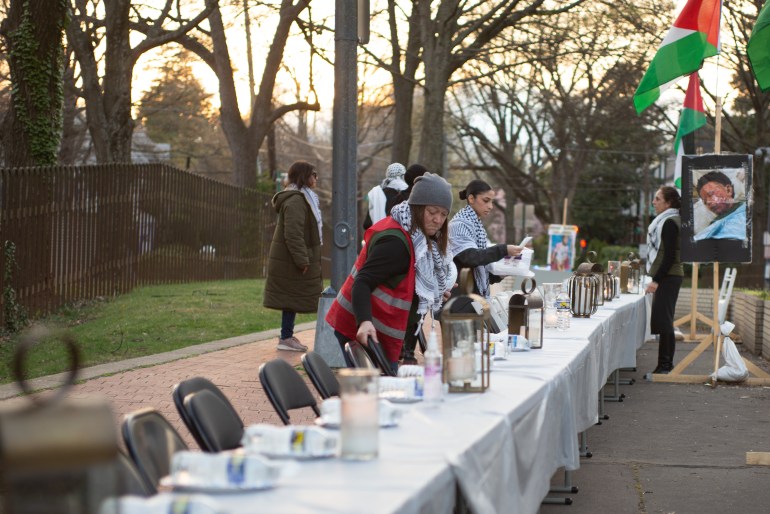
Washington, DC – Forty-eight folding chairs, but will it be enough? “It’s OK, some of us will stand,” said 60-year-old Haitham Arafat, a soft-spoken, bespectacled man in a keffiyeh and a canary yellow shirt. But soon, more chairs arrived, and were quickly lined up along 40 metres (131 feet) of table that stretched along a street facing the Israeli embassy in the northwest corner of this US capital city. A row of Ramadan lanterns lit the place settings ahead of the iftar meal. “We break fast here every day,” said Arafat, who has been coming to the embassy for the last 21 days as part of a 24-hour, seven-day-a-week protest. “But today is special.” The long-haul demonstration began 35 days ago, inspired by a sister demonstration outside the Virginia home of US Secretary of State Antony Blinken. That protest – dubbed Kibbutz Blinken – has been going for 68 consecutive days. Protesters set up an iftar table in front of the Israeli embassy in Washington, DC [Joseph Stepansky/Al Jazeera] But on Sunday, family and friends of protesters were invited to attend an iftar meal at the Israeli embassy. Arafat described it as the latest effort to show the community’s resolve as the killings and deprivation in Gaza continue. Like many of those gathered, Arafat simply would not entertain the notion that fasting for Ramadan was a burden, noting that he has personally lost about 100 relatives in northern Gaza since October 7. “With the massacres that are happening in Palestine, the starvation, this is nothing compared to what they are experiencing,” he said, his voice growing sharper as he spoke. “If we can just experience a little bit of their hardship, just to show them that ‘Hey, we think of you every day, we’re doing our best to stop this madness.’” Soon, Nora Burgan began dispensing hot drinks and cups of tomato and lentil soup to ward off the brisk air of early spring. Salad, dates, kebabs, rice and hummus were spread along the table’s expanse. People took their seats, sitting along one side of the table under a sky that had threatened rain earlier but was now beginning to clear. Nora Burgan loads cups of soup onto a tray for iftar [Joseph Stepansky/Al Jazeera] “It’s not meant to be a feast,” Burgan told Al Jazeera. “It’s not perfect, but we will share whatever food we have … very simple, humble and accepting of community and this moment.” “We want to always think about Gaza, a free Gaza and a free Palestine,” she told those who had gathered for iftar. As of Monday, the official death toll in Gaza had reached 32,845, with humanitarian organisations continuing to warn of impending famine while accusing Israel of blocking the delivery of food, medicine and other supplies to the enclave. Israeli Prime Minister Benjamin Netanyahu has maintained that Israeli forces will move ahead with an offensive in the southern city of Rafah, where most of Gaza’s displaced have fled. Meanwhile, warnings from US President Joe Biden’s administration have not yielded any substantive changes on the ground in Gaza. Last week, the Washington Post reported the administration had signed off on yet more weapons transfers to Israel, including one-tonne (2,000-pound) bombs linked to mass casualty events. Ahmed Afifi hands out food during iftar at a protest in front of the Israeli embassy in Washington, DC [Joseph Stepansky/Al Jazeera] ‘Unapologetically out here’ As the day’s fast broke and the evening turned a darker shade of blue, Hazami Barmada, the activist who spearheaded the camps at Blinken’s home and the Israeli embassy, stood over the now-crowded span of table. “We are unapologetically out here breaking bread, side by side in solidarity on a main road, in front of the very thing that does not want us to be here,” said Barmada, whose watermelon earrings danced while her 16-month-old son shifted his weight in her arms. Barmada has learned a lot about this type of protesting in recent months. The demonstration at Blinken’s home began with just Barmada and a few others, who began to stay around the clock. At the end of February, she landed in the emergency room with a fever of more than 40 degrees Celsius (104 degrees Fahrenheit). But the effort has become more formalised since, with schedules and rotating shifts to relieve some of the pressure on the protesters, as well as providing them with a support system to help with needs such as child care or transportation. Barmada believes that the unrelenting demonstration is unique in its ability to shine a light on the public outrage over what is happening in Gaza. A protest camp is seen in front of the Israeli embassy in Washington, DC [Joseph Stepansky/Al Jazeera] Barmada has also become adept at making sure the demonstrations remain peaceful and in compliance with local regulations, while also managing to confront counterprotesters, angry embassy staff and the ever-present US Secret Service and local police. Demonstrators document their interactions to avoid false charges that could conceivably shut down the protests, she said. ‘Part of resistance is finding joy’ Some protesters have been involved in the marathon demonstration since the beginning, and others have just joined. “I think it’s a moral boost for us coming out here and being in a community,” said 41-year-old Jinan Deena, who waved a Palestinian flag in front of the embassy in what she said was her second day of protesting there. Hazami Barmada glances at the Israeli embassy as she speaks to those gathered for iftar [Joseph Stepansky/Al Jazeera] “But also seeing the symbolism of an Israeli embassy being occupied by Palestinians. It’s kind of like a reverse occupation,” Deena said. The scene reflects the deep divide that is inherent in the conflict, with photos of bloodied Gazan children surrounded by Palestinian flags and signs reading “Genocide is Not Self Defense” and “Israel bombs babies”. On the embassy’s grounds, Israeli flags are planted in the grass or hung on external walls, next to photos of
US doubles down on its defence of arming Israel despite Gaza atrocities

Biden administration says ‘too many civilians’ killed in Gaza but reasserts commitment to supporting Israel in war. Washington, DC – The United States has defended its arms transfers to Israel, reasserting its commitment to the country’s security despite growing concerns about rights abuses in the Gaza Strip. Department of State spokesperson Matthew Miller was asked on Monday whether recent weapons transfers, which included fighter jets and 900kg (2,000lb) bombs, damaged the “credibility” and “sincerity” of US statements decrying the crisis in Gaza. “I do not agree with that at all. We have been very clear that we want to see Israel do everything it can to minimise civilian casualties. We have made clear that they need to operate at all times in full compliance with international humanitarian law,” Miller said. “At the same time, we are committed to Israel’s right to self-defence, and this is a long-term commitment the United States has made.” The administration of President Joe Biden has been facing criticism over its policy of arming Israel, which critics say violates US laws prohibiting military aid and weapon sales to countries engaged in rights abuses. The Washington Post reported last week that the US had approved the transfer of billions of dollars in weapons to Israel, including thousands of bombs. Miller said on Monday that the weapons were pre-approved, stressing that the administration had notified Congress about the transfers. He gave what he called a fictional example to describe the situation: “Let’s say they requested 100 planes. We make a decision. We notify Congress. That doesn’t mean that they take 100 planes tomorrow. … They draw those down over time, and sometimes it takes years to fulfil those requests.” Still, the administration has the final say over what it chooses to transfer to Israel. Unlike with military aid to Ukraine, the Pentagon and State Department have not publicly announced and detailed what the Israeli drawdowns would entail. The weapons transfers come amid accusations that Israel is committing widespread violations of international humanitarian law — a set of rules aimed at protecting civilians in armed conflicts, including the Geneva Conventions. Witnesses and rights groups have accused Israel of indiscriminate bombing in Gaza, targeting civilian infrastructure, mistreating detainees, extrajudicial executions and using humanitarian aid as a weapon of war, among other abuses. But last week, the State Department said it has not found Israel to be in violation of international humanitarian law in any incident. On Monday, Miller argued that the ongoing US arming of Israel is not just about the war in Gaza but is also designed to help the country against regional adversaries, including Iran and Hezbollah. US officials, including Biden, have criticised Israel’s tactics in Gaza. But so far, his administration has rejected calls to place conditions on its military aid to Israel. Miller stressed that Washington regularly urges Israel to use its weapons in accordance with international humanitarian law. “We have had very frank conversations with them about the fact that far too many civilians have died through their operations and that they need to do better and take into account the need to minimise civilian harm, and we’ll continue to do that,” he said. Several progressive lawmakers have urged Biden to end his unconditional support for Israel. On this Easter, let’s ponder Netanyahu’s indiscriminate bombing of Gaza, which has killed more than 20,000 women and children, and his restriction of humanitarian aid, which has pushed Palestinians to the brink of famine. — Senator Jeff Merkley (@SenJeffMerkley) March 31, 2024 On Sunday, Democratic Senator Jeff Merkley invoked the Easter holiday to slam the war on Gaza. “We must also recognize that America is complicit in this tragedy by resupplying Israel with bombs and failing to use America’s leverage to increase aid delivered into Gaza,” he wrote in a series of social media posts. “Reflecting on the admonition to feed the hungry and assist the stranger, and ‘blessed are the peacemakers,’ let’s push Team Biden to do better. More aid. No bombs.” Adblock test (Why?)
Iran’s persecution of Baha’is branded ‘crime against humanity’

New report says minority group faces a ‘spectrum of abuses’, including arbitrary arrest and property confiscation. Iran’s persecution of its Baha’i minority has been branded “a crime against humanity”. Human Rights Watch alleged in a report released on Monday that Iran’s largest non-Muslim minority has faced a “spectrum of abuses” since the Islamic revolution of 1979. The New York-based NGO suggested that the case fits the remit of the International Criminal Court (ICC). HRW said among the persecution endured by the Baha’is are arbitrary arrest, property confiscation, restrictions on school and job opportunities, and the right to a dignified burial. “The cumulative impact of authorities’ decades-long systematic repression is an intentional and severe deprivation of Baha’is’ fundamental rights and amounts to the crime against humanity of persecution,” the report says. HRW argues that this falls within the scope of the ICC, whose statute defines persecution as the intentional and severe deprivation of fundamental rights contrary to international law on national, religious or ethnic grounds. The findings in the report relied on a number of varied sources, including government policies, court documents, and interviews with Baha’is in and out of Iran. According to HRW, while the intensity of violations against Baha’is “has varied over time”, the persecution of the community has remained constant, “impacting virtually every aspect of Baha’is’ private and public lives”. “In recent years, as Iranian authorities have brutally repressed widespread protests demanding fundamental political, economic, and social change in the country, the authorities have also targeted Baha’is,” the report notes. “Authorities have raided Baha’i homes, arrested dozens of Baha’i citizens and community leaders, and confiscated property owned by Baha’is.” Iran holds “extreme animus against adherents of the Bahai faith” and repression of the minority is enshrined in Iranian law and is official government policy, the report asserts. “Iranian authorities deprive Baha’is of their fundamental rights in every aspect of their lives, not due to their actions, but simply for belonging to a faith group,” said Michael Page, deputy Middle East director at HRW. “It is critically important to increase international pressure on Iran to end this crime against humanity.” This is believed to be the first time a leading international organisation has labelled Iran’s treatment of the Baha’is as a crime against humanity. Unlike other minorities, Baha’is do not have their faith recognised by Iran’s constitution and have no reserved seats in parliament. How many members of the community remain in Iran is not known, but activists believe there could still be several hundred thousand. HRW said as a religious minority unrecognised in Iran’s constitution Baha’is are prohibited from freely holding prayers, even in private. Adblock test (Why?)
Key India opposition leader sent to jail until April 15 in corruption case

Delhi Chief Minister Arvind Kejriwal’s custody extended less than three weeks before the country begins to vote in a seven-phase election. An Indian court has sent Delhi Chief Minister and key opposition leader Arvind Kejriwal to jail until April 15 in a corruption case, less than three weeks before the country begins voting in a seven-phase national election. India’s financial crimes investigating agency, the Enforcement Directorate (ED), had arrested Kejriwal last month in connection with allegations related to the capital city’s liquor policy and he had been remanded to the agency’s custody until April 1. ED lawyers on Monday said Kejriwal had been “non-cooperative” and was “giving evasive replies”, asking the court to remand him to judicial custody for 15 days, news website Live Law reported. Kejriwal’s Aam Aadmi Party (AAP) says he has been “falsely arrested” in a “fabricated” case ahead of the polls, but Prime Minister Narendra Modi’s government and his Bharatiya Janata Party (BJP) deny political interference. Kejriwal blamed Modi for his arrest. “What the prime minister is doing is not good for the country,” he told reporters on his way to the court. All the senior leaders of AAP were already imprisoned in the same corruption case before Kejriwal’s arrest. The action against the high-profile leader led to protests in the capital and the northern state of Punjab, which is also governed by his party, last week. The court’s decision came a day after the INDIA bloc, an alliance of 27 opposition parties including AAP, came together at a rally in New Delhi to protest Kejriwal’s arrest and accused Modi of seeking to rig the election. Besides AAP, several other opposition parties, including regional groups, are also facing action from federal agencies, which they say is “politically motivated”. The country’s main opposition Congress party says it has been hit with large income tax demands which it says is an effort to “cripple it financially” before the election. Modi and the BJP have denied the allegations. During a hearing in the Supreme Court on Monday, India’s Income Tax department said it will not pursue a 35-bn rupee ($420m) payment from the Congress until after the completion of the election in June. The court set July 24 for the next hearing on the tax matter. The seven-phase election is set to be held from April 19 to June 1 and votes to be counted on June 4. Kejriwal’s arrest has also drawn international attention, with the United States and Germany urging a “fair” and “impartial” trial, causing New Delhi to strongly object by asking them to stay away from its “internal” affairs. Adblock test (Why?)
Are Sudan’s civil society activists being targeted by both warring sides?
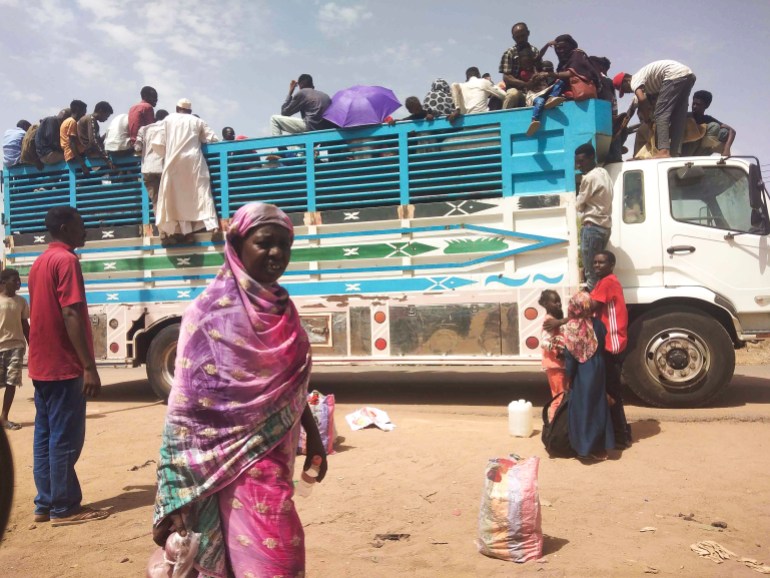
In Sudan’s war, even making food for the poor is dangerous. On March 23, Sudan’s paramilitary Rapid Support Forces (RSF) arrested activists from the Sharq al-Nile neighbourhood in the war-torn capital, Khartoum, while they were supervising soup kitchens feeding thousands of hungry people every day. The recent arrests in Khartoum are only part of a broader strategy of the RSF and the Sudanese Armed Forces (SAF) – who are fighting for power in the country – to clamp down on civil society actors by arresting volunteers, limiting access to aid and obstructing the arrival of relief, according to local volunteers and aid groups. “More arrests could affect the many poor people who depend on the [soup kitchens] to survive,” Musab Mahjoub, a human rights monitor in Sharq al-Nile, told Al Jazeera as a nationwide famine looms. The reason for the March arrests is unknown. “We tried to contact the RSF to ask … but they didn’t respond,” Mahjoub said, adding that the RSF had arrested activists running soup kitchens last month too, although they were all released days later. Local relief groups have called on Western donors to support and protect them from warring parties they believe are profiteering off controlling humanitarian aid. The response from the belligerents, the activists say, has been to arrest, kidnap, rape, and even kill local relief workers to maintain a tight grip over aid operations. With soup kitchens now in the crosshairs, these violations are exacerbating the food crisis in Sudan, where more than 18 million people are coping with acute levels of hunger and five million are suffering “catastrophic” hunger. People board a truck to leave Khartoum on June 19, 2023, before an international conference to raise funds for humanitarian assistance [AP Photo] Settling scores When Sudan’s civil war erupted on April 15 last year, members of the resistance committees – neighbourhood pro-democracy groups that were instrumental in bringing down then-President Omar al-Bashir – set up “emergency response rooms” (ERRs). ERRs started as local initiatives tasked with ferrying vulnerable people out of neighbourhoods where clashes were occurring and administering first aid to the wounded. Over time, the ERRs grew distinct from the resistance committees and began soliciting donations from abroad to feed their hungry communities. But they are now facing similar threats to other civil activists in Sudan. ERR volunteers operating in RSF-controlled areas say that total lawlessness puts them in constant fear of being arbitrarily arrested, beaten or raped. Other ERR activists, who operate in SAF-controlled areas, say they are targeted by military intelligence and security factions tied to the “Kizan” – a common name for members of Sudan’s political Islamic movement that ruled alongside al-Bashir for three decades. Key Kizan figures have come out of the shadows to support the army since the war, with activists saying they are targeting civil society in revenge for it overthrowing them in 2019. Just last month, ERR spokesperson in Khartoum Hajooj Kuka said activists were targeted after the army recaptured neighbourhoods from the RSF in Omdurman, one of the three cities in the national capital region. “Two youths were assassinated by the army … in the communal kitchen of a Sufi sheikh, called Wad Elamin. But now the army is OK with the sheikh and he’s working and opened another kitchen,” Kuka told Al Jazeera. “We also have members who had to flee because one of the militias fighting with the army – called al-Baraa bin Malak – started seeking out people who were part of [pro-democracy] protests.” Al Jazeera contacted SAF spokesman Nabil Abdallah to ask about the military’s purported targeting of local activists, but he did not respond. Obstructing food aid Weeks after war erupted, United Nations agencies and global relief groups that had evacuated Khartoum finally set up field offices in Port Sudan on the Red Sea – SAF’s de facto administrative capital now – which enabled the army to control the humanitarian response, aid groups told Al Jazeera. Since then, the army has severely restricted UN agencies and aid groups from delivering relief to RSF-controlled regions, according to these aid groups. “I’m worried that there is an underlying policy position in general [from the army] to starve out certain parts of the country for direct or indirect reasons and to divert aid elsewhere,” said the country director of one international relief organisation, who requested anonymity out of fear of losing even more access to deliver aid. Sudanese armed popular resistance supporters, who back the army, in Gadarif, eastern Sudan, on March 3, 2024 [AFP] In the last month, no aid has reached RSF-controlled areas from Port Sudan, according to the spokesperson of one UN agency, who requested anonymity for fear of jeopardising current negotiations for aid delivery access. The spokesperson told Al Jazeera that even when the UN obtains “some clearances” to move aid from Port Sudan, they are not given security guarantees from RSF fighters. “The RSF is requesting payment in exchange for security guarantees,” the spokesperson said. “But that’s something that [we] won’t do, and can’t do.” Al Jazeera sent questions to RSF spokesperson Abdulrahman al-Jaali, raising the allegations that the paramilitary was attempting to profiteer from aid convoys, but he did not respond. Humanitarian imperative? A Western aid worker in Sudan, who was not authorised to speak due to the sensitivity of the matter, told Al Jazeera that UN agencies and other global relief groups should be prioritising their “humanitarian imperative” over respecting the sovereignty of Sudan’s de facto military authorities. For months, global relief organisations and UN agencies have lobbied for aid delivery access from two land borders via South Sudan and Chad. But in March, Sudan’s army-aligned Ministry of Foreign Affairs revoked the World Food Programme’s (WFP’s) permission to provide food to West and Central Darfur from the Chadian town of Adre. The ministry cited security reasons, saying the border had been used for arms transfers to the RSF. Three days later, SAF approved WFP food shipments via Tina, Chad, a border area that
Two killed as Russia escalates attacks on Ukraine’s energy infrastructure

Russia’s attacks on such infrastructure in recent days have also caused severe power outages. Russian strikes on Ukrainian energy infrastructure have killed two people, one in the country’s western Lviv region, the other in an attack in the northeast, officials said. The attack in Lviv destroyed a building and sparked a fire, Governor Maksym Kozytskyi wrote on Telegram on Sunday, adding that rescue operations were under way. In the Kharkiv region, Governor Oleh Syniehubov said that an air attack killed a 19-year-old man after a projectile hit a petrol station. Meanwhile, hundreds of thousands in Ukraine’s Odesa region were left without power after debris from a downed Russian drone caused a blaze at an energy facility, Governor Oleh Kiper said. Ukraine’s largest private electricity operator DTEK said 170,000 homes suffered power outages as a result of the attack. The Ukrainian air force said that it shot down nine of 11 drones launched by Russia overnight, as well as nine out of 14 cruise missiles. DTEK said five of its six plants have been damaged, with 80 percent of their generating capacity lost, according to Al Jazeera’s Charles Stratford, reporting from Ukraine’s capital Kyiv. DTEK supplies around a quarter of the country with electricity and repairs could take up to 18 months, said Stratford. “But those six plants are just a drop in the ocean in relation to other energy plants, energy facilities that have been hit by Russia in recent weeks,” he said. Russia has escalated attacks on Ukraine’s energy infrastructure in recent days, causing significant damage in several regions. Ukrainian energy company Centrenergo said on Saturday that the Zmiiv Thermal Power Plant, one of the largest in the northeastern Kharkiv region, was entirely destroyed following Russian shelling last week. Around 120,000 people in the area were still being affected by power outages, days after 700,000 people lost electricity after the plant was hit on March 22. “These attacks are, in the Kremlin’s words, revenge for attacks that Ukraine had been making deep inside Russia, targeting their energy facilities and oil installations,” said Al Jazeera’s Stratford. Ukraine’s President Volodymyr Zelenskyy, in an Easter message on Sunday, urged the country to persevere. “There is not a day or night right now when Russian terror does not try to shatter our lives. Last night, we once again saw rockets and Shaheds launched against our people,” he said. “We defend ourselves, we persevere; our spirit does not give up and knows that death can be averted. Life can win,” Zelenskyy said. In Russia, 10 Czech-made Vampire rockets landed in the border region of Belgorod on Sunday, the Ministry of Defence said. One woman was injured when a fire broke out following the attack, said regional Governor Vyacheslav Gladkov. Adblock test (Why?)
Will ultra-Orthodox Jewish Israelis serve in the military?

The government is under growing pressure to end a decades-long exemption for ultra-Orthodox Jews. For generations, ultra-Orthodox Jewish Israelis have been exempt from military service. But a court order could soon change that. Prime Minister Benjamin Netanyahu has filed a last-minute application to the Supreme Court for a ruling to be deferred for 30 days. And the controversy isn’t going anywhere. Israel’s war on Gaza is fuelling a sense of urgency and anger among Israelis required to sign up. So how much of a threat does this pose to Netanyahu’s coalition? And would his government survive the fallout from such a change of policy? Presenter: James Bays Guests: Efraim Inbar – President of the Jerusalem Institute for Strategy and Security Yossi Mekelberg – Associate fellow at Chatham House specialising in Israeli and Middle East politics Meron Rapoport – Editor of Hebrew-language news site Local Call Adblock test (Why?)
Photos: Aftermath of an Israeli air strike on hospital courtyard

At least two people have been killed and several others wounded after an Israeli air strike hit the courtyard of the crowded Al-Aqsa Hospital in Deir al-Balah in central Gaza, Palestinian authorities said. The Government Media Office in Gaza, which is governed by the Palestinian group Hamas, said the attack struck a tent where displaced people were sheltering and journalists were working. At least two displaced people were killed in the air strike and three journalists were wounded, according to the Palestinian Civil Defence. Israel’s military said the attack targeted a command centre operated by the Palestinian Islamic Jihad armed group. Adblock test (Why?)
Polls open in Turkey local elections in key test of Erdogan’s popularity

Polls have opened in Turkey for local elections in a crucial test for President Recep Tayyip Erdogan as he seeks to win back control of key urban areas he lost to the opposition five years ago. Voting stations opened on Sunday at 7am local time (04:00 GMT) in eastern Turkey, with voting elsewhere starting at 8am and ending at 5pm. Initial results are expected by 10pm (19:00 GMT). The vote is a barometer of Erdogan’s popularity and will decide who gets to control the economic hub of Istanbul and the capital Ankara, both of which he lost in 2019. The 70-year-old Turkish leader has set his sights on wresting back Istanbul, a city of 16 million people, where he was born and raised, and where he began his political career as mayor in 1994. “Winning major cities is more of a deal for the opposition, but also it means access to foreign funds, having transnational links with both economic actors and political actors,” Evren Balta, professor of political science at Turkey’s Ozyegin University, told Al Jazeera. “If you are governing a major global city, it means you have visibility in the international scene.” A strong showing for Erdogan’s ruling Islamic-oriented Justice and Development Party, or the AK Party, would likely harden his resolve to usher in a new constitution – one that would reflect his conservative values and allow him to rule beyond 2028, when his current term ends, analysts say. For the opposition – divided and demoralised after a defeat in last year’s presidential and parliamentary elections – keeping Istanbul and Ankara would be a tremendous boost and help remobilise supporters. Some 61 million people, including more than a million first-time voters, are eligible to cast ballots for all metropolitan municipalities, town and district mayorships as well as neighbourhood administrations. Vote amid cost of living crisis Turnout is traditionally high in Turkey, but this time the vote comes against the backdrop of a cost of living crisis. Observers say disillusioned opposition supporters could opt to stay home, doubting its ability to change things. Governing party supporters, meanwhile, could also choose not to go to the polls in protest of the economic downturn that has left many struggling to pay for food, utilities and rent. Some 594,000 security personnel will be on duty across the country to ensure the vote goes smoothly, Interior Minister Ali Yerlikaya said. Polls have pointed to a close race between Istanbul’s incumbent mayor, Ekrem Imamoglu, of the main opposition, pro-secular Republican People’s Party, or CHP, and the AK Party’s candidate Murat Kurum, a former urbanisation and environment minister. However, this time, Imamoglu – a popular figure touted as a possible future challenger to Erdogan – is running without the support of some of the parties that helped him to victory in 2019. Al Jazeera’s Sinem Koseoglu, reporting from Istanbul, said whoever wins the polls will have “far-reaching implications” on Turkey’s politics. “Imamoglu’s victory might lent him opposition leadership and presidential nomination in 2028. But Kurum’s victory might help President Erdogan strengthen his power base and repair his legacy, particularly the troubled economy and foreign affairs.” Meanwhile, the pro-Kurdish Peoples’ Equality and Democracy Party (DEM Party) and the nationalist IYI Party (the Good Party) are fielding their own candidates in the race, which could siphon votes away from Imamoglu. A six-party opposition alliance led by CHP disintegrated after it failed to remove Erdogan in last year’s election, unable to capitalise on the economic crisis and the government’s initially poor response to last year’s devastating earthquake that killed more than 53,000 people. One factor working against Erdogan is a rise in support for the Islamist New Welfare Party (YRP) due to its hardline stance against Israel over the war in Gaza and dissatisfaction with the AK Party’s handling of the economy. In Ankara, incumbent Mayor Mansur Yavas – also seen as a potential future challenger to Erdogan – is expected to retain his post, according to opinion polls. His challenger – Turgut Altinok, the AK Party candidate and mayor of Ankara’s Kecioren district – has failed to drum up excitement among supporters. In Turkey’s mainly Kurdish-populated southeast, the DEM Party is expected to win many of the municipalities but it is unclear whether it would be allowed to retain them. In previous years, Erdogan’s government removed elected pro-Kurdish mayors from office for alleged links to Kurdish groups and replaced them with state-appointed trustees. Adblock test (Why?)
Ramadan 2024: Where do your dates come from?

As the sun goes down during the Muslim holy month of Ramadan, many Muslims will break their fasts with a sweet, brown, dried fruit that has ancient history in the region. During these 29 or 30 days, able-bodied, observant Muslims abstain from eating, drinking, smoking and sexual relations during daylight hours to achieve greater “taqwa”, or consciousness of God. Breaking one’s fast with dates and water is rooted in the religious teachings of the Prophet Muhammad and is specifically mentioned in the Quran for its nutritional value. Dates, fresh or dried, contain important vitamins, minerals and fibre. They are also high in antioxidants. Given their high level of fructose, a natural sugar found in fruit, dates are a great source of energy, especially after a long day’s fast. There are many different varieties of dates, each with different tastes and textures: Medjool: known for their large size, sweet taste, amber colour and richness in flavour Mabroom: less sweet than other kinds of dates with an elongated shape, reddish-brown hue and chewiness Ajwa: have a soft, fleshy, almost juicy feel, are very sweet and are among the dates most revered by Muslims because they are grown in Medina, Saudi Arabia Deglet Noor: medium-sized, lighter in colour and ideal for cooking and baking Piarom: darker skin, rich flavour, slightly drier and known for their unique taste Interesting facts about dates Dates have been cultivated for thousands of years. Date palm trees are either male or female, and only the female plant produces fruit. A mature date palm can produce more than 100kg (220lb) of dates per harvest season – about 10,000 dates. The Ajwa date is the most expensive date in the world. Top producers of dates In 2022, according to Tridge, a food and agriculture database, about 10 billion kilogrammes (22 billion pounds) of dates were produced worldwide. Dates tend to thrive in countries with long, hot summers like those in the Middle East and neighbouring regions. Egypt is the world’s top date producer, producing nearly one in five, or 18 percent, of the world’s dates, according to Tridge. Saudi Arabia follows at nearly 17 percent with Algeria rounding off the top three at 13 percent. The infographic below shows where most of the world’s dates come from: Boycotting Israeli dates Israel is one of the world’s largest exporters of dates, selling $330m of medjool dates abroad in 2022, according to Tridge. During Israel’s nearly six-month war on Gaza, which has killed more than 32,000 people, several groups have called for a boycott of Israel-related products. One such group is the Boycott, Divestment and Sanctions Movement (BDS), a Palestinian-led initiative that seeks to challenge international support for what it calls Israeli apartheid and settler colonialism. BDS has urged consumers to always check labels and not buy dates that are produced or packaged in Israel or its settlements in the occupied West Bank, which are illegal under international law. They recommend avoiding the following brands: Hadiklaim and its brands: King Solomon, Jordan River and Jordan River Bio-Top Mehadrin MTex Edom Carmel AgrexcoArava Adblock test (Why?)