

Russia-Ukraine war: List of key events, day 761
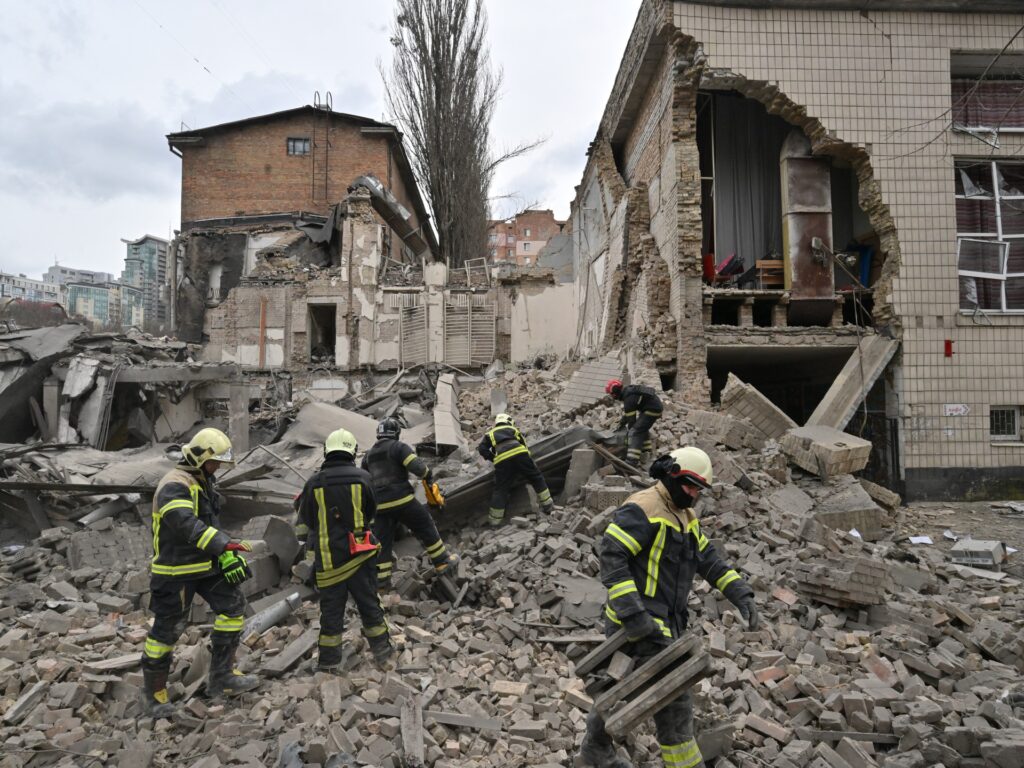
As the war enters its 761st day, these are the main developments. Here is the situation on Tuesday, March 26, 2024. Fighting Ten people, including a teenage girl, were injured after Russia hit Kyiv with missiles in the third bombardment in five days. Air defence shot down the missiles but people were hurt when the debris crashed to the ground in several central districts. Almost a dozen people were injured after Russia attacked the southern region of Mykolaiv and Odesa with drones. The authorities said eight of nine drones were shot down but that a fire at a plant in Odesa forced an emergency power shutdown. Authorities in the northeastern Kharkiv region said a 65-year-old man was killed in the courtyard of his home during Russian shelling. Oleg Kalashnikov, a press officer for Ukraine’s 26th Artillery Brigade, said the eastern city of Chasiv Yar was facing a “difficult and tense” situation, with Russian forces trying to “push through” Ukrainian defences. Kalashnikov said Moscow was dropping powerful guided bombs “on populated areas and on our fortified positions”. A fire broke out at a major Russian power plant in the southwestern Rostov region after a Ukrainian drone attack. Two power units at the Novocherkassk power station, one of the largest in the region, were shut down while the blaze was brought under control. Politics and diplomacy Russian President Vladimir Putin said “radical Islamists” were behind Friday night’s attack on the Crocus City Hall but added, without evidence, that Ukraine had a role. The Afghan branch of ISIL, also known as the Islamic State in Khorasan Province or ISKP, has said it was responsible for the attack, which killed 139 people and injured 182. Speaking in his nightly video address, Ukrainian President Volodymyr Zelenskyy again dismissed Putin’s claim. Ukraine has denied any role in the attack and Zelenskyy has accused Putin of seeking to divert blame. Poland’s Foreign Ministry said that Sergey Andreev, the Russian ambassador in Warsaw, failed to show up for a diplomatic summons issued after a Russian missile breached Polish airspace over the weekend. The wife of jailed Kremlin critic Vladimir Kara-Murza said she was in favour of prisoner exchanges to rescue him and other political detainees in Russia. Kara-Murza, who also has United Kingdom citizenship, was jailed for 25 years last year after saying Russia had committed “war crimes” against Ukraine. Russia’s Foreign Ministry summoned Australia’s chargé d’affaires in Moscow to complain about a social media post that said Russia’s staging of presidential elections in occupied parts of Ukraine, which Moscow claims to have annexed, was a “flagrant violation of international law”. Weapons Ukrainian Foreign Minister Dmytro Kuleba reiterated his call for international allies to supply more air defences, particularly Patriot systems and missiles, after Russia’s latest attack on Kyiv. Adblock test (Why?)
Palestinian boy assaulted by Israeli forces over ‘gun’ shirt

NewsFeed Video has been shared online of a Palestinian boy being assaulted and made to remove his shirt by an Israeli soldier because it had images of guns on it. After the video was published, the store was raided by the army in an attempt to confiscate the original video. Published On 25 Mar 202425 Mar 2024 Adblock test (Why?)
Warnings against normalising conflict as Yemen marks decade of war
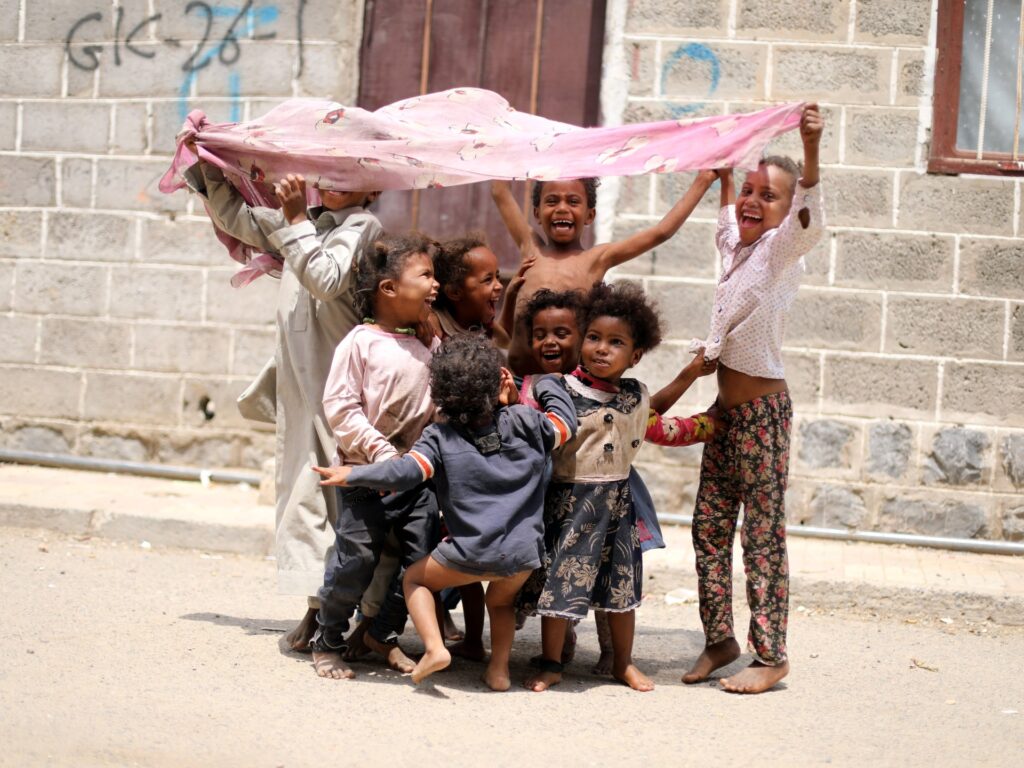
About four and a half million children are not in education in Yemen, while half of the country is in desperate need of medical aid, NGOs have warned. Reports released on Monday said two in five Yemeni children are not attending school while more than 17 million people – half of them children – require health assistance. The statistics underline the uncertainty of daily life following a decade of brutal war, the NGOs noted, pointing to mounting difficulties in funding and supplies as the number of emergency situations spread across the Middle East and other global locations. A Save the Children publication [PDF], Hanging in the Balance: Yemeni Children’s Struggle for Education, details the continuing issues in the country, where a United Nations-negotiated ceasefire has restored relative calm, but humanitarian needs still remain dire amid low-intensity violence. The Saudi-backed Yemeni government and Iran-aligned Houthis in Saudi Arabia have been fighting since 2014. A UN-brokered truce that took effect in April 2022 brought a sharp reduction in hostilities. The truce expired in October last year, and fighting largely remains on hold following a renewed peace process reached in December. PRESS RELEASE: After 9 years of conflict in #Yemen:▪️ 4.5 million children are out of school▪️ Displaced children are twice as likely to drop out▪️ 76% of students reported that their sense of safety has not increased.New report and press release 👇https://t.co/pAfi85JTmz — Save the Children MENA & Eastern Europe (MENAEE) (@scmenaee) March 25, 2024 “Nine years into this forgotten conflict, we are confronting an education emergency like never before,” Save the Children’s Mohamed Mannaa said in a statement. “While the truce reduced some violence, it hasn’t ever brought the stability families desperately need to rebuild their lives. Above everything else, families in Yemen need an official ceasefire; without one, families are left in limbo.” ‘Normalized’ The World Health Organization (WHO) said on Monday that as the conflict in Yemen enters its 10th year, over half of the country’s population is in desperate need of aid. An estimated 17.8 million people require health assistance, 50 percent of them children, the NGO said in a statement. “It’s almost as if ongoing conflicts have become an accepted part of the everyday realities of life in the region. It’s important to step back and remember that hungry children, disease outbreaks, hospitals shutting down … these are not to be normalized,” said Hanan Balkhy, WHO regional director for the Eastern Mediterranean. Amid the escalating emergencies in the Middle East and elsewhere, WHO is finding it harder to secure the necessary emergency funding for war-torn spots like Yemen. In the last five years, it warned, WHO funding for the country has declined by 45 percent. In 2024, WHO needs $77m to provide essential health assistance, it insisted. Other aid agencies are also experiencing increasing difficulties in providing urgently needed help to Yemen. In December, the World Food Programme suspended food aid to northern parts of the country citing limited funding and a disagreement with the authorities over how to distribute supplies Survival trumps education At least one child has dropped out of school in the past two years in one-third of the families surveyed for the Save the Children report. Displaced children are twice as likely to drop out than their peers, the researchers found. Economic hardships and insecurity were the main drivers of absenteeism. More than 44 percent of guardians and children surveyed said they were more interested in supporting their family’s income. Children as young as 12 told the researchers they have had to leave education in order to work. About a quarter of the families said they could not afford monthly fees and school books. The UN High Commissioner for Refugees has labelled the conflict in Yemen as the world’s worst humanitarian crisis. Thousands have died and millions have been displaced. Two-thirds of Yemen’s 33 million inhabitants have fallen below the poverty line, Save the Children said, with about 4.5 million people displaced. Over 3,700 schools have been damaged or repurposed. Persisting violence Fourteen percent of families interviewed pointed to insecurity as the reason for children dropping out, with three-quarters of students – 76 percent – reporting that they feel no safer since the truce. The ripple effects of Israel’s war on Gaza have dragged the country into further warfare, and threaten further destabilisation. The Houthis, who control much of the country, have attacked ships in the Red Sea in support of Palestinians. In turn, the United States and other military forces, have fired at Houthi targets in Yemen. Meanwhile, on Sunday, al-Qaeda launched an attack against troops from the secessionist Southern Transitional Council. Although at odds with the internationally-recognised government, the council – backed by the United Arab Emirates and controlling much of Yemen’s south – is its ally in the war against the Iranian-backed Houthi. Adblock test (Why?)
EU to investigate Apple, Google, Meta under new digital law

Antitrust regulators will probe the Big Tech companies for potential breaches of the Digital Markets Act. European Union regulators have opened investigations into Apple, Alphabet’s Google and Meta, in the first cases under a sweeping digital law designed to stop Big Tech companies from cornering digital markets. The European Commission, the 27-nation bloc’s executive, said on Monday that it was investigating the companies for “non-compliance” with the Digital Markets Act (DMA), which took effect on March 7. The law requires six gatekeepers – which provide services such as search engines, social networks and chat apps used by other businesses – to comply with guidance to ensure a level playing field for their rivals and to give users more choices. Violations could result in fines of as much as 10 percent of the companies’ global annual turnover. The rules have the broad but vague goal of making digital markets “fairer” and “more contestable” by breaking up closed tech ecosystems that lock consumers into a single company’s products or services. The commission said in a statement that it “suspects that the measures put in place by these gatekeepers fall short of effective compliance of their obligations under the DMA”. It is looking into whether Google and Apple are fully complying with the DMA’s rules requiring tech companies to allow app developers to direct users to offers available outside their app stores. The commission said it is concerned the two companies are imposing “various restrictions and limitations” including charging fees that prevent apps from freely promoting offers. Asked if the commission was rushing the process, EU industry chief Thierry Breton said the investigations should not be a surprise. “The law is the law. We can’t just sit around and wait,” he told a press conference. He said Meta, which introduced a no-ads subscription service in Europe last November that has triggered criticism from rivals and users, should offer free alternative options. Google and Apple have similarly introduced new fees for some services. Earlier this month the EU issued Apple an antitrust fine of more than 1.8 billion euros ($1.95bn) following a complaint by music streaming service Spotify. It was the first-ever antitrust fine slapped on the company by the bloc. The commission said the charge was triggered after Spotify complained in 2019 that Apple had prevented music-streaming services from informing users of payment options outside its App Store. Apple criticised the EU decision, saying it would challenge it in court. Google is facing scrutiny for not complying with DMA provisions that prevent tech giants from giving preference to their own services over those of rivals. The commission said it was concerned that Google’s measures would result in third-party services listed on its own search results page not being treated “in a fair and non-discriminatory manner”. The commission is investigating whether Apple is doing enough to allow iPhone users to easily change web browsers. It is also looking into Meta’s option for users to pay a monthly fee for ad-free versions of Facebook or Instagram so they can avoid having their personal data used to target them with online ads. “The Commission is concerned that the binary choice imposed by Meta’s ‘pay or consent’ model may not provide a real alternative in case users do not consent, thereby not achieving the objective of preventing the accumulation of personal data by gatekeepers,” it said. The EU has sought to crack down on Big Tech companies, handing out a series of multibillion-dollar fines for Google and charging Meta with distorting the online classified advertising market. Apple’s fine is about a quarter of the 8.25 billion euro ($8.95bn) the EU regulator fined Google in three cases in the last decade. Adblock test (Why?)
Vote counting under way in Senegal’s delayed presidential election
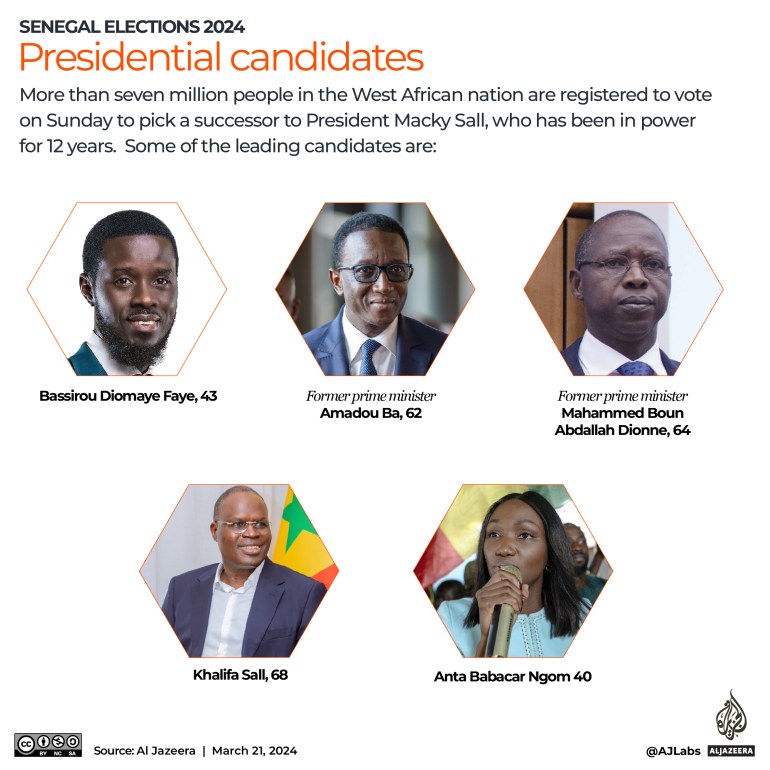
Vote counting is under way in Senegal after a delayed presidential election that many hope will bring change after a turbulent political period that has triggered violent anti-government protests and boosted support for the opposition. More than seven million of the country’s over 17 million people were registered to vote in Sunday’s election. Nineteen contenders are vying to replace President Macky Sall, stepping down after a second term marred by unrest over the prosecution of opposition leader Ousmane Sonko and concerns that Sall wanted to extend his mandate past the constitutional limit. The incumbent was not on the ballot for the first time in Senegal’s history. His ruling coalition has picked former prime minister Amadou Ba, 62, as its candidate. Sonko, in jail until recently, was disqualified from the race because of a defamation conviction. He is backing the co-creator of his now-dissolved PASTEF party, Bassirou Diomaye Faye, who was also detained almost a year ago on charges including defamation and contempt of court. An amnesty law passed this month allowed their release days before the vote. He and his colleague Diomaye have campaigned together under the banner “Diomaye is Sonko”. Besides Ba and Faye, Dakar’s former Mayor Khalifa Sall, veteran politician Idrissa Seck, former Prime Minister Mahammed Boun Abdallah Dionne, a close ally of President Sall Aly Ngouille Ndiaye and entrepreneur and political newcomer Anta Babacar Ngom — the sole woman among the candidates — are all a part of the presidential race. (Al Jazeera) To avoid a run-off election, one candidate must secure more than 50 percent of the vote. While official results are expected next week, in previous elections candidates have announced their predictions on the same evening as the vote. Reporting from Dakar, Al Jazeera’s Nicolas Haque said it was an “unusual” election. “There is both anticipation like you would have in any election; there is an element of fear and unknown because this is the first election in the last 12 years where President Macky Sall is not in the running … and there is an element of excitement, especially among those young, first-time voters. “This is an election like no other and it’s very important, especially for young people.” ‘Voting for change’ Lines formed outside polling stations around Dakar on Sunday. Roads were quiet as the nation’s elite police force was deployed across the city in armoured vehicles, checking voters’ cards. “I am so happy to be able to exercise my right to vote as a Senegalese citizen,” voter Thiaba Camara Sy, from the organisation Demain Senegal (Tomorrow Senegal), told Al Jazeera at a polling station in Dakar. “This is something that we have won because the risk was high of the election being delayed until who knows when, so I’ve been queuing for two hours but I’m happy.” In the ocean-facing neighbourhood of Dakar’s Ngor, fisherman Alioune Samba, 66, said he was voting for the change everyone wants. “Food, water, school; everything is expensive with the low income we have in Senegal,” the father of three told Reuters news agency. People wait to cast their votes outside a polling station during the presidential elections, in Dakar, Senegal [Mosa’ab Elshamy/AP] Khodia Ndiayes, a 52-year-old cook, told the Associated Press news agency she picked Faye on the ballot because she wanted Sonko to win. “I’m proud to have voted,” she said. “We need a new president because life is expensive, the economy is bad and we need better schools.” Al Jazeera’s Haque said it appeared that a lot of people have come out to vote. “It’s interesting who those people are: a lot of young men but also women, key in this election because women make up a substantial part of the electorate in Senegal,” he said. Faye versus Ba After casting his vote, Ba called for peace and said he wished for the Senegalese people to find out who their next president is soon and to calmly resume their daily lives. He said he was “very, very, very confident” of his chances of winning. Most of Sonko’s supporters are expected to vote for Faye, analysts say. “The population is choosing between continuation and rupture,” Faye said after voting, urging contenders to accept the result. In these elections, “the two political camps stand on opposite sides of the political spectrum”, Mucahid Durmaz, a senior political risk analyst for West Africa at Verisk Maplecroft, told Al Jazeera. He noted that while outgoing President Sall and his ruling coalition candidate Ba favour economic liberalisation policies, opposition figure Sonko and his chosen candidate Faye plan to introduce a new currency and renegotiate contracts with oil and gas operators in the country. “The issue here is that despite the economic boom that the country has witnessed over the years under President Sall, it’s not really facilitated a wider socioeconomic development for the country’s youthful population,” Durmaz said. Economic issues Unemployment is another key issue in the election. Frustration at the lack of job opportunities has spurred support for Sonko and his backed candidate Faye, particularly among the youth. The share of young Senegalese not in employment, education or training stood at 35 percent in 2019, before the COVID-19 pandemic further squeezed the job market. Besides unemployment, the rising cost of living spurred by Russia’s war in Ukraine and the appreciation of the United States dollar have undermined support for current ruling Senegalese authorities. The launch of oil and gas production later in 2024 has also raised questions about whether the natural resource wealth will benefit the wider population and create jobs. The Sonko-backed opposition coalition has promised to renegotiate energy contracts to maximise revenues, while Ba is running on the slogan “Prosperity Shared”. ‘Calm’ voting process While the elections come amid frustrations over a fragile economy, according to election observers, the voting process has been relatively peaceful. Hundreds of election observers from civil society, the African Union, the regional group the Economic Community of West African States (ECOWAS) and the European Union were on the ground monitoring the
Simon Harris to be Ireland’s youngest PM after clinching party leadership

Harris will be voted in as Ireland’s youngest-ever prime minister when parliament next sits on April 9. Simon Harris is set to become Ireland’s youngest prime minister after he was appointed as the new leader of the governing Fine Gael party. The 37-year-old said it was the “absolute honour of my life” to be appointed party leader on Sunday, replacing Leo Varadkar, who resigned unexpectedly on Wednesday, saying the party would be better governed under another leader. Harris will be voted in as the Republic of Ireland’s youngest-ever prime minister – known as the taoiseach – when the country’s parliament or Oireachtas next sits on April 9 due to support from Fine Gael’s coalition partners. “I think he’s done a really good job in securing the leadership in as comprehensive a way as he has,” Fine Gael deputy leader Simon Coveney said. Harris told the centre-right party’s members that he would repay their faith with “hard work, with blood, sweat and tears, day in and day out with responsibility, with humility and with civility”. Setting out his priorities, Harris insisted that Fine Gael “stands for law and order” and told members he wanted to “take our flag back” from nationalists, to loud cheers. He also said that he would pursue a “more planned and sustainable” immigration policy, following increased tension over the issue, and that he would “fight against the dangers of populism”. On the international front, he called for an immediate ceasefire in Gaza and condemned Russia’s “horrific illegal invasion of Ukraine”. He will have no more than a year to save the coalition from defeat at parliamentary elections. In the last three years, polls have put Sinn Fein, a left-wing party that backs unification with Northern Ireland, a British province, as the preferred choice to lead the next government. However, two more polls on Sunday confirmed a recent trend of support for Sinn Fein dropping off highs of 12-18 months ago. A Business Post/Red C poll conducted before Varadkar’s departure as taoiseach put Sinn Fein’s lead over Fine Gael at six percentage points, while an Irish Independent/Ireland Thinks survey showed a five-point edge. Harris, formerly a minister for education, research and science, is best known for taking responsibility for Ireland’s COVID-19 response. He said recently that he became involved in politics as an “opinionated, moody teenager” bothered by the lack of educational supports for his autistic brother. Although he has spent most of his adult life in parliament, Harris has cast himself as an “accidental politician”. His online presence led one opponent in the Oireachtas to dub Harris the “TikTok taoiseach”. While the economy grew strongly under Varadkar, successive governments, of which Harris has been part, have struggled to tackle a decade-long housing crisis and, more recently, the pressure from record numbers of asylum seekers and refugees. Inheriting a three-party coalition government working off an agreed policy programme will not give the incoming leader much room for major new policy initiatives. Before Harris, Varadkar was the country’s youngest-ever leader when first elected at age 38, as well as Ireland’s first openly gay prime minister. His mother is Irish and his father is Indian, which also made Varadkar Ireland’s first biracial taoiseach. Varadkar, 45, has had two spells as taoiseach — between 2017 and 2020, and again since December 2022 as part of a job-share with Micheal Martin, head of coalition partner Fianna Fail. Adblock test (Why?)
Chad main opposition figures barred as leaders cleared for election

The central African country’s presidential election is set to take place in May. Authorities in Chad have cleared 10 candidates for this year’s long-awaited presidential election, barring two fierce opponents of the military government from standing. Chad’s Constitutional Council announced on Sunday that outspoken opposition figures Nassour Ibrahim Neguy Koursami and Rakhis Ahmat Saleh would be barred. It said their applications had been rejected because they included “irregularities”. The council said that the nominations of interim President Mahamat Idriss Deby and the country’s recently-appointed Prime Minister Succes Masra had been accepted. The central African nation is scheduled to hold the first round of a presidential election on May 6 and the second round on June 22, with provisional results on July 7. The elections are part of a transition back to democracy from rule by Chad’s military government, which is one of several currently in power in West and Central Africa. There have been eight coups in the region since 2020, sparking concerns of a democratic backslide. It is the first time in Chad’s history that a president and a prime minister will face each other in a presidential poll. Deby initially promised an 18-month transition to elections after he seized power in 2021, when his long-ruling father was killed in clashes with rebels. But his government later adopted resolutions that postponed elections until 2024 and allowed him to run for president, triggering protests that were violently quelled by security forces. In December, Chadians voted in favour of a new constitution that critics said could help cement Deby’s grip on power as it allowed him to run for the presidency. Deby confirmed his intention to run earlier this month. Masra, previously a staunch opponent of Chad’s military rulers, had fled the country after dozens were killed when security forces cracked down on demonstrations in the capital N’Djamena in October 2022. He returned in November after a reconciliation agreement was signed that guaranteed him the ability to participate in political activities. Several opposition parties have since distanced themselves from Masra. Call for boycott Wakit Tamma, another of the main opposition platforms in Chad, on Saturday called for a boycott of the presidential vote, denouncing it as a “masquerade” aimed at upholding a “dynastic dictatorship”. The barring of the opposition candidates comes less than a month after General Deby’s main rival Yaya Dillo Djerou was shot dead in an army assault on his PSF party headquarters. In early March, Human Rights Watch called for an independent investigation into the murder of Dillo, arguing that the army assault “raises serious concerns about the environment for elections scheduled for May”. Prime Minister Masra subsequently promised that his government would hold an international inquiry to determine responsibility for the death of the military government’s main opponent. [embedded content] Adblock test (Why?)
Pro-West candidate beats Slovakia PM’s ally to set up presidential run-off

Ex-Foreign Minister Ivan Korcok and current parliament Speaker Peter Pellegrini to face off in April’s vote dominated by the Ukraine war. Slovakia’s former pro-West Foreign Minister Ivan Korcok and current parliament Speaker Peter Pellegrini will face off in April’s presidential election run-off, according to the final results. The liberal Korcok led with 42.44 percent backing with 99.9 percent of the vote counted, while former Prime Minister Pellegrini earned 37.07 percent, the Slovak Statistical Office said late on Saturday. The result was expected by analysts as the 48-year-old Pellegrini and 59-year-old Korcok topped the opinion polls before the vote marked by deep divisions on the war in neighbouring Ukraine. The presidential election is a chance for Prime Minister Robert Fico, whose views on Ukraine have angered critics for veering too close to Russia, to strengthen his grip on power. President Zuzana Caputova, 50, who has been a fierce opponent of Fico, did not seek a new term. But the opposition forces want a counterbalance to Fico’s rule. Korcok, a career diplomat who was a minister in a past government, will advance to a run-off on April 6 against Pellegrini, who heads the Hlas (Voice) party. A Russian-leaning former Supreme Court chief, Stefan Harabin, gained the third most votes at just 11.75 percent, after getting support from a nationalist party that is also in the government coalition. His voters could help Pellegrini. “I certainly have to speak to the tens of thousands of voters of the ruling coalition who disagree with where the government is pulling Slovakia,” Korcok told his supporters. Fico and his ruling leftist Smer party won a parliamentary election last September with pledges to halt military aid to Ukraine and maintain support for people hit by price surges. Pellegrini, a former member of Smer, was key in forming a coalition and said the first-round results showed a majority did not want a “liberal-right-progressive” president who would only be in conflict with the government. “The majority in Slovakia expressed an interest in having a president who will defend the national state interests,” he said. Presidents do not wield many executive powers but have a role in government and judicial appointments, can veto laws and shape public debate as the liberal Caputova often did. Voters in the past have rejected giving ruling parties both the government and presidential offices, including Caputova’s win in 2019 when anticorruption sentiment hurt Fico’s party, which was in government then. “This election will show whether mass protests that have taken place in Bratislava and other major cities in recent weeks are also supported by people who usually express their disapproval at the polling stations,” said Radoslav Stefancik, political analyst at the University of Economics in Bratislava. Adblock test (Why?)
Nigerian army rescues 17 students abducted from Sokoto state

NewsFeed Children who were kidnapped in two separate abductions in northern Nigeria have been freed. On Friday the army rescued one group taken from Sokoto, while more than 130 students from Kaduna were released early on Sunday. Published On 24 Mar 202424 Mar 2024 Adblock test (Why?)
Only effective way to ramp up Gaza aid is by land, UN chief Guterres says

During a visit to Egypt, Antonio Guterres warns of the impact Israel’s months-long war on Gaza is having around the globe. The only effective and efficient way to deliver heavy goods to meet Gaza’s humanitarian needs is by road and includes an exponential increase in commercial deliveries, says the United Nations Secretary-General Antonio Guterres. Speaking during a visit to Egypt on Sunday, Guterres also warned of the impact Israel’s months-long war on Gaza was having around the globe. “The daily assault on the human dignity of Palestinians is creating a crisis of credibility for the international community,” he said in remarks following a visit to the gates of the besieged Palestinian territory at the Rafah border crossing on Saturday. Guterres repeated his call for an immediate ceasefire to alleviate “the plight of Palestinian children, women and men struggling to survive the nightmare” in famine-threatened Gaza. “Looking at Gaza, it almost appears that the four horsemen of war, famine, conquest and death are galloping across it,” he said. “The whole world recognises that it’s past time to silence the guns and ensure an immediate humanitarian ceasefire.” The UN has repeatedly warned of famine in the Palestinian territory, particularly in the north, which has been largely cut off from aid deliveries. Guterres said Palestinians in Gaza “desperately need what has been promised – a flood of aid”. “Not trickles. Not drops,” he added. The Israeli government is under growing international pressure to ease its bombardment and ground offensive in Gaza, which the territory’s Ministry of Health says has killed at least 32,226 people in less than six months, most of them women and children. The bombings began on October 7 after the Palestinian armed group, Hamas, led an unprecedented attack on Israel, killing about 1,160 people, mostly civilians, according to Israeli officials. Israel has pledged to pursue its military campaign all the way to Gaza’s southernmost city of Rafah, where 1.5 million Palestinians have sought shelter, penned in by the Egyptian border. Guterres, who also met with Egyptian President Abdel Fattah el-Sisi, called the Rafah border crossing and Egypt’s El Arish airport where assistance is sent “essential arteries for life-saving aid into Gaza”. “But those arteries are clogged,” he said, with massive lines of trucks piled up on the Egyptian side, only trickling in as the humanitarian situation worsens. Adblock test (Why?)