

What is the history of foreign interventions in Haiti?

The proposal initially sparked an uproar. In October 2022, then-Haitian Prime Minister Ariel Henry and 18 top officials called on the international community to send a “specialised armed force” to help combat the spread of gang violence in Haiti. But Haiti has struggled with a long, fraught history of foreign involvement — and the prospect of a new wave of outside interference was met with scepticism. Now, experts say that public opinion is shifting in Haiti, as the violence continues to fester and Haiti’s already tenuous government is on the verge of yet another shake-up. “In October 2022, most Haitians were against an international force,” said Pierre Esperance, executive director of Haiti’s National Human Rights Defense Network (RNDDH). “But today most Haitians will support it because the situation is worse, and they feel there are no other options.” Still, the history of international involvement in Haiti casts such a long shadow that it continues to be a divisive subject — both among the Haitian people and the outside forces that would potentially be involved. A new level of crisis The instability in Haiti entered a new chapter this week when Prime Minister Henry — an unelected official who has been serving as de facto president — announced that he planned to resign. The announcement came after mounting international pressure, as well as threats from the gangs themselves. One of the country’s most notorious gang leaders, Jimmy “Barbecue” Cherizier, told reporters that a “civil war” would erupt if the deeply unpopular Henry did not step down. The calls for an international force to intervene arise from the acute nature of the situation, Esperance and other experts told Al Jazeera. Gang violence has forced more than 362,000 Haitians from their home, largely in and around the capital of Port-au-Prince. The United Nations estimates that at least 34,000 of those have been displaced since the start of the year. Armed groups have also taken control of roadways and other vital arteries around the country, limiting the flow of supplies. With high rates of poverty already driving malnutrition, the UN has warned the country is at risk of famine. “The gangs control more than 95 percent of Port-au-Prince,” Esperance said. “Hospitals don’t have materials, there’s not enough drinking water, the supermarkets are almost empty. People are staying at home because it’s very dangerous.” Will Kenya take the lead? With gang violence at crisis levels and Haiti’s government in shambles, some Haitians are increasingly looking abroad for assistance. An August poll released by the business alliance AGERCA and the consultancy DDG found that about 63 percent of Haitians supported the deployment of an “international force” to combat the gangs. An even higher portion — 75 percent — said the Haitian police needed international support to reestablish order. But countries like the United States and Canada have baulked at the prospect of helming such a force themselves, though they have offered to back other governments that might lead one. In July 2023, Kenya announced it would be willing to deploy forces to Haiti and potentially lead a multinational security mission. The UN Security Council threw its support behind the initiative, approving the Kenya-led mission. But the effort has since stalled, amid court challenges and other slowdowns. In January, a Kenyan court ruled that deploying forces in Haiti would be “illegal and invalid”. And just last Tuesday, Kenyan officials said they would pause any deployment to Haiti until a new government was in place. Jonathan Katz, the author of the book The Big Truck That Went By: How the World Came to Save Haiti and Left Behind a Disaster, told Al Jazeera that the international community’s hesitation to lead a mission to Haiti is a testament to the poor track record of past foreign interventions. “These countries are saying, ‘We need to do this because we can’t think of any other solution,’” said Katz. “But nobody wants to do it themselves because every single one of these interventions throughout Haiti’s history have ended with significant egg on the face for everyone involved.” ‘A direct colonial occupation’ Since the early 1900s, there have been at least three direct interventions in Haiti, including a decades-long occupation by US forces. That occupation lasted from 1915 to 1934 and was carried out in the name of restoring political stability after the assassination of then-President Vilbrun Guillaume Sam. But during their time in Haiti, US forces oversaw widespread human rights abuses and the implementation of a “corvée”, a system of forced labour sometimes likened to slavery. “Slavery it was — though temporary,” said US civil rights leader James Weldon Johnson, writing for The Nation magazine in 1920. “By day or by night, from the bosom of their families, from their little farms or while trudging peacefully on the country roads, Haitians were seized and forcibly taken to toil for months in far sections of the country.” US soldiers even removed substantial funds from the Haitian National Bank, carting them off to New York. “This was a direct colonial occupation that began under US President Woodrow Wilson and lasted for five administrations, both Republican and Democrat,” Katz said of that period. “Later occupations were carried out with varying degrees of directness and indirectness.” A hand in Haiti’s politics For instance, the US would intervene again in Haitian politics during the Cold War, as it propped up governments friendly to its interests in the name of anti-Communism. Positioning himself as an anti-Communist leader upon his election in 1957, Haitian President Francois “Papa Doc” Duvalier actively courted US support, even as he led a brutal campaign of state violence against his own people. Despite misgivings about Duvalier, the US offered him aid: US Ambassador Robert Newbegin, for instance, arrived in Port-au-Prince prepared to give Duvalier’s administration approximately $12.5m in 1960 alone. One estimate puts the total US support given to Haiti under Duvalier and his son, Jean-Claude “Baby Doc” Duvalier, at $900m. Meanwhile, the Duvaliers faced accusations of murder, torture and other violations. The US
Survivors of rescued Mediterranean ship say dozens died during the voyage
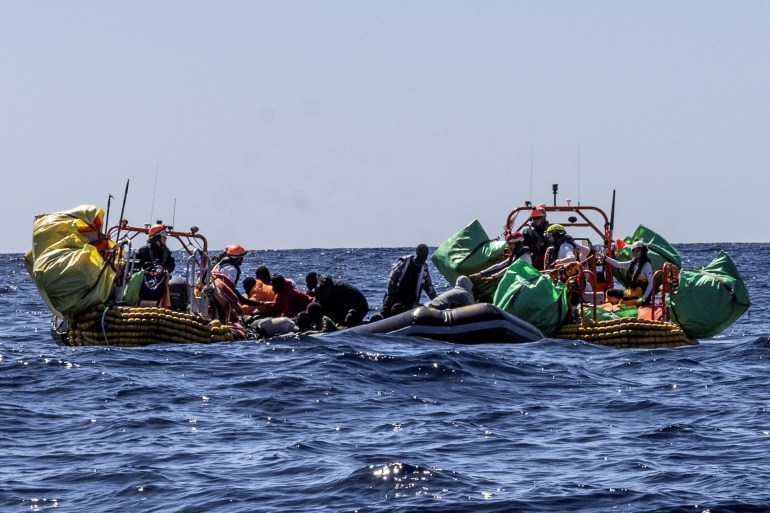
At least 60 people died as the boat spent about a week lost at sea after leaving Libya, survivors tell rescuers. Survivors from a deflating rubber dinghy rescued in the central Mediterranean Sea reported that at least 60 people who departed Libya with them a week ago died during the journey, a charity rescue group has said. SOS Mediterranee said on Thursday that it had rescued 25 people in a “very weak” condition in coordination with the Italian coastguard a day earlier. Two unconscious people were also flown to Sicily by helicopter but later died. “The survivors departed from Zawiya, Libya, seven days before they were rescued,” SOS Mediterranee said on X. “Their engine broke after three days, leaving their boat lost (and) adrift without water and food for days. Survivors report that at least 60 people perished on the way, including women and at least one child,” it added. The rescue group’s spokesman Francesco Creazzo said the survivors were all male, 12 of them minors. They were from Senegal, Mali and The Gambia. Survivors are rescued by a ship run by SOS Mediterranee [Johanna De Tessieres/Sos Mediterranee/Handout via Reuters] According to testimonies the group gathered, the boat spent about a week lost at sea, with survivors saying many people perished and many others are missing. There was no immediate comment from the Italian Coast Guard. The International Organization for Migration (IOM) said it was “deeply troubled” by the incident. “Urgent action is needed to strengthen maritime patrols and prevent further tragedies,” the agency said on X. After yesterday’s rescue of 25 people in very weak health condition, a medical evacuation took place in cooperation with the Italian Coast Guards. Two unconscious people our teams weren’t able to rouse were flown to Sicily by helicopter. (1/2) pic.twitter.com/zmBPBSyilN — SOS MEDITERRANEE (@SOSMedIntl) March 14, 2024 SOS Mediterranee said the central Mediterranean route, which the migrants were attempting to cross, is one of the world’s most dangerous sea migration routes. According to the IOM, almost 2,500 migrants died or went missing on the route last year, with the number for this year at 226 so far. Italy and other European Union governments are trying to quell the number of migrants crossing from North Africa, providing money and resources to Libya and Tunisia to help stop the departures from their shores. According to the Italian Interior Ministry, 5,968 migrants have arrived by sea so far this year, down from 19,937 at the same stage in 2023. Adblock test (Why?)
NATO allies must do more as Ukraine runs out of ammunition: Stoltenberg
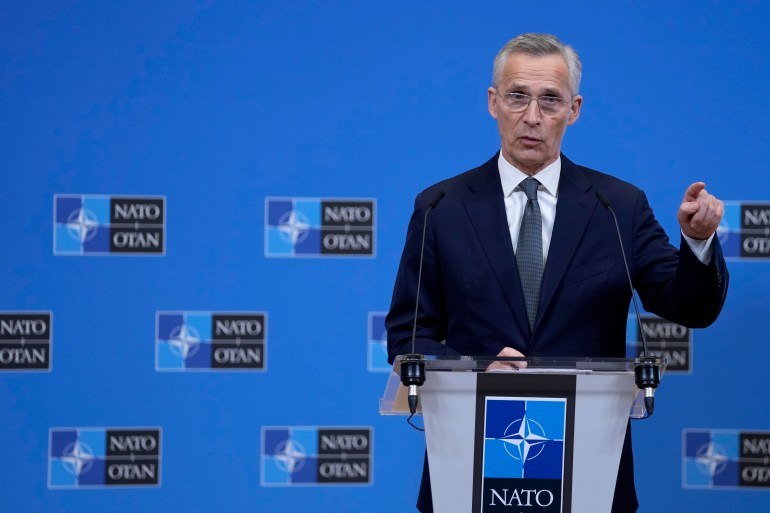
NATO’s secretary-general calls on members to show the political will to offer more support for Kyiv against Russia. Ukraine is running out of ammunition and NATO members are not doing enough to help Kyiv, the alliance’s secretary-general, Jens Stoltenberg, has said, in unusually blunt comments about the state of the war. “Unprecedented aid from NATO allies has helped Ukraine survive as an independent nation. But Ukraine needs even more support and they need it now,” Stoltenberg told reporters at NATO headquarters in Brussels on Thursday. “The Ukrainians are not running out of courage, they are running out of ammunition,” he said. More than two years after Russia’s full-scale invasion, Ukraine’s military has recently been grappling with significantly reduced weapons supplies from the West. “NATO allies are not providing Ukraine with enough ammunition and that has consequences on the battlefield every day,” Stoltenberg said. “It is one of the reasons why the Russians have been able to make some advance on the battlefield over the last weeks and months. “It is an urgent need for allies to make the decisions necessary to step and provide more ammunition to Ukraine. That’s my message to all capitals. “We have the capacity, the economies, to be able to provide Ukraine what they need. This is a question of political will. To take the decisions and to prioritise support for Ukraine.” Stoltenberg presents the 2023 NATO annual report [Virginia Mayo/AP Photo] The US on Tuesday announced a new $300m weapons package for Ukraine, but a further $60bn in funding remains stalled by Republicans in Congress. On Wednesday, European Union countries agreed to provide five billion euros ($5.48bn) for military aid to Ukraine as part of a revamp of an EU-run assistance fund. However, the bloc is well behind schedule in its promise, made last year, to send a million artillery shells to Ukraine by this month. The Czech Republic has led an 18-nation coalition buying artillery shells from outside Europe, and this month Prague announced that the first of 300,000 shells could reach Kyiv within weeks. EU leaders will meet at a Brussels summit next week to discuss initiatives aimed at boosting Europe’s weapons industry. Meanwhile, Russia has ramped up its domestic arms production by putting its economy on a war footing and has received major deliveries of weapons from Iran and North Korea. Adblock test (Why?)
The never-ending war on truth

On March 9, 2015, five men driving a white truck with a concealed number plate abducted Itai Dzamara, a Zimbabwean journalist and activist, from a barbershop in the Zimbabwean capital Harare. Within seconds, he was bundled into the unmarked car and driven to an unknown location. Dzamara has not been seen ever since. Eight days before his enforced disappearance, he had called on Zimbabweans to demonstrate against the tough and deteriorating socioeconomic conditions in their country. And he had called on then-President Robert Mugabe to resign. His forced disappearance was not an extraordinary event in a country where journalists were (and still are) routinely harassed and detained by authorities for publishing stories deemed to be “politically sensitive” or damaging to those in positions of power. Sixteen years earlier, in January 1999, two journalists, Mark Chavunduka and Ray Choto, who worked for the Standard newspaper, were forcibly disappeared for 10 days. While under illegal detention, they suffered electric shocks to their hands, feet, and genitals and their heads were submerged in drums of water. When they eventually appeared in court, they both had burn marks on their bodies. Their alleged crime was to publish a story about 23 army officers being arrested for plotting a coup against President Mugabe. In 2008, Jestina Mukoko, a prominent former TV journalist, who also runs an NGO, was abducted from her home in the middle of the night, detained incommunicado for days and tortured by alleged state agents, for her alleged involvement in planning anti-government protests. She thankfully survived her horrific ordeal, and returned to her family and advocacy work. But Dzamara has not been as lucky. He has never returned home to his wife and two young children. Every year on the anniversary of his disappearance, Zimbabweans take to social media to remember him and to vent their frustrations about Zimbabwe’s seemingly never-ending war on journalists, and truth. Despite efforts by civil society and the main opposition party, the state appears extremely reluctant to solve Dzamara’s case and finally deliver justice to his long-suffering family. Mugabe has been out of power since 2017, and Zimbabwe is supposedly a changed country, but to date, the Zimbabwean government has not even bothered to launch a high-level investigation into Dzamara’s violent abduction. This speaks volumes about Harare’s unrelenting contempt for the truth, and war on those who dare to speak truth to power. Whoever disappeared Dzamara clearly intended to instil a great deal of fear in media practitioners and kill journalism in the small southern African country. To some extent, they have succeeded. As recently as this February, a local paper, the NewsHawks, was forced to abandon its investigations into the Zimbabwe National Army after subtle threats from senior army officials. Journalists who dare to investigate military and government corruption in Zimbabwe still expect to be harassed, unlawfully arrested, tortured or worse to this day. Regrettably, Zimbabwe is not an outlier. This proclivity to threaten or kill the messenger to conceal bitter truths appears to be endemic across Africa and around the globe. Joao Chamusse – a veteran Mozambican journalist, and the co-owner and editor of online newspaper Ponto por Ponto – was found dead in the backyard of his house in KaTembe, Maputo City, on December 14, 2023. His neighbours said they heard him scream for help before falling silent. His horrendous murder came on the back of a wave of intimidation against journalists and media outlets in the run-up to this year’s general election. In Lesotho’s capital Maseru, Ralikonelo “Leqhashasha” Joki, who was a prominent reporter for Ts’enolo FM radio station, was shot at least 13 times by unknown assailants as he left the studio after a show in May 2023. Joki was highly critical of state officials, and his death appears related to his endeavours to expose the truth and hold government officials accountable for their actions. It would be amiss to speak of the war on truth tellers without paying homage to the Palestinian journalists killed in Israel’s war on Gaza. At least 88 Palestinian media workers have been killed as they braved shelling to expose Israel’s genocidal violence. Israel’s war on journalists who expose the injustice of its occupation and its abuse of Palestinians did not begin with this latest war, either. Shireen Abu Akleh, a Palestinian-American journalist and correspondent for Al Jazeera, was shot dead in May 2022 while reporting on an Israel raid in the Jenin refugee camp. And Israel had killed dozens of media workers before her. I despair at the loss of Abu Akleh, and all the other brave, admirable Palestinian journalists who had been silenced by Israeli bombs and bullets. I mourn for Leqhashasha, Chamusse and all the others who have been slain for exposing corruption or speaking truth to power. My heart bleeds for the family of Dzamara, and those of other “disappeared” journalists across the globe, who will likely never learn what actually happened to their loved ones. I feel the deepest pain, however, for those journalists who I fear will meet similar fates in the coming months and years. Indeed, in the absence of strong legal repercussions, there is every chance that other journalists will go missing or be killed by “unknown” people in Zimbabwe. The same is true for those working in Lesotho, Mozambique and elsewhere. And we know Israeli bombs continue to fall on Palestinian journalists as I write these lines. When a journalist is killed or disappeared, people are quick to express sympathy and voice condemnation. Following such news, our social media timelines always fill with messages honouring their lives and achievements. Governments, NGOs, and international institutions issue statements, and vow to hold those responsible to account. Words of empathy and condemnation are of course commendable, but what is needed above all is simple: justice. In the case of Zimbabwe, the African Union and the Southern African Development Community (SADC) have to stop paying lip service to press freedom and demand answers from President Emmerson Mnangagwa. And they should take
Morocco’s Marrakesh is awakening slowly from the earthquake damage

Marrakesh, Morocco – Like everyone in Marrakesh, 39-year-old Zakaria Lamnichri was surprised when the earthquake hit six months ago. Speaking from his stall in the centre of the city, the easy flow of his conversation interrupted by queries from browsing tourists, he recalls the tremors he experienced as the magnitude 6.9 earthquake ripped through the nearby mountains, claiming the lives of about 3,000 people. “The moment, for those who lived it, was horrifying. My wife and son were away in the mountains. I was here. I was terrified for them. For them, that terror lasted for days,” he said, describing how rescuers struggled to reach the small, isolated village where his family was staying and, like many in the High Atlas Mountains, accessible only by donkey or moped. “No one expected it,” he continued. “No one knew what to do. What affected me especially was the emotional part, of seeing other people’s problems. Of rich people who were left with nothing,” he says, pausing. “People who had children and lost them.” While the epicentre of the earthquake may have been some 75km (47 miles) distant, the destruction that remains in the centre of Marrakesh is a testament to its destructive power. Equally, that the tourists have returned in such numbers is a testament to the enduring lure of the North African city. Zakaria [Simon Speakman Cordall/Al Jazeera] However, for many of the people who live here, like those in the mountains, any sense of permanence, or confidence that the future may hold the same rewards and challenges as the past, has been lost. History ends Today, much of the rubble that blocked the passageways of the 12th-century medina has been cleared. However, for the houses hit the worst, like those in the Jewish district, or mellah, fields of loose rock now lie where homes once stood. Karim Nassir’s house withstood the earthquake. But he remembers being bundled out into the dark, along with his wife and his seven-year-old son. “It was very dark,” he recalls now, his son hanging off his leg. “But you could hear the houses falling down,” he said, describing the dust and confusion that filled the narrow lanes and alleyways that define much of the medina. “A lot of families have changed their houses,” 27-year-old spice seller Abdul Samad says. “A lot of families have gone. It’s all over, look,” he says, pointing to the latticework of cracks and fissures that stretch out along the wall behind him. “My family has changed house,” he says, describing how his family’s home had barely withstood the quake. Parts of the medina still show the damage from September’s earthquake [Simon Speakman Cordall/Al Jazeera] While the damage extends across much of the medina, even reaching as far as the landmark Kutubiyya Mosque, whose distinctive minaret adorns the thousands of fridge magnets on sale throughout the medina, the brunt was felt in the mellah, once home to about 70,000 ethnic inhabitants, reduced over subsequent years by emigration, war and history to a cluster of just 250. Across the mellah, houses that had withstood the passage of generations lie in rubble, their inhabitants forced to live in storehouses and outhouses undamaged by the quake. Everywhere, as it is across the mountains that look down upon the city, people talk of the loss of any sense of permanence, of waiting for the next earthquake that will destroy everything in a region that, historically, has known only earthquakes. Tourists return Inevitably, as news of the earthquake spread around the world, tourists cancelled their trips. Tourism, representing approximately 7 percent of gross domestic product (GDP), is one of the key pillars of the Moroccan economy that had been all but wiped out during the global pandemic. For a time in September at least, it seemed like any kind of sustainable recovery would elude what was Morocco’s most visited city. But as inevitably as the tourists departed, they returned. [embedded content] Despite the destruction and loss of life, 2023 proved a record year, with tourism closing 12 percent up on the previous year. Even in February, the low season by Moroccan standards, Marrakesh’s hotels buzz with the international chatter of hikers, tourists and the curious, while the alleyways and lanes of the medina are full of those seeking a little winter sun and some culture. “Numbers dropped by around half after the earthquake,” stallholder Nourddine Idar says from the depths of the Jewish district, the wall behind him a tapestry of imitation animal hides. “About two weeks later, they were back,” the 26-year-old said, describing the variety of visitors that pass by his shop and peruse his goods. Cracks line the wall opposite him. In the courtyard of one of the mellah’s two synagogues, Brian Cox and Kayleigh Singh, both in their 20s, had just arrived the day before from the United Kingdom to scrutinise an especially confident tortoise. “We just came to see something new,” Kayleigh says. Nourddine Idar’s simple stall in Marrakesh, February 2024 [Simon Speakman Cordall/Al Jazeera] Jack chimes in: “We heard it’s very culturally rich and the people are very nice and welcoming, too.” The future However, there is no denying that the medina remains shattered. Tourists must now snake their way past joints and buttresses to explore the medina’s inner reaches, just as residents have come to lie their washing upon the soaring wooden joints so that they can dry in the sun. In the square, Zakaria combs through a box of welded metal fittings. “You know, coronavirus changed our [attitude to] life, the way you survive, the way you treat money, the way you think money will always be there, that your work will be there. “You know, before corona[virus], we were too arrogant, or at least I was,” he says with a laugh. He looks out at the square, the competing stands and the bustling tourists. “After what happened here, we realised that we were nothing. What we have now, we can lose a second,” he said. “It’s not
Japan court rules ban on same-sex marriage is ‘unconstitutional’

Japan is only G7 nation that excludes same-sex unions with conservative government criticised as stonewalling diversity. A high court in Japan has ruled that the country’s ban on same-sex marriage is “unconstitutional” as pressure mounts for such unions to be legalised. On Thursday, the Sapporo High Court said not allowing same-sex couples to marry violates their fundamental right to have a family, and called for urgent government action to address a lack of laws allowing same-sex unions. A lower court in Tokyo issued a similar ruling earlier on Thursday, becoming the sixth district court to do so. But the Tokyo District Court ruling was only a partial victory for Japan’s LGBTQ community calling for equal marriage rights, as it does not change or overturn the current civil union law that describes marriage as between a man and a woman. Japan is the only member of the Group of Seven (G7) nations that still excludes same-sex couples from the right to legally marry and receive spousal benefits. Support for marriage equality has grown among the Japanese public in recent years, but the governing Liberal Democratic Party, known for its conservative family values and reluctance to promote gender equality and sexual diversity, remains opposed to the campaign. ‘Groundbreaking’ Amnesty International said Thursday’s rulings were “groundbreaking”. “The court decisions today mark a significant step towards achieving marriage equality in Japan. The ruling in Sapporo, the first High Court decision on same-sex marriage in the country, emphatically shows the trend towards acceptance of same-sex marriage in Japan,” said the group’s East Asia researcher Boram Jang. “By recognizing that the government’s ban on same-sex marriage is unconstitutional, these rulings make clear that such discrimination has no place in Japanese society,” the statement said, adding that the government now needs to be proactive in moving towards the legalisation of same-sex marriage so that couples can fully enjoy the same marriage rights as their heterosexual counterparts. Japan: Groundbreaking same-sex marriage rulings a long-awaited victory for LGBTI rights https://t.co/nq6MZT6Pyg — amnestypress (@amnestypress) March 14, 2024 The high court does not have the power to overturn the constitution. Five previous courts delivered varying rulings in the past two years before Thursday with some upholding the current law – while raising concerns about protecting individuals’ rights – and others ruling against it. Dozens of advocacy groups have pushed for anti-discriminatory laws. About 8 percent of the more than 120 million population in Japan identify as being a sexual minority. Views about same-sex marriage in Japan have shifted in recent years, with some 68 percent of the population saying they favour a law legalising it, according to a 2023 survey by the Pew Research Center. Hundreds of municipalities throughout Japan allow same-sex couples to enter partnership agreements but their rights are limited. Partners cannot inherit each other’s assets or have parental rights to each other’s children, hospital visits are not guaranteed, and spousal benefits cannot be collected. Last July, the government passed a “fostering LGBTQ understanding” law that stipulates “there should be no unfair discrimination” against sexual minorities, but critics argue it is not strong enough. “The law passed by the government last year to ‘promote understanding’ of LGBTI people is not enough,” Amnesty said. “There need to be concrete, legal measures in place to protect same-sex couples and the LGBTI community in Japan from all forms of discrimination.” Adblock test (Why?)
‘Do I vote? Hell no’: Russia heads to predictable presidential election

On Friday, Russians will head to the polls to cast their ballots in a presidential election that has an all but certain outcome. Incumbent President Vladimir Putin is widely predicted to win a fifth term. Assuming he serves the full six years until 2030, if taken together with his time as prime minister from 2008 to 2012, he would become the longest-reigning Russian leader since Joseph Stalin. But formally, at least, he is pitted against three other presidential hopefuls: Leonid Slutsky of the ultranationalist Liberal Democratic Party of Russia (LDPR), Vladislav Davankov of the centre-right New People, and Nikolai Kharitonov of the Communist Party. “I’m voting for Putin because I trust him,” 69-year-old Tatyana, from Moscow, told Al Jazeera. “He is very educated and sees the world globally, unlike the leaders of other countries. I support the direction of development of our country under the leadership of Vladimir Vladimirovich [Putin] because we see no other way. Once upon a time, I don’t remember when, I voted for [Boris] Yeltsin.” As Russia’s full-scale invasion of Ukraine continues, Tatyana believes Western powers are at fault. “In recent years, the West has demonised Russia, and it was clear even to me that we were being prepared for slaughter. And if you look at the world map in 2020, you will see how NATO bases have surrounded our country. 1+1=2!!! The mosaic has come together,” she said. According to the latest figures from the independent Levada polling agency in February, 86 percent of Russians approve of Putin’s presidency and his running of the country. Although the reliability of collecting such data in states such as Russia, with a hardline leader, has been questioned, Putin still undeniably enjoys support and his victory is considered a given. That, together with allegations of vote rigging and the careful vetting of candidates, has left many opposition-minded Russians thinking: Why bother? Even so, some Russians are planning protest votes while others won’t be casting a ballot at all. “Do I vote? Hell no,” said 33-year-old Viktor from St Petersburg. “It’s not like a hard stance, I just don’t bother. The thing with Russian political thinking, if you’re against Putin, is that it’s heavily infected with moralism. Like you must vote, just because you don’t have any other ways to express your indignation.” He believes that “such imperatives don’t have any firm ground beneath”. “I just forgot about elections at all,” added a friend of Viktor’s. Few of the Russians Al Jazeera interviewed appeared particularly passionate, one way or the other. “I think this is because the result is predictable,” said 70-year-old Valentina, an academic from St Petersburg. Neither she nor her husband have yet decided whether they’re going to vote. “I don’t remember elections anywhere in the world with an element of surprise. Perhaps there will be an illusion of surprise.” But 33-year-old Alexey, also from St Petersburg, is determined to fulfil his civic duty. “Yes, that’s right, I plan to vote,” he told Al Jazeera. “I’m choosing between coming and ruining the ballot, or not voting for Putin,” said Alexey, requested to be identified only by his first name. He derided the other candidates on the ballot, “but if you had to choose one, then the least cannibalistic one is [Vladislav] Davankov”, he said. “He at least supported [Boris] Nadezhdin. He’s not that conservative. It seems to me that he is against the war [in Ukraine], he’s just afraid to talk about it at this time. In a situation of normal competitive politics, I would not choose him. If Nadezhdin had been allowed to participate in these elections, I would have voted for him.” Boris Nadezhdin took a cautiously open antiwar stance, still referring to it by the official euphemism of “special military operation”. By February, he amassed the 100,000 signatures required to run for the presidency. Neither Nadezhdin nor another dovish hopeful, Yekaterina Duntsova, were considered serious challengers to Putin, but rather a way of letting antiwar Russians express their frustration. But both were disqualified by the central election committee, leaving Davankov as the least hawkish candidate. In January, Davankov signed for and supported Nadezhdin’s candidacy, despite disagreements on some issues. While not running on an openly peacenik platform, Davankov has called for negotiations with Ukraine while being highly critical of both wartime censorship, and what he termed “cancel culture”. Otherwise, Davankov is best known as the lawmaker behind the bill banning sex change surgery in Russia. “Any other result other than a VVP victory is impossible, this is fantasy,” Alexey continued, referring to Putin. “I’m going to vote just to clear my conscience – this is the last opportunity to protest in Russia without the obvious danger of getting arrested. In general, I think that it is important to go to elections, even if they never decide anything in Russia. I also often listened to [Alexey] Navalny’s Smart Voting advice, in both regional and Duma [parliamentary] elections.” The late Kremlin opponent Alexey Navalny, who died mid-February at a penal colony, and his team came up with the concept of Smart Voting in 2018. The idea was to vote tactically for any candidate, of any party, with the best chance of beating Putin’s United Russia party in any local or regional election, with the aim to weaken Putin’s grip over lawmakers. The strategy was criticised for endorsing candidates who are not members of United Russia but are de facto aligned with the Kremlin, the so-called “systemic opposition”. The Communist Party benefitted most from Navalny supporters. Although the party leadership often broadly aligns with the Kremlin and has rallied behind Putin’s invasion of Ukraine, it has also historically organised protests against election results. “Most often I voted for the Communists, because they have the greatest opportunity to rally the protest electorate around themselves,” continued Alexey. “I will say right away that the form that the Communist Party of the Russian Federation takes in Russia is of course not socialism or communism, but there are some reasonable people
‘Death trap’: Israeli forces kill six aid seekers in Gaza City

Israeli forces have shot dead at least six Palestinians and wounded 83 in Gaza City as they were waiting for food and humanitarian supplies at the Kuwait Roundabout, an area where large groups of people gather for arriving aid trucks. The attack on Thursday took place hours after at least five people were killed by an Israeli air strike on a food distribution centre in Rafah, southern Gaza, run by the United Nations Relief and Works Agency for Palestinian Refugees in the Near East (UNRWA), which is the main humanitarian agency in Gaza. There has been an uptick in fatal assaults by Israeli troops on crowds of starving civilians lining up for aid in recent weeks. On Monday night, Israeli forces killed 11 people waiting for food aid at the same roundabout. Reporting from Rafah, Al Jazeera’s Hani Mahmoud said seeking aid has become “really dangerous” in the enclave, adding that “the Kuwaiti Roundabout is now known as a death trap”. “We heard from a hungry and largely traumatised population stranded in the Gaza Strip asking what is the purpose of getting those aid trucks into Gaza and its northern area if they’re getting shot at,” he said. “[The Israeli aggression] also endangers the work of aid workers on the ground,” he added. The Kuwait Roundabout is between the central area of the Gaza Strip and Gaza City, linking northern Gaza to the south. At least 400 Palestinians have been killed in Israeli attacks on aid deliveries. ‘Forbidden’ Sami Abu Salim, an UNRWA employee, told Al Jazeera that he felt frustrated over the attack as the employees of the aid centre in Rafah have been working around the clock to provide aid to displaced Palestinians. “This [attacking an aid centre] is forbidden. We are an international institution,” Abu Salim said. “We take all of this [aid] to the elderly and the children.” The facility in Rafah is one of the last operating food distribution centres in Gaza, and the UNRWA is calling for an independent inquiry into repeated Israeli attacks on the UN agency. Rights groups say that Israel is using starvation as a weapon of war against Palestinians. Agnes Callamard, the secretary-general of Amnesty International, slammed the global community for pretending the crisis in Gaza was of a humanitarian nature and not one engineered by Israel. “While the international community is busy pretending Gaza is a humanitarian crisis, Israel continues to violate international law in total impunity,” she said in a post on X, referencing Israel’s attack on the UN food centre in Rafah. “Humanitarian assistance air drop and a Gaza aid port won’t address these violations. And they won’t address engineered starvation,” she added. While the international community is busy pretending Gaza is a humanitarian crisis, Israel continues to violate international law in total impunity. Humanitarian assistance air drop and a Gaza aid port won’t address these violations. And they wont address engineered starvation. https://t.co/WjTQpcPehr — Agnes Callamard (@AgnesCallamard) March 13, 2024 The UNRWA has said Israeli authorities have not allowed it to deliver supplies to the north of the Strip since January 23. Israel, which controls Gaza’s border crossings, has opened just one entry point into the enclave since the start of the war and imposed “endless checking procedures” for trucks to pass through, UN agencies say. Since February 9, the average number of trucks that entered Gaza daily was about 55, compared with 500 that used to enter before the start of the conflict, according to the UN Office for the Coordination of Humanitarian Affairs (OCHA). The UN has said at least half a million, or one in four people in Gaza, face famine as it highlighted the problem of getting desperately needed humanitarian relief into Gaza amid Israeli restrictions. A new report by humanitarian group Refugees International said that Israel has generated “famine-like conditions” in the Gaza Strip. The group’s research in Egypt, Jordan and Israel revealed that Tel Aviv “consistently and groundlessly impeded aid operations within Gaza, blocked legitimate relief operations and resisted implementing measures that would genuinely enhance the flow of humanitarian aid into Gaza”. The Ministry of Health in Gaza reported on Thursday that at least 31,341 Palestinians have been killed and 73,134 wounded by Israeli attacks since October 7. In the past 24 hours, Israeli attacks have killed 69 Palestinians in Gaza, the ministry said. Adblock test (Why?)
Three Egyptian Coptic Orthodox monks killed in South Africa monastery

A 35-year-old male suspect has been arrested but police say the motive for the fatal stabbings is still unclear. Three Egyptian Coptic Orthodox monks have been stabbed to death in a monastery in South Africa. A 35-year-old man was arrested in connection with the killings, police said on Wednesday, but they were still to establish a motive for the crime, in Gauteng province. The suspect, whose name was not made public, was due to be arraigned in court on Thursday. The three monks were murdered on Tuesday inside the Saint Mark the Apostle and Saint Samuel the Confessor Monastery in Cullinan, a town 50km (30 miles) northeast of the capital, Pretoria, police said. “Three victims were found with stab wounds while the fourth victim that survived alleged that he was hit by an iron rod on his hand before fleeing and hiding in one of the rooms,” the police statement said. Nothing was taken from the scene, it added. Egypt’s Ministry of Foreign Affairs said it was “closely following the investigations into the killing of three Egyptian monks”. The Coptic Orthodox Church said all three monks were Egyptian nationals as it named them as Hegumen Takla el-Samuely, Yostos Ava Markos and Mina Ava Markos. “There is no doubt that it is a painful incident,” Pope Tawadros II said in a statement on Wednesday, calling the monks “martyrs” and saying that the church had sent a delegation to South Africa. “There are many rumours, but so far the truth of the situation has not become apparent. We console their families, we console the church there, and we console ourselves.” No date has been set for a funeral but the monks will likely be buried in South Africa where they served according to tradition, the pope added. Deadly attacks on places of worship in South Africa are rare, however, the Coptic Orthodox Church, one of the oldest Christian communities in the world, has been the target of assaults by Islamic fighters in Egypt and elsewhere. The church had in recent months condemned Israel’s continuing war on Gaza. Adblock test (Why?)
Israeli strike killed ‘clearly identifiable’ reporter in Lebanon: UN probe

An Israeli tank killed Reuters reporter Issam Abdallah in Lebanon last year by firing two 120mm rounds at a group of “clearly identifiable journalists” in violation of international law, a United Nations investigation into the October 13 incident has found. The investigation by the UN Interim Force in Lebanon (UNIFIL), summarised in a report seen and reported by Reuters on Wednesday, said its personnel did not record any exchange of fire across the border between Israel and Lebanon for more than 40 minutes before the Israeli Merkava tank opened fire. “The firing at civilians, in this instance clearly identifiable journalists, constitutes a violation of UNSCR 1701 (2006) and international law,” the UNIFIL report said, referring to the Security Council Resolution 1701. The seven-page report dated February 27 said further: “It is assessed that there was no exchange of fire across the Blue Line at the time of the incident. The reason for the strikes on the journalists is not known.” Under Resolution 1701, adopted in 2006 to bring an end to the war between Israel and Lebanese Hezbollah fighters, UN peacekeepers were deployed to monitor a ceasefire along the 120km (75-mile) demarcation line, or Blue Line, between Israel and Lebanon. As part of their mission, UN troops record violations of the ceasefire and investigate the most egregious cases. Besides killing Abdallah, the two tank rounds also wounded six other journalists at the scene, including two from Al Jazeera. Audio picked up by an Al Jazeera video camera at the scene showed the reporters also came under fire from 0.50 calibre rounds of the type used by the Browning machineguns that can be mounted on Israel’s Merkava tanks – likely from the same point as the tank, a report by the Netherlands Organisation for Applied Scientific Research (TNO) said last week. The TNO report concluded that an Israeli tank crew “likely” opened machinegun fire on the group of journalists near the border with Lebanon who were also targeted by shelling. An earlier report by Reporters Without Borders (RSF) said the journalists were deliberately targeted, although it did not attribute responsibility to Israel. Asked about the UNIFIL report, Israeli army spokesperson Nir Dinar said Hezbollah had attacked the army near the Israeli community of Hanita on October 13. It responded with artillery and tank fire to remove the threat and subsequently received a report that journalists had been injured. “The IDF deplores any injury to uninvolved parties, and does not deliberately shoot at civilians, including journalists,” Dinar said, referring to the Israeli army. “The IDF considers the freedom of the press to be of utmost importance while clarifying that being in a war zone is dangerous.” He said the General Staff’s Fact-Finding and Assessment Mechanism, which is responsible for reviewing exceptional events, will continue to examine the incident. According to the army’s website, the fact-finding team submits its reviews to the Israeli military’s legal affairs department, which decides whether a case warrants a criminal investigation. Reuters Editor-in-Chief Alessandra Galloni has called on Israel to explain how the attack that killed Abdallah, 37, could have happened and to hold those responsible to account. Al Jazeera has also urged the Israeli government to disclose the findings of its own investigation, noting after the release of the TNO report that the “incident strongly indicates intentional targeting, as confirmed by investigations”. The UNIFIL report was sent to the UN in New York on February 28 and has been shared with the Lebanese and Israeli militaries, two people familiar with the matter said. “[The] IDF should conduct an investigation into the incident and a full review of their procedures at the time to avoid a recurrence,” the report said in its recommendations. “The IDF should share their investigation’s findings with UNIFIL.” A UN spokesperson confirmed that the UNIFIL report had been shared with the parties. “We reiterate that all actors should uphold their obligations under international law, and that civilians, including journalists, should never be a target. Journalists and media professionals must be protected,” the spokesperson said. For its investigation, UNIFIL sent a team to the site on October 14, and also received contributions from the Lebanese armed forces and from an unnamed witness who was present on the hill when the strikes occurred, the report said. Details of incidents in UNIFIL’s area of operations are included in regular reports by the UN secretary-general on the implementation of Security Council Resolution 1701. UNIFIL’s investigations, however, are not usually made public, and Reuters was unable to determine if there would be any UN follow-up. UNIFIL spokesperson Andrea Tenenti said he was not in a position to discuss the investigation. UNIFIL’s findings lend further support to a Reuters investigation published on December 7 that showed that seven journalists from the AFP news agency, Al Jazeera and Reuters, were hit by two 120mm rounds fired by a tank 1.34km (0.8 miles) away in Israel. The group of reporters had been filming cross-border shelling from a distance in an open area on a hill near the Lebanese village of Alma ash-Shaab for nearly an hour before the attack. The day afterwards, the Israeli army said it already had visuals of the incident and it was being investigated. The army has not published a report of its findings to date. UNIFIL said in its report that it sent a letter and a questionnaire to the Israeli army requesting its assistance. The Israeli army replied, but did not answer the questionnaire. Reuters said it had not seen a copy of the Israeli army’s letter, the content of which was summarised in the UNIFIL report. Israel’s war on Gaza is one of the deadliest on record for journalists, with more reporters killed in the first 10 weeks following the October 7 Hamas attacks than have ever been killed in a single country over an entire year, according to the Committee to Protect Journalists (CPJ). Al Jazeera cameraperson Samer Abudaqa was killed by an Israeli strike on December 15 while reporting at the Farhana school in