

Venezuela sets presidential polls for July amid ban on opposition candidate

Incumbent Maduro’s strongest adversary, Maria Corina Machado, was banned from public office for alleged corruption. Venezuela will hold presidential elections on July 28, the electoral authority said, with President Nicolas Maduro expected to run again – possibly without a strong challenger. The date, which was announced on Tuesday, was chosen by the ruling party-aligned National Electoral Council after Maduro’s government and the opposition agreed in the Caribbean island of Barbados in October to hold a free and fair vote in 2024 with international observers present. But in January, the country’s top court upheld a ban that prevents popular opposition presidential candidate Maria Corina Machado from running for office. Machado, a former lawmaker, won the opposition’s independently run presidential primary last October with more than 90 percent of the votes despite the government announcing a 15-year ban on her running for office just days after she formally entered the race in June. Her campaign has not commented on the election date announcement although the 56-year-old industrial engineer and longtime government foe earlier promised to stay in the race following the ban. A March 25 deadline for candidate registration could force the opposition to act. The United States, which backs some factions of the opposition coalition, reimposed sanctions on Caracas following the ban on Machado, just as the two countries started to mend ties. Washington blocked US companies from trading with the Venezuelan state mining firm Minerva in January. The OPEC member could also see recently restored oil trade agreements with the US expire on April 18 unless Machado is allowed to run. Washington initially rolled back longstanding sanctions on the country in October, conditioning relief on a prisoner swap and an electoral deal between Maduro and the opposition. Opposition members expressed doubt at the time that the president would see the pact through. In December, the US granted clemency to Alex Saab, a Colombian businessman and Maduro ally who was being held in a Miami jail awaiting trial on a charge of money laundering, in return for 10 Americans imprisoned in the South American country. Maduro, who has been in office since 2013, was re-elected to a six-year term in a 2018 vote criticised by the opposition, the US, and others as largely fraudulent. Just months after a thaw in ties between Washington and Caracas, Maduro’s government did an about-face in February, shuttering a United Nations human rights office and arresting an activist. Surveys by independent pollster Delphos in December showed that support for the president has waned slightly, with 25 percent of people saying they would vote for his ruling socialist party, down from 30 percent in the previous year. July 28 is the birthday of the late President Hugo Chavez, Maduro’s mentor and predecessor, who died in 2013. Adblock test (Why?)
When is Ramadan 2024 and how is the moon sighted?

For most countries, the first day of fasting is likely to be March 12, depending on the sighting of the new moon. The first day of fasting for the Muslim holy month of Ramadan in Mecca will be Monday, March 11 or Tuesday, March 12, depending on the sighting of the new moon. Ramadan is determined by the Islamic lunar calendar, which begins with the sighting of the crescent moon. Saudi Arabia and other Muslim-majority countries rely on the testimonies of moon sighters to determine the start of the month. How is the Ramadan moon sighted? For the moon to be visible, the crescent must set after the sun. This allows the sky to be dark enough to spot the small slither of the new moon. After the sun sets on the night of March 10, 29th of Shaaban month in the Hijri calendar, moon sighters face west with a clear view of the horizon for a first glimpse of the crescent moon. If the moon is sighted, the month of Ramadan begins, with the first fasting day being March 11. Otherwise, Shaaban will complete 30 days, and the first fasting day will be March 12. In Saudi Arabia, testimonies of people who have spotted the moon are recorded and the Supreme Court makes a decision on when Ramadan should begin. When does Ramadan begin in different countries? According to Crescent Moon Watch, a moon tracker run by the United Kingdom’s Nautical Almanac Office, Ramadan’s new moon will begin on March 10 at 17:23 GMT (8:23pm Mecca time), with no sightings of any type expected that night. On March 10, the new moon should be visible only in the Pacific, near the Hawaiian Islands and parts of French Polynesia. It is unlikely that most of the world, including the Middle East, North America and Europe, will be able to see the new crescent with the naked eye. The new moon could possibly be seen without optical aid if the skies are clear across most of the world on March 11. Telescopic sightings are likely in southern Australia, Tasmania and New Zealand. For most countries, the first day of fasting will likely be March 12. The moon phases of Ramadan Lunar months last between 29 and 30 days, depending on the sighting of the new moon on the 29th night of each month. If the new moon is not visible, the month lasts 30 days. Why is Ramadan holy? Muslims believe that Ramadan is the month in which the first verses of the Quran were revealed to the Prophet Muhammad more than 1,400 years ago. Throughout the month, observing Muslims fast from just before the sunrise prayer, Fajr, to the sunset prayer, Maghrib. The fast entails abstinence from eating, drinking, smoking, and sexual relations to achieve greater “taqwa”, or consciousness of God. Fasting is one of the five pillars of Islam, along with the Muslim declaration of faith, daily prayers, charity, and performing the Hajj pilgrimage to Mecca if physically and financially capable. In many Muslim-majority countries, working hours are reduced, and most restaurants are closed during fasting hours How do you wish someone for Ramadan? Various Muslim-majority nations have a personalised greeting in their native languages. “Ramadan Mubarak” and “Ramadan Kareem” are common greetings exchanged in this period, wishing the recipient a blessed and generous month, respectively. When is Eid al-Fitr? At the end of Ramadan, Muslims celebrate Eid al-Fitr. In Arabic, it means “festival of breaking the fast”. Depending on the new moon sighting, Eid al-Fitr, which lasts three days, will likely start on April 10 or 11. Adblock test (Why?)
Chinese coast guard ship blasts water cannon at Philippine vessel

NewsFeed Video shows a Chinese coast guard ship blasting a water cannon through the window of a civilian Philippine vessel in disputed waters in the South China Sea, where the two countries have been involved in several incidents in recent months. Published On 6 Mar 20246 Mar 2024 Adblock test (Why?)
What has caused security to deteriorate in Haiti?

State of emergency declared after unrest worsens and thousands of prisoners break out of jail. Haiti’s director of National Police has warned the capital is at war. Port-au-Prince has been overrun by gangs. A state of emergency has been declared after gang members attacked two prisons over the weekend – freeing several thousand prisoners. The security situation worsened after President Jovenel Moise was assassinated three years ago. For months, protesters have been calling for Prime Minister Ariel Henry to step down. They are angry about delayed elections, the rising cost of living and insecurity. The United Nations says the violence has forced 300,000 people from their homes this year. The foreign minister has likened Haiti to a warzone. To help restore order, the UN has proposed sending a multinational force. So what has led to this crisis? And is international intervention the way to resolve it? Presenter: Jonah Hull Guests: Francois Guillaume – Haitian ambassador to Qatar Erwan de Cherisey – Principal, Janes defence intelligence company Vanda Felbab-Brown – Director of initiative on non-state armed actors at the Brookings Institution Ralph Emmanuel Francois – Haitian social entrepreneur and activist Adblock test (Why?)
Children are dying of malnutrition in Gaza

NewsFeed Gaza’s Health Ministry says that 15 children have died of malnutrition in a single hospital in northern Gaza, in recent days. Published On 5 Mar 20245 Mar 2024 Adblock test (Why?)
Gaza ceasefire talks fail to make breakthrough with Ramadan approaching

Three days of negotiations end at an impasse, as Hamas and Israel insist the other give in to their demands. Three days of negotiations with Hamas over a ceasefire in Gaza have failed to achieve a breakthrough, less than a week before the start of the Muslim holy month of Ramadan – the informal deadline for a deal. The United States, Qatar and Egypt have spent weeks trying to broker an agreement in which Hamas would release Israeli captives in return for a six-week ceasefire, the release of some Palestinian prisoners and more aid to Gaza. Al Jazeera’s Hamdah Salhut said on Tuesday that the latest round of talks in Cairo, Egypt, has “ended with a standstill” and that it was unclear what would happen next. “The Israelis say they are waiting for Hamas’s response, while Hamas says they are awaiting for Israel’s response,” she said, reporting from occupied East Jerusalem “Mediators in the middle are trying to bridge these gaps trying to find a solution between both sides, but it seems that there are sticking points that just can’t seem to be resolved.” Hamas has refused to release all of the estimated 100 hostages it holds, and the remains of about 30 more, unless Israel ends its offensive, withdraws from Gaza and releases a large number of Palestinian prisoners, including fighters serving life sentences. Senior Hamas official Osama Hamdan said on Tuesday that his group wants a permanent ceasefire, rather than a six-week pause, and a “complete withdrawal” of Israeli forces. “The security and safety of our people will be achieved only by a permanent ceasefire, the end of the aggression and the withdrawal from every inch of the Gaza Strip,” Hamdan told reporters in Beirut. Israeli Prime Minister Benjamin Netanyahu has publicly rejected those demands and repeatedly pledged to continue the war until Hamas is dismantled and all the captives are returned. Israel did not send a delegation to the latest round of talks. Meanwhile, Israel wants Hamas to hand over a list of captives who are alive, as well as the captive-to-prisoner ratio it seeks in any release deal. Senior Hamas leader Bassem Naim told the AFP news agency on Monday that the group did not know “who among [the captives] are alive or dead, killed because of strikes or hunger”, and that the captives were being held by numerous groups in multiple places. “So there are two completely different perspectives and two different sticking points here on what the other side is not willing to compromise on,” Salhut said. At US-Qatar Strategic Dialogue talks on Tuesday, US Secretary of State Antony Blinken urged Hamas to accept the ceasefire plan. “It is on Hamas to make decisions about whether it is prepared to engage in that ceasefire,” the top US diplomat said as he met Qatari Prime Minister Sheikh Mohammed bin Abdulrahman Al Thani in Washington, DC, in the US. “Qatar, the United States and our partners will be always persistent to make sure that this deal happens,” said Al Thani, standing next to Blinken. With the latest round of discussions having come to an end, Hamas has presented a proposal that mediators will discuss with Israel in the coming days, two Egyptian officials said, according to The Associated Press news agency. At least 1,139 people were killed and about 250 captives were taken in Hamas-led attacks on southern Israel on October 7. More than 100 captives were released during a weeklong ceasefire in November. Israel’s retaliatory offensive on Gaza has killed more than 30,000 people, mostly women and children, according to Gaza’s Health Ministry. The nearly five months of fighting have left much of Gaza in ruins and created a worsening humanitarian catastrophe, with many, especially in the devastated northern region, scrambling for food to survive. Adblock test (Why?)
Wyclef Jean sings Haiti’s prime minister ‘Ariel’s gotta go’’

NewsFeed Haitian musician Wyclef Jean is joining calls for the removal of Haiti’s prime minister from office following increasing violence in the country. The Grammy award winning artist shared his message in a song that he sang for Al Jazeera. Published On 5 Mar 20245 Mar 2024 Adblock test (Why?)
Photos: Israel bombs mosque, hitting families sheltering nearby
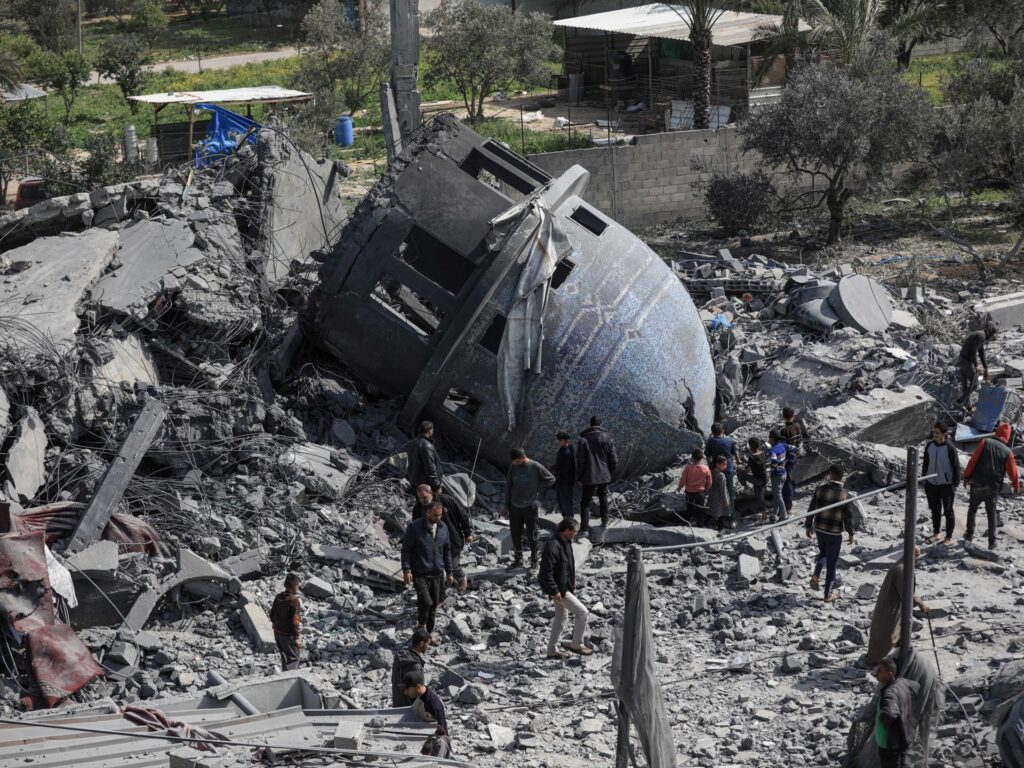
Deir el-Balah, Gaza – At dawn on Saturday, Israeli aircraft bombed a mosque next to makeshift tents housing displaced people in the city of Deir el-Balah in the central Gaza Strip. The bombing resulted in the killing of a young woman and left 20 others injured. They were transferred to the city’s Al-Aqsa Martyrs Hospital. The 33-year-old woman, Walaa Saada, was known for her community and humanitarian efforts during the war. She was killed in her tent while she was sleeping next to her mother, Yosra Abu Saada, who was injured in the attack. “My daughter Walaa and I had dinner together before I went to bed.” Yosra told Al Jazeera. “Walaa stayed awake working on some lists of displaced people in need on her laptop.” Suddenly, Yosra woke up to piles of stones raining down on her from the bombing, while dust covered their surroundings and their tent collapsed on them. “I did not realise what was happening around me. I thought I was dreaming, but I controlled myself and started calling my daughter Walaa, but she did not answer.” “People and paramedics rushed to our aid. I was desperately calling out for Walaa until I saw her lifeless body lying on the ground, soaked in her own blood,” Yosra said while crying. In a nearby tent, 60-year-old Mahmoud Saadeh and his family were asleep before finding themselves thrown to the ground by the explosion. “I woke up and found myself far away [from our tent] with my family members. Everyone was screaming and the children were screaming,” Mahmoud says. “The mosque’s rubble had flattened our tents completely.” Suffering severe chest injuries, Mahmoud received limited medical attention at the hospital due to shortages of supplies and resources. “The medical staff were overwhelmed. Some nurses attended to us with what little they had. But resources were scarce, so we left.” “As you can see, our tents were completely burned and we lost all of our things that we fled with from one area to another. Now, we do not know where we will go.” The displaced in Deir el-Balah have come from all over Gaza, forced to flee under Israeli attack. The Gaza Health Ministry reports that more than 30,000 people have been killed in Israel’s war on Gaza, and international condemnation of Israel’s targeting of civilian areas has been growing as the war persists. Adblock test (Why?)
Meta’s Instagram, Facebook hit by widespread outages

Facebook users unable to sign in while Instagram users’ feeds not refreshed. Users of Meta’s Facebook and Instagram platforms have experienced login issues in what appears to be a widespread outage. The social media platforms were down for hundreds of thousands of users across the globe from about 15:00 GMT on Tuesday, but the sites appeared to be returning to normal about two hours later. “Earlier today, a technical issue caused people to have difficulty accessing some of our services,” Meta spokesperson Andy Stone said in a post on X, formerly Twitter. “We resolved the issue as quickly as possible for everyone who was impacted, and we apologize for any inconvenience,” he added. The issue peaked about 15:30 GMT with 500,000 reports of outages for Facebook and 70,000 reports for Instagram, according to the outage tracking website Downdetector.com. Threads, the rival to Twitter that Meta launched in 2023, also suffered reported outages although Meta’s messaging service WhatsApp appeared to be spared. Facebook suffered a similar outage in October 2021, which was attributed to technical issues. At the height of the incident on Tuesday, Facebook’s status page, intended for advertisers, said the site was suffering “major disruptions” and “engineering teams are actively looking to resolve the issue as quickly as possible.” Users trying to access Facebook were asked to log in but were unable to sign in using the correct password. On Instagram, the feeds of mobile users were not being refreshed. The outage was among the top trending topics on X with several users saying they had suddenly been logged out of the Meta-owned social media platforms. Adblock test (Why?)
The Israelis who want a ceasefire in their country’s war on Gaza

West Jerusalem – “I don’t believe in this war and I don’t believe that the goals of this war can be achieved,” said 39-year-old Avital Suisa. “This war is pointless.” That blunt position is not typical for Israelis, but neither is Suisa. She’s an activist from West Jerusalem, and is a firm believer in the two-state solution, even as Israeli society drifts away from that position, and one-state apartheid rule becomes more entrenched on the ground. Suisa also regularly travels to the occupied West Bank, where she tries to discourage and even fend off settlers from attacking vulnerable Palestinian Bedouins. But while Suisa sits firmly on the left of Israeli politics, and is in a minority when it comes to her activism, calls for a ceasefire in Israel are increasing – for various different reasons. Some believe a ceasefire is the best way to save Israeli captives taken by Hamas, while others add that killing innocent people in Gaza jeopardises Israel’s security in the long run. Some only want a temporary pause, while others – like Suisa – want a permanent end to the fighting. Since an October 7 attack on Israel by Hamas’s Qassam Brigades and other Palestinian armed factions – in which 1,139 people were killed and nearly 250 taken captive – Israel has killed more than 30,600 people in Gaza, starving the civilian population and destroying more than 70 percent of the enclave. Israel’s stated aim has been to “eradicate Hamas”, but its scorched-earth tactics have deliberately and disproportionately killed civilians, including thousands of women and children. The atrocities have sparked outrage across the world and prompted United States and European officials to begin to push for a ceasefire, including US Vice President Kamala Harris, who called for a six-week pause in the fighting on March 4. But for Suisa, those calls for only a temporary pause don’t go far enough. “Of course, the fact that nearly 1,200 people died on October 7 – some in a brutal way – is terrible. But that does not justify killing [more than] 30,000 people in Gaza – many kids and women – who didn’t do anything to me,” Suisa told Al Jazeera. Captives exchange On Sunday, families of Israeli captives held by Hamas marched from southern Israel to downtown West Jerusalem, where they called for the immediate release of their loved ones. Many in the crowd told Al Jazeera they supported a ceasefire that would bring their loved ones home. “I understand it is not possible to bring back all the hostages [through military means]. The rational way is to bring them all back through a deal,” said Shay Bickmann, a 28-year-old Israeli medical student whose aunt was killed on October 7, and whose cousin was taken captive. She did not clarify whether she supported a temporary or a full ceasefire, but said she defers to the Israeli government’s judgement and that she realises it is “problematic to make a deal with a terror organisation”. Hamas is considered a “terrorist” organisation by Israel, the US and the European Union, but many Palestinians view the group as a legitimate resistance organisation. Despite her views on making a deal with Hamas, Bickmann added that she does not want revenge, but wants to live in peace with her neighbours. Shay Bickmann at a protest in downtown Jerusalem calling for the release of Israeli captives in Gaza. Her cousin was taken on October 7 and her aunt was killed [Mat Nashed/Al Jazeera] A temporary truce brokered in November led to the release of 110 Israeli captives in exchange for 240 Palestinian prisoners. Another captive exchange might give hope to countless Palestinians in the West Bank and Gaza, whose loved ones have been unlawfully arrested or disappeared by the Israeli army. According to Addameer, which monitors Palestinian detainees, Israel holds about 9,070 Palestinian political prisoners – a sharp increase from the 5,200 held before October 7. Many Palestinians – including children – were arrested and are being held in administrative detention without charge for expressing sympathy for Palestinians in Gaza or for waving a Palestinian flag. The number of detainees does not include the many Palestinians being held, interrogated and tortured in Israeli bases and makeshift detentions in Gaza, Addameer told Al Jazeera. Israel’s retaliatory violence against Palestinians in the occupied West Bank and Gaza has compelled some Israelis to call for a permanent ceasefire. “I think we need to get a ceasefire to start to promote a better place and region [for Palestinians and Israelis]. That would be a start,” said Naima, an Israeli who did not disclose her last name due to the polarising political climate in Israel. A return to normal Many Israelis also told Al Jazeera that they yearn for life to return to normal, although the effects on daily life in Israel have been marginal compared to the destruction of Gaza that has upended the lives of 2.3 million Palestinians. However, Israel’s economy has been impacted by Israel’s ongoing war in Gaza. Its construction sector has been hit hard, and both foreign and domestic tourism, which struggled to recover after the COVID-19 pandemic, have flatlined since October 7. Plia Kettner, 39, said most of the service industry, including her restaurant which caters to tourists, has taken a financial hit. “I hope we can recover once the war ends and tourists return,” she told Al Jazeera. Despite the financial woes, Kettner added, she believes that about half the population would prefer to continue an indefinite war on Gaza until Hamas is eradicated while the other half believes that negotiating a ceasefire to secure the release of Israeli captives is the foremost priority. However, experts and commentators have long argued that Hamas cannot be defeated in any demonstrable sense and that an all-out war on Gaza will not reinforce Israel’s security. Suisa said that in her view, Israel’s war on Gaza is generating so much suffering it will perpetuate another “cycle of violence”. “I do think that many people in