

Is Israel’s killing of civilians putting ceasefire talks at risk?

Calls for an immediate ceasefire in Gaza are growing louder. More than 30,000 Palestinians have been killed and tens of thousands injured in Israel’s war on Gaza. The United Nations has warned of famine, and says the healthcare system is on its knees. But nearly five months since the start of the devastating war, there is no let up in Israel’s daily attacks. Qatar, the United States and Egypt have been mediating talks for a ceasefire, but there are fears the constant bombardment could threaten those discussions. Israel’s killing of more than 100 Palestinians as they waited to collect food on Thursday is threatening to inflame the region. But Prime Minister Benjamin Netanyahu insists his military offensive will continue until his goals are achieved. So, what does that mean for ceasefire negotiations? Presenter: Jonah Hull Guests: Yossi Beilin – Former Israeli justice minister Ibrahim Fraihat – Associate professor of conflict resolution at the Doha Institute Mohammed Cherkaoui – Professor of conflict resolution and diplomacy at George Mason University Adblock test (Why?)
Rubymar cargo ship earlier hit by Houthis has sunk, Yemeni government says

The UK-owned bulk carrier was struck on February 18 with multiple missiles resulting in an oil slick in the Red Sea. The cargo ship Rubymar, which was abandoned in the southern Red Sea after being targeted by Houthi rebels last month, has sunk, according to Yemen’s internationally recognised government. “The MV Rubymar sank last night, coinciding with weather factors and strong winds at sea,” a crisis cell of Yemen’s government in charge of the case said in a statement on Saturday. A military official, who spoke to the Associated Press on condition of anonymity as no authorisation was given to speak to journalists, confirmed the incident. The United Kingdom Maritime Trade Operations centre (UKMTO), which watches over Middle East waterways, separately also acknowledged the Rubymar’s sinking, AP reported. However, Roy Khoury, chief executive of the ship’s operator Blue Fleet, told the AFP news agency he was unaware of the sinking. “We have nobody on board to check if it’s true or not,” he said. The Rubymar, a Belize-flagged, United Kingdom-owned cargo ship which transported combustible fertilisers, was hit by missiles on February 18 while sailing through the Bab al-Mandeb Strait. The crew then abandoned the vessel and evacuated to safety. Yemen’s Houthis – who say they have been targeting ships linked to Israel, the United States and the UK in an attempt to pressure them to end Israel’s war on Gaza – claimed responsibility for the attack. Rubymar’s sinking marks the first vessel lost since the Iran-backed Houthis began targeting commercial shipping in November. Potential ‘environmental catastrophe’ Yemen’s government statement said the ship sunk on Friday night and warned of an “environmental catastrophe”. Yemen’s internationally recognised government is based in the southern port of Aden, while the Houthis control much of the north and other large centres. The ship was carrying more than 41,000 tonnes of fertiliser when it came under attack, the US military’s Central Command previously said. On Monday, a Yemeni government team visited the Rubymar and said it was partially submerged and could sink within a couple of days. The US military previously said the attack had significantly damaged the freighter and caused an 18-mile (29km) oil slick. The Houthi attacks launched against shipping vessels affiliated with Israel are a response to Israel’s war on Gaza, the group has said. The attacks have disrupted international trade on the shortest shipping route between Europe and Asia. Rerouting vessels around the Cape of Good Hope, the Cape Peninsula in South Africa, can add up to two weeks to a shipment’s journey and between 3,000 and 6,000 extra nautical miles (between 5,556 and 11,112km). In response to the attacks on ships, the US and UK began launching strikes against targets in Yemen in January. The US also renamed the Houthis a Specially Designated Global Terrorist (SDGT) entity. The attacks and counter-attacks have stoked fears that Israel’s war on Gaza could spread, destabilising the wider Middle East. Adblock test (Why?)
US airdrops food into Gaza in move criticised by aid groups

United States military cargo planes have air-dropped food into Gaza, in the first of series of aid drops as humanitarian groups criticise Israel for blocking access to the besieged and bombarded strip. The US, together with Jordan’s air force, “conducted a combined humanitarian assistance airdrop into Gaza … to provide essential relief to civilians affected by the ongoing conflict”, US Central Command said in a statement on Saturday. The C-130 planes “dropped over 38,000 meals along the coastline of Gaza allowing for civilian access to the critical aid”, it added, as the enclave faces a humanitarian crisis after almost five months of war. US President Joe Biden had announced a day earlier that the US would airdrop aid there after more than 100 Palestinians were killed on Thursday in northern Gaza while queuing for aid. US National Security Council spokesman John Kirby said on Friday that the US will carry out multiple airdrops in the next few weeks, which will be coordinated with Jordan. Kirby said the airdrops have an advantage over trucks because planes can move aid to a particular area quickly. However, in terms of volume, the airdrops will be “a supplement to, not a replacement for moving things in by ground”, he added. The Biden administration is also considering shipping aid by sea from Cyprus, according to a US official. Since Israel’s war began on October 7 following Hamas’s attack, Israel has barred the entry of food, water, medicine and other supplies, except for a tiny trickle of aid entering the south from Egypt at the Rafah crossing and Israel’s Karem Abu Salem (Kerem Shalom) crossing. ‘The US is weak’ The US’s move has been criticised as inefficient and simply a public relations move by members of international aid organisations. “The airdrops are symbolic and designed in ways to appease the domestic base,” Dave Harden, former USAID director to the West Bank, told Al Jazeera. “Really what needs to happen is more crossings [opening] and more trucks going in every day?” “I think the United States is weak and that’s really disappointing to me,” Harden added. “The US has the ability to compel Israel to open up more aid and by not doing that we’re putting our assets and our people at risks and potentially creating more chaos in Gaza.” UK-based charity Medical Aid for Palestinians (MAP) echoed Harden’s statement, telling Al Jazeera in a statement that the US, the UK and others should instead work to “ensure that Israel immediately opens all crossings into Gaza for aid.” Oxfam also blasted the Biden administration’s plans, labelling the effort an attempt to assuage the guilty consciences of US officials. “While Palestinians in Gaza have been pushed to the absolute brink, dropping a paltry, symbolic amount of aid into Gaza with no plan for its safe distribution would not help and be deeply degrading to Palestinians,” Scott Paul, who leads Oxfam’s US government advocacy work, said in a statement on X. US is considering airdrops of aid into Gaza. My statement: “Oxfam does not support US airdrops to Gaza, which would mostly serve to relieve the guilty consciences of senior US officials whose policies are contributing to the ongoing atrocities and risk of famine in Gaza. 1/ — Scott Paul (@ScottTPaul) February 29, 2024 The Palestinian Foreign Ministry also criticised the US for acting as a “weak, marginal state” unable to secure aid to Palestinians. US Senator Bernie Sanders, however, welcomed the US’s move. “I applaud President Biden for understanding that there is a dire humanitarian crisis in Gaza,” Sanders said on X. Mahjoob Zweiri, the director of the Gulf Study Centre in Doha, told Al Jazeera the international community is not putting enough pressure on Israel to allow the waiting aid trucks to enter Gaza by land. “Why not send food in through Karem Abu Salem?” Zweiri said. “There are 2,000 trucks waiting to get into Gaza” at border crossings, he said, while food and medicines pile up for months past their expiry dates. “Why isn’t the international community not putting enough effort into delivering aid in an organised manner?” he asked. Adblock test (Why?)
Seven killed in Russian drone attack on Odesa apartment block

Separate attacks killed an additional three people in Ukraine as Zelenskyy urges the West to deliver more air defences. A Russian drone attack on an apartment block in the southern Ukrainian port city of Odesa has killed at least seven people, including a three-year-old and a woman with an infant child, regional authorities said. “Rescuers in Odesa have just uncovered the bodies of a mother with a three-month-old baby,” Interior Minister Ihor Klymenko said in a post on the Telegram app on Saturday. At the scene, smoke poured from rubble strewn across the ground where the drone had ripped a chunk several storeys high out of the building. Clothes and furniture were scattered in the ruined mass of concrete and steel hanging off the side of the apartment block. Ukraine’s State Emergencies Service posted photos, including of a dead toddler being placed in a body bag by rescuers. “This is impossible to forget! This is impossible to forgive,” it wrote. It said five people including a child had been rescued alive. Odesa region governor Oleh Kiper said eight people were wounded, and rescuers were still looking for more people under the debris. Zelenskyy calls for more air defences Ukrainian President Volodymyr Zelenskyy said the drone was a Shahed supplied by Iran. Russia has launched several thousand of these long-range winged drones throughout the war at targets deep inside Ukraine. Al Jazeera’s Rob McBride, reporting from Kyiv, said a total of 17 Shahed drones targeted Ukraine in the overnight attacks, with most of them intercepted by air defences. [Al Jazeera] Separate shelling attacks on the front-line Kharkiv, Kherson and Zaporizhzhia regions killed three, Ukrainian officials have said. The spate of attacks led Zelenskyy to re-iterate his calls on the West to deliver more air defence systems. “We need more air defences from our partners. We need to strengthen the Ukrainian air shield to add more protection for our people from Russian terror. More air defence systems and more missiles for air defence systems save lives,” he said. Ukraine is currently on the back foot in the two-year war as a crucial $60bn aid package is held up in the US Congress. Local residents react at the site of an apartment building heavily damaged by a Russian drone attack, amid Russia’s attack on Ukraine, in Odesa on March 2, 2024 [Stringer/Reuters] Drone crashes into building in St Petersburg Ukraine also appears to have launched an attack of its own, with a drone striking a five-storey residential building in St Petersburg, Russia’s second city, on Saturday causing no casualties, according to Russia’s National Guard division. Videos on Russian social media showed what appeared to be a drone spiralling downwards into the building, triggering an explosion, blowing out windows and causing small fires. The city’s National Guard division said its preliminary assumption was the damage was caused by a “falling drone”. Ukrainian media reported that the drone was shot down by Russia’s air defences while targeting an oil depot around a kilometre from the crash site. Kyiv has hit several Russian oil facilities in recent months in what it has called fair retribution for Moscow’s attacks on Ukraine’s power grid. Adblock test (Why?)
Chad interim leader Deby confirms plan to run for president in May
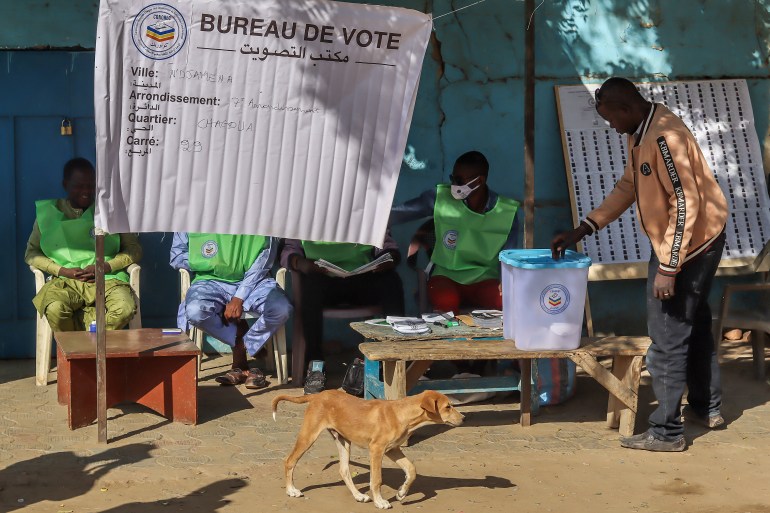
The announcement comes days after the military chief’s main rival was killed in murky circumstances. Chad’s military leader has said that he will run in the country’s long-awaited presidential elections in May, just three days after his chief rival was killed in suspicious circumstances. “I, Mahamat Idriss Deby Itno, am a candidate for the 2024 presidential election under the banner of the For a United Chad coalition,” Deby said in a speech on Saturday. The vote will mark the end of three years of military rule in the politically charged Central African country. Deby took power after his father and longtime ruler, Idriss Deby Itno, died fighting rebels in the country’s north in April 2021. The younger Deby promised a return to civilian rule, as well as elections, but the leader extended the transition by two years, despite loud objections from opposition parties. Last week, the country’s elections agency finally announced that the vote would be held on May 6, following a December referendum promising to amend the constitution. “Mahamat Idriss Deby said it was not his intention to run for president. He said his focus when he took over from his father when he was killed on the front lines was to stabilise Chad, to ensure that the institutions of governance continue as well as to provide peace and stability to the country and the region,” Al Jazeera’s Ahmed Idris noted, reporting from Chad’s capital N’Djamena on Saturday. “Now, he has been endorsed by a coalition of more than 220 political parties and associations. “But that declaration has been overshadowed by events of the past weeks, which include the raid on the main opposition political party headquarters, the demolition of the party headquarters and the killing of its leader, as well as the arrest of several other members of the political party. Many people feel that that could affect the credibility of the elections on May 6,” Idris said. A man casts his vote at a polling station during the constitutional referendum in N’Djamena, on December 17, 2023 [File: Denis Sassou Gueipeur/AFP] Deby’s candidacy confirmation has come just days after one of his main opponents was killed in a military operation in the capital N’Djamena. Yaya Dillo Djerou, a cousin of president Deby, died on Wednesday after troops attacked the office of his Socialist Party Without Borders (PSF). PSF officials have accused soldiers of killing Dillo in an “execution” before the May vote, in which he planned to run. Several people were injured in the attacks. In a statement on Friday, Human Rights Watch called for an investigation into the killing of the politician, known simply as Yaya Dillo, and questioned how ready N’djamena was for free and fair elections. “The circumstances of Yaya Dillo’s killing are unclear, but his violent death highlights the dangers facing opposition politicians in Chad, particularly as elections approach,” Lewis Mudge of HRW said. “The prime minister and other key national figures should publicly call for an independent investigation into his death with an eye toward ensuring greater accountability before the election,” Mudge added, referring to Prime Minister Succes Masra. Chadian authorities have rejected the accusations against them, saying Dillo “opposed his arrest” and fired on security forces. Adblock test (Why?)
Norway gives Arctic foxes a helping hand amid climate woes

One by one, the crate doors swing open and five Arctic foxes bound off into the snowy landscape. But in the wilds of southern Norway, the newly freed foxes may struggle to find enough to eat, as the effects of climate change make the foxes’ traditional rodent prey more scarce. In Hardangervidda National Park, where the foxes have been released, there has not been a good lemming year since 2021, conservationists said. That is why scientists breeding the foxes in captivity have also been maintaining more than 30 feeding stations stocked with dog food kibble across the alpine wilderness – a rare and controversial step in conservation circles. “If the food is not there for them, what do you do?” asked conservation biologist Craig Jackson of the Norwegian Institute for Nature Research, which has been managing the fox programme on behalf of the country’s environment agency. That question will become increasingly urgent as climate change and habitat loss push thousands of the world’s species to the edge of survival, disrupting food chains and leaving some animals to starve. While some scientists have said it is inevitable that more feeding programmes to prevent extinctions will become necessary, others have questioned whether it makes sense to support animals in landscapes that can no longer sustain them. As part of the state-sponsored programme to restore Arctic foxes, Norway has been feeding the population for nearly 20 years, at an annual cost of about 3.1 million Norwegian krone ($293,000) and it has no plans to stop anytime soon. Since 2006, the programme has helped to boost the fox population from as few as 40 in Norway, Finland, and Sweden, to about 550 across the Scandinavian Peninsula today. Adblock test (Why?)
Protecting climate refugees requires a legal definition

During the UN Climate Conference (COP28) in Dubai last year, the terms “climate migrants” and “climate refugees” echoed loudly across meeting rooms and panels. These labels were passionately used by high-ranking UN officials, external stakeholders, scholars and activists grappling with the consequences of climate change. During a panel discussion, I emphasised that these terms hold no legal weight and inquired about the need for specific legal protections for those affected by climate-induced displacement. My question was quickly shut down by the panel organisers, surprising attendees. My thoughts ran quickly to the many people displaced by climate change I knew: the Ecuadoran refugees who arrived in New York, seeking sanctuary from environmental turmoil at home, the women in the Sundarban islands of West Bengal facing climate-driven disasters but unable to relocate, and many of my neighbours in Brooklyn, who have experienced recurrent home destruction due to heavy rainfall. All of them do not have any form of international legal protection that can guarantee them dignified life. Sadly, the dismissive response at COP28 reflects a larger pattern of denial. Legally defining “climate refugees” has been fiercely debated globally on many accounts. Critics often argue that attributing migration solely to climate change oversimplifies a complex web of influences on human mobility. They claim that these terms diminish the role of institutional and human responses, and social conditions in transforming environmental stressors into crises. Thus, this complexity makes it impossible to distinguish between climate refugees and economic migrants. Ironically, this argument actually persists alongside predictions that estimate a possible 1.2 billion people (PDF) might be displaced by 2050 due to climate-change-related hazards. After COP28, this recurring chorus echoed in my mind: “No legal changes are needed; we have it covered with UN initiatives like the 2018 Global Compact for Safe, Orderly, and Regular Migration”, which commits (PDF) parties to creating “conducive political, economic, social and environmental conditions for people to lead peaceful, productive and sustainable lives in their own country and to fulfil their personal aspiration”. Under its second objective, the compact emphasises the need for cohesive approaches in handling migration challenges amid both sudden and gradual natural disasters, urging the integration of displacement concerns into disaster preparedness strategies. Let us pause for a moment. While these policies project preparedness, they fall remarkably short in offering robust legal recognition and protections to those facing climate crises and the need to move – including the groups and individuals in the examples I shared earlier. This absence of a specific legally defined framework poses hurdles for individuals seeking migration status due to climate change impacts. Calls to establish international legal frameworks tailored to address migration needs arising from environmental factors have been equated with opening Pandora’s box. Some suggest this could challenge the 1951 Refugee Convention, which defines the term “refugee” strictly along the lines of “fear of being persecuted for reasons of race, religion, nationality, membership of a particular social group or political opinion.” They worry an unravelling that would add climate and environmental movement protection might destabilise our already fragile global commitments to upholding all refugee rights. They warn that this opening might overshadow the plight of those fleeing persecution and conflicts. My sympathy for this concern runs deep. I agree that this critique deserves careful consideration. But here is the crux: The urgency to address climate-induced humanitarian crises shouldn’t be paralysed by the complexities of diplomacy or the fear of potential aftershocks. Let us be clear: The pains of any form of persecution, and seeking refuge from conflicts demand immediate action. But we should not allow these complexities to shroud the urgency of rethinking international agreements. International agreements are reviewed all the time, so doing so regarding climate change realities would be no different. Think about the 1992 UN Framework Convention on Climate Change – the first legally binding treaty signed by 154 countries committing to reduce atmospheric concentrations of greenhouse gases to “prevent dangerous anthropogenic interference with the climate system”. Its outcome has been far from satisfactory, but it placed us on track to formulating the Paris Agreement in 2015, and finding ways to make common progress in addressing climate change. Similarly, when it comes to a legal framework for climate refugees, maybe we will not negotiate binding conventions today, maybe not tomorrow. But we can start thinking – or rethinking – them now. The time has come to envision a sensible and sustainable course towards protection for vulnerable populations grappling with the effects of climate change and environmental disasters, while safeguarding existing refugee statuses. This calls for a collective effort, uniting those directly affected by climate change, alongside scholars, activists, international organisations, and government representatives, to rethink, conceptually and legally, the implications of creating a radically different approach. Being mindful of the multilayered challenges of slow-onset climate change could help develop a spectrum of strategies, intertwining migration management, refugee protection, and environmental solutions for those who stay and/or return. Our overarching aim should be to prevent the heartbreaking displacement of people from their homes involuntarily, while also ensuring the human rights of those who have no choice but to leave or are already displaced. These strategies align with previous agreements, but they also call upon us to collectively reimagine and address the evolving needs and diverse vulnerabilities of both humanity and the planet. Human rights-based approaches and explicit legal frameworks are essential for enforcing claims at all levels of governance and providing access to sustainable environmental justice. Fear cannot lead our decisions. Upholding human rights should be the compass guiding us through this intricate political and climate landscape. The views expressed in this article are the author’s own and do not necessarily reflect Al Jazeera’s editorial stance. Adblock test (Why?)
In Lydd, Palestinians fear tinderbox of Israel’s war, threat of expulsion

Lydd, Israel – One week after Israel began bombing Gaza last October, Ghassan Mounayer received a call from the Israeli police. An officer warned him not to write any critical Facebook posts about the war or call for demonstrations in Lydd [Lod in Hebrew], where Palestinian citizens of Israel like Mounayer live alongside Jewish Israelis. “They said, ‘We’re watching your Facebook’, and not to write anything ‘Satanic’,” said Mounayer, who is a human rights activist. “I said, ‘Do you have any examples of posts like this?’ He said, ‘Don’t be smart. You are being watched’.” Since Israel launched its war on Gaza following Hamas’s deadly attack on October 7, tensions in mixed Palestinian and Israeli cities have approached boiling point. But few places are as tense as Lydd, a city run by far-right Mayor Yair Revivo and where relations between Palestinians and Israeli Jews have been fraught for years. Palestinian activists say they fear for their lives, living in the shadow of the Israeli authorities and heavily armed Jewish Israeli citizens, many of whom belong to supremacist movements. They are warning that the city could “explode” into conflict and lead to the persecution and even expulsion of Palestinian residents. “Palestinians know that Israelis are looking for any situation to kill us or arrest us, because right now it is war time,” Mounayer told Al Jazeera. “Israel is just a democracy for Jewish Israelis and many Jewish Israelis want us to leave Lydd and go to Arab villages.” ‘Living under constant threat’ Palestinians in Lydd make up about 27 percent of the city’s population, many of whom live in urban and impoverished neighbourhoods and whose families have lived in Lydd for generations, pre-dating the Nakba or catastrophe, when 750,000 Palestinians were uprooted from their homes and villages during the creation of Israel. Some are the children and grandchildren of Palestinians who fled the village of Majdal, which is roughly 62km (38 miles) from Lydd, during the Nakba. Others from Majdal – now called Ashkelon in Israel – went to Gaza. Entire Palestinian families remain split between Lydd and Gaza today. Maha al-Nakeeb, a Palestinian human rights lawyer in Lydd, has lost 16 of her relatives in Israel’s relentless bombing campaign in Gaza. Despite the trauma, she has refrained from commenting or critiquing the war on social media out of fear that she could be arrested. In the first two weeks after October 7, at least 100 Palestinian citizens of Israel were arrested for social media posts expressing sympathy or anger over Israel’s war on Gaza, which has killed more than 30,000 people to date, the vast majority of whom are children and women. Thousands more are lost under the rubble of the war, presumed dead. “Palestinians are living under constant threat … all Arabs here live in fear,” al-Nakeeb told Al Jazeera. “The Israelis want us to think that we live in their house. That this city – this place – does not belong to us.” Mounayer added that Israel has historically tried to punish or crush expressions of solidarity between Palestinians who live in Israel and those who live in the occupied territories. He added that Palestinians in Lydd are holding in their anger over all the reports of Israeli atrocities coming out of Gaza. “Israel does not want us to feel solidarity with our brothers and sisters. They don’t want us to ask for collective rights,” he said. ‘We are not treated as citizens’ Israeli extremists have long viewed Lydd – and other mixed cities – as a battleground on which they are fighting to increase their numbers and gradually erase Palestinian existence. This is the explicit mission of Garin Torani, or Biblical Seeds, an Israeli supremacist group that intentionally settles in Palestinian neighbourhoods across Israel. With most Palestinians unable to acquire building permits, members from this group and other far-right Israelis exploit this discriminatory policy to build new homes in heavily populated Palestinian districts. When Prime Minister Ariel Sharon pulled Israeli troops and settlers out of Gaza in 2005, many settlers relocated to Lydd and other mixed cities. Illegal settlers from the occupied West Bank have also strategically relocated to Lydd to “Judaise” the city, often resulting in acute gentrification and soaring tensions with Palestinians. But whenever a dispute erupts, the security forces and Mayor Revivo solely protect Jewish Israelis, according to Nisrine Shehada, a Palestinian activist in Lydd. “We are citizens of this state, but we are never treated as citizens,” she told Al Jazeera from her office. Shehada recalled Lydd’s solidarity protests with the Palestinians who were being expelled from Sheikh Jarrah in East Jerusalem and attacked in Al-Aqsa Mosque in May 2021. Back in Lydd, far-right Jewish Israelis responded to the protests by attacking and shooting at a group of Palestinians on May 10. They killed 32-year-old Musa Hassuna, a Palestinian resident in the city. After the incident, protests escalated as did ethnic violence between Israelis and Palestinians. A Jewish Israeli man, Yigal Yehoshua, was killed by a Palestinian mob a week later. According to Human Rights Watch, Israeli authorities handled the killings of Hassuna and Yehoshua very differently. All Jewish Israeli suspects were released on bail within just two days of Hassuna’s killing and were then later cleared of all charges. However, eight Palestinian men were swiftly arrested in connection with Yehoshua’s killing and accused of “murder” and “terrorism”. Police also failed to protect Palestinians from violence by far-right Jewish Israeli groups and arrested 120 Palestinians in Lydd, compared with just 34 Jewish Israelis. “The protests were understandable and expected, but the government made all Palestinians pay a price for it,” said al-Nakeeb. ‘We know they want to kick us out’ Palestinian residents of Lydd told Al Jazeera that they do not want any confrontations with far-right Jewish Israelis in the city, despite Israel’s continuing atrocities in Gaza. Many fear that Palestinian communities could be gunned down or expelled from the city altogether if tensions boil over. Since October 7, Israel’s far-right National Security
Kashmiri journalist Aasif Sultan re-arrested days after release

Aasif Sultan, a former editor of Kashmir Narrator magazine, has been re-arrested under ‘anti-terror’ law days, two days after his release following five years in jail. A Kashmiri journalist, who was released after spending more than five years in jail earlier this week, has been re-arrested by police in another case under India’s stringent “anti-terror” law, according to his lawyer. Aasif Sultan, 36, has been sent to a five-day police remand after he was produced in a court in the city of Srinagar on Friday, Adil Abdullah Pandit, Sultan’s lawyer, told Al Jazeera. Pandit said that Sultan was arrested on Thursday in a 2019 case regarding violence inside the central jail in Srinagar under the Unlawful Activities Prevention Act (UAPA), which international rights groups have described as a “draconian” law. Srinagar is the largest city and summer capital of Indian-administered Kashmir. Rights activists have said getting bail under a UAPA case is nearly impossible, which means Sultan could stay in jail without trial indefinitely. The case is related to “the sections of rioting, unlawful assembly, endangering human life, attempt to murder under Indian Penal Code (IPC) and section 13 of UAPA for advocating, abetting or inciting unlawful activity”, according to the lawyer. At the time of the violence, Sultan was already lodged in jail. The riots inside the jail had erupted over a move by authorities to shift prisoners to jails outside Indian-administered Kashmir. Hundreds of Kashmiris have been lodged in jails in other parts of India, making it difficult for families to meet their relatives. ‘Harbouring militants’ Sultan worked as an assistant editor for a Srinagar-based English magazine, Kashmir Narrator, which is now defunct, when he was arrested in September 2018 on allegations of “harbouring militants”. His family has denied the allegations, saying he was being targeted for his work as a journalist. On February 27 he was released from a jail in the northern Indian state of Uttar Pradesh about 1,400km (870 miles) away. But the brief joy for his family in Batamaloo locality in Srinagar turned into grief on Thursday when Sultan was re-arrested. “He saw his five-and-half-year-old daughter for the first time since his 2018 arrest. His daughter is asking about him and we don’t know how long this fight can be,” one of Sultan’s relatives told Al Jazeera on the conditions of anonymity, referring to the difficulty in securing bail under the UAPA. “He looked very weak and wanted to rest. His blood pressure was also unstable. When we asked the police, they said he was accused in another case.” Sultan was able to secure bail in the 2018 case in April 2022, when a court said that investigation agencies had failed to establish his links with any armed group. There has been an armed rebellion in Kashmir against Indian rule since the 1980s. But authorities immediately charged him under the Public Safety Act (PSA), a law under which a person can be jailed for up to two years, without a trial. Amnesty International has termed it a “lawless law”. Sultan’s release on Tuesday came more than two months after the Jammu and Kashmir High Court quashed his detention order under the PSA. Laxmi Murthy, co-founder of Free Speech Collective, an organisation that advocates freedom of expression, said, “The re-arrest of Aasif Sultan is another example of ‘lawfare’ or the (mis)use and overuse of draconian laws to harass journalists.” “Since the process is punishment, Aasif Sultan will have to spend the next few years of his life proving his innocence.” Since India scrapped Kashmir’s special status in 2019 and imposed central rule, authorities have cracked down on free speech under which multiple journalists and activists have been arrested — mostly under “anti-terror” laws such as the UAPA. Adblock test (Why?)
Europe risks losing credibility over silence on Israel’s war on Gaza: MP

Europe risked any credibility to speak on Russia’s actions in Ukraine if it remained silent on Gaza, according to a Belgian member of parliament, who is among the more than 200 lawmakers who have signed a letter calling for an arms embargo on Israel. “We are so hypocritical in Europe to speak about international law when we speak about Ukraine and Russia, [but] if we don’t have the same [views] when we speak about the Palestinians, we will not have any credit in the future to speak about [it],” Simon Moutquin, a Belgian member of parliament, told Al Jazeera in an interview on Saturday. More than 200 legislators from countries, which fund Israel militarily, on Friday called for their countries to stop selling weapons to Tel Aviv citing “violations of international law” as Israel’s relentless bombardment of Gaza has killed more than 30,000 people, most of them civilians. In a letter signed by parliamentarians from 13 countries, the lawmakers announced that they would not be “complicit” and would take “immediate coordinated action” in their respective legislatures to stop their governments from arming Israel. The Belgian member of parliament said that his own country had to act to stop Israel as well, citing a “risk of genocide” if countries continue to fund Tel Aviv’s war on Gaza. “As a signatory country of the Convention Against Genocide, [Belgium has] a legal and moral obligation to act and prevent the risk of genocide, so I think this letter … is a good first step, but we need to go further,” said Moutquin, who raised concerns about an internal split in the European Union that has seen the bloc struggle to address Israel’s war on Gaza cohesively. Continued military funding for Israel amid Gaza war The United States is by far the biggest funder of the Israeli military, providing roughly $3bn in aid annually. Presently, US lawmakers are debating an additional $14bn to support Tel Aviv’s operations in Gaza. Washington sent guided-missile carriers and F-35 fighter jets, as well as other military equipment to Tel Aviv in the immediate aftermath of Hamas’s October 7 attacks on Israel, and Tel Aviv’s subsequent declaration of war on the Gaza Strip. Some 68 percent of Israel’s weapons imports between 2013 and 2022 came from the US. Tel Aviv also relies on German weapon imports, primarily air defence systems and communications equipment. In total, Germany provides 28 percent of Israel’s military imports, although that rose nearly tenfold between 2022 and 2023 after Berlin ramped up sales to Israel in November. The United Kingdom, Canada, France and Australia among others also provide military support to Israel. However, following an International Court of Justice (ICJ) ruling that found Israel may “plausibly” be committing genocide in Gaza and that ordered Israel to prevent genocide in Gaza, some countries have stopped exporting arms to Tel Aviv. In the Netherlands, a court in February ruled that exports of parts for military fighter jets be halted after rights groups sued the government. Similarly, Belgium, Spain and Japan have also ceased military cooperation with Tel Aviv in recent weeks. Legislators in donor countries ‘take a stand’ An arms embargo on Israel is a legal necessity, the legislators said in the open letter, citing the ICJ’s February ruling. “Our bombs and bullets must not be used to kill, maim, and dispossess Palestinians,” they said. “But they are: we know that lethal weapons and their parts, made or shipped through our countries, currently aid the Israeli assault on Palestine that has claimed over 30,000 lives across Gaza and the West Bank.” Largely from France, Australia, Spain, Turkey and Brazil, the representatives accused Israel of defying international law by not only continuing its war on Gaza, but also ramping up plans for an invasion of Rafah, the last enclave that is housing more than 1.5 million Palestinians displaced by the war. “Today, we take a stand,” the letter further read. “We will take immediate and coordinated action in our respective legislatures to stop our countries from arming Israel.” Legislators from Germany, Portugal, the US, Ireland, Netherlands, Canada, Belgium and the UK were also signatories to the missive. At least 30,228 people have been killed in Gaza since October 7, most of them children and women. Aid is barely flowing in, causing deaths from starvation and dehydration. The UN has warned that invading Rafah will be“the nail in the coffin” of the humanitarian crisis in the strip. Adblock test (Why?)