

At Rio’s Carnival parades, Yanomami activists fight ‘genocide’ with samba
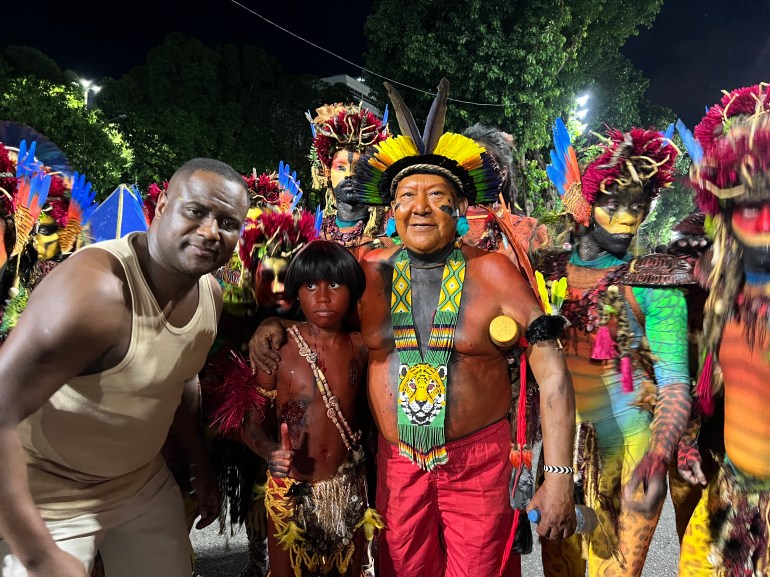
Rio de Janeiro, Brazil – Yellow and green feathers radiating from his headdress, Davi Kopenawa strode onto the parade route with a mission in mind. All around him, the city of Rio de Janeiro was pulsing with music and merry-making: It was February 12, and the world’s largest Carnival celebration was under way. But Kopenawa was not in town to party. Rather, he had travelled more than 3,500 kilometres (2,000 miles) from his village in Brazil’s Amazon rainforest to spread a dire message: His people, the Yanomami, were in trouble. For decades, the Indigenous Yanomami have suffered at the hands of illegal gold miners, who destroyed vast stretches of their homeland and polluted their rivers with mercury. But since 2019, the crisis has reached new heights, with hundreds of Yanomami dying from conditions related to the mining. President Luiz Inacio Lula da Silva has gone so far as to declare the situation a “genocide”. “Every day, we face death in our villages and attacks from illegal miners,” Kopenawa, a shaman, told Al Jazeera. Davi Kopenawa, centre, poses with parade participants in Rio de Janeiro [Monica Yanakiew/Al Jazeera] So this year, Kopenawa and other Indigenous leaders took an unusual step. They teamed up with Salgueiro, one of Rio’s celebrated samba schools, to stage an awareness campaign, right in the middle of the annual Carnival festivities. The result was unveiled in the early hours of Monday at Sambadrome, one of the premier destinations for Carnival parades. Floats dedicated to the “people of the forest” sailed down the Sambadrome’s wide parade avenue, surrounded by stands packed with thousands of spectators. Some of the floats featured larger-than-life depictions of Indigenous peoples, arms outstretched as if to soar above the pavement. One float, however, represented the death and destruction wrought by the miners, with feathered headdresses crowning skulls. Adblock test (Why?)
How likely is a regional conflict in the Middle East?

Israel has ramped up attacks in Lebanon – and Hezbollah has promised to retaliate. The Israeli military has been exchanging almost daily fire with Lebanese group Hezbollah since the war on Gaza began on October 7. Hezbollah says it is acting in solidarity with its ally in Gaza, Hamas, and that it will continue attacks as long as Israel bombards the besieged Palestinian strip. This week, Israeli attacks killed 10 civilians – including children – in southern Lebanon. Hezbollah has promised to retaliate. Both sides say they are not looking for all-out war, but increasingly, attacks are happening far beyond the border area. So what does each party want to achieve? Presenter: Adrian Finighan Guests: Elijah Magnier – Military and political analyst who has covered conflicts in the Middle East and North Africa for more than 35 years Hala Jaber – Award-winning journalist and author of the book, Hezbollah: Born With A Vengeance Gilbert Achcar – Professor of development studies and international relations at the University of London’s School of Oriental and African Studies Adblock test (Why?)
Russia’s Putin will not go unpunished for Navalny’s death, wife Yulia says

Russian President Vladimir Putin and his associates will not go “unpunished” if the death of Alexey Navalny, as reported by Russian officials, turns out to be true, the Kremlin critic’s wife Yulia has said. Russia’s prison agency earlier said Navalny died on Friday in the Arctic penal colony where he was serving a 19-year sentence. The 47-year-old had crusaded against official corruption and staged massive anti-Kremlin protests as Putin’s fiercest foe. Navlany’s team said it has not yet received direct confirmation of his death and had only seen a general announcement by the regional judicial authorities. Yulia Navalnaya called upon the international community to come together and fight against the “horrific regime” in Russia, speaking at the Munich Security Conference on Friday in an appearance that was scheduled before the news of her husband broke. In her speech, she expressed some doubt over the veracity of the news of her husband’s death. “I don’t know whether we should believe the terrible news that we are receiving exclusively from Russian state sources,” said Yulia Navalnaya. “We cannot believe Putin and Putin’s government,” she added. “They always lie.” However, she called on the international community “to unite and fight evil”, and that Putin and his supporters would be held accountable soon. Earlier, Navalny’s mother Lyudmila Navalnaya said her son had been “alive, healthy and happy” when she last saw him on February 12, according to Russian newspaper Novaya Gazeta. “I don’t want to hear any condolences. We saw him in prison on [February] 12, in a meeting. He was alive, healthy and happy,” Navalnaya mother said in a Facebook post, according to the publication. In his last public appearance before his reported death, Navalny spoke by videolink to a court on Thursday, Russian state media reported. Navalny did not complain about his health and “spoke actively, presenting arguments in defence of his position”, a regional court from the city of Vladimir, to the east of Moscow, told the RIA news agency. Separately Nikolaos Gazeas, a German lawyer for Navalny, told the daily Koelner Stadt-Anzeiger that he was stunned by the news of Navalny’s death after seeing images of him participating in the court hearing. “He made a fit and strong impression as usual,” he said, adding that a Russian colleague had visited Navalny on Wednesday while another was currently on his way to his prison to learn more about the circumstances of his death. Alexey Navalny and his wife Yulia in April 2015 [File: Tatyana Makeyeva/Reuters] ‘Navalny has become immortal’ Meanwhile, other Putin opponents also reacted strongly to the news of Navalny’s death. “There is nothing more the dictator can do to Navalny, Navalny is dead and has become immortal,” said Boris Akunin, a renowned Russian writer who lives in self-imposed exile in Europe. “I also think that a murdered Alexey Navalny will be a bigger threat for the dictator than a living one. Most likely, to drown out voices of protest, [Putin] will launch a campaign of terror in the country,” he told AFP. Russian Nobel Peace Prize winner Dmitry Muratov described Navalny’s death as “murder”. “Alexey Navalny was tortured and tormented for three years. As Navalny’s doctor told me: the body cannot endure such things. Murder was added to Alexey Navalny’s sentence,” he was quoted as saying by the Novaya Gazeta newspaper. Exiled Russian opposition politician Dmitry Gudkov said on social media, “Alexei’s death is a murder. Organised by Putin … Even if Alexei died of ‘natural’ causes, they were caused by his poisoning and further torture in prison.” Bill Browder, a British American businessman who was once among the biggest foreign investors in Russia before becoming a fierce regime critic, said on X, “Putin assassinated Navalny … He did so because Navalny was brave enough to stand up to Putin. He did so because Navalny offered the Russian people an alternative to kleptocracy and repression.” Adblock test (Why?)
What’s behind Israel’s threat to attack Rafah?

On February 12, Saleh Abou Ghanem heard Israeli warplanes buzzing in the sky from night until dawn. They were bombing Rafah, the southern Gaza town near the Egyptian border where 1.4 million Palestinians have sought relative safety from relentless Israeli attacks. While Abou Ghanem survived the attacks, he learned that his aunt was killed in her home by an Israeli bomb. “She was sleeping when she was martyred,” he told Al Jazeera. Last week, Israel’s Prime Minister Benjamin Netanyahu reiterated his intention to expand military operations into Rafah. Two days later, Israel launched a series of strikes that killed dozens of people. Analysts believe Netanyahu’s stated plan is part of a broader plot to depopulate Gaza and extend his political survival, as many predict that he will be removed from his post after the war. But world leaders have warned that a full-scale assault on Rafah is a “red line,” despite few threatening to punish Israel if it goes through with the offensive. After being forcefully evacuated into Rafah, Palestinians have nowhere else to flee. Many fear that a military operation could lead to some of the worst violence in a war that has already killed more than 28,000 Palestinians following Hamas’s deadly attack on October 7, in which nearly 1,200 people were killed. “Some people have fled Rafah [since the recent attacks], but I don’t know where they went. There is nowhere to go. Where can anyone go?,” said Abou Ghanem, with resignation. Depopulating Gaza The looming military operation in Rafah intends to permanently displace hundreds of thousands of Palestinians over the border into Egypt, according to Omar Rahman, an expert on Israel-Palestine with the Middle East Council for Global Affairs think tank. He told Al Jazeera that Israel’s war on Gaza has always been a much broader campaign against the Palestinian population and not just Hamas. He said that Israel’s plans to attack Rafah are further proof. “The Israeli war machine is bearing down on Rafah with genocidal intent,” he said. Haneen Rizk, an employee in Gaza with the UN Relief Works Agency (UNRWA), which provides schooling, healthcare and other relief services to Palestinian refugees in the occupied territories and surrounding states, said that most people are just waiting to die. She added that some families returned from Rafah to their homes and communities in central and northern Gaza. But with at least 70 percent of Gaza’s homes destroyed or damaged, Rizk said that most people in Rafah have no alternative but to stay put. “If Egypt opens the border … most people would leave,” she told Al Jazeera. “But right now, it’s so expensive for anyone to try and afford to get into Egypt. It requires about $5,000 and so few people have that kind of money.” Egypt has sealed its border with Gaza since October 7. But Rizk was referring to private bus companies that charge hefty fees, which few in Gaza can afford, to transport Palestinians into Egypt. “Game of chicken” Since early in the war, Egypt’s President Abdel Fattah el-Sisi has publicly stated that he will not absorb Palestinian refugees out of concern that it would “end the Palestinian cause” and threaten Egypt’s national security. The Egyptian leader has called for a ceasefire to avert a humanitarian catastrophe that might complicate further his diplomatic relations with Israel. “I call it a game of chicken,” said Rahman. “The Israelis are hoping the Egyptians will concede by opening up the border [if pressured] and the Egyptians are hoping that they can buy enough time until Washington [ends] the war,” he told Al Jazeera. Egypt may already be budging. Local rights groups have reported that Egypt is building a “buffer zone” in its Sinai region to absorb Palestinians expected to flee from Rafah. However, Egypt has not confirmed the reports. CIA chief William Burns also recently visited Egypt’s capital Cairo to discuss the possibility of a temporary truce that would allow Hamas and Israel to exchange captives. Hamas captured about 240 Israelis during its attack on Israeli communities and military outposts on October 7, while Israel holds about 10,000 Palestinian prisoners for “security related’ offences — although many have not even been charged. Netanyahu has insisted on rescuing Israelis in Gaza via military means, despite objections from captives’ families who are pleading for a deal. Rahman believes that Netanyahu’s real motive is to maintain an occupation force in Gaza for a considerable period to prevent Palestinians from rebuilding their homes and to ensure that civilians live under constant fear. “Israel’s intention … is to keep the pressure on [Palestinians] to flee,” he said. Political ploy? Netanyahu’s political survival is also tied to maintaining the war in Gaza, according to Mairav Zonszein, an expert on the Israel-Palestine conflict with the International Crisis Group, a think tank dedicated to conflict prevention and resolution. Netanyahu’s popularity is low and many Israelis are calling for a national election after the war. Any national vote would likely remove Netanyahu from power, according to recent opinion polls. As a result, Zonszein believes that Netanyahu may delay a full-scale military operation on Rafah to prolong the war. “All of this talk about Rafah – and leveraging it for a hostage deal – is just a way for Netanyahu to bide more and more time,” she said. Palestinians in Rafah hope Netanyahu is bluffing, but many believe that an onslaught is imminent. Abou Ghanem, who lost his aunt, said that he just wants his three young children – two girls and one boy – to survive. “Children are dying every day … and we’re living like animals,” he told Al Jazeera. “Tell the world that we just want a ceasefire.” Adblock test (Why?)
Alexey Navalny: An archenemy Putin wouldn’t name and Kremlin couldn’t scare

Alexey Navalny, who churned out muckraking exposes of corruption in the Kremlin and led protests that propelled him to YouTube stardom – and the nearly lethal position of Russian President Vladimir Putin’s political nemesis – has died in a remote penal colony, prison authorities say. He was 47 and died on Friday in IK-3, one of Russia’s northernmost prisons. The lawyer and securities expert, who used to live with his wife, Yulia, and two children, Daria and Zahar, in a drab concrete high-rise in southeastern Moscow, rose to fame in the late 2000s by exposing the graft of top officials, including Putin. “Putin is the man who steals Russia’s future. I am taking part in this election to fight him,” Navalny said in 2017 when announcing his decision to run for president. “Under [Russia’s first democratically elected president, Boris] Yeltsin, corruption was problematic. Under Putin, it became systemic,” he wrote in 2012. First as a lone LiveJournal blogger and gradually with a team of researchers and producers, Navalny released dozens of investigations backed with bank records, leaked documents, maps, blueprints of properties, photos and drone footage. These reports identified and described how the country’s small elite lived in palaces in Russia and luxurious real estate abroad. He exposed their foreign passports and multibillion-dollar assets, their families’ unexpected wealth and well-paid jobs in Kremlin-controlled corporations. Navalny appears in the Moscow Regional Court via a video link from a Moscow detention centre on January 28, 2021 [File: Alexander Nemenov/AFP] His team disseminated the exposes via social networks, creating an online alternative to the Kremlin-backed media that dominate Russia. Millions subscribed to his YouTube channel, and the videos, often with Navalny as a presenter, were seen tens of millions of times. They also won professional praise. “I think there is a very high level of storytelling, dramatically and visually,” Askold Kurov, who filmed and co-produced Welcome to Chechnya, an award-winning HBO documentary, told Al Jazeera, describing Navalny’s documentary about a $1.35bn palace allegedly built for Putin. Released in January 2021, the 113-minute film, called Putin’s Palace, was seen by hundreds of millions of people. Meanwhile, Navalny’s Fund to Fight Corruption recruited hundreds of grassroots activists who “incited”, according to police, dozens of protests across Russia’s nine time zones. Even though the rallies triggered thousands of arrests, hundreds of trials and dozens of attacks and convictions, many protesters kept coming back, seeing Navalny as a catalyst for change – without necessarily agreeing with his ideas. “When asked, ‘Navalny or Putin?’ this is a strange question. In fact, we don’t have any choice. And that’s why Navalny is part of the force that demands this freedom of choice,” Aleksandr Siriskin, a Moscow-based actor who was sentenced to seven days in jail for taking part in a pro-Navalny rally in January 2021, told Al Jazeera. Less visible but no less effective were Navalny’s online projects that used crowdsourcing to identify corruption in thousands of government contracts, monitor regional and local elections, form trade unions of underpaid government employees and file legal complaints about potholed roads and leaking roofs. Kremlin-controlled media responded to Navalny’s investigations and popularity by branding him a “traitor”, a “NATO spy” and even a “political pedophile” who “lures” teenagers to rallies. Navalny’s jailing in early 2021 sparked protests across Russia [File: Mikhail Svetlov/Getty Images] The negative coverage seemed to have worked. Only 19 percent of Russians approved of Navalny’s work and 56 percent disapproved of what he did, according to a February 2021 survey by the Moscow-based Levada Center polling organisation. Russians “get irritated when Alexey Navalny or someone else disturbs the habitual worldview. It even boils down to the transformation of passive conformism into aggressive rejection of all groups that confront the state”, Andrey Kolesnikov of the Moscow Carnegie Center, a think tank, wrote about the poll. ‘That character’ Putin, symbolically or superstitiously, never uttered Navalny’s name, calling him instead “that character”, “the aforementioned citizen”, a “sick man” and a “protege” of US intelligence agencies. “I’m like Lord Voldemort. Putin cannot say my name out loud,” Navalny told this reporter in 2018, referring to the main villain in the Harry Potter novels and movies. He was standing in his Moscow office that had just been raided by police, who took away laptops, documents, leaflets and handouts. After the 2015 shooting death of charismatic opposition leader Boris Nemtsov, most of Putin’s critics gravitated towards Navalny. “He is supported by both the youngsters who saw nothing but Putin’s rule and who have no economic or political future under the current system as well as of those who didn’t become beneficiaries of Yeltsin’s and Putin’s eras,” Pavel Luzin, an analyst with the Jamestown Foundation, a think tank in Washington, DC, told Al Jazeera. Navalny’s current supporters include some former critics of his nationalist stance. Beginning in the late 2000s, Navalny used racial slurs when describing ethnic Georgians, called for the deportation of Muslim migrant workers and delivered speeches at Russian Marches, annual rallies of far-right nationalists, white supremacists and neo-Nazis. “It was a long time ago,” Alexander Verkhovsky, head of the Moscow-based Sova hate crimes monitor, told Al Jazeera in 2021, describing Navalny as “a different man now”. Municipal workers paint over a mural of Navalny in St Petersburg on April 28, 2021 [File: AP] Navalny coined characterisations that became instant viral memes. The ruling United Russia party was a “party of crooks and thieves”, Putin “a grandpa in the bunker”. His misfortunes, including arrests and suspected poisonings, generated popular jokes, a badge of honour in Russia, where political humour is often as dangerous as “serious” dissidence. But to the Kremlin, he was no joke. It orchestrated – according to Navalny, independent lawyers and human rights groups – his unending persecution and “fabricated” trials. In 2013, he was sentenced to five years in prison for embezzling $500,000 from a timber company, but the judge replaced it with a suspended sentence after the ruling sparked massive protests. The European Court for Human Rights ordered Russia’s
“It’s not complex, it’s genocide” Former top UN official on Gaza

‘Israel operates under a climate of absolute impunity,’ says Craig Mokhiber, former top UN official. Since the start of Israel’s war on Gaza the United Nations has been under pressure. More than 85 percent of the Gazan population is currently homeless and living in dire conditions, while the UN remains in political gridlock. Three weeks after the beginning of Israel’s war on Gaza, the former director of the UN High Commissioner for Human Rights, Craig Mokibher, resigned from his post, protesting that the UN was “failing” in its duty to prevent what he called a “textbook case of genocide” against Palestinians in Gaza. He also accused the US and most of Europe of being complicit. So, is the UN failing in its duty to prevent the massacre in Gaza? And what is at stake for the future of Palestine? On UpFront this week, Marc Lamont Hill discusses the role of the UN in Israel’s war on Gaza with Craig Mokhiber, the former director of the New York office of the UN High Commissioner for Human Rights. Adblock test (Why?)
Alexey Navalny timeline: From poisoning to prison to death

Russian opposition leader Alexey Navalny died on Friday in the Arctic penal colony where he was serving a 19-year-term, the country’s prison authorities have said. Navalny lost consciousness after a walk and could not be revived by medics, the prison service said. The 47-year-old was Russian President Vladimir Putin’s most prominent critic, and spent much of his time in recent years either in prison or recovering from attacks — including a near-deadly poisoning attempt that grabbed the world’s attention and became emblematic of the risks faces by the Kremlin’s opponents. Here’s a look at some of the key moments in his life since that attempted poisoning. August 20, 2020 – Navalny is hospitalised in the Siberian city of Omsk after falling ill and losing consciousness while on a flight over Siberia. Navalny’s spokeswoman says he was poisoned, perhaps by a cup of tea he drank prior to the takeoff from Tomsk’s Bogashevo airport, but Russian doctors treating him say they have found “no trace” in his blood or urine. August 22, 2020 – Navalny is airlifted to Charite hospital in Germany’s capital, Berlin, for treatment. The Russian medical team treating him had initially refused the move before later releasing him. German doctors say their tests indicate Navalny was poisoned. September 2, 2020 – German officials say there is “unequivocal proof” Navalny was poisoned with a Novichok nerve agent, a Soviet-era chemical weapon. Chancellor Angela Merkel says Navalny is a victim of attempted murder, adding there are “serious questions that only the Russian government can and must answer”. International calls for an investigation into the incident mount. September 3, 2020 – The Kremlin rejects claims, including those made by Navalny’s team, that Moscow was behind the poisoning. September 4, 2020 – A Russian toxicologist says Navalny’s health could have deteriorated because of dieting, stress or fatigue, insisting no poison had been found in his body. September 7, 2020 – German doctors say Navalny is out of an artificial coma. September 11-13 – Russia holds local elections during which Navalny’s allies make gains in Siberian cities. September 14, 2020 – Laboratories in France and Sweden confirm Germany’s findings that Navalny was poisoned with a Novichok nerve agent. French President Emmanuel Macron urges Putin to shed light on the “attempted murder”, but the Russian leader only condemns what he describes as “unsubstantiated” accusations. September 15, 2020 – Navalny posts a message on Instagram saying he is able to breathe unaided, appearing with his wife Yulia and two children, sitting up in bed looking gaunt. September 17, 2020 – Navalny’s aides say they have discovered traces of Novichok on a bottle taken from the hotel in Siberia where he stayed before falling ill. September 21, 2020 – Navalny says Western laboratories have found traces of Novichok in and on his body and he demands Moscow return his clothes from the day he fell ill. September 22, 2020 – Navalny is discharged from hospital and doctors say a “complete recovery is possible”. The Kremlin says Navalny is welcome to return to Moscow, while his spokeswoman says Russia froze his assets while he was in a coma. October 1, 2020 – Navalny accuses Putin of being behind his poisoning, and says he will not give the Russian president the pleasure of being in exile. Putin’s spokesman Dmitry Peskov accuses Navalny of working for the CIA and calls his claims “groundless and unacceptable”. December 14, 2020 – Citing flight records and mobile phone geolocation data, investigative website Bellingcat and Russian media outlet The Insider publish results of a joint investigation into Navalny’s alleged poisoning. In cooperation with Der Spiegel and CNN, and endorsed by Navalny, they claim to have identified a team of assassins from Russia’s FSB security service who have stalked him for years. It names intelligence officers and poison laboratories it says were behind the operation. December 21, 2020 – Navalny releases a recording of him appearing to trick an FSB agent into confessing that he tried to kill him by putting poison in his underpants. The FSB denounces the video clip of the phone call as “fake”. December 28, 2020 – Russia’s prison service gives Navalny a last-minute ultimatum, telling him to fly back from Germany at once and report at a Moscow office the following morning. The prison service warns Navalny he will be jailed if he returns after the deadline. Navalny’s spokeswoman says it is impossible for him to return in time, adding that he is still convalescing after his poisoning, and accuses the prison service of acting on orders from the Kremlin. January 12, 2021 – Court documents reveal a Russian judge has been asked to jail Navalny in absentia for, among other infractions, having allegedly broken the terms of a suspended sentence he had been serving. January 13, 2021 – Navalny posts a video on Instagram announcing plans to return home to Russia. “It was never a question of whether to return or not. Simply because I never left. I ended up in Germany after arriving in an intensive care unit for one reason: they tried to kill me,” he says. January 17, 2021 – Navalny flies home to Russia from Germany. He is detained shortly after landing at Moscow’s Sheremetyevo airport. The arrest provokes condemnation from several European and world powers and a chorus of calls for his immediate release. January 18, 2021 – A Russian judge remands Navalny in pre-trial detention for 30 days for violating the terms of his suspended jail sentence at a hastily arranged court hearing in a police station on the outskirts of Moscow. Navalny urges Russians to take to the streets in protest in the wake of the decision. “Don’t be afraid, take to the streets. Don’t go out for me, go out for yourself and your future,” he says in a video published on social media. February 2, 2021 – A Moscow court orders Navalny to serve two-and-a-half years in prison for his parole violation. While in prison, Navalny stages a three-week hunger strike to protest a
Why is a planned ground attack in Rafah causing alarm?

NewsFeed The UN and international aid groups have warned of a ‘slaughter’ if Israel launches a ground attack in Rafah, where more than one million displaced Palestinians currently are sheltering. Published On 16 Feb 202416 Feb 2024 Adblock test (Why?)
‘Brutally murdered’: World reacts to Alexey Navalny’s death in prison

Leaders say Putin critic ‘paid for his courage with his life’ and that they hold Russia responsible for his death. Imprisoned Russian opposition leader Alexey Navalny has died after collapsing and losing consciousness in the remote penal colony north of the Arctic Circle where he was serving a long sentence, the federal prison service said. Kremlin spokesperson Dmitry Peskov said on Friday that Vladimir Putin has been briefed on the death of Navalny, a fierce critic of the Russian president. Kira Yarmysh, a spokesperson for Navalny, said his lawyer was on the way to the IK-3 penal colony, located in Kharp, in the Yamalo-Nenets region. Navalny aide Leonid Volkov said Russian authorities published “a confession that they killed” him in prison. Maria Zakharova, the spokesperson for the Russian foreign ministry, wrote on her Telegram channel that the West has already arrived at “conclusions” without forensic evidence. She said the immediate reactions “in the form of direct accusations against Russia are self-revealing”. Ukraine President Volodymyr Zelenskyy said Navalny was “obviously killed by Putin”. Speaking from Berlin, where he was signing a security deal with Germany, he added that Putin does not care who dies as long as he maintains his position at the top. Czech Republic Jan Lipavsky, the minister of foreign affairs, wrote on X that Russia is treating its citizens like it treats its foreign policy. “It has turned into a violent state that kills people who dream of a better future, like Nemtsov or now Navalny – imprisoned and tortured to death for standing up to Putin,” he said, referring to assassinated Putin critic Boris Nemtsov. France “Alexei Navalny paid with his life for his resistance to a system of oppression,” French foreign minister Stephane Sejourne said on X. “His death at a penal colony reminds us of the reality of Vladimir Putin’s regime,” Sejourne said, expressing condolences to Navalny’s family and the Russian people. European Union European Council President Charles Michel said the Russian dissident “fought for the values of freedom and democracy” and made the ultimate sacrifice. “The EU holds the Russian regime for sole responsible for this tragic death.” Germany Chancellor Olaf Scholz said Navalny paid for his courage with his life. Scholz recalled occasions when he had spoken with Navalny about the “great courage” that prompted him to return to Russia after recovering in Berlin from a poisoning attack. “He has now paid for this courage with his life,” said Scholz. NATO Secretary-General Jens Stoltenberg said he was “deeply saddened and disturbed” by the reports of Navalny’s death. “We need to establish all the facts, and Russia needs to answer all the serious questions about the circumstances of his death.” Sweden Swedish foreign minister Tobias Billstrom said if the “dreadful news” about Navalny is true then it “represents another terrible crime by Putin’s regime”. “The ruthlessness against Navalny shows again why it is necessary to continue to fight against authoritarianism.” United Kingdom Prime Minister Rishi Sunak said: “This is terrible news. As the fiercest advocate for Russian democracy, Alexei Navalny demonstrated incredible courage throughout his life. “My thoughts are with his wife and the people of Russia, for whom this is a huge tragedy.” Latvia Latvian President Edgars Rinkevics said in a post on X: “Whatever your thoughts about Alexey Navalny as the politician, he was just brutally murdered by the Kremlin.” Whatever your thoughts about Alexey @Navalny as the politician, he was just brutally murdered by the Kremlin. That’s a fact and that is something one should know about the true nature of Russia’s current regime. My condolences to the family and friends. — Edgars Rinkēvičs (@edgarsrinkevics) February 16, 2024 Norway “The Russian Government bears a heavy responsibility,” wrote Espen Barth Eide, the foreign minister of Norway, on X, adding that he was saddened by the news of Navalny’s death in prison. Nobel winner Dmitry Muratov Nobel Peace Prize laureate Dmitry Muratov told the Reuters news agency that Navalny’s death constituted “murder”. The editor-in-chief of Russia’s most famous independent newspaper, Novaya Gazeta, said he believes prison conditions led to his demise. Adblock test (Why?)
It is time for a new Africa beyond borders and boundaries

African leaders will be convening in Ethiopia’s capital, Addis Ababa, for the 37th summit of the African Union on Saturday. During the two-day gathering, the Heads of State and Government of the African Union will discuss issues of peace, development and integration against the backdrop of resurgent coups, global food and commodity crises and heightened geopolitical competition across the continent. The integration agenda holds particular significance as global powers vie for influence over African states, evident in the growing number of “Africa summits” hosted by individual countries outside the continent in recent years. Africa faces several complex and multifaceted challenges, yet the urgent priority today must be continental integration which would remove barriers to labour and capital mobility. To this end, I urge the leaders gathered in Addis Ababa to rise above customary speechmaking and confront this challenge head-on. They can draw inspiration from the unwavering resolve of AU founders who united to alleviate the adverse effects of colonialism. To this end, the summit must take concrete and practical steps to accelerate the implementation of the African Continental Free Trade Area (AfCFTA), a trade regime that aims to establish a tariff-free market for goods and services. In addition, the summit should lay the groundwork for the creation of a “Made in Africa” economic corridor that would augment the continental efforts towards a pan-African marketplace. I have witnessed such promises made in the past. In May 2022, during the Extraordinary AU Summit in Malabo, Equatorial Guinea, I was part of the Ethiopian delegation led by Prime Minister Abiy Ahmed. That trip took us to Kenya, Nigeria and Equatorial Guinea. As minister of minerals and energy, I attended ministerial meetings and AU sessions that seemed routine, rather than practical steps to address real challenges. As we flew across the continent and during the summit, a single question kept percolating in my head: Why can’t Africa and its leaders join hands and realise the prosperity that our people so richly deserve? Are there, perhaps, some invisible chains holding us back? If so, what are they? Then, I remembered the fable of the elephant rope: the story of a young man who, while travelling through the forest, stumbles across a camp of elephants; he finds the mighty elephants tied to a small tree with thin pieces of rope and unable to roam freely. The elephants, the man later learns, had been held in place by the same chain since childhood, conditioned as they were, believing they could never break free. It is an apt metaphor for the structural impediments and systems of thought that still hinder the age-old dream of integrated Africa. The truth is our continent is filled with big elephants now: a young and rapidly growing population; proliferating technological and economic innovations; vast reserves of human and material resources that are yet to be fully explored and utilised; and a growing consumer base for global goods and commodities. However, it seems Africa is still being held back by a tiny rope: post-colonial artificial borders and a governance model that keeps it in shackles. The convergence of colonial borders and leadership failures continues to push African countries into internal conflicts, civil wars, border disputes, and fragile political, economic, and institutional predicaments. Kenyan-American scholar Makau W Mutua has argued for a return to the pre-colonial map – to a world before European colonisers divided our overlapping communities. But, this, of course, poses more questions than it answers: who would initiate or even be trusted to embark on such a controversial project? Are colonial borders truly the root causes of African conflicts and barriers to its integration? Across Africa, the boundaries of ethnic and cultural groups are often fluid and porous. It would be challenging indeed to determine where one group’s territory ends and another’s begins. Additionally, redrawing the map of Africa would likely lead only to more conflicts. It might increase economic disparities and language barriers. Importantly, doing away with post-colonial borders would not promote the goal of a united and prosperous Africa. We must think differently. Let us take a step back a few decades. At the inaugural summit of the Organization of African Unity (OAU), the forerunner of AU, in 1963, the founding fathers laid down a resounding vision for continental integration, unity and solidarity. They stressed the critical need for Africans to unite in order to overcome their shared difficulties and shape the continent’s future. There was a strong sense of optimism, resolve and dedication to cooperating for the advancement and welfare of African people. The leaders articulated a shared vision of a united Africa, free from conflict, division, and underdevelopment. They set up African states to assume their rightful place as influential, independent nations. The aspiration for unity, integration and intercontinental solidarity has been a recurring theme in AU policy blueprints and the rhetoric of African leaders since the 1960s. The chorus of calls often stresses the need for a single African organisation through which Africa’s voice could be heard on the global stage and its problems resolved. One key question continues to reverberate: could African unity be achieved through top-down or bottom-up approaches, or by winning the hearts and minds of African people in the march to dismantle postcolonial national boundaries? Here are some modest proposals. First, our leaders need to show the resolve and determination of their 1960s predecessors to alleviate the adverse effects of colonialism, which still persist. Now, as then, the goal of unifying and integrating Africa requires removing barriers, not redrawing borders. We need to think bigger. To this end, we should eliminate restrictions on the flow of labour and capital within the continent of Africa. This must be accompanied by major public and private investment in quality products in sectors ranging from agriculture, minerals and natural resources, renewable energy, technology and innovation, and tourism. The sluggish productivity of our small-holder farmers, for instance, can only be enhanced through the removal of barriers and the promotion of large-scale commercial farming agriculture. Second, we should