

Boeing flight returns to Japan airport due to cockpit window crack

The aircraft is not one of Boeing’s 737 MAX 9 planes which have been in the spotlight after Alaska Airlines blowout. A domestic flight of Japan’s All Nippon Airways (ANA) has returned to its departure airport after a crack was found on the cockpit window of the Boeing 737-800 aircraft midair. Flight 1182 was headed to Toyama airport in Japan but headed back to the Sapporo-New Chitose airport after the crack was found on the outermost of four layers of windows surrounding the cockpit, a spokesperson for the airline said on Saturday. There were no injuries reported among the 59 passengers and six crew, the airline added. “The crack was not something that affected the flight’s control or pressurisation,” the ANA spokesperson said. This is the second incident involving a Boeing aircraft in a week. The ANA plane, also a 737 model aircraft, is however not one of Boeing’s 737 MAX 9 aeroplanes which have been in the spotlight since an Alaska Airlines flight suffered a blowout that left a gaping hole in the side of the fuselage last Saturday. While the Alaska flight also landed safely with all 174 passengers and six crew members, flight data showed the plane climbed to 16,000 feet (4,876 metres) before returning to Portland International Airport. Alaska Airlines has said it was grounding its fleet of 737-9 aircraft. Planes ‘grounded’ On Friday, the US Federal Aviation Administration (FAA) said that all 737 MAX 9 planes would remain grounded until Boeing provides further data following the near-catastrophic Alaska Airlines incident. “For the safety of American travellers the FAA will keep the Boeing 737-9 MAX grounded until extensive inspection and maintenance is conducted and data from inspections is reviewed,” the FAA said in a statement. The regulator has also launched a safety probe into the incident, the first major in-flight safety issue on a Boeing plane since fatal 2018 and 2019 737 MAX crashes that led to a lengthy grounding of the aircraft. “We are working to make sure nothing like this happens again,” FAA administrator Mike Whitaker said. “Our only concern is the safety of American travellers and the Boeing 737-9 MAX will not return to the skies until we are entirely satisfied it is safe.” In a statement on Friday, Boeing welcomed the FAA’s announcement and said the company would “cooperate fully and transparently”. “We support all actions that strengthen quality and safety and we are taking actions across our production system.” Boeing 737 Max jets have been grounded worldwide in the past. In October 2018 they were not let to fly for almost two years after a crash in Indonesia killed 189 people, and another in Ethiopia five months later, which killed 157 people. The aircraft was cleared to fly again after Boeing revamped its automated flight-control system that had activated erroneously in both crashes. Adblock test (Why?)
Taiwan votes in closely watched presidential and parliamentary elections

William Lai Ching-te has won Taiwan’s presidential elections, despite China’s warnings not to vote for him. Lai, from the governing Democratic Progressive Party (DPP), took 40.2 percent of votes cast on Saturday, according to partial results from the Central Election Commission after 98 percent of polling stations closed. Lai promised to stand “on the side of democracy” and defend the self-ruled island from “intimidation” from China, which claims Taiwan as part of its territory. Lai, the current vice president, was in a three-way race with Hou Yu-ih from the conservative Kuomintang (KMT) and former Taipei Mayor Ko Wen-je from the Taiwan People’s Party (TPP). The DPP favours a higher international profile for Taiwan as a de facto independent state, while the KMT promised closer ties with China but potentially better economic relations, and the TPP, which was founded in 2019, offered an untested but new third way between the other parties. Taiwan’s elections carry an outsized importance because of the territory’s disputed political status. While self-governed since the 1940s, China still claims the island and its outlying territories and has not ruled out the use of force to achieve its ambitions. In the run-up to the polls, China denounced Lai as a dangerous separatist, said he would be a threat to peace in the region if he won, and called the elections a choice between “peace and war“. Voters also elected politicians to Taiwan’s 113-seat legislature on Saturday. The DPP has been in power for the past eight years under President Tsai Ing-wen. Some 19.5 million people aged 20 and over were eligible to vote. Adblock test (Why?)
Ukraine says Russia launched barrage of missile attacks nationwide

Mass onslaught took place before France’s new foreign minister’s visit to Kyiv. Russia launched dozens of attacks across Ukraine overnight, the Ukrainian air force said, as Kyiv continued its diplomatic efforts to ratchet up support and military aid. “A total of 40 means of enemy air attack were recorded,” the air force said on Saturday, adding that it destroyed eight missiles. “More than 20 devices” failed to reach their targets due to “active measures by means of electronic warfare”. Russia said it destroyed all targets in a barrage of attacks on facilities producing ammunition and drones in Ukraine. The defence ministry in Moscow said its armed forces “carried out a group strike … against facilities of the Ukrainian military-industrial complex”. It said it was targeting places producing shells, gunpowder and unmanned aerial vehicles. “All designated facilities were hit,” it added. No fatalities were reported so far, but Ukrainian authorities said a civilian was wounded in the northeastern Sumy region. According to the Ukrainian air force, Russia fired Kinzhal missiles, perhaps the toughest conventional Russian missile to shoot down, moving at several times the speed of sound. The missiles were shot down in at least five regions across Ukraine, according to local officials from those provinces. Police in the northern region of Chernihiv posted a picture of a large crater made by a downed missile. “As a result of being hit by the debris of an enemy missile, several private homes and non-residential buildings were damaged, one building was practically destroyed,” the police wrote, adding that a dog had been killed but no people were hurt. The air force in Ukraine’s neighbour Poland said it had briefly activated air defence systems due to the increased level of threat. The attacks took place as France’s newly appointed foreign minister, Stephane Sejourne, arrived in Kyiv on Saturday for his first official trip abroad, in a sign of support as the Russian invasion of Ukraine nears its second year. Stephane Sejourne (centre) and Dmytro Kuleba, right, walk to enter the building of Ukraine’s Ministry of Foreign Affairs in downtown Kyiv [Roman Pilipey/AFP] Speaking at a news conference in Kyiv, Ukrainian Foreign Minister Dmytro Kuleba praised Sejourne for not “being intimidated by Russia’s latest large-scale missile attack” and reaching the Ukrainian capital so soon after his appointment on Thursday, which he said “says a lot about the priorities of France’s foreign policy”. Sejourne confirmed his visit was a “message to the Ukrainians”. “Ukraine is and will remain France’s priority,” he said. “Our resolve is intact and so is our admiration for the courage of the Ukrainian people during this difficult time.” He added that he would work in the coming days and weeks to fix European Union and bilateral legal issues to help French companies set up more military production facilities in Ukraine, without saying what these legal issues were. Sejourne also encouraged French companies to invest in Ukraine, mentioning the transport, energy, telecoms and water sectors. The visit follows that of British Prime Minister Rishi Sunak on Friday, where he unveiled new military funding for Ukraine and reassured the country that the West is still providing support. Sunak and Ukrainian President Volodymyr Zelenskyy signed a bilateral security agreement for the next 10 years. It will remain in effect until Ukraine acquires its hoped-for NATO membership, Zelenskyy said. Adblock test (Why?)
Pro-Palestine protests held around the world as Gaza war nears 100 days
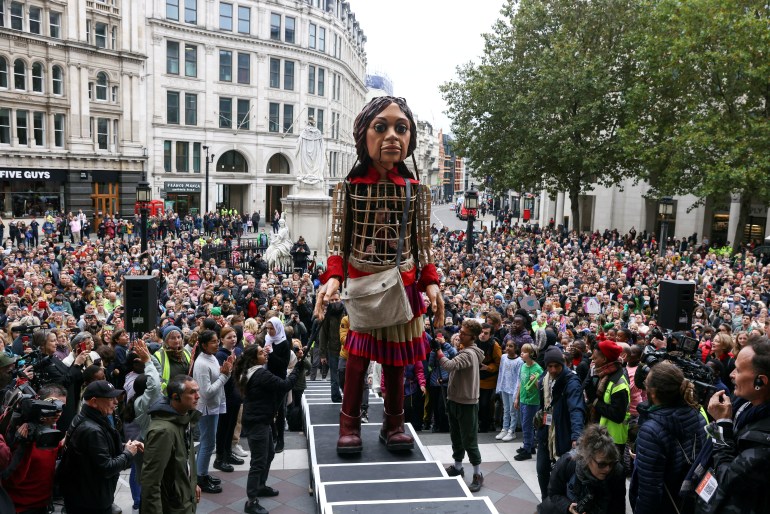
Hundreds of thousands of people are taking to the streets across the world to protest against the war in Gaza, as it nears the 100-day mark, and to demand an end to Israel’s offensive. At rallies on Saturday in Kuala Lumpur, Malaysia, people gathered at the United States embassy to send a message to Israel’s staunch ally. The US has vetoed United Nations resolutions backed by a vast majority of the UN Security Council calling for an immediate ceasefire. “We’ve spoken to people here who say they’ve come to show solidarity with Palestinians. People are holding up placards that read: ‘Stop the genocide’, as well as ‘Bombing children is not self-defence’,” said Al Jazeera’s Florence Looi, reporting from Kuala Lumpur. The demonstrations are part of a “global day of action for Palestine” and to call for an end to the bloodshed that has killed 23,843 people and wounded more than 60,317, according to Palestinian health officials. Israel on Friday rejected accusations of genocide in Gaza during a public hearing at the International Court of Justice, claiming the case filed by South Africa with the top UN court was a distortion of truth that amounted to libel. Its arguments were based on its alleged right to self-defence following the attack by Hamas in southern Israel on October 7, which killed 1,139 people, as well as a lack of genocidal intent against the Palestinian people. Last month, Malaysia’s government said it would no longer allow Israeli-owned ships to dock in Malaysian ports. It also said any vessel en route to Israel would not be allowed to unload cargo at any Malaysian port. The protest movement in Malaysia, organised in collaboration with dozens of NGOs, said it aimed to educate people not only about the atrocities that are happening in Gaza, but also about the history of the occupation. Thousands of people also gathered outside the US embassy in Indonesia’s capital, Jakarta, waving Indonesian and Palestinian flags and holding signs that read “Boycott Israel” and “Ceasefire Now.” Demonstrators gathered outside the US consulate in Johannesburg, South Africa, where Al Jazeera’s Fahmida Miller said many in the crowd accused the US, which has supplied Israel with thousands of tonnes of military equipment since the war started, of “complicity in the bombardment of the Palestinian people”. The protest has been bolstered by South Africa’s case at the ICJ, Miller said. Roshan Dadoo, a leader of South Africa’s Boycott, Divestment, Sanctions movement, who attended the protest, said: “We’re going to be here until we can make sure there is a ceasefire and sufficient humanitarian assistance for Gaza.” Rallies were also expected to kick off in world capitals including Paris, Vienna, Berlin, Amman and Washington, DC. Jeanine Hourani, a member of the Palestine Youth Movement attending the march in London, said protesters are angry over the injustice in Gaza and determined to keep marching for Palestinian rights. “The sentiment is one of rage and frustration” she told Al Jazeera. “We have been taking to the streets every week since October 7.” Hourani said that while the British public largely supports a ceasefire in Gaza, “the UK’s politicians have continued to fund and support the genocide.” “Ultimately, we know that in the grand scheme of things – in the long arc of justice – we are winning,” she said. “We are going to continue taking to the streets, continue applying pressure, until Palestine is free.” Thousands gathered at Bank Junction in central London, the Palestine Solidarity Campaign (PSC) said. The seventh National March for Palestine featured an appearance by Little Amal, a giant puppet of a Syrian child refugee, joining a group of Palestinian children. ‘Little Amal’, a puppet of a Syrian refugee girl, has become an international symbol of human rights [File: Tom Nicholson/Reuters] The 3.5-metre puppet, whose name means hope in Arabic, became an international symbol of human rights after she journeyed 8,000km (4,970 miles) from the Turkish-Syrian border to Manchester in July 2021. About 1,700 officers were on duty to police the march in London, the Metropolitan Police said. Adblock test (Why?)
Australian Open 2024: Top seeds, schedule, wildcards, draw and prize money

The first tennis Grand Slam of the year is upon is as Melbourne Park plays host to the Australian Open 2024. Here’s what you need to know about the tournament: What are the key dates? The Australian Open begins on Sunday, January 14 and runs through to the men’s singles final on Sunday, January 28. The women’s singles final will be staged the day before. The event’s 15-day duration is a first, given the tournament would usually begin on a Monday, but an extra day has been added in the hope of avoiding late-night finishes. Players qualify for the main draw by being ranked in the top 104, or by winning three qualifying matches (in qualifiers from January 8 to 11), or by wildcard. How much is the prize money? The total prize money for the tournament has increased by 13 percent this year to stand at 86.5 million Australian dollars ($57.83m). The singles champions will win 3.15 million Australian dollars ($2.11m) each. Who are the favourites? Both reigning champions will line up in Melbourne to defend their crowns, with Serbia’s Novak Djokovic defending his men’s singles title and Belarus’s Aryna Sabalenka competing to retain the women’s trophy. Djokovic, 36, has won the Australian Open on 10 occasions and is the top seed. Spain’s Carlos Alcaraz, Russia’s Daniil Medvedev and Italy’s Jannik Sinner are ranked two, three and four. Alcaraz heads to Melbourne Park without any competitive matches under his belt this season. Ready? PLAY 💥 pic.twitter.com/ccffFod5wr — #AusOpen (@AustralianOpen) January 11, 2024 Sabalenk lost the women’s number one ranking to Poland’s Iga Swiatek last year. America’s Coco Gauff is seeded third behind the pair after winning the US Open in September. Elena Rybakina, who won Wimbledon in 2022, is ranked fourth. The biggest name to miss out is Spain’s Rafael Nadal as he continues his rehabilitation from a hip injury but Britain’s Emma Raducanu, who won the 2021 US Open, returns from eight months out following surgery on both her wrist and ankle. Japan’s Naomi Osaka also returns after giving birth last July, hoping to add to her four major titles. Leading the charge 💪 pic.twitter.com/mLfAnQRwkJ — #AusOpen (@AustralianOpen) January 11, 2024 What happened in Thursday’s Australian Open draw? Djokovic begins his quest for a record-extending 11th Australian Open title and 25th Grand Slam crown overall against one of the qualifiers. The Serbian required treatment for a wrist problem during his United Cup defeat by Alex de Minaur last week – his first loss in Australia for six years. The 36-year-old has been given a relatively gentle start but could play Greek seventh seed Stefanos Tsitsipas in the quarterfinals in what would be a mouthwatering rematch of last year’s final. King of Melbourne. Who will it be this year? 🏆 🤔 pic.twitter.com/oFqnvg8wrf — #AusOpen (@AustralianOpen) January 11, 2024 Meanwhile, Swiatek faces a tricky test against 2020 champion Sofia Kenin. Defending champion Sabalenka will also take on a qualifier first while 2023 runner-up Elena Rybakina, who Sabalenka in the final of the tune-up tournament in Brisbane, faces former world number one Karolina Pliskova. Wimbledon champion Alcaraz meets French veteran Richard Gasquet. The 20-year-old second seed is on course for a quarterfinal clash with the rejuvenated Alexander Zverev, who goes up against fellow German Dominik Koepfer. Tsitsipas squares off with Matteo Berrettini in another tantalising opener, while twice-finalist Medvedev will start against a qualifier. Italian youngster Jannik Sinner, who is tipped to go deep at Melbourne Park, will face Botic van de Zandschulp. Coming for the Melbourne crown 👑 The CHAMPION will be… 👀 pic.twitter.com/sXrYsEsiqM — #AusOpen (@AustralianOpen) January 11, 2024 US Open champion Gauff faces Anna Karolina Schmiedlova, while Osaka, who won the title in 2019 and 2021, returns to Grand Slam tennis for the first time since 2022 and is pitted against Frenchwoman Caroline Garcia in a tricky opener. Angelique Kerber, who also made her comeback to the tour following a lengthy maternity break, will play 2022 runner-up Danielle Collins in her opener and could take on top seed Swiatek in the next round. Wild card Caroline Wozniacki, another former champion and returning mother, will play 20th seed Magda Linette. Australia’s Alex de Minaur, who stunned Djokovic last week before beating Alcaraz in a charity match, will spearhead local hopes and begin his campaign against Canadian former world number three Milos Raonic. What time will the ties be played? The show courts start at 12pm (01:00 GMT) while the day sessions begin an hour earlier on the outer courts. The Rod Laver Arena, Margaret Court Arena and John Cain Arena will host the night sessions which begin at 7pm (08:00 GMT). Both the women’s and men’s singles finals start at 7:30pm (08:30 GMT). Adblock test (Why?)
Israel’s war on Gaza: What constitutes genocide?

With the International Court of Justice deliberating over South Africa’s genocide case against Israel, we look at how the proceedings could affect reporting on the war. Contributors:Qaanitah Hunter – Journalist, News24Nimer Sultany – Editor-in-Chief, The Palestine Yearbook of International LawDaniel Levy – President, US/Middle East ProjectTony Leon – Political commentator On our radar: In Ecuador, masked gang members break into the studio of the state broadcaster, firing at staff and taking hostages. Tariq Nafi explains the country’s gang violence crisis and why the media has become a target. Feature – Sudan: 2023’s Forgotten War Thousands killed, millions displaced – the crisis in Sudan continues unabated and underreported. Two Sudanese journalists reflect on the coverage of Sudan’s civil war. Contributors:Yassmin Abdel-Magied – Editor, Eyes on SudanIsma’il Kushkush – Sudanese-American journalist Adblock test (Why?)
Taiwan ruling party’s Lai wins presidential election

William Lai Ching-te from the ruling Democratic Progressive Party (DPP) has won Taiwan’s presidential election. Lai, the current vice president, was in a three-way race with Hou Yu-ih from the conservative Kuomintang (KMT) and Ko Wen-je from the Taiwan People’s Party. Hou conceded defeat on Saturday and congratulated Lai on his victory. He also apologised to KMT supporters for not being able to oust the DPP. Voters also elected lawmakers to Taiwan’s 113-seat legislature in elections closely watched by China and the United States. Taiwan’s election carries an outsized importance because of the territory’s disputed political status. While de facto independent since the 1940s, China still claims the island and its outlying territories and has not ruled out the use of force to achieve its ambitions. China has previously said that Lai would be a threat to peace in the region if he wins, and called the polls a choice between war and peace. Lai has said he is committed to peace in the region and open to conditional engagement with Beijing. More to come… Adblock test (Why?)
What does the Alaska Airlines incident tell us about air safety?

Last week, an Alaska Airlines Boeing 737 Max 9 aircraft was forced to make an emergency landing in Portland, the United States, when a cabin panel blew off in midair leaving a gaping hole in the aircraft’s fuselage. Just days before, a Japan Airways Airbus collided with a smaller coastguard plane, resulting in the Airbus catching fire. The Federal Aviation Administration (FAA) has ordered an inquiry into the incident and several passengers filed a class action lawsuit against Boeing in Washington state on Thursday. So, is it really safe to travel by air? Here is what we know about the Alaska Airlines incident and the general safety of aviation: What happened to the Alaska Airlines flight? On January 5, just moments after takeoff, a cabin door panel blew off in midair during an Alaska Airlines flight from Portland to Ontario, leaving one side of the aircraft’s body with a gaping hole, reducing cabin pressure and prompting an emergency landing. The blown-out door panel was later discovered by a Portland teacher, in his garden. Federal officials in the US ordered the temporary grounding of all Boeing 737 Max 9 jetliners until they can be inspected. The cabin panel that flew out was a “door plug” installed over an extra emergency exit door, which had been removed. (Al Jazeera) Thankfully, no one was seated next to the gaping hole. Additionally, the plane was only 16,000 feet (4,876 metres) above the ground. Planes typically fly more than 31,000 feet (9,448 metres) when they are at their highest. Had the aircraft been much higher, the pressure difference could have become large enough to suck passengers out of the aircraft, former FAA accident investigator Jeff Guzzetti told The Washington Post. The aircraft, which had departed from Oregon and was heading for California, landed safely in Portland with all 174 passengers and six crew members mostly unharmed. Some passengers sustained minor injuries. The aircraft is a new Boeing 737 Max 9 which had been delivered to Alaska Airlines in late October and certified as safe by the FAA in early November. It had been in service for just eight weeks. London-based independent aviation expert John Strickland told Al Jazeera that the panel which flew off is supposed to be a secure part of the aircraft’s structure. “That’s why it’s more surprising and a matter of concern that this blowout happened,” he said. London-based aviation analyst and consultant Alex Macheras agreed: “This should not be downplayed, that’s for sure. Because in modern commercial aviation, we do not see sections of an aircraft body, of fuselage, becoming separated from the rest of the aircraft, certainly not mid-flight.” Has Boeing taken responsibility? As more than 170 planes remained grounded last week, Boeing CEO Dave Calhoun acknowledged errors made by Boeing and provided reassurance. He told staff that the company would ensure an incident like the Alaska Airlines blowout could never happen again. It has not been confirmed what the actual fault in the aircraft was, although experts told Al Jazeera it is most likely down to a manufacturing flaw rather than a design flaw. There has also been speculation about parts coming loose after both Alaska Airlines and United Airlines reported incidents of needing to tighten loose hardware last Monday. Earlier, the US chief accident investigator, The National Transportation Safety Board (NTSB), said it had received reports that warning lights had been triggered on brand-new Boeing 737 Max 9 crafts on three flights. Two of these alerts happened on consecutive days before the Alaska Airlines blowout. Richard Aboulafia, aviation industry analyst and managing director of Washington-based AeroDynamic Advisory, told Al Jazeera that the warning lights were likely the result of a technical glitch. “They ignored it because, strangely, the pressure differential came on while it was on the ground, which means it was a glitch. There’s no pressure differential while you’re on the ground,” he explained. The cabin pressure can only vary when the aircraft is in the air, which is why it was acceptable to ignore the warning and fly the plane over land, he said. The company stopped flying the aircraft over the Pacific Ocean to Hawaii due to the warnings, yet kept it flying over land, the NTSB said. Who checks the safety of an aircraft? Aboulafia explained that the FAA typically certifies an aircraft, approving its operations and production. However, since the Boeing 737 Max has had safety issues before, the FAA announced that it would inspect every single aircraft in the Max series under these unusual circumstances. The details about the exact checks that were carried out are not public. Once the aircraft is in use by an airline, regular maintenance checks called A, B, C and D checks are carried out, Aboulafia explained. While an A check is typically a cursory investigation of a plane’s moving parts, exterior wear and tear and of oil and fuel, a D-check is rigorous and involves a teardown and detailed inspection of the aircraft. These checks are carried out at dedicated intervals based on the number of years an aircraft has been in service or its number of flight hours. Some airlines have their own in-house capabilities to carry out these checks and while many airlines are able to do A or B checks, only certain airlines are able to do C or D checks themselves. Others use third-party services. “This is an unprecedented production ramp and, clearly, there needs to be more resources provided for it, whether it’s at the manufacturing level or the inspections level,” Aboulafia added, referring to how aeroplanes are now manufactured in large numbers. He called for a greater number of people to be assigned more time for inspections. Aboulafia added that it is imperative to identify where and how the Alaska aircraft passed its safety checks, and whether it was Boeing, Spirit Aerosystems or the FAA that cleared the jetliner without detailed inspection. There is no information about the level of detail of inspection that took place before the plane
Republican caucuses? Iowa’s Arabs and Muslims are more concerned with Gaza
Des Moines, Iowa – National media, political pundits and United States presidential hopefuls all converged on the state capital of Des Moines this week, as it played host to the final Republican debate before the Iowa caucuses. But just miles down the road from where Nikki Haley and Ron DeSantis traded barbs on Wednesday night, local businessman Mohamed Ali was unfazed. “Honestly, we don’t care about them,” Ali told Al Jazeera, blowing smoke from his hookah pipe in a packed cafe outside Des Moines. “With all the debates, they all fight and compete over who supports Israel more.” While indifferent towards the race for the Republican nomination, the 46-year-old Palestinian American father of three said one thing was certain: He would not back Democratic President Joe Biden for a second term in November. Israel’s war in Gaza had been a turning point for Ali, who previously supported Biden in 2020. Dressed in a white button-up shirt with a light blue blazer over it, he alternated between anger and stoicism — voicing rage over Biden’s support of Israel and apathy towards the 2024 elections. “The Arab and the Muslim community, they are not voting for Biden. I did not talk to a single person who said he’s going to vote for Biden,” Ali told Al Jazeera, as Arabic pop music blared in the background of the cafe. He added that even the prospect of Donald Trump’s return to the White House was not enough to spur Arab Americans to vote Democrat in the presidential race. Des Moines-area businessman Mohamed Ali says it is too late for President Joe Biden to win the votes of Arab Americans in Iowa [Ali Harb/Al Jazeera] Ali was born in Lebanon to Palestinian refugee parents. He studied in Tunisia before moving to New York and ending up in Iowa — the rural, sparsely populated state where the first Republican primary contest will take place on Monday. But Ali, like many Arab and Muslim Americans, has found himself disillusioned with mainstream US politics as the war in Gaza unfolds. Biden has articulated “unwavering” support for Israel, and his rivals in the Republican field have all tried to outdo each other with their advocacy for the US ally. All the while, international outcry has mounted over the rising death toll in Gaza, where an Israeli military campaign has killed over 23,700 Palestinians. Israel itself faced genocide accusations this week before the International Court of Justice. So in Iowa, as the election approaches, many Arab Americans feel stuck between Biden and a hard place. For now, many are spending their energy on local activism for Gaza. Ali himself has organised several Palestine solidarity protests, drawing hundreds of people in Des Moines. ‘Litmus test’ Although overwhelmingly white, Iowa is home to sizable Arab and Muslim communities: One grassroots project estimated Iowa’s Arab American population to include upwards of 17,700 people, in a state of 3.2 million. One of the nation’s oldest mosques is in the eastern Iowa city of Cedar Rapids, an area that elected its first Arab American state legislator in 2022. South of Cedar Rapids, in the college town of Iowa City, there is also a growing Sudanese American community. In Des Moines, meanwhile, there are clusters of Arab and Muslim Americans from the Middle East, South Asia and Bosnia. While US Arabs and Muslims are no monolith, more than a dozen activists interviewed by Al Jazeera echoed the same sentiment: They feel alienated by Republicans, but they will not vote for Biden. Ending the war in Gaza is now the central issue for many of Iowa’s politically active Arab Americans. They have organised protests, met with representatives and pushed ceasefire resolutions at the local level to make their voices heard. “I find it very difficult to stomach anybody who can’t call for a ceasefire at this point, no matter what party they’re in,” said Maria Reveiz, a Lebanese American yoga instructor who owns a jazz club in Des Moines. “I’ve left the Democratic Party. I have no affiliation. Palestine from here on out is my litmus test for anybody to get my support ever again.” That sense of disenfranchisement among Arab and Muslim Americans in Iowa has been amplified by a lack of outreach from campaigns during this year’s presidential race. While Democrats made headlines in 2020 for organising caucuses in Iowa mosques, Republican candidates have not reached out specifically to Arab and Muslim Americans, adding to those communities’ lack of concern with Monday’s race. Reveiz, a curly-haired mother of three, campaigned for Bernie Sanders during the 2020 Democratic caucuses, but she has since covered a sticker of a mittened Sanders on her laptop with a Palestinian flag. Sanders has not called for a permanent ceasefire in Gaza. When she spoke to Al Jazeera, Reveiz’s house looked like a shrine for Palestine: a keffiyeh above the fireplace, a painting by a Palestinian artist on the wall, a scarf with the colours of the Palestinian flag on a shelf. Reveiz herself wore a pendant that said “Palestine” in Arabic around her neck. Even a Buddha statue in the corner of her living room was draped with a Palestinian flag. Reveiz had visited Gaza several times in the past years with an aid group to lead yoga classes designed to help address trauma. Israeli shelling has since killed one of her friends in the Palestinian territory. “Ahmad Ismail,” Reveiz said, whispering his name but stopping short of crying. “Wonderful human.” With Israel restricting access to food, medicine and water in Gaza, Ismail had been on his roof collecting rainwater when he was hit by shelling in Deir el-Balah. Reveiz said she has now contacted the offices of her representatives in Congress so often that staffers recognise her. She has also written to the White House demanding a ceasefire. But she has not heard any positive responses to her requests. “It’s futile,” Reveiz told Al Jazeera. Sami Scheetz stands outside the Iowa state capitol in Des Moines [Ali Harb/Al Jazeera]
Israel rejects genocide charges in Gaza, asks ICJ to dismiss case

NewsFeed Israel has rejected South Africa’s claims it is carrying out a genocide against the people of Gaza and has asked the International Court of Justice to dismiss the case. Published On 12 Jan 202412 Jan 2024 Adblock test (Why?)