

‘Dangerous’: US attacks on Yemen’s Houthis belie push for de-escalation
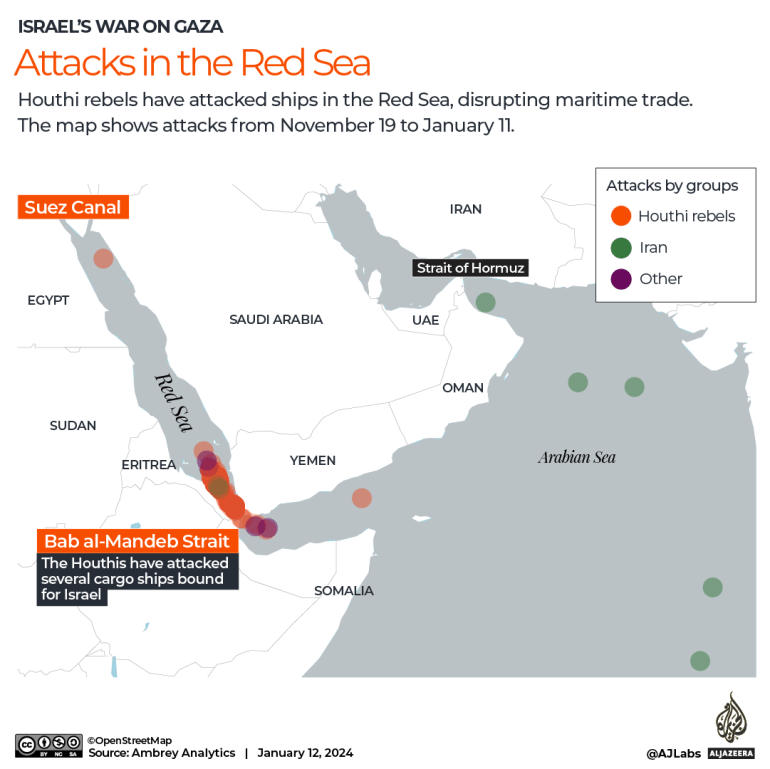
For months, top United States officials have repeatedly said that President Joe Biden does not want to see Israel’s war in the Gaza Strip escalate into a wider conflict in the Middle East. That was the central message US Secretary of State Antony Blinken conveyed this week as he made his fourth visit to the region since the war began. His trip came in the shadow of Israeli attacks in Lebanon and attacks by Yemen’s Houthi rebels on vessels in the Red Sea. “The Red Sea — we want to avoid escalation there,” Blinken said in Cairo on Thursday, when asked about his efforts to prevent the conflict from spiralling. But only hours later, the US confirmed it had collaborated with the United Kingdom to launch “strikes against a number of targets in Yemen used by Houthi rebels”, in coordination with a handful of other countries. Experts and rights advocates warn that the attacks clash with the Biden administration’s stated goals of de-escalation and fail to address the root cause of the soaring tensions in the region: Israel’s military assault on Gaza. “It does run contrary to what the administration has been saying, but it was also inevitable,” said Hassan El-Tayyab, legislative director for Middle East policy at Friends Committee on National Legislation, a Quaker advocacy group in Washington, DC. “Everybody watching this situation knew that it was a matter of time before the war in Gaza spilled out across the region. And we’re seeing that not only in the Red Sea, but we’re also seeing it in Lebanon, Syria and Iraq,” he told Al Jazeera. “Without that ceasefire in Gaza, it’s hard to see how this gets better. And I think the simmering pot is now boiling over, and it’s just going to get worse and worse as time goes on. It’s really a very dangerous moment.” Red Sea attacks On Friday, a senior US official told the Reuters news agency that more than 150 munitions had been used to hit nearly 30 locations linked to the Houthi armed group in Yemen. The Iran-aligned Houthis control large swaths of Yemen including the western coast overlooking the Bab al-Mandeb Strait, which leads to the Red Sea. The group began firing missiles at Israel and attacking commercial ships shortly after the war on Gaza began in October. The group has said it is targeting Israel-linked vessels as part of an effort to pressure the Israeli government to end its Gaza bombardment and allow more humanitarian aid deliveries into the coastal Palestinian enclave. The attacks in the Red Sea — a key commercial thoroughfare through which about 12 percent of global trade transits — led shipping companies to suspend operations in the area and drew condemnation from the US and its allies. In mid-December, Washington launched a multinational force aimed at defending “freedom of navigation” in the Red Sea, and at the end of the month, US forces sank three Houthi boats, killing 10 fighters. During a news conference from Egypt’s capital on Thursday, Blinken condemned the Houthis and noted that the United Nations Security Council passed a resolution a day earlier urging the group to end its attacks. “We have a number of countries that have made clear that, if it doesn’t stop, there’ll have to be consequences, and unfortunately, it hasn’t stopped. But we want to make sure that it does, and we’re prepared to do that,” the top US diplomat said. Brian Finucane, a senior US programme adviser at the International Crisis Group think tank, said it was widely expected that the US would launch attacks against the Houthis in Yemen amid the escalating Red Sea confrontations. But Finucane — who previously worked at the US State Department, advising on the use of military force — told Al Jazeera that the Yemen strikes show that the Biden administration “has adopted a posture of self-deception and a self-defeating policy”. “On the one hand, they repeat in this mantra-like fashion their desire to avoid a wider regional war. On the other hand, we already have that wider regional war and the underlying cause … is the conflict in Gaza, which the US is fuelling through unconditional military support [for Israel],” he said. ‘Arsonist and firefighter’ Biden, who confirmed the strikes on Thursday, said his administration was sending “a clear message that the United States and our partners will not tolerate attacks on our personnel or allow hostile actors to imperil freedom of navigation in one of the world’s most critical commercial routes”. “I will not hesitate to direct further measures to protect our people and the free flow of international commerce as necessary,” the US president said in a statement, which did not mention the Israeli war in Gaza. Earlier this month, a senior administration official also rejected the Houthis’ claim that their attacks in the Red Sea are tied to Gaza, calling that rationale “illegitimate”. The war in Gaza has killed more than 23,700 Palestinians since October 7, prompting widespread international outcry and raising questions about the risk of genocide. According to Finucane, the US’s failure to “acknowledge reality” — that the Gaza war lies at the heart of current regional tensions — “will make it very difficult to craft effective policy”. And while the US said its overnight Yemen strikes were “intended to disrupt and degrade the Houthis’ capabilities”, Finucane questioned whether they would really stem the Red Sea attacks. The Houthis in Yemen have already withstood years of bombings in a war led by Saudi Arabia and the United Arab Emirates. The group is currently in talks with Riyadh over a lasting ceasefire. “I think it’s really important to recognise that the US is simultaneously playing the role of arsonist and firefighter in the Middle East,” Finucane said. “It is pouring fuel on the fire in Gaza, while at the same time trying to tamp down the flare-ups elsewhere in the region — flare-ups that endanger US service members.” Gaza ceasefire key Shireen Al-Adeimi, a Yemeni American assistant professor
Prosecutors in Peru seek 34-year sentence for ex-President Castillo

Former President Pedro Castillo is accused of ‘carrying out a coup’ after he attempted to dissolve Congress in 2022. Peru’s prosecutor’s office has formally requested 34 years in prison for former President Pedro Castillo, who was dramatically removed from office and arrested after his attempt to dissolve Congress in late 2022. Castillo, whose removal sparked off months of deadly protests that hit the key mining sector in the copper-rich country, remains in pre-trial detention. On Friday, the public prosecution office wrote on social media that it sought the jail term for “crimes of rebellion, abuse of authority and serious disturbance of public peace”. In the request presented to the court, Castillo is accused of “carrying out a coup d’etat”. Castillo, a former teacher from rural Peru, elected in 2012, was the first leader of the Andean nation with no ties to the elites and was hailed as the country’s first poor president. Once he took up the position, the leftist leader was locked in a power struggle with the opposition-led Congress and was accused by the attorney general of leading a criminal organisation involving his family and allies that handed out public contracts for money. Before his removal in December 2022, Castillo said the plan to “temporarily” dissolve Congress was to “reestablish the rule of law and democracy” in the country. However, opposition politicians said the decision went against Peru’s constitution, and Congress voted overwhelmingly to remove him from the country’s top position. Castillo has argued that he was the victim of a political conspiracy between the right-wing opposition and the attorney general. “I never took up arms,” he has told court hearings since his arrest. Castillo was replaced by his vice president, Dina Boluarte, who faced protests as some called for her to step down and hold an early election. A crackdown by security forces killed about 50 people, according to an estimate by Human Rights Watch, which accused Peruvian authorities of extrajudicial and arbitrary killings. While Boluarte is facing a probe over the deaths of the protesters, she maintains immunity until her term ends in 2026. Adblock test (Why?)
Israel rejects accusations of genocide in Gaza war at ICJ hearing

Israel has rejected the accusations brought by South Africa to the International Court of Justice (ICJ) that its actions in Gaza amount to genocide, in a second day of a public hearing at the world body in The Hague. Israel’s legal representatives on Friday claimed South Africa’s case was “unfounded”, “absurd” and amounting to “libel”, and said Israel sought not to destroy a people but to protect its people. On Thursday, on the first day of hearings, South Africa argued Israel had committed “systematic” acts of genocide in Gaza, where more than 23,500 Palestinians have been killed amid Israel’s military campaign, with at least 70 percent of whom were women and children, according to Gaza’s Health Ministry. Israel’s arguments revolved around its “right to self-defence” following the attacks by Hamas on October 7, as well as what it called a lack of evidence of “genocidal intent”. Christopher Staker, a lawyer representing Israel, said, “The inevitable fatalities and human suffering of any conflict is not of itself a pattern of conduct that plausibly shows genocidal intent.” Malcolm Shaw, a professor of international law representing Israel, said the case relates only to charges of genocide, which “stands alone among violations of international law as the epitome of evil”. If the charge of genocide is levelled incorrectly, “the essence of this crime would be lost”, he said. Shaw added that such evidence was lacking in the arguments South Africa presented a day earlier. Detailing its evidence on Thursday, Tembeka Ngcukaitobi, a lawyer for South Africa, said, “The evidence of genocidal intent is not only chilling, it is also overwhelming and incontrovertible.” ‘Massive disconnect’ Israel’s legal representatives insisted its army has acted in compliance with international law in Gaza and aimed to mitigate civilian harm by warning of impending military actions, including via telephone calls and leafleting. Omri Sender, another lawyer, argued that Israel’s efforts to facilitate humanitarian assistance to people in Gaza testified to its objective of protecting the civilian population, rather than destroying it. However, Thomas MacManus, a senior lecturer in state crime at Queen Mary University of London, told Al Jazeera the ICJ is likely to see a “massive disconnect” between the picture Israel painted of its humanitarian concern for Gaza and “the reality on the ground where UN agencies say people are starving, lacking water, and seeing attacks on hospitals, schools, and universities”. Speaking before the ICJ hearing, Galit Raguan, acting director of the international justice division at Israel’s Ministry of Justice, refuted the claim that Israel had bombed hospitals. She argued Israel had found evidence of Hamas using “every single hospital in Gaza” for military purposes. Responding to claims that hospitals were used as military bases, Palestinian foreign ministry official Ammar Hijazi told Al Jazeera outside The Hague that Israel’s arguments were not based in fact or law. “What Israel has provided today are many of the already debunked lies,” he said. ‘Plausible right to self-defence’ The ICJ is set to rule on nine provisional measures effectively seeking the suspension of military operations in Gaza, but a timeline for when that will happen has not been stated. Israel has argued the provisional measures cannot require a state to refrain from exercising a “plausible right to defend itself”. On the issue of jurisdiction, Israel argued that one of the requirements of the ICJ’s mandate is that the state putting forward the case should try to sort out this problem first. According to Israel, they did not manage to talk to South Africa before they brought this case to the court. In turn, South Africa argued it had reached out to Israel but obtained no response. The Israeli team did make strong “jurisdictional and procedural arguments”, Al Jazeera’s senior political analyst Marwan Bishara said, but he added that “Israel lost the moral, factual, historical and humanitarian argument because of the way the situation has unravelled in Gaza – with the sheer death and industrial killing there.” Tal Becker, the legal adviser of Israel’s foreign ministry, told the ICJ hearing that South Africa enjoyed close relations with Hamas and was therefore attempting to put forward a “distorted factual and legal picture”. South Africa “firmly rejects” that claim, Al Jazeera’s Fahmida Miller said, reporting from South Africa. “The South African government has said that it doesn’t have bilateral relations with Hamas and that its stance in terms of supporting the Palestinian struggle against occupation does not equate to the support of Hamas,” she said. In its presentation on Thursday, South Africa’s lawyers also condemned Hamas’s actions on October 7. ICJ President Joan Donoghue ended the two-day hearing saying the court will announce its decision in the coming days. Adblock test (Why?)
China says will ‘crush’ Taiwan independence efforts before vote

The governing DPP, which champions Taiwan’s separate identity, will be seeking a third term in elections on Saturday. China’s military has promised to “crush” any efforts to promote Taiwan’s independence, a day before a crucial election on the self-ruled island which Beijing claims is part of its territory. Hundreds of thousands of people attended final pre-election rallies in Taiwan on Friday in advance of critical presidential and parliamentary polls on Saturday. “The Chinese People’s Liberation Army maintains high vigilance at all times and will take all necessary measures to firmly crush ‘Taiwan independence’ attempts of all forms,” China’s defence ministry spokesperson Zhang Xiaogang said in a statement. Responding to a question on Taiwan’s air force upgrading F-16 fighter jets and buying more from the United States, Xiaogang said even with purchases of US weapons the governing Democratic Progressive Party (DPP) “cannot stop the trend of complete reunification of the motherland”. Taiwan has been a democratic success story since holding its first direct presidential election in 1996, the culmination of decades of struggle against authoritarian rule and martial law. The DPP, which champions Taiwan’s separate identity and rejects China’s territorial claims, will be seeking a third term in office with its candidate, current Vice President Lai Ching-te. Supporters attend a campaign rally of the governing DPP before the presidential and parliamentary elections in Taipei, Taiwan [Carlos Garcia Rawlins/Reuters] China has framed the elections as a choice between “peace and war”, calling the DPP dangerous separatists and urging Taiwanese to make the “right choice”. The DPP has rejected China’s sovereignty claims, and said only Taiwan’s people can decide their future. Speaking at a rally in Taipei’s neighbouring city New Taipei, Lai said the world was watching how Taiwan voted. “If Taiwan moves closer to China again, Taiwan will lose its advantage, and foreign investment in Taiwan is more likely to be suspended or stopped,” he told the crowd. “Therefore, Taiwan must win this battle.” China repeatedly denounced Lai in the run-up to Saturday’s election and rebuffed repeated calls from him for talks. Al Jazeera’s Tony Cheng, reporting from Taipei, said Taiwan had witnessed Chinese military actions “in the background” over the past few weeks. “There have been military exercises, information gathering balloons flying overhead, and we’ve even seen in the last week a Chinese satellite causing an alert across the island,” Cheng said. Lai is facing two opponents for the presidency – Hou Yu-ih of Taiwan’s largest opposition party the Kuomintang (KMT) and former Taipei mayor Ko Wen-je of the small Taiwan People’s Party (TPP), only founded in 2019. Hou wants to re-start engagement with China, beginning with people-to-people exchanges, and has, like China, accused Lai of supporting Taiwan’s formal independence. Lai has said Hou is pro-Beijing, which Hou rejected. “If Lai Ching-te is elected, the Taiwan Strait will likely fall into turmoil. Do you also want Taiwan to fall into war, folks?” Hou told his supporters. Ko has won a passionate support base, especially among young voters, for focusing on bread-and-butter issues like the high cost of housing. He also wants to re-engage China, but insists that cannot come at the expense of protecting Taiwan’s democracy and way of life. Al Jazeera’s Cheng said, “All three parties can see that China is a threat and their platforms are pretty much the same when it comes to China, so this [election] may go down to domestic issues.” Polls open at 8am local time (00:00 GMT) and close at 4pm (08:00 GMT), with ballot counting by hand starting almost at once. The result should be clear by late evening Saturday when the losers concede and the winner gives a victory speech. Adblock test (Why?)
As Arevalo inauguration approaches, Guatemalans express cautious optimism

Guatemala City, Guatemala – Guatemalan President-elect Bernardo Arevalo is poised to assume office on Sunday, following his landslide victory in the 2023 presidential elections. But Arevalo’s impending inauguration has been overshadowed by a string of recent legal attacks against him and his party — widely interpreted as attempts to overturn the vote. Now, as he prepares to be sworn in, analysts question how much the uncertainty of the past months has weakened Guatemala’s fragile democracy and shaken public confidence. Arevalo, an anticorruption candidate, first catapulted into the international spotlight with a surprise second-place finish in the June general elections. Those results assured the dark-horse candidate of a spot in the run-off election — and placed a target on his back. Guatemala has long struggled with corruption in its government, and several leading candidates had already been disqualified. Beginning in July, prosecutors under Attorney General Maria Consuelo Porras sought to suspend the legal status of Arevalo’s party, the Seed Movement, citing alleged irregularities with the years-old signatures used to form the party. Prosecutors also pursued court orders to raid the party’s headquarters, as well as the offices of Guatemala’s election authority. In the process, boxes with sealed ballots were opened, spurring concerns of election interference. Arevalo nevertheless delivered a commanding victory over his run-off opponent, former First Lady Sandra Torres, earning 60 percent of the vote. But the legal actions against him continued. In November, prosecutors issued a request to strip Arevalo and his allies of their political immunity over their support for student protesters in 2022. To date, Guatemala’s Supreme Court has not ruled on whether to lift Arevalo’s immunity, which would leave him potentially vulnerable to prosecution. In December, prosecutors went so far as to openly question whether to annul the 2023 election results — despite assurances from the country’s election authority that the tally was “unalterable”. All the while, the volley of legal attacks has ignited widespread outcry, both within Guatemala and from international observers. Indigenous leaders organised weeks of protest in the country, with some blocking highways and camping outside the attorney general’s office for 100 days. The United States and European Union, meanwhile, have both imposed sanctions on officials accused of undermining the 2023 election. But Arevalo has proceeded with his plans to take office on Sunday, announcing a largely traditional slate of cabinet picks on January 8. In the week ahead of his inauguration, Al Jazeera spoke to residents in Guatemala City about the attacks on the country’s democratic process — and whether they are optimistic for change under the new administration. Luis Mendez Salinas, right, and Carmen Lucia Alvarado expressed hope for the Arevalo administration [Jeff Abbott/Al Jazeera] Luis Mendez Salinas, 37, author and co-owner of the publisher Catafixia from Guatemala City “It’s strange to say, but every [legal attack] that has been made from June 25 until today — and probably until January 14 — has filled me with optimism. Because every attempt that has been made by these corrupt political elites and political clients has failed. “2023 was a historic year. It seems to me that the crisis generated by Arevalo’s victory, paradoxically, brings with it a possibility of redirecting Guatemala along the democratic path that was opened in 1985. “Why? Because we were seeing a very noticeable deterioration of all institutions and an authoritarian regression. “It seems to me that the fact that the population has surged in terms of voting for a candidate who was totally outside of that system is a great lesson in the possibility of hope.” Carmen Lucia Alvarado, 38, author and co-owner of the publisher Catafixia from Quetzaltenango “I hope that the population understands that we are not facing a miracle. We are facing the logical reaction of a society that collectively chose an option that can give us at least a path forward. “I hope the new government achieves the minimum to return dignity [to the people].” Jose Miguel Echeverria worried that highway blockades in support of President-elect Arevalo would negatively impact small businesses like his [Jeff Abbott/Al Jazeera] Jose Miguel Echeverria, 36, coffee roaster and small business owner from Guatemala City Echeverria was hopeful Arevalo’s administration would follow through with its promises to improve Guatemala’s healthcare and roadway infrastructure, but he expressed frustration with the highway blockades that accompanied pro-democracy protests in recent months. “The situation has been difficult and complex. “The roadblocks in October really affected the country. We were afraid that, if they lasted longer than 15 days, we would have to lay off people. “Sooner or later, these political conflicts will begin to affect small- and medium-sized businessmen and entrepreneurs. That is the most difficult issue, because we understand that the country’s situation is difficult. We also understand that there is horrible corruption that is taking advantage of our taxes. But on the other side, slowing [corruption] is sometimes complex, because no one knows where to start. “The only job of the politicians — of the president, of Congress, those who are developing policies — is to meet the needs of the people.” Elsira Rodriguez expressed frustration with the government of outgoing President Alejandro Giammattei [Jeff Abbott/Al Jazeera] Elsira Rodriguez, 70, flower vendor from San Pedro Sacatepequez “Everything [about the election crisis] has been bad for us. We do not have a government that supports us. “We hope to God that Arevalo is also a responsible person, that he fulfils what he promised us, and that he fulfils [the promise to] provide for security. “We truly hope that this new government will come to change everything.” Romelia Jalal accused past Guatemalan governments of knowing how to ‘steal’ the things they want [Jeff Abbott/Al Jazeera] Romelia Jalal, 58, vendor of artisanal crafts from Tactic Jalal said she is cautiously optimistic about Arevalo’s government. She credited the attacks on his campaign to establishment politicians refusing to accept defeat. “People do not know how to lose. Maybe [Arevalo] has new purposes, new goals, something new for Guatemala, but we Guatemalans do not know
As a feminist, what I wish for in 2024 is criminal justice reform

If I could have one wish for the new year, it would be for Britain’s criminal justice system to be reformed in a way that would ensure the arrest, prosecution and conviction of every single rapist in the country. I do not mean, of course, any man accused of rape, but every man who has actually committed rape. One of the most prevalent and persuasive myths about rape and sexual assault is that a large number of allegations are false and men who have been publicly accused of rape but could not be convicted in a court of law are the victims of grave miscarriages of justice. According to the United Nations, “globally, an estimated 736 million women – almost one in three – have been subjected to physical and/or sexual intimate partner violence, non-partner sexual violence, or both at least once in their life.” Despite such shockingly high figures, there is still a presumption that many women make false allegations about male violence – in particular, rape. In the United Kingdom, the government estimates that false allegations and cases of mistaken identity make up just 2 to 4 percent of reported rapes – a figure believed to be broadly accurate across countries. Of course, men’s rights activists and other anti-feminists never mention this figure in their unhinged rants about how women routinely lie about being sexually assaulted and raped. Currently, in England and Wales, the conviction rate for rape is at an all-time low. Of those reported to police, known to be just small a minority of sexual assaults actually committed, only 1 percent end in a conviction. That means, if we also take into account the small percentage of false allegations, well over 90 percent of rapists get away with their crimes. These men are bound to be emboldened by their ability to evade justice and will almost certainly do it again. Given the terrible, devastating impact that rape often has on women subjected to it – resulting in chaotic lifestyles, drug and alcohol abuse, and other actions fuelled by trauma – victims of rape are more likely to end up in prison than their rapists. The biggest obstacles to securing rape convictions in the UK are prejudiced jurors and the reluctance in every level of the justice system to prosecute “difficult” cases – such as those involving women in prostitution, drug and alcohol users, and teenage girls, all of whom are often seen as unreliable witnesses. Contrary to what is often said in defence of the low number of cases getting to court, there is no such thing as a sex crime prosecution that is “too difficult to prosecute”. In the UK, the Crown Prosecution Service only takes sex crime cases to court if it believes there is at least a 50 percent chance of a conviction. This often means that the more complicated cases, or those involving victims who are considered imperfect, are dropped. The advantage of the system in the United States is that prosecutors in Special Victims Units work exclusively on sex crimes and receive intensive and ongoing training from experts. These prosecutors play a pivotal role from the moment a rape is reported, working with police to investigate the case and developing an intimate understanding of the details of the crime. This gives them an obvious advantage when it comes to presenting their case clearly and persuasively in court. By comparison, in the UK, the first time the complainant will meet the prosecutor is at the trial. This is why I advocate for the use of specialised prosecutors in sex crime cases in the UK too. The UK does have prosecutors trained in rape and serious sexual offences, but all that is required is to have attended a training course. These prosecutors also take on a range of other cases, and their “expertise” is, therefore, limited. What we need is a type of super-lawyer, highly trained in every detail and aspect of sex crimes. This would include legislation, forensic science and victim/jury psychology, equipping them, for instance, to explain to jurors that if a complainant laughs or appears bored or distracted in the witness box, this could be the result of trauma. Prevailing rape myths, such as “She was asking for it,” “He’s handsome and does not ‘need’ to rape” and “If she didn’t want it, she would close her legs,” can poison the mind of a juror against the complainant, whatever the evidence against the defendant. Women and girls are routinely blamed for being raped – which means the perpetrator, even when it is abundantly clear that he is guilty, is too often absolved. This is how patriarchy works: Keep women and girls in constant fear of male violence, and then when it happens, put the responsibility for it firmly on their shoulders. Another potential reform put forward by feminists is the abolition of the jury system when it comes to rape and sexual assault trials. When we make this suggestion, however, we are often countered with the argument “Our jury system, the bedrock of a fair trial, is under threat as it is.” While that may well be the case, if we are to ensure victims of rape and sexual assault are to find justice, we need to take drastic measures. Rape myths are entrenched in society. Not only those working in the justice system, from police to prosecutors and judges, but also all potential jurors carry these myths with them into courtrooms. While those actively working the system can be trained to look beyond their prejudices, such training can hardly be extended to jurors. Thus, it may be beneficial to women for rape and sexual assault trials to not involve jurors. Currently, the justice system in the UK is designed to help perpetrators of rape and sexual assault at every step of the way. For example, police routinely try to access the counselling and therapy notes of rape victims, which can then be read by them as well as
Who are the Houthis? A simple guide to the Yemeni group

Following weeks of Houthi-led attacks on vessels in the Red Sea, the United States and United Kingdom have launched military strikes in Yemen in response, which the Houthis have described as “barbaric”. The Houthis are an Iran-aligned group based in Yemen and have said their attacks are a response to Israel’s bombardment of Gaza, and the international community’s failure to put an end to it. The Houthis have primarily targeted Israel-linked ships and in December, the US formed a multilateral coalition to safeguard commercial traffic from attacks. The force now has more than 20 countries, according to the Pentagon. But who are the Yemeni fighters at the heart of this escalation? Who are the Houthis? The Houthis, also known as Ansar Allah (supporters of God), are an armed group that control most parts of Yemen, including the capital, Sanaa, and some of the western and northern areas close to Saudi Arabia. The Houthis emerged in the 1990s but rose to prominence in 2014, when the group rebelled against Yemen’s government, causing it to step down and sparking a crippling humanitarian crisis. The group then spent years, with Iran’s backing, fighting a military coalition led by Saudi Arabia. The two warring sides have also repeatedly tried to hold peace talks. However, analysts say the Shia group should not be seen as an Iranian proxy. It has its own base, its own interests – and its own ambitions. What’s the status of Yemen’s civil war? Yemen has been in a decade-long civil war as the Houthis maintain control of parts of the country. The group has been in ceasefire talks with Saudi Arabia while Yemen’s official government is based in Aden and led by President Rashad al-Alimi. Al-Alimi came into office in 2022 after the country’s exiled president Abd-Rabbu Mansour Hadi ceded power to him. Relations between Hadi and the Houthis were especially fraught. Yemen’s civil war has plunged the country into what the United Nations called “the world’s worst humanitarian crisis”, in March 2023. An estimated 21.6 million people or two-thirds of Yemen’s population are “in dire need of humanitarian assistance and protection services”, according to the UN. Fighting between Houthis and the military coalition, however, largely subsided last year. In 2023, the Yemeni rebels and government forces also exchanged about 800 prisoners over three days. The Houthis have been engaging in Omani-mediated talks with Saudi officials to negotiate a permanent ceasefire. Saudi Arabia also restored relations with Iran in 2023, raising hopes for the Yemen peace process. Why are the Houthis attacking Red Sea ships? The Houthis say their attacks on commercial and military ships with potential Israeli links are primarily aimed at pressuring Tel Aviv to end its war on Gaza. On November 18, the group took over a cargo ship called the Galaxy Leader, which they have since turned into a tourist attraction for Yemenis. “We have emphasised to everyone that [the Houthi] operations are to support the Palestinian people in the Gaza Strip, and that we cannot stand idly by in the face of the aggression and siege,” Houthi chief negotiator and spokesperson Mohammed Abdulsalam told Al Jazeera in December. The Houthis have also said they will continue to attack Israel-linked ships even after the strikes on Yemen by the US and UK on Thursday. “They were wrong if they thought that they would deter Yemen from supporting Palestine and Gaza,” Abdulsalam wrote online. The group’s “targeting will continue to affect Israeli ships or those heading to the ports of occupied Palestine,” he wrote. The group has also been demanding that Israel allow increased humanitarian aid into Gaza. But analysts also say that attacks help the Houthis in other ways. Domestically in Yemen, the group has seen a sharp uptick in recruitment, riding on popular support for the people of Gaza. The attacks, and the response from major powers like the US, also force other countries and governments to negotiate with them, giving them de facto legitimacy at a time when they are not officially recognised internationally as Yemen’s government. The Red Sea and Suez Canal account for 30 percent of the world’s container ship traffic and since the onset of attacks, several shipping companies have said they will divert ships across Africa instead. Will the latest escalation affect Yemen’s fragile peace? Analysts say that the Houthis attacks on Red Sea ships could threaten peace within Yemen, particularly as ceasefire talks after a decade-long war appear to be gathering momentum. The UN announced in late December that serious progress was made in negotiations, but experts warned that Houthi activity in the Red Sea could derail a final deal. They explained that attacks could trigger a US military response that could in turn “unravel the fragile ceasefire conditions”. Some analysts also fear that the Houthis could be tempted to use their bolstered numbers – because of increased recruitment – to expand their ambitions. In recent weeks the Houthis have deployed 50,000 troops around Marib, the internationally recognised Yemeni government’s last stronghold. But other analysts point out that the Houthis might also seek closer relations with Saudi Arabia, a factor that could hold them back from any actions that escalate tensions within Yemen. Adblock test (Why?)
Burundi closes border with Rwanda in latest East Africa row

President Ndayishimiye accuses Rwanda of backing DRC-based armed group Red Tabara against his government. The Rwandan government says Burundi had decided to shut its border with the East African nation, weeks after its president accused Kigali of hosting a rebel group. In late December, Burundi’s president, Evariste Ndayishimiye, accused Rwanda of hosting and training the Red Tabara rebel group, which claimed responsibility for an attack near Burundi’s western border with the Democratic Republic of the Congo (DRC). Rwanda has rejected his allegations. A Rwanda spokesperson said on Thursday that the government learned about Burundi’s border closure through media reports, adding that it violated the principles of a regional bloc both are members of. “This unfortunate decision will restrict the free movement of people and goods between the two countries and violates the principles of regional cooperation and integration of the East African Community,” Yolande Makolo said. “Today we closed the borders, and someone who will go there will not pass,” Burundian Interior Minister Martin Niteretse was quoted as saying on Thursday by local media. Burundi has said the December attack killed 20 people while Red Tabara said on the social media platform X that it killed nine soldiers and a police officer. Red Tabara has been battling Burundi’s government from bases in the eastern DRC since 2015. [embedded content] Regional rifts Relations between some nations within the East African Community (EAC) – which also includes Uganda, Kenya, Tanzania, South Sudan, the DRC, and Somalia – have been frosty for years. Uganda and Rwanda reopened their border posts after a three-year closure caused by Kigali’s claim that Kampala was supporting dissents to overthrow the Rwandan government. The DRC has repeatedly accused Rwanda of backing the armed group M23, which has triggered the displacement of millions of Congolese. From 2022 to 2023, the EAC deployed soldiers to battle the group and scores of others that operate in Africa’s second largest country by landmass, but Rwandese soldiers were excluded. United Nations experts and the European Union have also cited evidence of Kigali’s support for M23, but Kigali denies the allegations. Angolan efforts to mediate between the DRC and Rwanda have failed. In December, DRC President Felix Tshisekedi further intensified the situation during a campaign stop. “I’ve had enough of invasions and M23 rebels backed by Kigali,” Tshisekedi said. “If you re-elect me and Rwanda persists, … I will request parliament and Congress to authorise a declaration of war. We will march on Kigali. Tell Kagame those days of playing games with Congolese leaders are over.” Adblock test (Why?)
I’m preparing for China’s war on Taiwan | Close Up

This Taiwanese citizen is taking up arms in preparation for what he believes is an imminent Chinese invasion. “I think China will invade Taiwan between 2025 and 2027,” says Wu Jheng Cong, a Taiwanese sofa-maker living in Taoyuan City. “These rations of food can last our entire family 20 days to a month.” He has stocked up on food, taken up weapons training and has weekly gatherings with his civil defence group, where they develop their survival skills. Local media in Taiwan reports that around half a million people have voluntarily enlisted in civil defence training. Wu is one of them. “When the war comes, things are going to get tough,” he tells us. His fear is that the Taiwanese military and reserve forces may not be large enough to withstand a military invasion by China, prompting him and his peers to organise and train for war. “You have to start years before it actually comes,” Wu says. While many Taiwanese believe China’s rhetoric around ‘reunification’ remains a distant threat, tensions between Beijing and Taipei have escalated dramatically in recent years. Wu believes that fostering a close connection with his training companions will be what protects him, his wife and his three-year-old son in case of emergency. “Being in a group like this, I’m reminded of my purpose. When the war comes, there’s someone to fight for.” Credits Filmed by: Joseph Mangat and Wang Chun Hong Produced by: Tierney Bonini and Antonia Perello Field Producer: Allen Chen Edited by: Joseph Mangat and Antonia Perello Sound recording: Ken Wu Sound Mixing: Linus Bergman Colourist: Catherine Hallinan Senior Editor: Donald Cameron Adblock test (Why?)
Putin waged a trade war long before bombing Ukraine. Which side is winning?

Last year, Russian President Vladimir Putin announced he was shutting down the Black Sea to Ukrainian agricultural exports. The reason, ostensibly, was Ukraine’s second attempt to cripple the Kerch Bridge, Russia’s main artery to the Crimean Peninsula and key to its ammunition logistics. A massive explosion caught on camera in the small hours of July 17 left a section of road deck hanging askew over the Black Sea. In December, the head of Ukraine’s Security Service (SBU), Vasyl Malyuk, confirmed the SBU had developed the Sea Baby drones used in the operation. In retaliation, Russia said it was withdrawing from an agreement allowing the shipment of Ukrainian grain out of the Black Sea, brokered a year earlier by the United Nations and Turkey to prevent hunger among the world’s poorest. Marking its withdrawal, Moscow launched an overnight missile attack on Ukraine’s Odesa and Chernomorsk, two of the three ports authorised to export grain under the initiative, destroying grain silos, fuel oil and loading equipment. Two days later, Putin revealed the real reason for his change in strategy. In a staged conversation with his agriculture minister, Dmitry Patrushev, Putin said Russian farmers had lost $1.2bn and Russian fertiliser manufacturers $1.6bn, roughly half their profit margins, due to high costs for shipping, spare parts and financial transactions. Ukraine, too, has suffered from higher shipping costs stemming from Putin’s war and the conflict in Gaza, which has forced commercial shipping to detour around Africa. But Putin and Patrushev blamed the increase solely on Western sanctions. According to Putin, Russia showed “miracles of endurance and patience” hoping that its foreign colleagues would finally begin to “fully comply with the agreed and approved parameters and conditions”. Instead, Russia reaped “arrogance and impudence, promises and empty chatter”, he said. Although the West never sanctioned Russian grain or fertiliser, Putin’s argument was that sanctions on Russian banks and machinery imports effectively sanctioned agricultural industries. He also believed 200,000 tonnes of Russian fertiliser were being unofficially blocked in European ports. Russia sought to leverage Black Sea security to overturn Kyiv’s sanctions, as well. “He wants the fertiliser pipeline through Odesa to be reopened,” Kyiv School of Economics Director Tymofiy Mylovanov told Al Jazeera, referring to a pipeline built in 1981, when Ukraine was part of the Soviet Union, to carry ammonia from the TogliattiAzot plant 500km (311 miles) east of Moscow to Odesa for export. A blast disabled the defunct pipeline last June. Russia accused Ukraine of sabotage. “There is no way Ukraine will reopen any kind of transit through Ukraine of any kind of Russian products,” Mylovanov said. “Russia is in a full-scale war with us and they want to trade through us. This is just not possible.” Russia’s very reason for agreeing to the grain initiative was to slow down Ukrainian exports, believed Mylovanov. Under the initiative Russia was entitled to inspect grain ships, but average daily inspections had fallen from 11 to five by early last year, said the UN, causing Ukrainian exports to fall from 4.3 million tonnes in October to 1.3 million tonnes in May. This was merely the latest tactic in a trade war that long predated Russia’s ground war, said Mylovanov. “Putin started placing … barriers to trade on Ukrainian agricultural products from grain to dairy as early as 2012,” he said. Russia “would impose certain tariffs and they would abandon them arbitrarily”. Farmer Vitalii Kistrytsya, 45, walks next to grain at his grain storage facility, as Russia’s attack on Ukraine continues, in the Dnipropetrovsk region [File: Alkis Konstantinidis/Reuters] In doing this, Putin was weaponising uncertainty “to paralyse decision-making in agricultural companies and to deny investment in the capacity,” Mylovanov said. The construction of the Kerch Bridge may have been part of this trade war. The bridge “basically denied high-volume tankers [access] so Azov Sea ports became unavailable to Ukraine in 2016-2019. We had to rebuild our railroad routes to pass through Odesa, so farmers in the east were hurt by this”, he said. None of Putin’s tactics seemed to work. Ukraine’s goods, mainly agricultural, were becoming ever-more competitive with Russia’s. Exports rose from $33.5bn in 2016 to $63.1bn in 2021, World Bank data showed. Only the full-scale invasion changed that. Putin’s war cost the Ukrainian economy 29 percent of gross domestic product (GDP) and 14 percent of its population. Its goods exports plummeted to $40.1bn. But Ukraine’s agriculture is now bouncing back, with a record harvest of 80 million tonnes – 58 million tonnes of it was grain. Russia harvested more than twice as much grain – 123 million tonnes – but its landmass is 28 times greater than Ukraine’s and its population five times greater. Ukraine is punching way above Russia’s weight. That is important because rising agricultural exports may now represent Ukraine’s best hope of prosecuting the war. Kyiv faces a gaping budget deficit of $43bn this year, which financial aid will only partly address and faces political hurdles in Brussels and Washington. Kyiv needs to maximise export revenues, and Russia is trying to starve it. “Ukraine, as today’s events show, cannot rely only on international grants and loans. You have to earn money yourself,” Odesa newspaper editor Oleg Suslov told Al Jazeera. “Russia understands this, too. Its desire to destroy the port infrastructure is aimed at reducing the flow of export earnings to Ukraine in the hope that this will destabilise the domestic economic situation and sow panic among the population,” he said. The longer-term strategy is geopolitical, said Mylovanov. “They want to get Ukraine off the market so … they can get monopoly positions and they can later weaponise or politicise them. For the Middle East, a lot of concerns are food security … If your major trading partner is just Russia, then they have some leverage.” Russia tries to enforce its embargo In addition to attacking Ukraine’s Black Sea ports, Russia sent drones and missiles to destroy cranes and silos at Ukraine’s Danubian ports of Reni, Izmail and Vylkove, and damaged trucks at the