

Names linked to Jeffrey Epstein set to be made public: All you need to know

A list of names connected to late financier and convicted sex offender Jeffrey Epstein is set to be released to the public, bringing renewed attention to a sex-trafficking operation that has captured international headlines for years. A United States judge authorised the unsealing of court documents last month, as part of a 2015 defamation lawsuit brought by Virginia Giuffre, who accused Epstein and his associate Ghislaine Maxwell of trafficking her as a minor. The documents are set to reveal more than 150 names of people linked to Epstein, who died by suicide in a US prison in 2019 while awaiting trial on sex trafficking and other charges. They include individuals accused of wrongdoing, as well as those who worked for or had only tangential ties to Epstein. Among the names are also alleged sex-trafficking victims and witnesses to crimes, US media outlets have reported. Here’s all you need to know about the list of names — and what its implications are. Where do the names come from? The names appear in court documents from the 2015 defamation lawsuit Giuffre filed against Maxwell, a British socialite who was later sentenced to 20 years in prison on charges related to sex trafficking. Giuffre had accused Maxwell of facilitating her sexual abuse at the hands of Epstein and other powerful men. When Maxwell called those accusations “obvious lies”, Giuffre responded with the defamation suit. The case was ultimately settled in 2017. As part of the court’s findings, a judge wrote that Giuffre “was a victim of sustained underage sexual abuse between 1999 and 2002”. But the documents used in the case continued to provoke interest, well after the suit ended. In 2018, the Miami Herald started legal proceedings to get access to the documents. “Thousands of pages have been released” on a “rolling basis” since then, according to the Herald, as part of a process to determine which files could be made public. Many of the names in the documents had been redacted, though. But on December 18, the US District Court judge overseeing the case, Loretta Preska, decided some of the names could be unsealed as well. She gave anyone affected until midnight on January 1 to file an objection, which means the files could be released as early as Tuesday. How did the judge decide which names could be made public? Preska argued in her decision that many of the names had already been revealed through court testimony or depositions, as well as in media reports. Up to the present, certain individuals had been referred to as John or Jane Doe in court documents. Some names will remain sealed, however, because the individuals were minors when the alleged sexual abuse occurred and they have not spoken publicly. “The public interest does not outweigh the privacy interests of the alleged minor victim,” Preska wrote. But concerns remain over how the public may react to any newly released names. The documents themselves “may not make clear why a certain individual became associated with Giuffre’s lawsuit”, ABC News reported. That said, the new revelations will likely help illustrate the scale of Epstein’s alleged sex-trafficking ring and his influence among powerful members of society. Epstein died by suicide before he could face sex-trafficking charges in court. Will prominent names be included? The United Kingdom’s Prince Andrew is expected to be named in the documents. Giuffre accused the British royal of forcing her to have sex with him two decades ago when she was 17, an allegation Prince Andrew has vehemently denied. The case was settled in 2022. According to ABC News, the unsealed court documents are expected to contain details from a witness — identified as Jane Doe 162 — “who testified she was with Prince Andrew, Maxwell and Giuffre, then 17, at Epstein’s New York mansion”. “Giuffre has alleged that gathering, in 2001, was one of the occasions she was directed to have sex with Andrew,” the news outlet reported. Former US President Bill Clinton is also expected to be named in the released documents, though he was not accused of any wrongdoing by Giuffre. She had said she met Clinton on Epstein’s private island in the Caribbean, US media outlets have reported. When US prosecutors filed sex trafficking and conspiracy charges against Epstein in 2019, the ex-president’s spokesman, Angel Urena, said Clinton “knows nothing about the terrible crimes” the disgraced financier had been accused of. “In 2002 and 2003, President Clinton took a total of four trips on Jeffrey Epstein’s airplane: one to Europe, one to Asia, and two to Africa, which included stops in connection with the work of the Clinton Foundation,” Urena said. “He’s not spoken to Epstein in well over a decade and has never been to Little St. James Island, Epstein’s ranch in New Mexico, or his residence in Florida.” ABC News reported that Clinton’s name appears more than 50 times in the court filings, but mentions of the former president are often related to efforts to subpoena him “for deposition testimony about his relationship with Epstein”. Statement on Jeffrey Epstein. pic.twitter.com/98ha9YYd1l — Angel Ureña (@angelurena) July 8, 2019 How important is the release? Rikki Klieman, a legal analyst with CBS News, said this week that “it’s highly significant for documents to be unsealed so that the complete story of Jeffrey Epstein and Ghislaine Maxwell can be made public”. “We need to know as members of the public who have an interest in keeping women and young girls, children, safe from predators,” Klieman said. Giuffre also commented on the release last month over social media, describing Judge Preska as “honourable” for her decision to make the names public and ensure transparency. She added there were “going to be a lot of nervous [people] over Christmas and New Years”. Adblock test (Why?)
Senior Hamas official Saleh al-Arouri killed in Beirut suburb
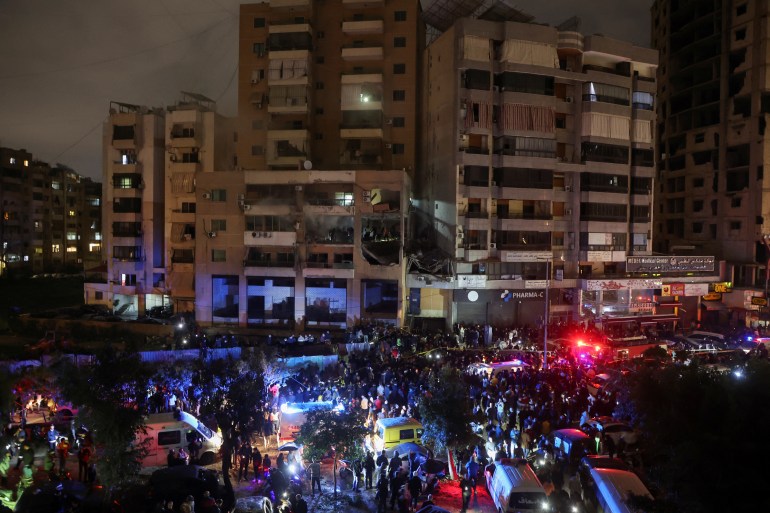
Senior Hamas official Saleh al-Arouri has been killed in an Israeli drone strike on Beirut’s southern suburb of Dahiyeh, the Palestinian group and Lebanese media outlets say. Al-Arouri was killed on Tuesday in a “treacherous Zionist strike”, Hamas said on its official channel. Hamas politburo member Izzat al-Sharq called it a “cowardly assassination”. Al-Arouri was a senior official in Hamas’s politburo but was known to be deeply involved in its military affairs. He had previously headed the group’s presence in the occupied West Bank. Lebanon’s state-run National News Agency said the blast killed at least six people and was carried out by an Israeli drone. People gather on January 2, 2024, in the Beirut suburb of Dahiyeh after an explosion [Mohamed Azakir/Reuters] Hamas vowed that al-Arouri’s killing will not “undermine the continued brave resistance” in Gaza, where the Palestinian group’s fighters are battling Israeli ground forces. “It proves once more the utter failure of the enemy to achieve any of its aggressive goals in the Gaza Strip,” senior Hamas official Izzat al-Rishq said in a statement. Mark Regev, an adviser to Israeli Prime Minister Benjamin Netanyahu, told MSNBC that Israel had not taken responsibility for this attack, but “whoever did it, it must be clear: That this was not attack an attack on the Lebanese state.” “Whoever did this did a surgical strike against the Hamas leadership,” Regev told MSNBC in an interview. Lebanon’s prime minister condemned the killing, saying the attack “aims to draw Lebanon” further into the Israel-Hamas war. “Prime Minister Najib Mikati condemned the explosion in the southern suburbs of Beirut that killed and injured many,” his office said in a statement. The attack “aims to draw Lebanon into a new phase of confrontations” with Israel at a time when Hamas ally Hezbollah has been exchanging daily cross-border fire with Israeli forces in northern Israel, the statement said. ‘Dangerous escalation’ Al Jazeera’s Zeina Khodr, reporting from Beirut, said there was “panic” in the Lebanese capital following the attack. “The targeted killing made many people here in the capital feel that this conflict could widen, and could escalate, and all eyes are now on Hezbollah’s reaction,” Khodr said. Commenting on the development, Iran said al-Arouri’s killing will further ignite the resistance against Israel, state media reported. “The martyr’s blood will undoubtedly ignite another surge in the veins of resistance and the motivation to fight against the Zionist occupiers, not only in Palestine but also in the region and among all freedom-seekers worldwide,” Iranian Foreign Ministry spokesperson, Nasser Kanaani, said. Kanaani also condemned the violation of Lebanon’s sovereignty and territorial integrity by “the aggressive Zionist regime”. Israeli Prime Minister Benjamin Netanyahu had long threatened to kill al-Arouri, before Israel’s latest assault on the besieged Gaza Strip. Israeli political analyst Akiva Eldar told Al Jazeera the killing was a much needed success for Netanyahu. Imad Harb, director of research at the Arab Center Washington DC, agreed, saying Israel carried out the attack in search what has become an elusive win. “So far, the Israelis have not been able to call a victory in Gaza, so assassinating Hamas leaders is partly something that they wanted to do anyway,” he told Al Jazeera. “This is an achievement for the Israeli army and for the Israeli politicians.” Since Israeli forces and Hezbollah began exchanging fire around the Lebanese-Israeli border on October 8, the fighting has largely been concentrated a few kilometres from the border. But on several occasions, Israel’s air force has hit what it said were Hezbollah positions deeper inside Lebanon. Harb noted that the killing of al-Arouri is a “dangerous escalation” because it took place in Hezbollah’s area of operation, far from the border. Harb said Hezbollah would likely step up attacks on Israel in response to the killing, but will stop short of escalating the conflict into an all-out war. Meanwhile, at mosques in Arura, hometown of the slain Hamas leader in the West Bank, Palestinians gathered to mourn al-Arouri’s death. Protests and gatherings are also taking place in Ramallah and several nearby towns, such as Deir Qaddis. A general strike in Ramallah has also been called for Wednesday. Adblock test (Why?)
What does a ‘new phase’ in Israel’s war on Gaza entail?

Israel says it will withdraw some troops from the besieged Gaza Strip. Israel has announced it will pull out some of its forces from Gaza, more than two months after it launched a ground invasion of the besieged Palestinian territory, a step that could potentially lead to a new phase in its war against Hamas. The announcement appears to align with plans Israeli officials have previously stated for a low-intensity military campaign that could last for several months, focusing on remaining Hamas strongholds. But with more than 20,000 Palestinians killed and hundreds of thousands displaced, there are growing questions about whether Israel will be able to fulfil its stated goal of toppling Hamas. So what could the announcement mean for Israel, the Palestinians and Hamas fighters? Presenter: Elizabeth Puranam Guests Andreas Krieg – Assistant professor at the Defence Studies Department at King’s College, London. Diana Buttu – Former legal adviser to the Palestine Liberation Organisation. Yossi Mekelberg – Associate fellow of the MENA Programme, Chatham House. Adblock test (Why?)
Israeli Cabinet members call for emigration of Palestinians from Gaza

NewsFeed “We must…encourage the emigration of the residents of Gaza.” Senior members of the Israeli government are proposing the emigration of Palestinians as a solution to the end of the Israel-Gaza war. Published On 2 Jan 20242 Jan 2024 Adblock test (Why?)
Israel maintains onslaught as Gaza death toll tops 22,000

Israeli attacks have continued across the Gaza Strip with little let-up, as the death toll in the enclave rose above the latest milestone of 22,000. The total number of Palestinians killed in Gaza since October 7 now stands at 22,185, while at least 57,000 have been injured, the Hamas-run Ministry of Health announced on Tuesday. Meanwhile, air and ground attacks continued across the Strip, including in the south, where hundreds of thousands of displaced people have been directed to seek safety. Some two-thirds of those killed amid Israel’s bombardment of Gaza are women and children, according to the ministry. Israel launched its campaign following Hamas’s raid into southern Israel, which killed around 1,140 and saw around 240 taken hostage. Overall, 207 Palestinians have been killed in 15 Israeli attacks over the past 24 hours, the health ministry said on Tuesday. It also reported that 338 people were wounded. Al Jazeera’s Hani Mahmoud, reporting from Khan Younis in the south, said there was “intense bombardment” in the central and southern regions last night and in the early hours of Tuesday morning. A view of a street filled with debris of destroyed buildings in Deir el-Balah, Gaza [Ashraf Amra/Anadolu Agency] “There were reports of massive explosions in these two areas, in Khan Younis and refugee camps in the central part,” he said. The intensity of the bombing and the fact that many roads and much infrastructure were destroyed prevented ambulances from going to the targeted sites and taking people to hospitals. Israeli forces hit a home in the central Gaza city of Deir el-Balah, and the majority of the dead were women and children, local Palestinian outlet Wafa News Agency said. In the Nuseirat refugee camp, also in central Gaza, at least one girl was killed and several others injured after an Israeli drone opened fire on the market. Meanwhile, in Khan Younis, in southern Gaza, four people were reported killed in an Israeli bombing. More than one million Palestinians have been displaced from northern Gaza since October 13, when the Israeli military ordered people to evacuate to the south with 24 hours of notice. Attack on Israeli forces In central Gaza’s Bureij refugee camp, Hamas’s armed wing, the Qassam Brigades, said it had clashed with Israeli forces in the eastern part of the camp, while also targeting an Israeli Merkava tank. The al-Quds Brigades, the armed wing of the Islamic Jihad, says that its fighters fought an armed battle with Israeli soldiers in the Bureij refugee camp that resulted in injuries among the soldiers. The armed wing also announced that it targeted the Israeli military with mortar shells in the al-Mahatta area in Khan Younis. Meanwhile, the Israeli military said it killed Hamas members who were planting mines along Gaza’s coastline and in nearby buildings. The Israeli army said it also killed three Hamas members in an air attack after seeing them enter a building south of Gaza City in the north. Lost ‘carte blanche’ With at least 22,000 Palestinians massacred in Gaza, Israel has lost its “carte blanche” from Western allies, said Adel Abdel Ghafar, a senior fellow at the Middle East Council on Global Affairs. “As scenes of carnage, displaced populations, dead children and starvation fill our screens, the tide is really shifting,” he told Al Jazeera, adding that massive pro-Palestinian rallies across Europe and the United States have exerted pressure on politicians, with some European countries like Belgium changing their tone on Gaza and calling for a ceasefire, something Israel has firmly rejected. “It’s also very interesting to keep an eye on US politics given that this is an election year and [US President Joe] Biden’s ratings are down,” said Abdel Ghafar. “This will factor into his calculus in this New Year.” Adblock test (Why?)
It is time to tax the rich… and their foundations

We are wrapping up yet another tumultuous year in which wars and disasters have ravaged communities across the world. These misfortunes have added to the misery of those who are already facing the ravages of harsh inequality, climate chaos, dispossession and marginalisation. As in the past, part of the global response to these crises included the “generous giving” of various philanthropists. Indeed, their representatives joined heads of state, CEOs, celebrities, royalty, and government officials for the annual United Nations General Assembly in September and then for the UN climate conference (COP28) in November to seek “solutions”. Many of them will meet again for the World Economic Forum in Davos later in January under the same guise. Yet, every year, nothing seems to change as the outcome of these events. This is partly because the very way elites see problems and solutions are limited by their gaze and worldview, which create and perpetuate the crises in the first place. But they are also ineffective because that is their purpose: They are structured to uphold the status quo, not to create deep systemic change. The philanthropic sector was also not created to address the root causes of systemic problems, but to protect private financial interests. It is time for the world to realise this. The sooner we do so, the sooner we can find more relevant ways to truly bring philanthropy into the important and messy work of real social change. How the rich get richer We all know the rich are getting richer, controlling a huge percentage of wealth across the planet. According to Oxfam’s recent Global Wealth Inequality Report, since 2020, the richest 1 percent have captured almost two-thirds of all new wealth, nearly twice as much as the bottom 99 percent of humanity. Rich people pay virtually no tax (often 3 percent or less of their income) and their billions just keep on growing through the application of compound interest. In the next 20 years, most of this wealth will move between family members in the wealthiest 1 percent. In the US alone, it is estimated that between $36 trillion and $70 trillion in wealth will be transferred from one generation to another. Calls to tax the rich are growing globally, and will be even more pronounced as this massive generational wealth transfer takes place. One of the key ways the rich address this pressure is through philanthropy. Philanthropic contributions are commended and perceived as a form of “giving back”. Currently, the estimated global value of philanthropy is $2.3 trillion, or approximately 2 percent of the world’s GDP, with most of those funds held in endowments. This is larger than the annual GDP of countries like Canada and Brazil. If philanthropy is inherently good, and more philanthropy is going to happen, what is there to worry about? Let us look at how philanthropy actually works in practice. For example, in the US, one aspect of philanthropy is the 5 percent payout rule which was put into US tax law in 1976. According to these legal provisions, a charitable foundation has to give just 5 percent of its overall endowment in the form of grants or programme-related investments annually in order to maintain its not-for-profit status. In practice, this rule has become the ceiling for giving grants rather than the floor. The other 95 percent of the endowment is treated as tax-exempt investment money, which most foundations continually grow. Let us break this down further. In 2020, the average rate of return for foundation endowments was 13.1 percent. If we take a $100m foundation as an example, it would be required to give away just $5m over the course of the year, but its endowment would have grown to $113m minus $5m for a year-end sum of $108m. The following year, this expanded pie of $108m would become $122m minus roughly $5.4m it would give away for a total of roughly $117m. So, the $100m becomes $117m in just two years and continues to grow. These endowment funds – or rather untaxed investment capital – are then funnelled into the usual engines of extractive capitalism: stock markets, bonds, real estate, fossil fuel companies, etc. This results in further wealth accumulation. While this 5 percent rule payout started in the US, it has been exported around the world and continues to be promoted as the global model for philanthropy: keep growing endowments, while foundations grant the minimum amount required. Their wealth and power grow while they trickle-down grants to those doing the hard work. It does not take an accountant or an economist to understand the implications of this model. Only a fraction of tax-exempt philanthropic funding is actually used to address social and ecological issues while the majority is reinvested in life-destroying activities via the extractive markets with high, ongoing returns on investment. Philanthropy as redistribution In most countries, any individual or corporation that makes a philanthropic donation receives a direct tax break against their income for the donated amount. As a result, philanthropy is an important part of a larger tax minimisation strategy, further concentrating wealth. A recent investigative report by The Nation magazine estimated that Bill Gates may have received more money back in the form of tax breaks than he has given in philanthropic grants through the activities of the Gates Foundation. Another example involves MacKenzie Scott, one of the largest philanthropic donors in the US. Over the past couple of years, she has been celebrated for the size, type and speed of her grants. According to Bloomberg’s Billionaire Index, in 2023, her wealth continued to grow, even though she gave away significant funds. Despite receiving huge tax benefits and doling out the smallest fraction of their endowments as grants, philanthropists are elevated in our society as benevolent, generous, and magnanimous individuals. It is time to drop the hero worship of philanthropists and go beyond simple declarations to tax the rich. We need to start taxing endowments. Consider what a tax on these massive philanthropic endowments
Dozens killed as extent of Japan earthquake damage becomes clear

NewsFeed Earthquakes that struck Japan on New Year’s Day have killed dozens of people and caused widespread damage across Ishikawa Prefecture. Published On 2 Jan 20242 Jan 2024 Adblock test (Why?)
What’s next for Netanyahu after top court ruling against judicial overhaul?

The Israeli Supreme Court has struck down a controversial law that Prime Minister Benjamin Netanyahu’s coalition government has been pushing for months – but caused uproar and prompted thousands of people to take to the streets in defiant protest. That decision is being seen as a blow to the coalition government which promised to enact sweeping changes that would curb judicial powers but has suffered deep divisions since being sworn in, late in 2022. Those fissures appear to have only deepened, with the top court’s ruling made as Israel wages a devastating war on Gaza that has already killed more than 22,000 people in the besieged enclave, more than a third of them children. So what is the controversy about – and what is next for Israel and Netanyahu? Protesters gather for an 11th straight week of protests against the government’s controversial judicial overhaul bill in Tel Aviv on March 18, 2023 [Jack Guez/ AFP] What was the law about? The law was the only one from a package of judicial overhauls by Netanyahu’s government that aimed to limit the Supreme Court’s powers concerning the executive. Since Israel does not have a constitution, it relies on a set of Basic Laws and the legislation in question was an amendment to an existing provision that allowed the Supreme Court to overrule laws that, in its view, did not pass a “reasonableness” test. The new law eliminated the top court’s ability to block laws using that test. Other laws that are part of the planned judicial overhaul would give the Knesset, Israel’s parliament, more power to appoint Supreme Court judges. Before being passed in July, and even after that, the law saw swift and intense opposition in Israel, with thousands of people in Israel and abroad demonstrating for several weeks on end. Thousands of army reservists also threatened to quit. Detractors say the law removes a crucial checks and balances component of Israeli democracy needed in a country with a fragile legal system. Many Israelis also said the amendment weakens the independence of the judiciary at a time when the country is being run by its most far-right and most religiously conservative coalition yet. Western allies, including the United States and the United Kingdom, cautioned Netanyahu and advised his government to “uphold democracy” as demonstrations raged across the two countries. Although it saw great opposition from inside the Knesset as well, the bill passed with a vote of 64 to 0 after opposition lawmakers boycotted and left the session. What did the Supreme Court say? In a vote on Monday, 12 of 15 Supreme Court judges ruled for the first time that the court had the power to strike down Basic Laws. Eight judges further voted to nullify this specific “reasonableness” amendment. It is the first time the court will nullify a Basic Law or an amendment to one. In a case summary, the Supreme Court said the government’s passing of the law “completely revoked the possibility of carrying out judicial review of the reasonableness of decisions made by the government, the prime minister, and the ministers,” and added that letting the law stand could cause “unprecedented and severe harm” to Israel’s democracy. Netanyahu’s government has always claimed the law is needed to create balance in government branches and to diversify the bench which it sees as putting minority interests before national ones. But some see the push for the law as an attempt by Netanyahu to avoid sentencing in a drawn-out corruption trial in which he faces charges of bribery, fraud and breach of trust. Those proceedings were suspended following the start of Israel’s war on Gaza, but resumed early in December. Netanyahu has denied any wrongdoing. What’s next? Netanyahu’s Minister of Justice Yariv Levin, who has shepherded the controversial laws, including the one that the court has struck down, hit out at the judges, insisting that the ruling would not “stay our hand”. Levin also said that the decision by the court to publish its ruling while Israel’s war on Gaza was continuing is “the opposite of the unity required these days for the success of our fighters on the front.” Likud, Netanyahu’s party, said the decision was “unfortunate”. Yet, if the government decides to ignore the Supreme Court ruling, it could end up destabilising the wartime coalition that is leading Israel’s assault on Gaza. Minister of Defense Yoav Gallant has opposed the amendment – and was even temporarily fired over it. On Monday, former defense minister Benny Gantz also called for the Supreme Court ruling to be respected – effectively publicly rejecting Levin’s criticism of the judges. ערב ה-7.10 החברה הישראלית הגיעה למקומות קיצוניים, לפילוג ולשיח שנאה שהיה אסור להגיע אליהם. את פסק הדין חובה לכבד, ואת הלקח מההתנהלות בשנה האחרונה חובה להפנים – אחים אנחנו, לכולנו גורל משותף. אלו לא ימים לניגוחים פוליטיים, אין היום מנצחים ומפסידים. היום יש לנו רק מטרה אחת משותפת… — בני גנץ – Benny Gantz (@gantzbe) January 1, 2024 “The verdict must be respected, and the lesson from the conduct of the last year must be internalised – we are brothers, we all have a common destiny,” he wrote on X. “These are not days for political arguments, there are no winners and losers today. Today we have only one common goal – to win the war, together.” Adblock test (Why?)
How devastating was Monday’s earthquake in Japan?

On Monday, a magnitude 7.6 earthquake hit Japan near the Noto Peninsula in the Ishikawa prefecture, prompting tsunami warnings for the nine prefectures along the west coast of the country and neighbouring areas such as South Korea. More quakes are expected to come this week. Japan is particularly prone to earthquakes because four of the earth’s tectonic plates meet in the country. Japan experienced a devastating quake in 2011 with a death toll of nearly 20,000 people, with most killed by tsunami waves, and also caused nuclear plant meltdowns in Fukushima. The disaster is believed to have caused $220bn worth of damage. Here is what you need to know about Monday’s earthquake. Where and when did the earthquake occur? Quakes began at around 4pm local time (07:00 GMT) on Monday. A magnitude 7.6 earthquake was reported near the Noto Peninsula in Japan’s Ishikawa prefecture. Japan is divided into 47 prefectures which are types of administrative divisions. Earthquakes measuring between 7.0 to 7.9 are considered “major” and can cause serious damage. The largest earthquake ever recorded was magnitude 9.6 in Chile in 1960. The earthquake generated ocean waves about 1 metre (3 feet) high along Japan’s west coast and on the coast of neighbouring South Korea. The temblor was also felt in Japan’s capital, Tokyo, 300km (186 miles) away on the other side of the country. Across nine prefectures, almost 100,000 people were evacuated and spent the night in sports halls and school gymnasiums, commonly used as evacuation centres in emergencies in Japan. These are often built with an accompanying “disaster storehouse” which contains food supplies and other essentials to support living for a period of time. The Japan Meteorological Agency (JMA) issued low-level tsunami warnings for the prefectures of Niigata and Toyama and a major tsunami warning for Ishikawa that was lifted on Tuesday morning. Within two hours of the major earthquake near the Noto Peninsula, the Japanese public broadcaster, NHK TV, had urged people to flee to higher ground or to get to the top of nearby buildings as quickly as possible. It was feared that floodwaters could reach as high as 5 metres (16.4 feet) in the event of a tsunami. A tsunami wave around 1.2 metres (4 feet) high hit Wajima city in Ishikawa 10 minutes after the magnitude 7.6 quake occurred, while a fire sparked by the collapse of buildings engulfed houses in the area. Residents were forced to evacuate in the dark because of power outages. People were seen carrying belongings such as blankets, while others rushed out holding babies. On Tuesday, JMA reported that the country had been hit by 155 earthquakes since the initial tremor on Monday. Is this region particularly prone to earthquakes? Japan is one of the countries in the world most at risk from earthquakes. Seismic activity has been simmering in the area for some time. Between December 2020 and last month, 506 quakes with an intensity of at least 1.0 were recorded. Experts say they will not know why this more major series of earthquakes was not anticipated until further research has been carried out. Ishikawa, a popular tourist destination famous for its cultural heritage sites, lies near the tectonic plate boundary between the earth’s Eurasian and North American plates. Such areas are particularly susceptible to earthquakes because of the movement of the plates against each other, and the stronger shock this causes in nearby areas. Monday’s earthquake is the strongest to have occurred in Ishikawa since 1885 when data first became available. Monday also marks the country’s first major tsunami warning since March 2011 when a magnitude 9.0 earthquake in the Tohoku region killed more than 18,000 people and triggered nuclear plant meltdowns in Fukushima. How many casualties have there been so far? At least 30 people have been killed in Ishikawa and rescue teams are still trying to reach areas where people are feared to have been trapped under collapsed buildings. At least 14 people have been critically injured. “The government has identified at least six to 10 people trapped inside buildings and [the total] may be much higher than that, considering the government is usually quite conservative about these numbers until their official [final tally],” said Al Jazeera correspondent Chris Gilbert, reporting from Tokyo. Will there be more quakes? JMA has warned that further quakes with a seismic intensity of 7.0 could hit the region over the next week, particularly in the next two to three days. There is a heightened risk of fires and landslides, the JMA said. Officials warned residents of some areas to stay away from their homes because of the potential danger. The warning of a major tsunami for Ishikawa, however, was cut to an advisory-only alert and eventually lifted on Tuesday morning. A tsunami “advisory” indicates that significant flooding is not expected but local officials may take some action such as closing beaches or evacuating harbours. “The tsunami threat has now largely passed,” the Hawaii-based Pacific Tsunami Warning Center said on Monday night. How much damage has the earthquake caused? The Japanese authorities are still assessing the extent of the damage but the quake has so far resulted in several deaths, collapsed buildings, fires in Wajima and power outages across Ishikawa. Almost 33,000 households remained without power in Ishikawa prefecture early on Tuesday morning in Japan, according to information on Hokuriku Electric Power’s website. Broadcaster NHK said most areas in the northern Noto Peninsula were also without water. Several highways near the epicentre were closed, while flights and bullet train services to the area had also been suspended. In Suzu, a coastal town of just over 5,000 households near the quake’s epicentre, there may have been as many as 1,000 houses destroyed, according to its mayor, Masuhiro Izumiya. How quickly will people trapped under rubble be rescued? With warnings of further quakes to come, Prime Minister Fumio Kishida warned late on Monday that efforts to rescue people trapped under collapsed buildings would be a “race against time”. Thousands of army personnel,
Turkey arrests dozens suspected of spying for Israel

Suspects detained in raids for allegedly planning to pursue, assault and kidnap foreign nationals living in Turkey. Turkey has reportedly detained 33 people suspected of spying on behalf of Israel. The authorities are still searching for 13 other people believed to have links to Israel’s Mossad security service, the Anadolu Agency reported on Tuesday. Ankara has previously warned that it will not allow Israel to strike at Hamas inside Turkey’s borders. The suspects were detained in raids in Istanbul and seven other provinces for allegedly planning to carry out activities that included “reconnaissance” and “pursuing, assaulting and kidnapping” foreign nationals living in Turkey, the agency reported. “We will never allow espionage activities to be conducted against the national unity and solidarity of our country,” Interior Minister Ali Yerlikaya said on social media. Anadolu did not provide information on the suspects, nor the foreigners who were allegedly targeted. The report came weeks after the head of Israel’s domestic security agency, Shin Bet, said in an audio recording that his organisation is prepared to destroy Hamas “in every place,” including in Lebanon, Turkey and Qatar. Turkish President Recep Tayyip Erdogan warned Israel of “serious consequences” if it pressed ahead with its threat to attack Hamas officials on Turkish soil. Following years of tension, Turkey and Israel moved towards normalising ties in 2022 as they resumed diplomatic ties. But that detente quickly deteriorated during the Israel-Hamas war, with Ankara becoming one of the strongest critics of Israel’s military actions in Gaza. Israel initially withdrew its diplomats from Turkey over security concerns and later announced it was recalling its diplomats for political reasons, citing “increasingly harsh statements” from Turkish officials. Turkey also pulled its ambassador from Israel. Erdogan’s reaction to the Israel-Hamas war was initially fairly muted. But the Turkish leader has since intensified his criticism of Israel, describing its actions in Gaza as verging on “genocide”. He has called for Israeli Prime Minister Benjamin Netanyahu to be prosecuted for “war crimes” and compared him to Nazi leader Adolf Hitler. The Turkish leader, whose government has hosted several Hamas officials in the past, has also said that the Palestinian group – considered a “terrorist organisation” by Israel, the United States and the European Union – is fighting for the liberation of its lands and people. The arrests have come amid a spate of arrests by Turkish security forces. In roughly two weeks before the new year, about 500 people suspected of having ties to the ISIL (ISIS) armed group were detained in raids across the country. The detentions were thought to be part of a drive by Turkey’s security forces ahead of New Year festivities. An ISIL attack in Istanbul on January 1, 2017, killed 39 people. At the same time, some have also viewed the uptick in arrests as part of a political push in advance of local elections in March. Analysts say that President Erdogan is eager to win back control of Istanbul, Ankara and other major economic hubs that his AK Party has lost. Adblock test (Why?)